What Is Pronation in Running And How It Impacts Your Gait
- penny.par591+abc123
- 15 hours ago
- 7 min read
Pronation is the natural inward roll of your foot as it absorbs shock during running. It’s not an inherent flaw but your body's built-in cushioning system, softening each landing and preparing you for the next push-off. Understanding your specific pronation pattern is key to preventing injuries and improving performance.
Index of Sections
Understanding Your Running Gait
The Three Types of Foot Pronation
Finding Your Foot Type
The Link Between Pronation and Running Injuries
How to Choose the Right Running Shoes
Exercises to Improve Your Foot Mechanics
Frequently Asked Questions
References
Understanding Your Running Gait
To understand what is pronation in running, it must be viewed as part of your overall running gait—the complete cycle of one foot hitting the ground, leaving it, and striking again. This motion involves a coordinated effort from your ankles, knees, and hips. While every runner's gait is unique, pronation significantly influences how impact forces are distributed throughout the body. The goal is not to eliminate pronation but to ensure it occurs efficiently without placing undue stress on other joints.
The Role of Biomechanics
Your body's movement patterns, or biomechanics, determine your pronation style. Factors like arch height, muscle strength, and joint flexibility influence how much your foot rolls inward. Getting a precise picture of these forces often requires advanced tools. In professional settings, a gait analysis force plate is used to measure ground reaction forces, providing detailed data on foot-to-surface interaction.
The Three Types of Foot Pronation
Pronation is a natural and necessary motion, but it manifests differently in everyone. Identifying your type is the first step toward finding the right running shoes and giving your body the support it needs.
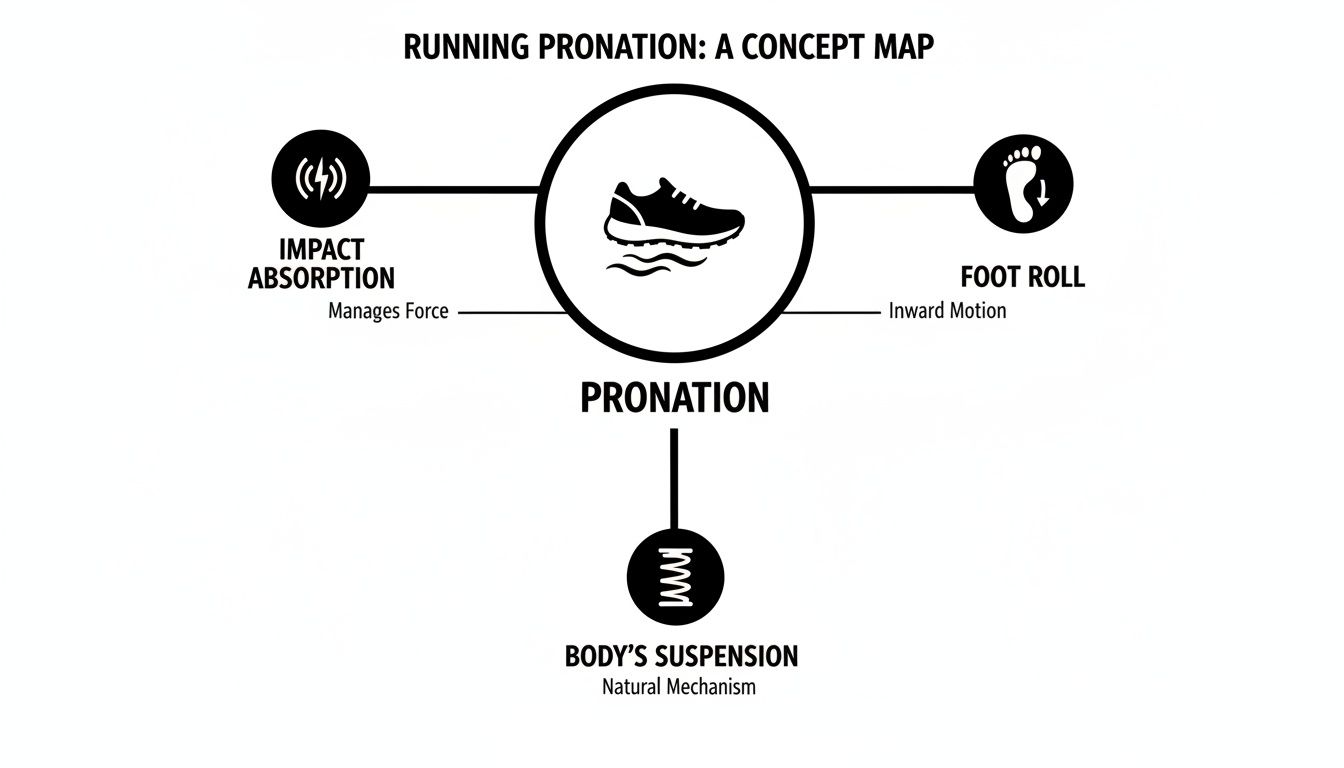
Neutral Pronation: The Goldilocks Scenario
Neutral pronation is considered the biomechanical ideal. The foot lands on the outside of the heel and rolls inward by about 15% to absorb shock and distribute pressure evenly. This sets up a powerful push-off from the front of the foot. An old pair of running shoes will typically show an S-shaped wear pattern from the outer heel toward the big toe, indicating a balanced gait.
Overpronation: The Excessive Inward Roll
Overpronation occurs when the foot rolls inward more than the ideal 15%. This causes the arch to flatten, placing extra stress on the inside of the foot, ankle, and shins. It is common in runners with flatter feet. The tell-tale sign is heavy wear on the inside edge of your shoes, particularly around the ball of the foot and under the big toe.
Supination: The Outward Roll
Supination, or underpronation, is the opposite. The foot does not roll inward enough, concentrating impact force on the outer edge. This is often seen in runners with high, rigid arches. If you supinate, your shoes will show excessive wear along the entire outside edge. For more specific advice, our guide on finding the best shoes for supination can be helpful.
Comparing Pronation Types At A Glance
Pronation Type | Foot Roll Motion | Arch Type | Shoe Wear Pattern |
|---|---|---|---|
Neutral | Rolls inward about 15% | Normal/Medium | Even, S-shaped pattern from outer heel to big toe |
Overpronation | Rolls inward more than 15% | Low/Flat | Heavy wear on the inside edge, near the big toe |
Supination | Rolls outward or stays on the outer edge | High/Rigid | Heavy wear along the entire outer edge of the shoe |
Finding Your Foot Type
You don’t need a high-tech lab to identify your pronation style. A few simple at-home tests can provide valuable clues about how your feet interact with the ground.
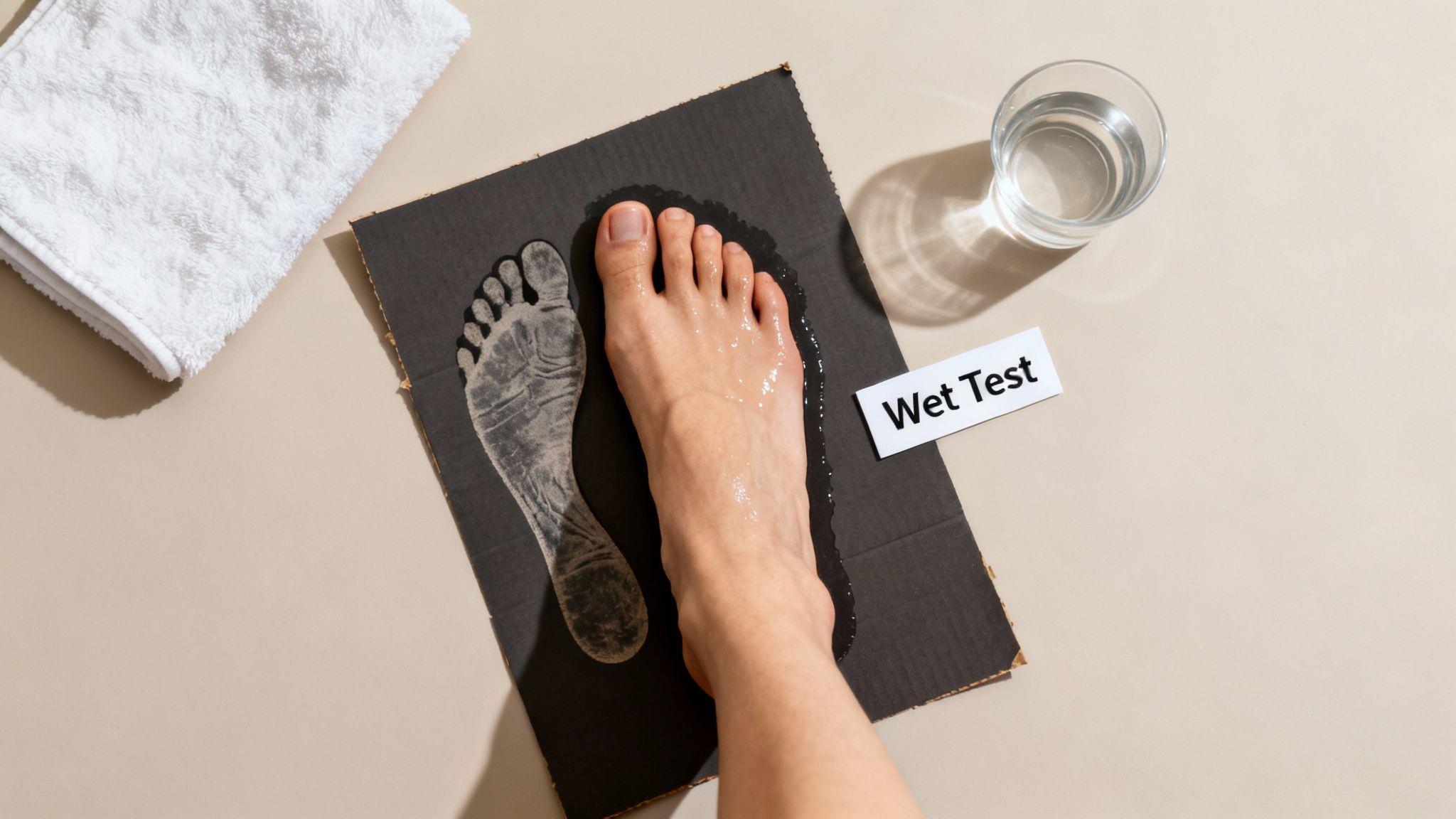
The Classic Wet Test
The wet test offers a quick snapshot of your arch height, a key indicator of your pronation type.
Set Up: Pour a thin layer of water into a shallow pan and place a piece of dark paper or cardboard next to it.
Get Wet: Step into the water with one bare foot.
Make Your Mark: Step firmly onto the paper.
Read the Results: A nearly filled-in footprint suggests a low arch, often linked to overpronation. A print showing only the heel, ball of the foot, and a thin outer line indicates a high arch, which may point to supination. A print with a distinct curve along the inside is typical of a neutral arch.
Let Your Old Shoes Do the Talking
Your retired running shoes hold a detailed record of your gait. The wear patterns on the soles reveal where you land and push off.
Neutral Pronation: Wear is in an S-shaped pattern from the outer heel to the big toe.
Overpronation: Excessive wear is visible along the inside edge of the sole.
Supination: Wear is concentrated along the entire outer edge of the shoe.
While these tests are a great starting point, a professional gait analysis at a specialty running store can offer more personalized advice.
The Link Between Pronation and Running Injuries
A common myth is that pronation is inherently bad. In reality, an inefficient pronation pattern can disrupt the body's kinetic chain, sending stress from your ankles up to your hips and back. For overpronators, this can lead to issues like shin splints or knee pain. If you struggle with shin splints, consider alleviating shin splints with strategic foam roller routines. Supinators, on the other hand, lack sufficient shock absorption, which can lead to IT band syndrome or stress fractures.
Looking Beyond Pronation
Pronation is just one piece of a larger puzzle. Blaming every ache on foot mechanics can cause you to overlook the real culprit.
Pronation itself is not the enemy. Injury risk is more closely tied to how your body manages load, your overall strength, and your running form, rather than just the degree your foot rolls inward.
Factors like training volume, muscle strength, and overall biomechanics are often more significant predictors of injury. Research shows novice runners have much higher injury rates than elite runners, with physical fatigue and previous injuries being commonly reported causes (van der Worp et al., 2015).
Common contributors to running injuries include:
Training Errors: Doing too much, too soon.
Muscle Imbalances: Weakness in the hips or core forces other body parts to overcompensate.
Poor Running Form: Overstriding can put massive braking forces on your joints.
For persistent discomfort, our guide on what causes runner's knee and how to fix it for good may be helpful.
How to Choose the Right Running Shoes
Finding the best running shoe isn't about the single "best" model, but the best shoe for your feet. Matching footwear to your pronation style is the foundation for a comfortable run. The main categories are Neutral, Stability, and Motion Control.
Neutral Running Shoes
Designed for runners with a neutral gait or supination, these shoes focus on cushioning and flexibility without corrective features. They provide a protective buffer that allows the foot to move naturally.
Best For: Neutral pronators and supinators.
Key Feature: Cushioning and flexibility.
Stability Running Shoes
Ideal for mild to moderate overpronation, stability shoes balance cushioning and support. They use features like medial posts or guide rail systems to gently slow excessive inward roll.
A stability shoe works with your foot's motion, not against it. It offers guidance during your stride rather than forcing a correction.
Our guide on men's shoes for overpronation offers recommendations.
Motion Control Running Shoes
For severe overpronation or very flat feet, motion control shoes offer the highest level of support. They are rigid and structured to minimize excessive foot motion using dense foam and wide bases.
Running Shoe Categories Explained
Shoe Category | Ideal For | Support Level | Primary Features |
|---|---|---|---|
Neutral | Supinators & Neutral Runners | Minimal | Cushioning, flexibility, shock absorption |
Stability | Mild to Moderate Overpronators | Moderate | Guide rails, dual-density midsoles |
Motion Control | Severe Overpronators & Flat Feet | Maximum | Firm medial posts, wide base, rigid heel |
Exercises to Improve Your Foot Mechanics
The right shoes are a great start, but building a strong foundation requires proactive exercises. Targeted movements can support your natural gait and improve your body's ability to manage impact forces.
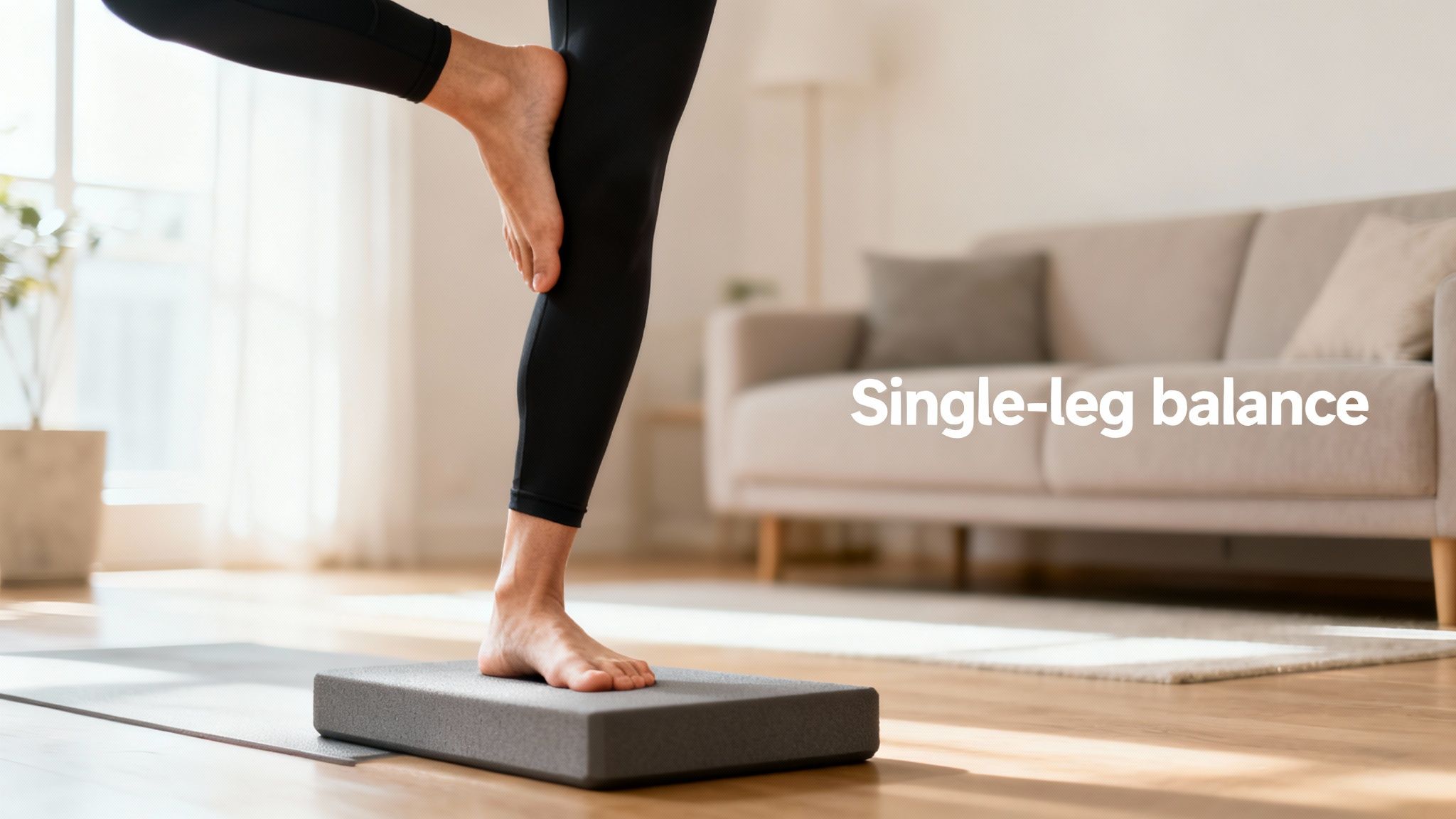
Strengthening Exercises for Overpronators
For overpronators, the goal is to build stability in the arches and ankles to better control the inward roll.
Calf Raises: Stand on a flat surface and slowly raise your heels until on your tiptoes, then lower with control. This strengthens calf muscles that support the arch.
Single-Leg Balances: Stand on one foot, keeping your core tight. Hold for 30 seconds before switching legs to improve ankle stability and proprioception.
Flexibility Exercises for Supinators
Supinators often have tightness in their lower legs. Improving flexibility can allow for a smoother footstrike.
Calf Stretches: Facing a wall, place one foot forward and one back. Lean forward, keeping the back leg straight and heel on the ground. Hold for 20-30 seconds.
IT Band Stretches: From standing, cross one leg behind the other. Lean away from the back leg to feel a stretch along the outer hip and thigh.
Frequently Asked Questions
Can I Permanently Fix My Pronation?
Pronation is a natural and necessary motion, not something to be "fixed." The goal is to support your natural gait with appropriate footwear and strengthening exercises that help your body manage impact more effectively.
Should I Wear Stability Shoes if I'm Not in Pain?
Not necessarily. Comfort should be your top priority. If you have mild overpronation but run pain-free in neutral shoes, there is no need to switch. Stability shoes are a tool for those who feel they need extra guidance.
How Often Should I Get a Gait Analysis?
A gait analysis every year or two is good practice, especially if you experience new aches. It is also wise to get re-evaluated after a significant injury, a major change in training volume, or when considering a new shoe model.
References
van der Worp, M. P., ten Haaf, D. S. M., van Cingel, R., de Wijer, A., Nijhuis-van der Sanden, M. W. G., & Staal, J. B. (2015). Injuries in runners; a systematic review on risk factors and sex differences. PLoS One, 10(2), e0114937. https://doi.org/10.1371/journal.pone.0114937
Here at Flourish-Everyday, we believe that understanding your body is the first step toward a healthier, more enjoyable lifestyle. Explore our guides and shoe reviews to find the perfect gear to support your unique running journey. Visit us today at https://www.flourish-everyday.com.
Comments