What Causes Runner's Knee and How to Fix It for Good

Updated: Jan 15
Runner's knee rarely pops up out of nowhere. It's almost always an overuse injury that builds over time from a perfect storm of factors, usually a mix of muscle imbalances, training errors, and iffy running form that messes with how your kneecap tracks.
Think of it less like a sudden breakdown and more like your car's alignment slowly going out of whack. One day, you just notice the wear and tear.

Table of Contents
What's Really Going On Inside Your Knee?
Clinically, this is called Patellofemoral Pain Syndrome (PFPS), but at its heart, it’s a tracking problem. Your kneecap (patella) is meant to glide smoothly in a little groove on your thigh bone (femur). When different forces start pulling it off center, it begins to grind against the bone, creating that familiar dull, aching pain around or behind the kneecap. That irritation is the real source of your trouble.
This is an incredibly common issue, and you're definitely not alone if you're feeling it. Its annual prevalence in the general population is a staggering 22.7% [1]. For new runners, that number jumps even higher. It's often the most frequent injury they face, hitting 19-30% of female runners and 13-25% of male runners [2]. These numbers really show how jumping into a new routine without proper conditioning can overload the knee joint.

The Main Culprits Behind That Ache
So, what are these forces throwing your kneecap off track? It usually boils down to a few key areas that work together to create the problem.
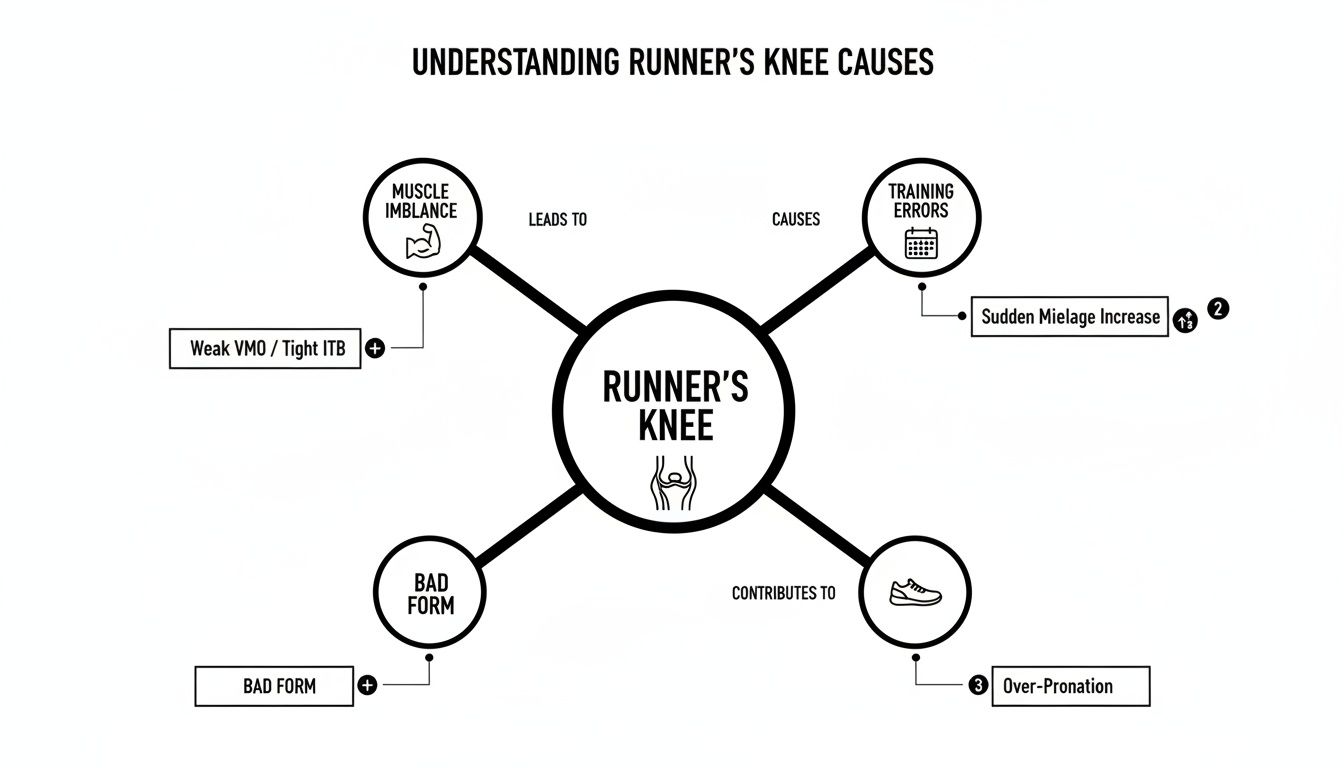
This visual helps simplify how muscle imbalances, poor form, and training mistakes all funnel stress directly to your knee. We're about to dive into each of these, but just seeing how they connect is the first step to figuring out how to fix it.
This guide is designed to map out these causes so you can start connecting the dots in your own routine. By breaking down these factors, you can build a smarter training plan. For a bigger picture on staying healthy on your runs, take a look at our guide on how to prevent running injuries with top tips for safe running.
Think of your kneecap as a train and the groove in your femur as the track. When weak or tight muscles (especially in your hips and glutes) act like sloppy signal operators, they fail to keep your leg stable. The track shifts just a little with every step, causing the train to grind against the rails. That constant friction is what sparks the pain and inflammation.
Runner's Knee Causes At a Glance
Cause Category | Specific Example | How It Contributes to Pain |
|---|---|---|
Muscle Imbalances | Weak glutes and hips | Fails to stabilize the thigh bone, causing the knee to collapse inward. |
Training Errors | Increasing mileage too quickly | Overloads the patellofemoral joint before it has time to adapt. |
Running Form | Overstriding or heel striking | Increases the braking forces that travel up the leg and into the knee. |
Structural Issues | Overpronation (flat feet) | Causes the lower leg to rotate inward, pulling the kneecap off its track. |
This table gives you a starting point for troubleshooting. By understanding these key areas, you're in a much better position to address the root cause of your pain instead of just treating the symptoms.
Why Weak Hips Are Your Knee's Worst Enemy
It's a surprising fact for many runners, but the real source of your runner's knee often has nothing to do with your knee. More often than not, the problem actually starts higher up the chain, specifically, with weak hips and glutes. This weakness creates a domino effect, sending instability right down to your kneecap.
Think of your leg as a tall building. Strong, stable hips are the solid foundation that keeps the whole structure perfectly aligned. But when that foundation is weak, the entire building gets wobbly, forcing the middle floors, your knees, to take on all the stress from that instability.
With every single stride, weak hip muscles can't keep your thigh bone (femur) in its proper place. This allows your knee to drift inward, a pattern known as valgus collapse. This subtle, yet repetitive, inward collapse is one of the biggest reasons runner's knee develops.
The Gluteus Medius: The Unsung Hero of Knee Stability
When we talk about hip strength, there's one muscle that deserves a special mention: the gluteus medius. This muscle sits on the side of your hip and its main job is to keep your pelvis stable when you're on one leg, which is exactly what happens every time you run.
If your gluteus medius is weak or isn't firing correctly, it can't keep your pelvis level. The result? Your opposite hip drops, your thigh rotates inward, and your knee gets pulled out of its happy, neutral alignment.
Imagine your kneecap is a train on a track. A strong gluteus medius keeps that track perfectly straight. But a weak one causes the track to veer inward, forcing the train (your kneecap) to grind against the rails. This creates friction, irritation, and eventually, pain.
This biomechanical flaw is a huge contributor to patellofemoral pain. The constant inward drift forces the kneecap to track improperly in its groove, leading to inflammation and that dull, achy pain so many runners know all too well.
For targeted routines to improve strength and flexibility in this area, you can learn more by checking out our guide on how to improve hip flexibility and unlock movement.
Weakness in the hip, glute, quad, and hamstring muscles is a primary culprit behind runner's knee. Research consistently shows that individuals with PFPS often lack strength in hip abductors and external rotators, leading to biomechanical glitches like hip adduction ('knock knees') and poor patellar tracking [3]. Females are particularly affected, with a point prevalence in female adolescent athletes reaching 22.7%, over twice the rate in males, partly due to anatomical differences and relative strength deficits [1]. You can explore more about how muscular weakness impacts knee health by beating runner's knee. Building a strong support system around the knee is non-negotiable for long term joint health.

How Training Mistakes Overload Your Knees
While muscle imbalances can definitely set the stage for runner's knee, it's usually a specific training mistake that flips the switch from a potential issue to a painful reality. Pushing too hard, too soon is one of the fastest ways to get sidelined.
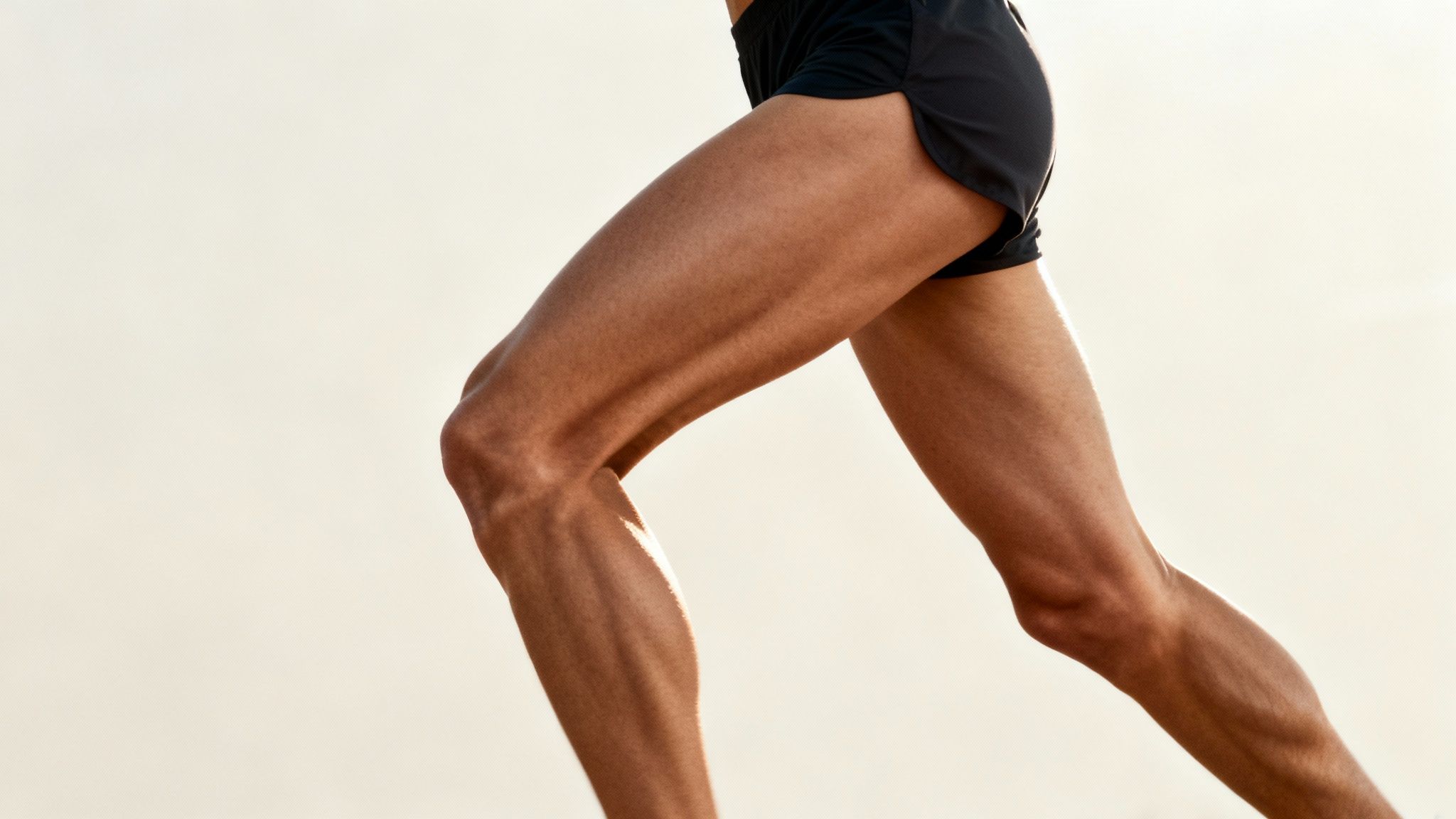
This is often called the "too much, too soon" syndrome. It’s what happens when the stress you put on your knees outpaces your body’s ability to repair itself and adapt. Your bones, tendons, and cartilage need time to get stronger in response to training, and when you rush the process, they start to break down instead of build up.
Think of your fitness like a bank account. Every run is a withdrawal, and every recovery day is a deposit. If you keep making huge withdrawals without making regular deposits (rest), you’ll eventually find yourself in injury bankruptcy.
Common Training Errors
These common errors are almost always the culprits when runner's knee shows up.
Ramping Up Mileage Too Quickly: The 10% rule, which advises against increasing your weekly mileage by more than 10%, is a sound guideline. Ignoring this puts a ton of unfamiliar stress right on the patellofemoral joint.
Sudden Intensity Changes: Throwing in hill sprints or track workouts without a solid base can shock an unprepared knee joint with increased force and different muscle recruitment.
Ignoring Recovery Days: Rest isn't lazy; it's when your body rebuilds and gets stronger. Skipping recovery means you're constantly breaking down tissue without giving it a chance to heal.
These missteps don't allow for the gradual adaptation your connective tissues need. The result is often that dull, persistent ache that’s your body’s way of telling you it’s been pushed past its limit.
Why Surface and Terrain Matter
The ground you run on also plays a huge part in how much load your knees have to handle. Constantly pounding on hard surfaces like concrete can dramatically increase impact forces.
Similarly, jumping from flat roads to hilly trails changes your running mechanics and puts new demands on your quads and glutes. If those muscles aren't ready for the challenge of controlling your body on a steep downhill, all that stress gets dumped directly onto your kneecap.
Your body is an incredible adaptation machine, but it demands consistency and patience. Sudden, drastic changes in your training volume, intensity, or terrain are like throwing a wrench in the gears. Your knee joint is often the first part to start screaming.
The key to avoiding this is to be methodical with your training. Introduce new challenges like hills or speed work gradually, one at a time. This approach gives your body the chance to adapt and build resilience.
The Critical Role of Footwear and Running Form
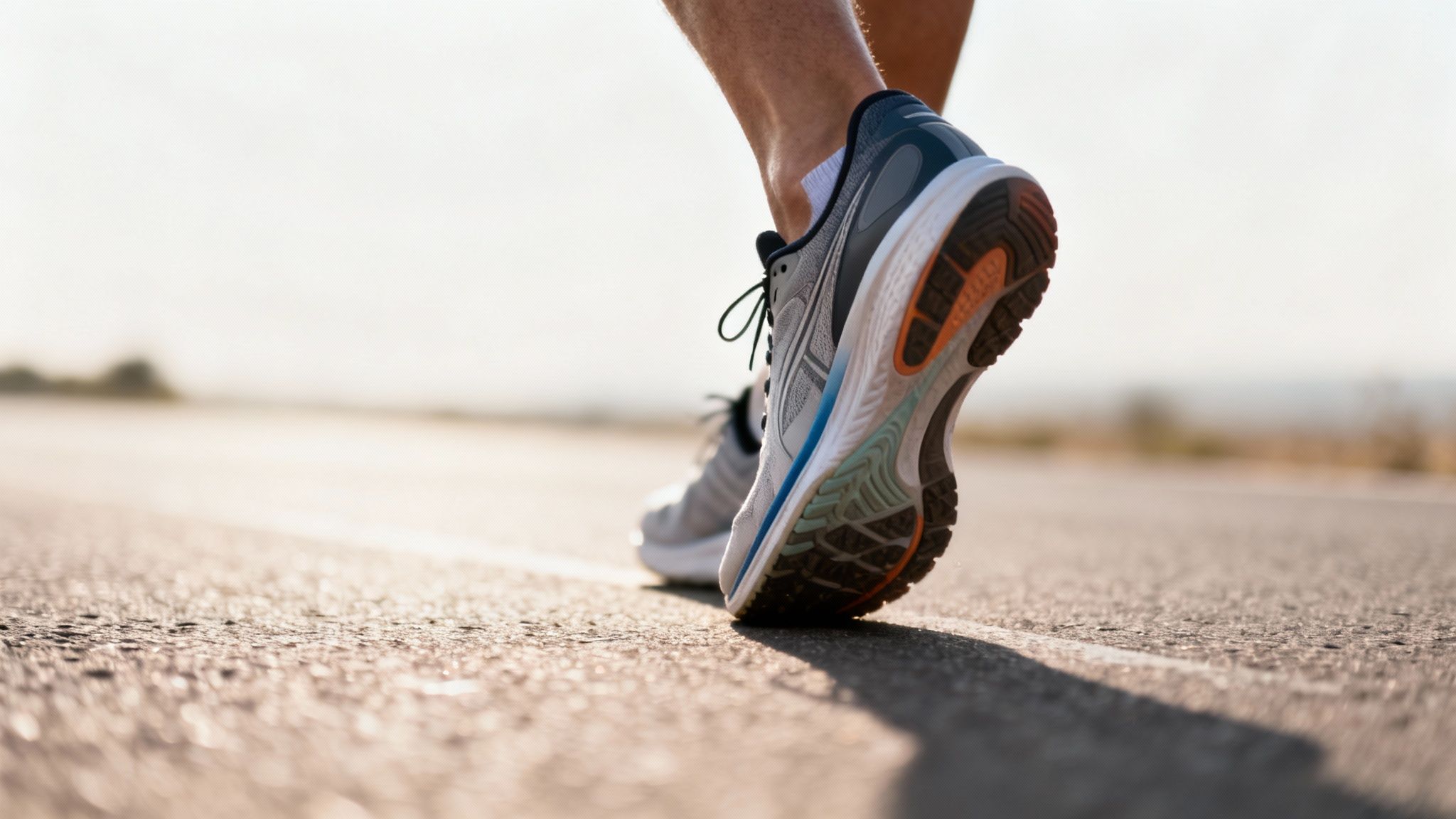
While weak hips and training mistakes set the stage, the real action happens where your feet meet the pavement. Your feet are the foundation of your body’s kinetic chain. When that foundation is shaky, instability shoots right up the leg, and your knee joint is directly in the line of fire. The wrong shoes can make these problems worse.
Understanding Your Foot Mechanics
Two common culprits that contribute to knee pain are overpronation and supination.
If you overpronate, your foot rolls too far inward when it lands. This motion causes your lower leg and thigh bone to rotate inward too, which yanks the kneecap off its happy path in the femoral groove.
On the flip side, supination (or underpronation) is when your foot doesn’t roll inward enough. This makes your foot too rigid to absorb shock properly, putting extra stress on the outside of the knee.
Your running shoes are more than just cushion, they're critical equipment that can help correct mechanical flaws. A good stability shoe can nudge an overpronating foot back into alignment, while a well cushioned, neutral shoe helps a supinating foot absorb impact.
How Poor Running Form Hurts Your Knees
Your actual running form plays a massive part in knee health. The goal is to run "lightly" and efficiently, cutting down on the harsh braking forces that hammer your joints.
One of the most common form mistakes is overstriding, where your foot lands way out in front of your body with a straight, locked knee. This creates a jarring braking force that rattles the knee joint. Research shows that increasing your step rate, or cadence, by just 5-10% can dramatically reduce the load on your knee [4].
It's a simple fix: shorten your stride and focus on landing with your foot more directly underneath your hips. This small change helps your muscles, not your joints, absorb the impact.

Choosing the Right Shoes to Protect Your Knees
Picking the right running shoes is nonnegotiable for preventing runner's knee. It's not about the flashiest brand, but about matching the shoe's features to your body's needs. For a complete walkthrough on this, check out our guide on how to choose running shoes for your specific needs.
Matching Shoe Types to Your Running Needs
Foot Type / Gait | Recommended Shoe Feature | Why It Helps Your Knees | Ideal For |
|---|---|---|---|
Overpronation | Stability Shoes | Uses guide rails or denser foam (medial post) to prevent the foot from rolling too far inward, keeping the knee aligned. | Runners whose feet and ankles collapse inward on impact. |
Neutral Gait | Neutral Cushioned Shoes | Provides shock absorption without trying to correct foot motion, allowing the foot to move naturally. | Runners with a healthy, efficient gait and good alignment. |
Supination | Highly Cushioned Neutral Shoes | Maximizes shock absorption to compensate for the foot's rigidity, reducing impact forces traveling up to the knee. | Runners with high, rigid arches whose feet roll outward. |
Heavy Impact | Max Cushion Shoes | Features extra thick midsoles to absorb the maximum amount of shock, protecting joints on long runs or hard surfaces. | Long distance runners or anyone running primarily on concrete. |
Your shoes and your form are a team. The right footwear gives your feet the support they need, while good form ensures you’re moving efficiently and putting less stress on your body.
Actionable Strategies for Recovery and Prevention
Knowing the causes is the first step; taking action is how you recover and build resilience. This is your game plan for getting back on the road safely.
First, calm the irritation. This usually means dialing back your running to give the joint a break. This isn't about stopping activity, but shifting to lower impact exercises while you fix the underlying issues.
Building Your Foundation With Targeted Strength
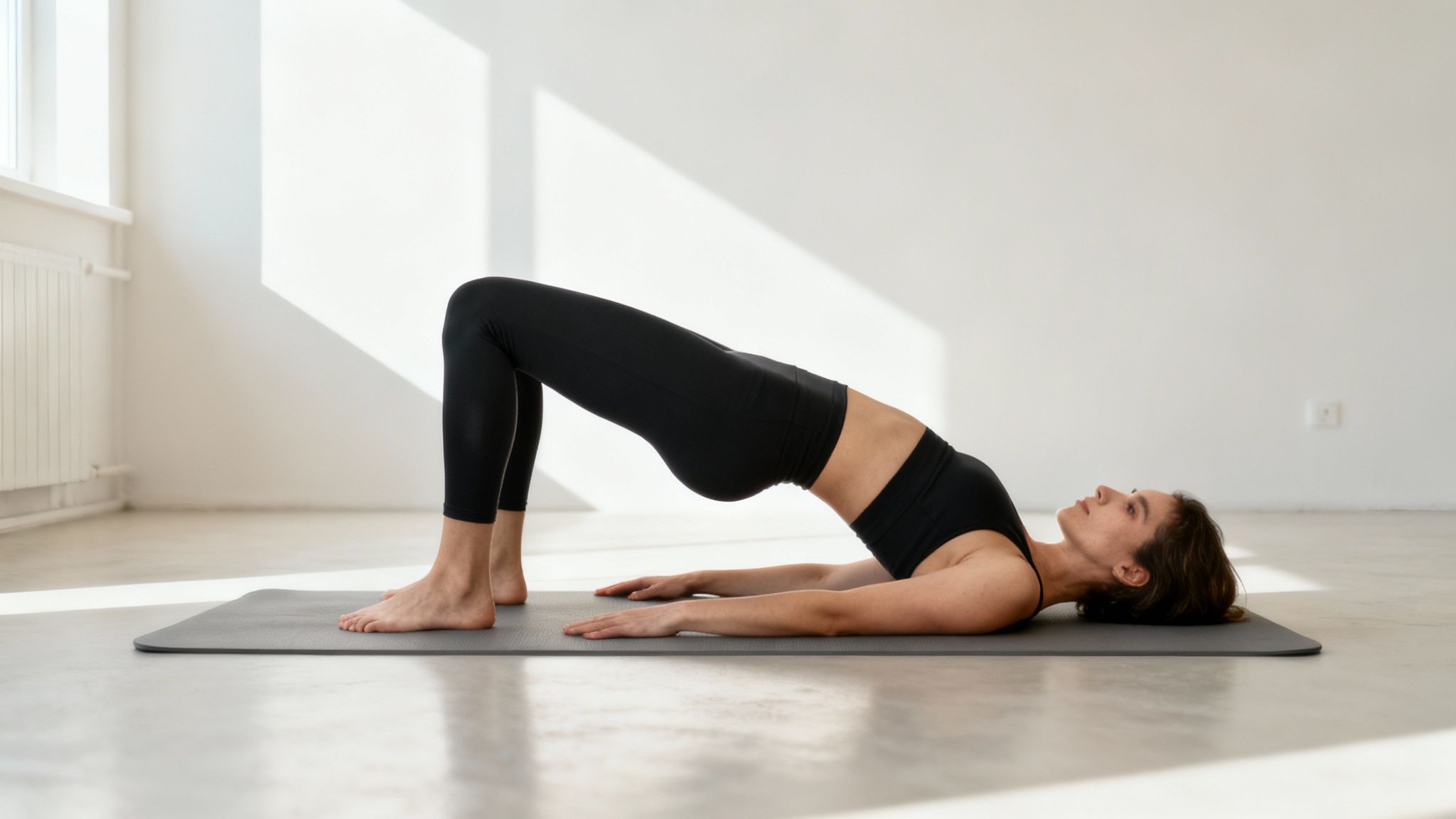
Since weak hips and glutes are often the main culprits, strengthening them is essential. Here are three powerhouse exercises to get you started:
Glute Bridges: Lie on your back, knees bent, feet flat on the floor. Squeeze your glutes and lift your hips until you have a straight line from your shoulders to your knees. Hold for a second, then lower slowly.
Clamshells: Lie on your side with your knees stacked and bent at 90 degrees. Keep your feet touching and lift your top knee toward the ceiling without rocking your hips back. This targets the gluteus medius, a key muscle for hip stability.
Side Leg Raises: Lie on your side with your legs straight and stacked. Slowly lift your top leg as high as you can without tilting your body, then lower with control. This builds hip abductors, which are critical for stopping inward knee drift.
Adding these exercises to your routine 2-3 times per week will build the muscular support your knees need.

The Importance of Flexibility and Mobility
Muscle tightness can also cause problems. When your hamstrings, quads, or IT band are too tight, they can pull on the kneecap and disrupt its tracking.
Think of your muscles and tendons as guide wires supporting a tall tower (your leg). If one wire is too tight, it pulls the whole structure out of alignment. Stretching loosens these wires, allowing your kneecap to glide smoothly.
Focus on holding gentle stretches for these key areas after your workouts. Using a foam roller on your quads, hamstrings, and IT band can also help release tightness.
Smart Training for Long Term Prevention
Once the pain is gone, prevention is key.
Warm-Up Properly: Always start with 5-10 minutes of dynamic movements like leg swings and walking lunges.
Progress Gradually: Stick to the 10% rule: don't increase weekly mileage by more than 10%.
Embrace Cross-Training: Mix in low impact activities like swimming or cycling to maintain cardio fitness while giving your knees a break.
Beyond these strategies, some athletes find that using a sauna for recovery helps ease muscle soreness and reduce inflammation.
Common Questions About Runner's Knee Answered
Getting clear, practical answers can make all the difference in your recovery. Here, we tackle common concerns to separate myth from fact.
Can I Still Run With Runner's Knee?
Let pain be your guide. Pushing through sharp or worsening pain is a terrible idea. However, if you can run with the pain level at no more than a 2 out of 10, it's generally okay. If that pain creeps up during the activity or feels worse the next morning, that's your body telling you to back off. This might mean shorter runs or cross-training until things calm down.
How Long Does It Take to Heal?
Recovery can take anywhere from a few weeks to several months. The biggest factor is how quickly you address the cause. If you only rest without fixing muscle imbalances or training mistakes, the pain will likely return.
The fastest way to get better is to be proactive. Healing isn't a passive process; it's an active one. Be consistent with your strengthening exercises, flexibility work, and smart training.
Will I Need Surgery for This?
It is extremely rare for runner's knee to require surgery. The vast majority of cases, well over 90%, resolve completely with conservative treatments like physical therapy, activity modification, and targeted strengthening. Surgery is a last-resort option, considered only after all other methods have failed over a long period. Focus on strengthening your hips, improving your form, and wearing the right shoes.
References
[1] Smith, B. E., Selfe, J., Thacker, D., Hendrick, P., Bateman, M., Moffatt, F., Rathleff, M. S., Smith, T. O., & Logan, P. (2018). Incidence and prevalence of patellofemoral pain: A systematic review and meta-analysis. PloS one, 13(1), e0190892.
[2] Taunton, J. E., Ryan, M. B., Clement, D. B., McKenzie, D. C., Lloyd-Smith, D. R., & Zumbo, B. D. (2002). A retrospective case-control analysis of 2002 running injuries. British journal of sports medicine, 36(2), 95–101.
[3] Powers, C. M. (2010). The influence of abnormal hip mechanics on knee injury: a biomechanical perspective. Journal of orthopaedic & sports physical therapy, 40(2), 42–51.
[4] Heiderscheit, B. C., Chumanov, E. S., Michalski, M. P., Wille, C. M., & Ryan, M. B. (2011). Effects of step rate manipulation on joint mechanics during running. Medicine and science in sports and exercise, 43(2), 296–302.
At Flourish-Everyday, we believe the right gear is a key part of a smart, sustainable training plan. Find expert reviews and recommendations on the best shoes to support your knees and keep you running strong by visiting us at https://www.flourish-everyday.com.


