The Ultimate Running Shoe Guide For Your Best Run

Updated: Feb 4
Workout enthusiasts know that choosing the right running shoe is the single most important gear decision a runner can make. It's the foundation for every stride, directly impacting comfort, performance, and injury prevention. With countless models and technologies on the market, finding the perfect pair can feel overwhelming. The Running Shoe Guide For Your Best Run simplifies the process, breaking down complex topics into practical, actionable advice.
We will cover everything from understanding your personal foot mechanics to decoding shoe anatomy, ensuring you can make an informed choice that works with your body, not against it.

Index of this Guide
Your Foundation For Every Stride
The perfect running shoe enhances your natural stride and provides a solid base for movement. Selecting the right shoe is a critical step in how to prevent running injuries and ensuring long term enjoyment of the sport. The goal is to find footwear that complements your biomechanics for maximum efficiency and comfort.
Determining your primary terrain is the first and most crucial filter. The global running shoe market, valued at USD 48,419.3 million in 2025 and projected to reach USD 75,916.4 million by 2035, reflects the growing global emphasis on active lifestyles. This trend is supported by evidence that regular running can reduce the risk of chronic diseases by up to 30% (Pedisic, Shrestha, et al., 2019).
Your shoes are arguably the most essential piece of gear you'll own. The right pair works with your body's natural mechanics, reducing stress on your joints and allowing you to run efficiently and pain free.
Understanding Your Foot Type And Gait
Before considering brands or styles, start with your own body. Understanding your foot's unique mechanics is key to finding a shoe that helps, not hinders. A simple at home diagnostic can provide valuable insight.
The "wet test" is a reliable method for determining your arch type. Wet the bottom of your foot and step firmly onto a piece of cardboard. The imprint reveals how your foot is built to handle impact.

Identifying Your Arch Type
The shape of your footprint provides a snapshot of your foot's structure, which dictates your support needs.
Flat Arch (Low Arch): A solid, complete footprint suggests your foot tends to roll inward excessively (overpronation).
Neutral Arch (Medium Arch): A C-shaped curve along the inside indicates a biomechanically efficient arch.
High Arch: The imprint shows only the heel and ball of the foot, suggesting the foot is rigid and may not absorb shock effectively.
Knowing your arch type is crucial, especially for those with specific needs like flat feet. Proper support is essential, and you can learn more about finding the best running shoes for flat feet.
Understanding Pronation: Your Body's Suspension
Pronation is the natural lateral rolling motion of the foot during movement, acting as the body's built-in shock absorption system. The degree of this roll is critical.
Overpronation: Common with low arches, the foot rolls excessively inward. This requires a stability shoe to guide the foot to a more neutral path.
Neutral Pronation: The foot rolls inward just enough to absorb impact efficiently. Neutral shoes are ideal.
Supination (Underpronation): Common with high arches, the foot doesn't roll inward enough, placing stress on the outer edge. Supinators need well-cushioned shoes to compensate for poor natural shock absorption.
Matching Shoe Support To Your Arch Type
Arch Type | Wet Test Footprint | Common Pronation | Recommended Shoe Category |
|---|---|---|---|
Flat / Low Arch | A full, solid footprint with little to no visible arch. | Overpronation | Stability Shoes or Motion Control Shoes |
Neutral / Medium Arch | A footprint with a noticeable curve on the inside. | Neutral Pronation | Neutral Shoes |
High Arch | A footprint showing only the heel and ball of the foot. | Supination (Underpronation) | Neutral Shoes with plenty of Cushioning |
Decoding The Anatomy Of A Running Shoe
Understanding a shoe's components helps you look past marketing and see its true purpose. Each part is engineered to work together to deliver a specific type of ride.
Cushioning, Stability, and Heel-to-Toe Drop
The midsole is the heart of the shoe, providing cushioning and determining the softness of the ride. Levels range from minimal (natural feel) to maximal (ultimate comfort).
Support is built into the midsole to accommodate different pronation patterns. A neutral shoe has uniform foam density for efficient runners. A stability shoe features firmer foam or "guide rails" on the inner side to correct overpronation.
Heel-to-toe drop is the height difference between the heel and forefoot. A higher drop (8-12mm) encourages a heel strike, while a lower drop (0-6mm) promotes a midfoot or forefoot strike. A sudden change can stress the body, so it's important to understand this metric. For a deeper dive, learn more about heel-to-toe drop in our article.
Women specific designs are also becoming more common, with features like wider toe boxes and softer cushioning reducing injury rates. For more market data, see the running shoes market on maximizemarketresearch.com.

Matching Your Shoe To Your Workout
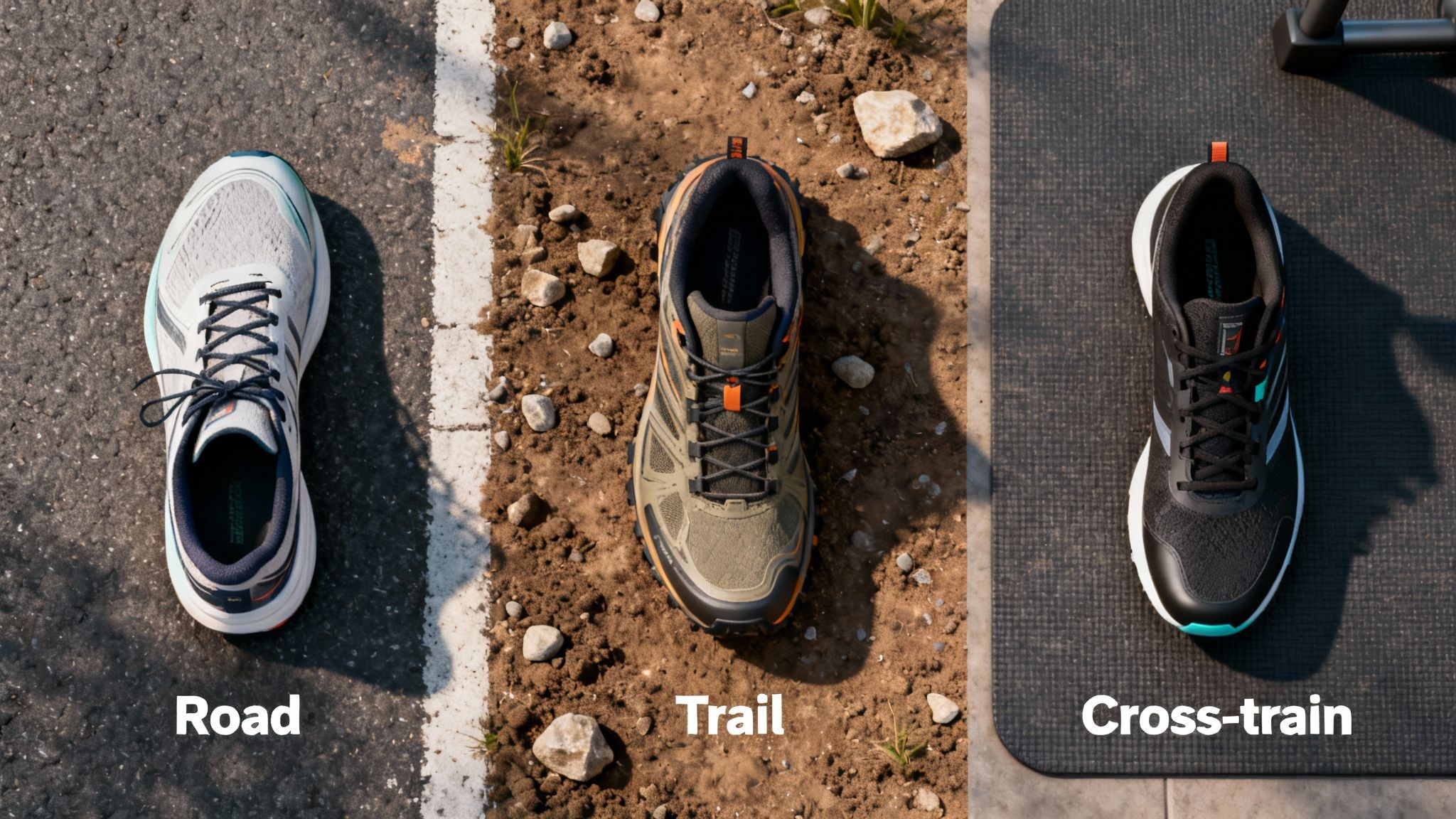
Using the right shoe for the activity is crucial for performance and injury prevention. Road, trail, and cross-training shoes are engineered for different demands.
Shoes For The Road
Road shoes are designed for hard, consistent surfaces like pavement. They prioritize cushioning to absorb repetitive impact and reduce stress on joints. Their outsoles are typically flatter for a smooth, stable ride.
Taking On The Trails
Trail shoes are the rugged 4x4s of footwear, built for unpredictable terrain. Key features include aggressive lugs for traction, rock plates for protection, and durable uppers to resist abrasions. The trail running market has seen significant growth, reflecting a post pandemic surge in outdoor fitness. You can find more insights on the trail running shoes market at Grand View Research.
Versatility For The Gym
Running shoes, with their high, soft heels, are unsuitable for gym workouts. The plush cushioning creates an unstable base for lifting and lateral movements. Cross-training shoes are the correct choice, offering a lower heel drop for stability, a durable outsole for grip, and a firmer midsole that provides a solid connection to the floor.
Using a running shoe for weightlifting is like trying to build a house on a mattress. The foundation is too soft and wobbly, increasing your risk of an ankle roll or worse.
Top Running Shoe Reviews
Here are some of the top rated running shoes for men and women, recognized for their performance, comfort, and technology across different categories.
Top Picks for Men
Best Daily Trainer: Brooks Ghost 15 - Known as a reliable workhorse, the Ghost 15 offers a perfect balance of soft cushioning and responsiveness. Its DNA LOFT v2 midsole provides a smooth ride suitable for all types of runs, making it a favorite for neutral runners.
Best for Stability: Hoka Arahi 7 - For overpronators, the Arahi 7 delivers exceptional stability without the bulk. Hoka's J-Frame™ technology guides the foot naturally, providing support in a surprisingly lightweight package.
Best for Race Day: Nike Vaporfly 3 - Engineered for speed, the Vaporfly 3 combines a carbon fiber plate with responsive ZoomX foam. This combination provides a propulsive feeling that helps runners achieve personal bests over long distances.
Top Picks for Women
Best Daily Trainer: New Balance Fresh Foam X 880v13 - This shoe is a dependable choice for everyday miles. The dual layer Fresh Foam X midsole offers a soft landing and an energetic toe-off, while the engineered mesh upper provides a secure and breathable fit tailored to the female foot.
Best for Stability: Asics Gel-Kayano 30 - A long standing leader in stability, the Gel-Kayano 30 features 4D GUIDANCE SYSTEM™ technology for adaptive support. It's an excellent choice for female runners who overpronate and need reliable cushioning for long runs.
Best for Trails: Salomon Speedcross 6 - Designed for technical trails, the Speedcross 6 offers unparalleled grip with its deep, aggressive lugs. The SensiFit™ construction cradles the foot, providing a secure and comfortable fit on uneven terrain.

Comparison of Well Being Trends: Barefoot vs. Cushioned Running
The running world has seen two opposing trends dominate discussions on foot health and performance: minimalist "barefoot" running and maximalist cushioned shoes.
The Barefoot/Minimalist Movement
Popularized by the book Born to Run, this philosophy argues that modern running shoes weaken feet and encourage an unnatural, heel striking gait. Proponents believe that running with minimal or no footwear promotes a more natural midfoot or forefoot strike, which may reduce impact forces on the joints. Research suggests that while it can strengthen foot muscles, a sudden transition to minimalist running without proper adaptation can lead to injuries like stress fractures and Achilles tendonitis (Lieberman, 2012).
The Maximalist Cushioning Trend
In direct contrast, brands like Hoka pioneered maximalist shoes with oversized, plush midsoles. This approach aims to provide superior shock absorption, reducing the load on the runner's body. These shoes are particularly popular for long distance and recovery runs, as the extreme cushioning can alleviate joint stress. However, critics argue that the thick foam can diminish ground feel and stability, potentially altering natural running mechanics. The choice between these two styles is highly personal and depends on a runner's biomechanics, injury history, and comfort preference.
How To Find The Perfect Fit
Getting the fit right is the most critical step. A shoe that feels great in the store can cause problems miles down the road. A common mistake is buying shoes that are too small, as feet swell during a run.
Pro Tip: Always shop for running shoes in the late afternoon or evening. Your feet will be at their largest, giving you a more realistic idea of the fit you'll need during a run.
Your In-Store Fitting Checklist
When trying on shoes, wear your usual running socks and use this checklist.
Check the Length: Ensure about a thumb's width of space between your longest toe and the shoe's tip to prevent black toenails.
Assess the Width: The shoe should feel snug but not tight. You should be able to splay your toes easily.
Test the Heel: Your heel should feel locked in with minimal or no slipping when you walk or jog.
When To Replace Your Running Shoes
Running shoes have a limited lifespan. Pushing them past their prime is a common cause of injury. The midsole foam compresses over time and loses its ability to absorb impact, leaving your joints to take the punishment.
Tracking Mileage and Recognizing Warning Signs
Most running shoes last between 300 and 500 miles. Tracking your mileage with an app or a simple log is the best way to know when it's time for a new pair.
A classic mistake is waiting until the shoe looks completely thrashed. The midsole foam that gives you support and cushioning breaks down long before the rubber on the bottom wears through.
Pay attention to subtle warning signs from your body and the shoes themselves:
Loss of Bounce: The shoe feels flat and unresponsive.
New Aches and Pains: Unexplained soreness in your feet, shins, or knees after runs.
Uneven Wear Patterns: The outsole tread is worn smooth, especially in a lopsided pattern.
Wrinkled Midsole: Deep compression wrinkles appear in the foam.
For more details, check our guide on how often to replace running shoes.

Common Questions About Running Shoes
Do I Really Need Different Shoes For Running And Gym Workouts?
Absolutely. Running shoes are built for forward motion and have soft cushioning that makes them unstable for gym activities like lifting or agility drills. A cross-trainer with a flatter, more stable base is essential for a safe and effective gym workout.
How Much Should I Spend On Good Running Shoes?
A quality pair of running shoes typically costs between $120 and $160. This price reflects better materials and cushioning technology that protect your joints and last longer. Avoid the cheapest options, as their foam breaks down quickly, and don't assume the most expensive shoe is the best for you.
Can I Just Buy The Newest Version Of My Favorite Shoe?
Be cautious. Brands update models annually, and "upgrades" can alter the fit and feel. Changes to foam, upper material, or shape can make the new version feel completely different. Always read reviews and, if possible, try them on before buying.
How Do I Break In New Running Shoes?
Modern running shoes require minimal to no break-in period. They should feel comfortable out of the box. However, it's wise to ease into them. Wear them around the house first, then use them for a few shorter runs before tackling a long run or intense workout.
References
Lieberman, D. E. (2012). What we can learn about running from barefoot running: an evolutionary medical perspective. Exercise and Sport Sciences Reviews, 40(2), 63-72.
Pedisic, Z., Shrestha, N., Kovalchik, S., Stamatakis, E., Liangruenrom, N., Grgic, J., ... & Oja, P. (2019). Is running associated with a lower risk of all-cause, cardiovascular and cancer mortality, and is the more the better? A systematic review and meta-analysis. British Journal of Sports Medicine, 54(15), 898-905.
At Flourish-Everyday, we're dedicated to helping you find the perfect shoes for running, cross-training, and living a healthy life. Explore our reviews and resources to support your journey. Find your next favorite pair at https://www.flourish-everyday.com.