Flourish-Everyday
Search Results
Search this site
346 results found with an empty search
- How to Run in the Rain and Actually Enjoy It
As you are aware, running consistently is key to performance outcomes. This includes running in all types of weather. Don't let a little rain ruin your run. Honestly, learning how to run in the rain successfully is all about having the right gear, a smart plan, and, most importantly, the right attitude. Instead of seeing a downpour as a reason to stay on the couch, think of it as a chance to build mental toughness. It's a unique sensory experience that can break up the monotony of your usual training routine. Table of Contents Embracing the Elements: Your Guide to Running in the Rain Essential Gear for Conquering a Rainy Run Your Pre-Run Checklist for a Safe and Effective Run Mastering Your Technique on Wet and Slippery Surfaces Post-Run Care to Prevent Chills and Injury Your Questions About Running in the Rain Answered References Embracing the Elements: Your Guide to Running in the Rain A rainy day doesn't have to mean a missed workout. In fact, some of my most rewarding runs have been in the rain. It prepares you for unpredictable race day conditions and gives you a serious confidence boost. Plus, it cools you down naturally, often clears popular routes of crowds, and turns a familiar path into a whole new adventure. The key is to stop just enduring the elements and start embracing them. This guide will walk you through the three pillars of a great wet weather run: Essential Gear Selection: We'll get into why certain materials will keep you comfortable while others, like your favorite cotton t-shirt, become a soggy, heavy mess. Safety and Preparation: This is all about picking the right route and making sure you’re visible to others, especially when the light is low. Post-Run Recovery: Knowing the immediate steps to take after your run is crucial to prevent chills, avoid injury, and keep your gear from getting ruined. Quick Guide to Running in the Rain Before we dive deep, here's a quick overview of what to consider. Think of this as your cheat sheet for gearing up and getting out the door safely. Each point is a crucial piece of the puzzle for turning a potentially miserable run into a great one. Phase Key Action Why It Matters Preparation Check for Thunderstorms Your safety is nonnegotiable. Lightning means the run is off, period. Gear Wear a Billed Cap & Bright Colors A cap keeps rain out of your eyes, and bright gear makes you visible to traffic. Technique Shorten Your Stride Quicker, shorter steps give you better traction and reduce your risk of slipping. Post-Run Change Clothes Immediately Getting out of wet gear stops your body temperature from dropping too fast. Running in less than ideal conditions shows you can adapt and thrive no matter what race day throws at you. If you can conquer wind and rain, you can conquer any challenge. By focusing on these key areas like preparation, proper gear, adjusted technique, and swift recovery, you transform what could be a miserable slog into a powerful training session. The rest of this guide will break down each of these components, giving you everything you need to not just survive a rainy run, but to truly own it. Essential Gear for Conquering a Rainy Run The goal isn't to stay bone dry, that's a losing battle and can actually make you wetter from sweat, but to use smart layers and materials that manage moisture. First things first, and this is essential: avoid cotton at all costs . Seriously. Cotton is like a sponge; it soaks up water, gets incredibly heavy, and leeches heat right out of your body. That's a fast track to being uncomfortable and, in colder weather, can even increase your risk of hypothermia. Building Your Rainy Run Wardrobe Think of your clothes as a system designed to handle water from two directions: sweat from the inside and rain from the outside. Layering is your best friend here, as it lets you adapt to the temperature and how hard it's raining. Moisture Wicking Base Layer: This is what’s right against your skin, and its main job is to pull sweat away from your body. Look for synthetics like polyester or natural fibers like merino wool. Both are fantastic because they keep insulating you even when they get a little damp. Water Resistant Outer Layer: Your main shield is a lightweight, breathable, and water resistant (or waterproof) jacket. Breathability is the key feature here. Without it, you're just trapping sweat and you’ll end up soaked anyway. A lot of great running jackets have vents built in to let that heat and moisture escape. A Billed Cap: This is a rainy day runner's secret weapon. A simple baseball cap or a running visor works wonders to keep the rain out of your eyes. It makes a huge difference in your comfort and lets you focus on your footing instead of constantly wiping your face. Footwear and Accessories for a Solid Grip Your feet do all the work, so keeping them as happy as possible is critical for a good run in the wet. Slipping is a real concern on slick surfaces, making your shoe choice incredibly important. You'll want to look for running shoes with an aggressive outsole . That means deeper lugs or a grippy tread pattern specifically made for wet pavement or trails. Some runners swear by shoes with a waterproof membrane like Gore-Tex, which can keep your feet drier for longer. If you want to go deeper on this, check out our guide to the best waterproof trail running shoes for any adventure . Let's be realistic: no shoe is 100% puddle proof. On a truly rainy day, your feet are probably going to get wet. The goal is to wear shoes and socks that don’t hold onto water and give you blisters. Always pair your shoes with moisture wicking socks made from wool or a synthetic blend. And just like with your other layers, stay far, far away from cotton. One last thing people often forget on a cool, rainy day is hydration. It's easier to get dehydrated when you don't feel as thirsty. A simple handheld water bottle for running is an easy way to make sure you're taking in enough fluids. Your Pre-Run Checklist for a Safe and Effective Run Getting ready for a run in the rain isn't just about grabbing a jacket. A little prep work before you even open the door can be the difference between a miserable slog and a fantastic workout. It all boils down to a smart pre-run routine that tackles the unique challenges of wet weather head on. Before you even think about gear, think about your route. Today is definitely not the day to explore that tricky, unpaved trail with all the exposed roots. You'll want to stick to familiar, well lit paths where you know the footing is solid. When things get slick, pavement is almost always a safer bet than the trail. Also, be mindful of any spots on your usual loop that are known for bad drainage. Splashing through a massive, unexpected puddle is more than just annoying, it can easily hide a pothole or uneven ground, setting you up for a nasty fall or a twisted ankle. Planning a route that steers clear of those low lying, flood prone areas is a simple but crucial safety measure. Maximize Your Visibility and Warmth When the sky is gray and rainy, visibility for drivers drops significantly, which means making yourself seen is nonnegotiable. Dark clothing will make you practically invisible. This is the time to break out the brightest colors in your running drawer, think neon yellows, pinks, and oranges. Reflective strips on your jacket, tights, or shoes are also your best friend for staying visible in low light. Your pre-run warm-up is more important than ever in cold, wet weather. Cold muscles are less pliable and more susceptible to strains and pulls. Performing a dynamic warm-up indoors is the best approach. Forget about old school static stretching. You need to focus on dynamic movements that get your blood flowing and signal to your muscles that it's time to work. Just a few minutes of these exercises can seriously slash your injury risk: Leg Swings: Forward, backward, and lateral swings are perfect for opening up your hips. High Knees and Butt Kicks: These classic drills fire up your hamstrings and quads. Walking Lunges: A fantastic way to warm up your glutes, quads, and hip flexors. Prevent Uncomfortable Chafing Finally, you have to deal with the number one fun killer of rainy runs: chafing . Moisture and friction are a terrible combination, and the constant dampness makes skin irritation almost a guarantee in sensitive areas. Before you head out, do yourself a huge favor and apply an anti-chafing balm or even just petroleum jelly to any spots that tend to rub. Common problem areas usually include: Inner thighs Underarms Along the sports bra line (for women) Around the nipples (for men) Taking this one simple step can save you from a world of hurt both during and after your run. By planning your route, making sure you're visible, warming up right, and protecting your skin, you're setting yourself up for a confident and successful run, no matter what the weather throws at you. Mastering Your Technique on Wet and Slippery Surfaces When the ground gets slick, adapting your running form isn't just a good idea, it's essential. Running in the rain is less about powering through and more about moving smarter to keep yourself upright and injury free. The single biggest change you can make is to shorten your stride and increase your cadence , which is the number of steps you take per minute. This simple adjustment is a must for your stability. A shorter, quicker stride means your feet land more directly underneath your center of gravity. This has a dual benefit: it cuts down on the braking force with each step and drastically lowers your risk of slipping on wet pavement or a patch of slick leaves. Navigating Different Terrains and Obstacles Every surface reacts differently to a downpour. A route you know like the back of your hand can suddenly turn into a series of mini challenges that demand your full attention. Pavement and Concrete: Normally, these are your most reliable surfaces. But watch out for painted lines, manhole covers, and metal grates, they become incredibly slippery. I treat them like patches of ice and do my best to avoid stepping on them directly. Grass and Dirt: These can turn into mud pits in a hurry. Unless you're geared up for a trail run with the right shoes, it’s probably best to stick to harder surfaces to avoid a messy, and potentially dangerous, slip-and-slide. Puddles: Here’s the big debate: do you run through them or go around? If it's a shallow puddle on a path you know well, powering through is often the easiest choice. But be careful, as deeper puddles can easily hide potholes or uneven ground. When in doubt, always go around. This focus on foot placement is so important. If you want to dive deeper into optimizing your movement, you might find our article on how to improve running form for better speed and endurance really helpful. One of the biggest mental hurdles of running in the rain is accepting that you're going to get wet. Once you let go of trying to stay perfectly dry and just embrace the conditions, the run becomes much more enjoyable. The Mental Game of a Rainy Run Running in the rain is as much a mental exercise as it is a physical one. All of your sensory inputs are different, the sound of the rain hitting the pavement, the feeling of it on your skin, and the way the world looks. Staying focused and keeping a positive attitude is absolutely key. Interestingly, rain doesn't automatically mean a slower pace. A statistical analysis of the Berlin Marathon over 46 years found a negligible link between rainfall and finish times (1). However, the study does point out that wet conditions reduce traction by changing the shoes grip. This makes your gear choices critical, as we saw in the 2018 Boston Marathon where many runners couldn't finish due to being unprepared for the cold, soaking rain. You can discover more insights on how weather impacts performance . Instead of seeing the rain as an obstacle, try to reframe it. Think of it as a unique training opportunity. It builds a kind of mental toughness that really pays off on race day when conditions might be less than perfect. Concentrate on your breathing, listen to the rhythm of your feet on the wet ground, and just appreciate the unique atmosphere. Post-Run Care to Prevent Chills and Injury You’ve logged the miles and conquered the rain, but what you do next is just as crucial. Your post-run routine is your first line of defense against chills, aches, and potential injuries. The absolute first thing you need to do? Get out of your wet clothes immediately. Soggy gear pulls heat from your body with surprising speed, leading to a sharp drop in your core temperature. This is what brings on those uncomfortable, uncontrollable shivers and post-run chills, which also happens to steal energy your body desperately needs for recovery. The First Steps to Recovery Once you're back inside, your mission is to warm up and refuel. A warm shower, not scalding hot, is the perfect way to gently bring your body temperature back to normal. It also feels amazing and helps rinse away any grit that could irritate your skin. After your shower, grab a warm drink like tea or broth to warm up from the inside out and start rehydrating. For some extra great tips on keeping your feet warm and preventing chills , this is a great resource. This is also the ideal time to do some gentle stretching to address any muscle tightness from the run. If you need some ideas, our guide on how to prevent muscle soreness with top tips for faster recovery has some excellent strategies you can use. The infamous 122nd Boston Marathon in 2018 was a masterclass in why post-run care in the cold rain is so critical. Droves of elite runners dropped out due to hypothermia, proving that getting out of wet gear and into warm, dry layers isn't just about comfort, it's a safety measure (2). Caring for Your Running Shoes Your shoes took a serious soaking out there, and leaving them wet is a fast track to mildew, bacteria, and a much shorter lifespan. Taking proper care of them is simple but makes a massive difference. Remove the Insoles: Always pull the insoles out and let them air dry separately. This is the only way the inside of the shoe will ever dry completely. Clean Off Debris: Grab a soft brush or an old cloth and gently wipe off any mud or dirt caked on the shoe’s upper and outsole. Stuff with Newspaper: Loosely crumple up some newspaper and stuff it inside each shoe. The paper is incredibly effective at absorbing moisture from the inside. Air Dry Naturally: Find a well ventilated spot and let them be. Keep them away from direct heat sources like radiators, which can warp the materials and totally ruin the shoe's fit and cushioning. Lastly, take a moment for a quick foot check. Blisters and hot spots are far more common after running in wet socks. Catching these minor issues early will keep them from becoming major problems that could sideline you from your next run. Your Questions About Running in the Rain Answered Even with the best prep, a few questions always pop up when you're staring out the window at a downpour. Let's tackle some of the most common ones so you can lace up with total confidence, no matter what the sky is doing. Is It Safe to Run in a Thunderstorm? Let's make this crystal clear: absolutely not . This is the one time you hang up the shoes and wait it out. A steady rain is one thing, but a thunderstorm brings the very real danger of lightning. Lightning can strike up to 10 miles away from the storm itself, which means you could be in danger even if it’s not raining hard where you are (3). Always, always check the forecast for thunderstorm warnings before heading out. If you get caught in one by surprise, your run is over. Find immediate shelter in a solid building or a hard topped car and stay clear of open fields or tall trees. Will Running in the Rain Make Me Sick? This is one of those old myths that just won't quit. The short answer is no, getting wet doesn't give you a cold. Viruses cause colds and the flu, not rain. However, there's a grain of truth in the concern. Staying cold and wet for a long time can lower your core body temperature and put a temporary damper on your immune system. That could make you a bit more susceptible if you happen to be exposed to a virus. The fix is simple: dress in proper moisture wicking layers and, most importantly, get out of your wet clothes and into a warm shower the second you walk through the door. Following the post-run care steps we talked about earlier is your best line of defense. A quick change of clothes is far more important for staying healthy than avoiding the rain altogether. How Do I Protect My Phone and Earbuds? Yeah, this is a big one. Nobody wants to fry their expensive electronics. Thankfully, you've got a few easy options, no matter your budget. Waterproof Gear: The most bulletproof solution is to use accessories designed for the job. A waterproof phone case or armband, paired with some waterproof or resistant sport earbuds , takes all the guesswork out of it. The DIY Fix: In a pinch, a simple plastic sandwich bag works wonders. Just seal your phone inside before you stick it in your pocket or running belt. It’s a surprisingly effective waterproof barrier. Use What You've Got: Don't underestimate your running hat or jacket hood. The brim of a cap can do a fantastic job of shielding your earbuds from the worst of the rain, often giving them all the protection they need. How Should I Adjust My Hydration Strategy? It's so easy to forget to drink on a cool, rainy day. You don't feel as parched as you do when the sun is beating down, but your body is still sweating and losing fluid. You probably won't need to chug water like you would in a heatwave, but you can't just ignore it. The best advice is to simply drink to thirst. If your run is pushing past an hour, stick to your usual hydration plan. Listening to your body is always the winning strategy. Have a great run. References Van de Vliet, P., & El-Etriby, M. (2021). The Effect of Weather Conditions on Marathon Running Performance: The Berlin Marathon from 1974 to 2019. International Journal of Environmental Research and Public Health, 18 (11), 5673. https://doi.org/10.3390/ijerph18115673 Roberts, W. O. (2018). It Was a Cold and Stormy Day—Hypothermia and the 2018 Boston Marathon. Clinical Journal of Sport Medicine, 28 (5), 417-418. https://doi.org/10.1097/JSM.0000000000000656 National Weather Service. (n.d.). Lightning Safety Tips and Resources . Retrieved from https://www.weather.gov/safety/lightning At Flourish-Everyday , we believe that the right information and gear can empower you to take on any challenge. We provide expert reviews and health insights to support your wellness journey, rain or shine. Find everything you need to know at https://www.flourish-everyday.com .
- How to Stay Consistent with Exercise and Build a Lifelong Habit
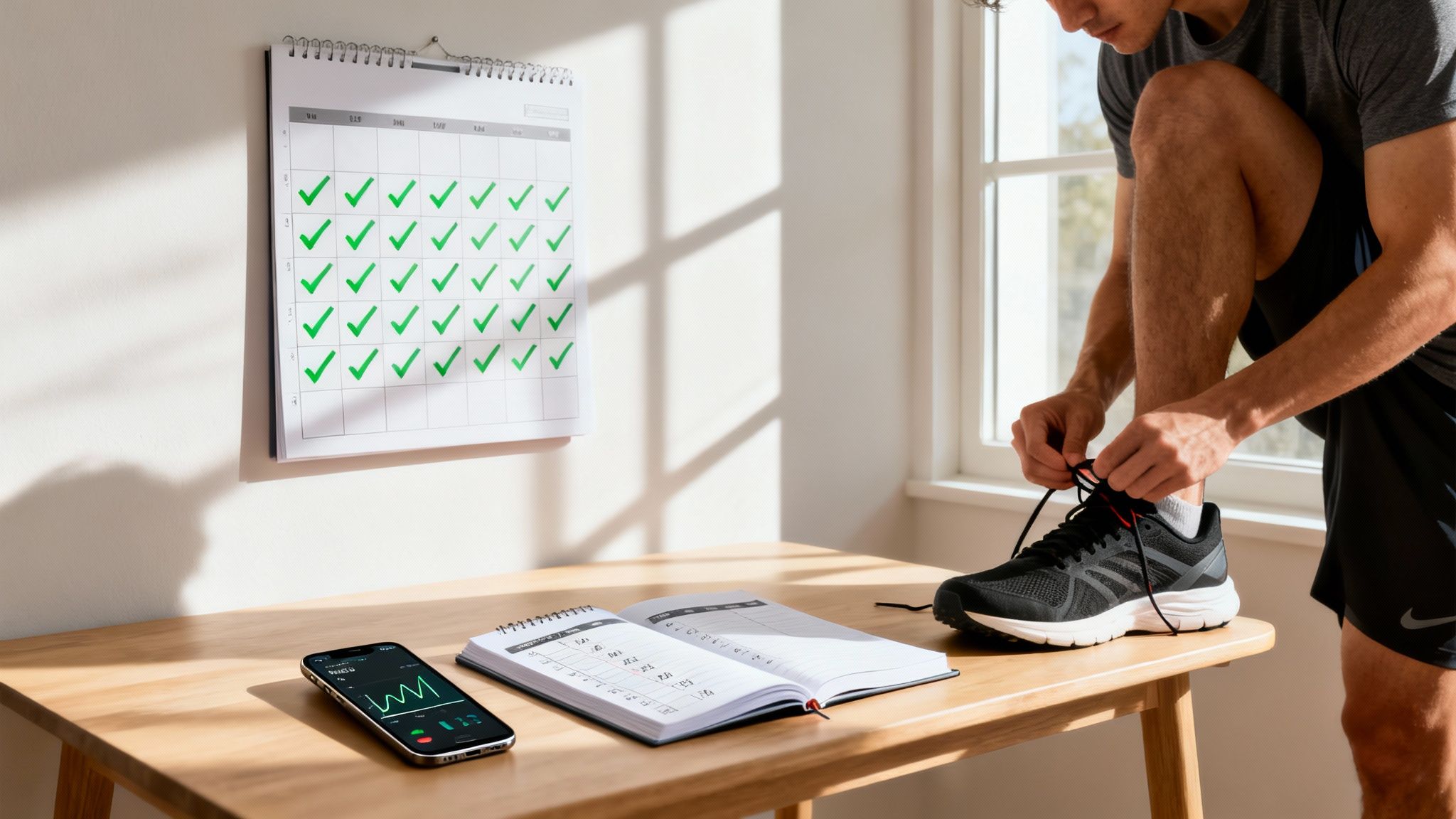
The secret to sticking with exercise isn't about having superhuman motivation or crushing yourself with insane workouts from day one. It’s about something much simpler: building a smart, sustainable system that you can actually stick with. The real key to long term fitness is a forgiving approach that values showing up over going all out every single time. This guide offers concise, informative health information to help you stay consistent with exercise and build that routine. Article Index Why Consistency Matters More Than Intensity Crafting Your Personal Exercise Blueprint Finding the Right Gear to Support Your Goals Wellness Trends: High-Intensity Interval Training (HIIT) vs. Low-Intensity Steady-State (LISS) Overcoming Common Roadblocks and Staying Motivated Using Progress to Fuel Your Motivation Your Fitness Consistency Questions Answered References Why Consistency Matters More Than Intensity The biggest challenge isn't the first workout; it's the fortieth. Many fall into the trap of chasing sporadic, high intensity sessions, only to burn out. This cycle is fueled by the myth that fitness demands constant, maximum effort. Focusing on consistent, moderate activity is a better way to build a lasting habit. Think of it like learning an instrument: practicing for 20 minutes daily is more effective than one three hour session monthly. This steady approach allows your body to adapt, builds momentum, and helps you avoid the burnout that stops so many people. The Motivation and Discipline Gap Motivation is the initial spark that gets you started, but it's temporary. Discipline is the system you build to keep going when excitement fades. True progress is measured by your ability to show up on the days you don't feel like it. This gap is reflected in global health statistics. According to a 2023 HFA Global Report, fitness participation is at a high, yet the World Health Organization warns that physical inactivity is also rising, projected to affect 35% of adults by 2030 (1, 2). People are starting, but they aren't staying consistent. Crafting Your Personal Exercise Blueprint Forget generic workout plans. The secret to making exercise a permanent part of your life is designing a routine that fits seamlessly into your world. This requires moving past vague goals like "get in shape" and building a concrete, personalized strategy founded on realism. Start Small and Scale Smart Your initial goal is to make showing up effortless. An ambitious plan can lead to burnout, while a manageable one builds confidence and creates a positive feedback loop. Consider these starting points: Three 20-minute sessions per week: A brisk walk, a short bodyweight circuit, or a light jog. The focus is on completion, not intensity. One group fitness class a week: This provides built-in accountability and structure. Ten minutes of movement daily: Stretching in the morning, a walk on your lunch break, or a simple yoga flow before bed. True, lasting progress happens when you ditch the "all-or-nothing" mindset and embrace steady, repeatable effort. Uncover Your Deeper Motivation Initial excitement fades. You need to connect your exercise habit to a powerful, personal "why" that will motivate you on low energy days. Your "why" must be specific and meaningful. Vague goals produce vague results. A specific, emotionally resonant 'why', like having more energy for your kids or managing stress to be more present at home, is the fuel that sustains long term consistency. Maybe your "why" is to boost mental clarity, manage a health condition, or be a healthy role model. Write it down and place it where you'll see it daily. For more help, see our guide on how to set fitness goals that actually stick . Master the Art of Habit Stacking Habit stacking is an effective technique for building consistency. Anchor your new workout habit to an existing part of your daily routine to remove the need for constant decision making. Here are some real world examples: For the Home-Gym User: After your morning coffee, head straight to your workout space for a 15-minute strength session. For the Runner: Place your running gear next to your bed. Get dressed and head out the door as soon as your alarm goes off. For the Group Fitness Fan: Drive directly to the gym after work without going home first to avoid distractions. Creating automatic triggers reduces the mental energy required to start, making exercise a necessary part of your life. Finding the Right Gear to Support Your Goals The right equipment is an investment in your ability to be consistent. While you don't need expensive gear, proper tools, especially good shoes, can prevent injuries and make exercise more enjoyable. Bad shoes can lead to shin splints, knee pain, or blisters that derail your progress. Top Athletic Shoes for Men and Women: An Overview For mixed activities like gym sessions, HIIT classes, or walking, a cross-training shoe offers a balance of support, flexibility, and cushion. Men's Top Athletic Shoes: Nike Metcon : Known for its stable base for lifting and flexibility for agility work. A durable, versatile gym shoe. Reebok Nano : Offers a stable platform and a wide toe box, making it excellent for heavy lifts and dynamic movements. Women's Top Athletic Shoes: Brooks Ghost : Technically a running shoe, its superb cushioning and support make it a top choice for walking and general gym use. HOKA Clifton : Famous for its maximum cushioning, providing exceptional comfort for running, walking, and standing activities. Choosing the right shoe isn’t about brand loyalty; it's about matching the shoe's design to your primary activity. A runner needs impact absorption, while a weightlifter needs a flat, stable base. Individual Brand Shoe Reviews for Specific Activities As your fitness becomes more focused, your footwear should too. Specialized shoes are engineered to enhance performance and prevent injury during specific movements. Best for Runners: Cushion and Support Running generates impact forces up to three times your body weight with each stride, making proper cushioning essential (3). ASICS GEL-Kayano : A top stability shoe for runners who overpronate (foot rolls inward). Its structured cushioning helps guide the foot, reducing strain on ankles and knees. Saucony Kinvara : A lightweight, responsive option for neutral runners. It offers a "fast" feel without sacrificing essential cushioning, ideal for distances from 5Ks to half marathons. Best for CrossFit: Stability and Grip CrossFit combines weightlifting, gymnastics, and cardio, requiring a shoe that offers stability for lifts and flexibility for dynamic movements. NOBULL Trainer : Renowned for its durability and minimalist design. The flat, grippy sole provides excellent traction for rope climbs and stability during Olympic lifts. Wellness Trends: High-Intensity Interval Training (HIIT) vs. Low Intensity Steady State (LISS) Understanding different exercise methods can help you find what works best for you. Two popular trends are HIIT and LISS. Feature High Intensity Interval Training (HIIT) Low Intensity Steady State (LISS) Description Short bursts of all out effort followed by brief recovery periods. (e.g., 30s sprint, 60s walk) Maintained, moderate intensity for a sustained period. (e.g., 45-min jog) Duration Typically 10-30 minutes. Typically 30-60+ minutes. Benefits Highly time efficient, boosts metabolism (EPOC effect), improves cardiovascular health quickly. Lower impact on joints, aids in recovery, improves endurance, can be meditative. Best For Individuals short on time, those seeking to break through plateaus. Beginners, individuals with joint issues, active recovery days, building an aerobic base. Comparison: HIIT is more time efficient and can burn more calories in a shorter period, but it's also more physically demanding and carries a higher risk of injury if form is compromised. LISS is safer, more sustainable for daily activity, and excellent for building foundational endurance. A balanced routine often includes both. For example, 2-3 HIIT sessions and 2-3 LISS sessions per week can provide comprehensive benefits. Overcoming Common Roadblocks and Staying Motivated Even the best plans face challenges. Consistency is about navigating hurdles like a busy schedule, low energy, or a lack of enthusiasm. Research shows that breaking activity into smaller chunks, like three 10-minute walks, can be as effective as one continuous 30-minute workout (4). This makes exercise feel more manageable. For more ideas, our guide on 7 proven strategies for how to find time to workout in 2025 offers actionable tips. The Difference Between Motivation and Discipline Motivation is the spark that starts you; discipline is the system that keeps you going. Relying on motivation alone leads to inconsistency because feelings are temporary. A disciplined habit functions even on days you don't feel like it. Building discipline isn't about forcing yourself through workouts you hate. It's about making the right choice the easiest one and learning how to overcome lack of motivation and reclaim your drive . Solutions for Common Exercise Barriers Here’s how to turn common excuses into actionable solutions. Common Barrier Psychological Hurdle Actionable Solution "I'm too tired." Decision Fatigue: A full workout feels overwhelming. Do a 10-minute version. A short walk, a few stretches, or one set of exercises. The goal is to just start. "I don't have time." All-or-Nothing Mindset: Believing short workouts are pointless. Find 15 minutes . Walk during a phone call, do squats while waiting for coffee, or do a quick HIIT circuit. "I'm bored." Lack of Novelty: Your brain craves a new stimulus. Change one variable. Try a new route, a different class, or a new playlist. "I'm not seeing results." Impatience: Expecting visible changes too quickly. Focus on non-scale victories . Track energy levels, sleep quality, or strength gains. Leveraging Accountability for Unstoppable Consistency Sharing your goals with an accountability partner or joining a fitness community creates a sense of shared purpose. Knowing someone is expecting you makes it harder to skip a session. This support system turns a solo effort into a team sport, providing encouragement on tough days and celebrating your wins. Using Progress to Fuel Your Motivation Tracking tangible progress creates a positive feedback loop that reinforces your habit. The secret is to focus on "process goals" (the actions you take) rather than "outcome goals" (the final result). For example, aim to complete three 20-minute workouts this week. This approach builds momentum and provides frequent, confidence boosting wins. The Power of Tracking Your Journey Logging your workouts makes your efforts feel concrete. Whether using an app or a notebook, this record is a powerful reminder of your progress. A workout journal helps you see how far you've come, which can be motivating on difficult days. Consider tracking your progress with a dedicated workout journal . Tracking isn’t about judging your performance; it’s about acknowledging your commitment. Every logged workout is proof that you are putting in the work. Celebrate Non-Scale Victories The scale is not the only measure of progress. Celebrating "non-scale victories" (NSVs) is crucial for staying positive. NSVs are real world improvements in your health and well being. Recognizing them helps you appreciate the full benefits of exercise. For more insight, our guide on how to measure body composition accurately offers a deeper look at your body's changes. Powerful non-scale victories to celebrate: Increased Energy: Having more stamina for daily activities. Improved Sleep: Falling asleep faster and waking up feeling rested. Better Mood: Experiencing less stress and a more positive outlook. Strength Gains: Lifting heavier or completing more reps. Clothes Fitting Better: Your favorite clothes feeling more comfortable. Bluebird Botanicals Your Fitness Consistency Questions Answered Even the best plans encounter obstacles. Here are answers to common questions about maintaining a consistent workout habit. How Long Does It Really Take to Form an Exercise Habit? There's no magic number. A 2009 study found the average was 66 days , but the range was from 18 to 254 days (5). Habit formation is a personal journey. Instead of fixating on a timeline, focus on winning today. Each workout strengthens the habit, making it easier to show up tomorrow. What Should I Do If I Miss a Workout… or a Whole Week? It will happen. The worst response is falling into the "all-or-nothing" trap. Missing one workout doesn't erase your progress. The key is to jump back in without guilt. Don't wait for Monday. Return on your next scheduled day. Make it easy. Your first workout back should be light, like a 15-minute walk. Count it as a win. Getting back on track is a victory in itself. Is It Better to Work Out in the Morning or at Night? The best time to work out is when you will actually do it. Morning: Fewer obstacles can derail your plans. Best for those with unpredictable evenings. Evening: A great way to relieve stress from the day. Best for those who feel stronger later or use exercise to decompress.Experiment to see what fits your schedule and energy levels. For more tips, see what health experts suggest for making exercise a regular part of your day . How Do I Stay Consistent When Traveling? Adapt your routine to keep the habit of daily movement alive. Pack light: A resistance band or jump rope is versatile and portable. Have a go-to bodyweight circuit: Master a 15-minute routine (squats, push-ups, planks) you can do anywhere. Build activity into your plans: Explore a new city on foot, plan a hike, or rent a bike. References Health & Fitness Association. (2024). 2024 HFA Global Report . Retrieved from https://healthandfitnessassn.org/press-release/global-report-shows-health-club-industry-serves-210-million-members/ World Health Organization. (2022, October 19). WHO highlights high cost of physical inactivity in first-ever global report . Retrieved from https://www.who.int/news/item/19-10-2022-who-highlights-high-cost-of-physical-inactivity-in-first-ever-global-report Lieberman, D. E., Venkadesan, M., Werbel, W. A., Daoud, A. I., D'Andrea, S., Davis, I. S., ... & Pitsiladis, Y. (2010). Foot strike patterns and collision forces in habitually barefoot versus shod runners. Nature , 463(7280), 531-535. Murphy, M. H., Lahart, I., Carlin, A., & Murtagh, E. (2019). The effects of continuous vs. accumulated exercise on health: a meta-analytic review. Sports Medicine , 49(10), 1585-1607. Lally, P., van Jaarsveld, C. H. M., Potts, H. W. W., & Wardle, J. (2010). How are habits formed: Modelling habit formation in the real world. European Journal of Social Psychology , 40(6), 998-1009. At Flourish-Everyday , we're here to help you on every step of your wellness journey. From practical guides like this to honest shoe reviews, we give you the tools and motivation to build a fitness habit that lasts. https://www.flourish-everyday.com
- Start Your Journey: The 12 Best Running Apps for Beginners in 2026
Starting a running routine can feel overwhelming, but the right digital tool can transform it into an exciting and achievable journey. With countless options available, finding the one that fits your goals, budget, and motivation style is key. This guide cuts through the noise to present the absolute best running apps for beginners, helping you take those first confident strides. This guide explores structured coaching plans, immersive audio experiences, and community driven platforms. We provide analysis of each app, complete with key features, pros, and cons to help you visualize the user experience. Beyond apps, we'll touch upon the importance of proper gear, with insights into athletic footwear, and how pairing the right app with the right shoe can prevent injury and enhance performance. For those just starting out and looking to experiment with structured training without extra cost, you can also explore various guides to free interval timer apps that complement your running journey. Index of this Guide Top Apps For Beginners Apple Store : Top tier fitness applications Google Play Store : For Android users, where runners can compare, and install popular apps Strava : The Social Network for Athletes Nike Run Club (NRC) : Guided Runs & Coaching ASICS Runkeeper : Personalized Goal Setting Adidas Running (Runtastic) : Community & Challenges MapMyRun : Detailed Route Planning C25K – Zen Labs Fitness : The Ultimate 5K Trainer Zombies, Run! : Gamified Running Adventure Peloton App : Motivation Driven Classes Pacer: Pedometer & Step/Run Tracker Apple Fitness+ : Seamless Ecosystem Integration Choosing Your Digital Running Partner Beyond The App Top Running Apps for Beginners: In-Depth Reviews 1. Apple App Store For iOS users, the journey to finding the best running apps for beginners often starts at the Apple App Store. It’s a curated ecosystem where Apple’s editorial team frequently highlights top tier fitness applications in collections like “The Best Running Apps.” This curation simplifies discovery, helping new runners find reputable tools like Nike Run Club, Strava, and Runkeeper. The platform excels by providing a secure, centralized hub for managing downloads and subscriptions. Why It's a Top Starting Point The App Store stands out for its transparency and user experience. Before downloading an app, its product page clearly lists potential in-app purchases, subscription tiers, and pricing, preventing unexpected costs. Managing subscriptions is also incredibly straightforward through your Apple ID, eliminating the hassle of dealing with multiple payment systems. Key Features and Usage Tips Curated Collections: Look for editorial picks on the "Today" and "Apps" tabs to find recommended running apps. Transparent Pricing: Review the "In-App Purchases" section to understand its monetization model before installing. Family Sharing: Many app subscriptions can be shared with family members. Seamless Integration: Apps from the store integrate smoothly with Apple Health and the Apple Watch. Pros: Trusted payment system, easy subscription management, and detailed app information. Cons: Exclusively for iOS devices; not available for Android users. Website: apps.apple.com 2. Google Play Store For Android users, the Google Play Store is the essential gateway to discovering the best running apps for beginners. It's a massive, centralized repository where runners can find, compare, and install popular apps like Strava, Runkeeper, and MapMyRun. Google often features editor curated lists and collections, which simplifies the search for high quality running tools for those just starting their fitness journey. Why It's a Top Starting Point The Google Play Store's strength is its breadth of options and deep integration with the Android ecosystem. The user review system provides valuable social proof, allowing you to see what other beginners think before downloading. Its integrated billing system simplifies subscriptions and in-app purchases, while Google Play Pass can offer premium access to certain fitness apps for a single monthly fee. Key Features and Usage Tips Broad App Selection: Explore a huge variety of Android native running apps. Integrated Billing: Manage app subscriptions and payments securely through your Google account. Editorial Lists: Check the "For you" and "Top charts" sections for recommendations. Family Library: Share eligible purchased apps and content with family members at no extra cost. Tracker Integration: Many apps sync well with devices like the Samsung Galaxy Fit 3. Exploring compatible Samsung Galaxy Fit 3 straps can enhance your experience. Pros: One tap installs across Android devices, and deep integration with Google billing. Cons: In-app purchase pricing isn’t always visible until you open the app details; pricing may vary by market. Website: play.google.com/store BlueBird Botanicals 3. Strava For beginners motivated by community and friendly competition, Strava is an unparalleled choice. It functions as both a powerful GPS run tracker and a social network for athletes. New runners can track activities, analyze performance, and share progress with a massive global community. This social aspect, featuring kudos and comments, transforms a solitary activity into a shared experience, making it one of the best running apps for beginners seeking external motivation. Why It's a Top Starting Point Strava's focus on routes and community engagement sets it apart. The "Segments" feature allows you to compare your times on popular stretches of road or trail against your own past efforts and those of other runners, providing clear, achievable goals. For those unsure where to run, the AI aided route planner suggests popular and safe paths based on user activities, removing a common barrier for newcomers. Key Features and Usage Tips Route Discovery: Use the "Routes" tab to find popular, runner vetted paths in your area. Join Challenges: Participate in monthly challenges to earn digital badges and stay motivated. Privacy Zones: Set up privacy zones around your home or office to hide the exact start and end points of your activities. Subscription Tiers: Explore the 30-day trial to see if premium features fit your goals. Pros: Huge, motivating community and challenge features; excellent route discovery tools. Cons: Many insightful features require a paid subscription; some users report friction managing subscriptions. Website: www.strava.com 4. Nike Run Club (NRC) For those just starting, Nike Run Club (NRC) stands out as one of the best running apps for beginners because its core coaching features are completely free. It removes financial barriers, offering high quality, guided audio runs and structured training plans that rival many paid services. The app is designed to build confidence, providing everything from your first guided run to a comprehensive 5K training program with a motivational tone. Why It's a Top Starting Point NRC is exceptional for newcomers due to its focus on guidance over raw data. Instead of complex metrics, the app features over 300 audio guided runs led by Nike coaches and elite athletes. These sessions provide motivation and form tips, making it feel like you have a personal coach. The "Get Started" collection is specifically designed to ease you into the sport safely and enjoyably. Key Features and Usage Tips Guided Runs: Explore the extensive library of audio guided runs for different goals. Training Plans: Select a structured plan, such as the 5K plan, which adapts to your progress. Safety Features: Use optional live location sharing to let friends or family track your run in real time. Device Integration: Connect your Apple Watch, Garmin, or COROS device for seamless data syncing. Pros: Strong free content library suited to beginners, simple and encouraging programs. Cons: Fewer deep analytics compared with paid platforms, community features are less robust than on platforms like Strava. Website: nike.com/nrc-app 5. ASICS Runkeeper ASICS Runkeeper has long been a reliable choice for runners, and its simplicity makes it one of the best running apps for beginners. The app excels at providing straightforward run tracking and guided workouts designed to help you reach specific goals, like completing your first 5K. Its clean interface avoids overwhelming new users, focusing on essential metrics while offering a clear path to progression. Why It's a Top Starting Point Runkeeper's gentle learning curve is ideal for beginners. The app guides you through runs with audio cues and structured plans that feel achievable. The "My First 5K" plan is a perfect example, breaking the journey into manageable walk-run intervals. This supportive approach builds confidence. Pairing the right training plan with supportive gear is key; discover more about finding the best running shoes for beginners to complete your setup. Key Features and Usage Tips Guided Workouts: Start with one of the free guided plans for structured coaching. Audio Cues: Customize audio stats during your run to hear your pace, distance, and time. Goal Setting: Set goals for distance, weight loss, or race completion to stay motivated. Device Integration: The app works seamlessly with the Apple Watch and other wearables. Pros: User-friendly interface suitable for new runners, affordable annual pricing tiers are often available. Cons: Many advanced features, like live tracking, require a Runkeeper Go subscription. Website: https://runkeeper.com 6. Adidas Running (Runtastic) Formerly Runtastic, adidas Running is a comprehensive GPS tracker welcoming for new runners. The platform provides structured guidance through training plans and real time voice coaching, removing the guesswork. Its integration with the adiClub rewards program adds a unique motivational layer, allowing beginners to earn points for their activities which can be redeemed for adidas products. Why It's a Top Starting Point Adidas Running blends performance tracking with tangible brand rewards. For fans of the brand, this creates a powerful incentive to stay consistent. The app's community challenges offer another layer of motivation, encouraging users to join global events. The voice coach feature is also a standout, providing live feedback on pace and distance to keep you on track. Key Features and Usage Tips Adaptive Training Plans: Start a plan tailored to your goals, whether it’s weight loss or running a 5K. Live Voice Coaching: Enable the voice coach to get real time audio feedback during your workout. adiClub Integration: Connect your account to start earning points. Check the adiClub section for challenges and rewards. Broad Device Support: The app syncs with a wide range of wearables, including Apple Watch and Garmin devices. Pros: Clear on-ramp for new runners with structured plans, and promotions through adiClub. Cons: Premium membership purchases are in-app only, and the subscription structure can change with adiClub updates. Website: https://www.runtastic.com/en/ 7. MapMyRun For beginners who thrive on exploring, MapMyRun stands out with an extensive route finding database. Powered by Under Armour, it offers robust GPS run tracking and integrates with a vast ecosystem of wearables. It is a fantastic choice for new runners who want to discover safe and popular local running paths created by a massive global community. Why It's a Top Starting Point MapMyRun's power is its combination of tracking and discovery. While the free version offers solid GPS tracking, upgrading to the MVP subscription unlocks personalized training plans, live tracking for safety, and advanced insights. This scalability makes it one of the best running apps for beginners, as it can grow with you from your first 5K to more advanced goals without switching platforms. Key Features and Usage Tips Route Discovery: Use the "Routes" feature to find or create running paths near you. MVP Subscription: The paid tier provides audio coaching, heart rate zone analysis, and removes ads. Device Integration: Connect your Garmin, Apple Watch, or other fitness tracker to seamlessly sync workouts. Live Tracking: A key MVP feature, share your real time location with friends for added safety on solo runs. Pros: Huge database of user-generated routes and easy to use for new runners. Cons: MVP subscription price has increased; legacy Under Armour connected footwear support is no longer active. Website: https://www.mapmyrun.com/ 8. C25K – Zen Labs Fitness For the absolute beginner, C25K by Zen Labs Fitness is the definitive starting line. This app is built around the "Couch to 5K" training methodology, a structured 9-week program that gradually eases you from walking into running. Its purpose is to get you across a 5K finish line, making it one of the best running apps for beginners who feel intimidated and need a simple, foolproof plan. The program requires just three 30-minute sessions per week. Why It's a Top Starting Point C25K's unwavering focus on a single, achievable goal sets it apart. Unlike complex apps that can overwhelm users, C25K provides a clear, linear path. The audio cues guide you through every walk/run interval, so you don't have to watch your screen. This focused approach has built a massive community of graduates. For more guidance, explore our practical beginner's guide on how to train for a 5K . Key Features and Usage Tips Guided Program: Follow the 9-week plan, with audio coaching telling you when to walk and when to run. Music Integration: Works alongside music apps, automatically lowering volume for coaching cues. Progress Tracking: Visuals show your completed runs, helping you stay motivated. Cross-Platform: Available on iOS and Android, ensuring accessibility for all smartphone users. Pros: Laser-focused on beginner success with a low barrier to start, simple 3x/week sessions. Cons: Limited advanced analytics; premium tiers and bundled purchases vary by app store. Website: https://www.zenlabsfitness.com/ 9. Zombies, Run! For beginners who find traditional running apps monotonous, Zombies, Run! transforms exercise into an immersive audio adventure. This app gamifies your run by placing you in a zombie apocalypse narrative, where you are a hero on a mission. Each run becomes a new episode, with story driven audio cues and sound effects that make you feel like you're outrunning a horde of zombies, turning a workout into a thrilling escape. Why It's a Top Starting Point Zombies, Run! is set apart by its powerful narrative motivation. Instead of chasing pace or distance goals, you’re driven by the story. This unique approach is one of the best for beginners who need distraction to build a consistent habit. The app cleverly integrates interval training by having you "sprint" when zombies are chasing you, making speed work feel like part of the game. Key Features and Usage Tips Immersive Storylines: With over 500 missions, the content provides long term engagement. Integrated Interval Training: Enable "Zombie Chases" for a high intensity interval workout prompted by the storyline. Abel Runner's Club Subscription: A single subscription unlocks all content and provides access to other fitness experiences. Virtual Races: The optional VIP plan includes virtual races and special events. Pros: Engaging narrative makes running fun, one subscription can unlock multiple apps, great for distraction-based motivation. Cons: The narrative style isn’t for everyone; the VIP tier can be costly if you only need basic tracking. Website: zombiesrungame.com 10. Peloton App (App One / App+) While famous for its bikes, the Peloton App is a powerhouse for beginner runners, offering high energy, coach led outdoor and treadmill runs without Peloton hardware. It excels at providing structured programs and audio guided runs that blend expert instruction with motivational playlists. This makes it one of the best running apps for beginners who thrive on the energy of a studio class but prefer running outdoors. Why It's a Top Starting Point Peloton's production quality and charismatic instructors set it apart. Peloton’s coaches provide a genuinely engaging experience, guiding you through every interval with encouragement and form cues. For beginners, this human element is key to staying motivated. The app also offers a huge library of cross-training classes like strength and yoga, crucial for building an injury free running habit. Key Features and Usage Tips Guided Programs: Explore beginner friendly programs like "Walk + Run" classes to build stamina safely. Outdoor Audio Runs: Use these GPS tracked runs for structured workouts on your own route. Cross-Training: Complement your runs with strength, yoga, or stretching classes to prevent injuries. Check for Discounts: Peloton frequently offers promotional trials for students, educators, and healthcare workers. Pros: High-quality coaching and production values that motivate novices, supports cross-training days. Cons: Best treadmill metrics require App+ or compatible devices, Pricing can differ by platform. Website: https://www.onepeloton.com/app-membership 11. Pacer For those intimidated by running, Pacer offers a gentle entry point. It's primarily a pedometer and walking app that excels at bridging the gap between walking and running. Its guided plans are for the absolute beginner, focusing on a gradual transition that builds confidence without the pressure of advanced, run centric applications. This approach makes it one of the best running apps for beginners starting from scratch. Why It's a Top Starting Point Pacer's strength lies in its simplicity and focus on community motivation. Instead of complex running metrics, it emphasizes daily step goals and consistent movement. The walk-to-run programs are structured and easy to follow, making the first steps into jogging feel achievable. The app's virtual challenges create a supportive environment that keeps motivation high. Key Features and Usage Tips Walk-to-Run Plans: Start with guided training courses designed to ease you into running. A 7-day Premium trial is available. GPS Tracking: Use the GPS feature to accurately track your walks and early runs. Community Challenges: Join virtual challenges to stay engaged and compete with a global community. Device Integration: Pacer syncs with various fitness trackers, including Apple Health and MyFitnessPal. Pros: Very beginner-friendly for users starting with walking, frequent community challenges to boost motivation. Cons: Premium pricing is only revealed in the app store at checkout; training content is less advanced. Website: https://www.mypacer.com/ 12. Apple Fitness+ For beginners in the Apple ecosystem, Apple Fitness+ offers a polished, integrated approach to starting a running routine. It's a comprehensive fitness service that includes high quality, guided running workouts. Its "Time to Run" audio episodes and treadmill programs are designed with structured coaching, making it one of the best running apps for beginners who want more than a GPS map. The service provides a holistic fitness solution, incorporating cross-training and recovery content. Why It's a Top Starting Point Apple Fitness+ stands out for its seamless integration with the Apple Watch and iPhone, providing real time metrics and motivation. The production quality is exceptional, with charismatic trainers guiding you through every step. This platform is perfect for those who feel intimidated by running and want an encouraging voice to build their confidence, both on the treadmill and outdoors. Key Features and Usage Tips Guided Programs: Explore collections like "Run Your First 10K" for structured plans that build endurance safely. Time to Run: These audio experiences feature trainers running in iconic locations, mixing coaching with stories and playlists. Cross-Training: Complement your runs with strength, core, and yoga workouts to prevent injuries. Apple Watch Integration: Let the service automatically track metrics, including heart rate zones and pace. Pros: Excellent instruction and structured plans for novices; pairs well with outdoor, treadmill, and cross-training sessions. Cons: Best experience requires Apple devices (not available on Android); subscription content, not a full analytics platform. Website: https://www.apple.com/apple-fitness-plus Top 12 Beginner Running Apps — Feature Comparison Product Core features ✨ UX / Quality ★ Value / Price 💰 Target audience 👥 Standout 🏆 Apple App Store Curated app collections, IAP visibility, Family Sharing ✨ ★★★★☆ Trusted, polished experience 💰 Free storefront; IAPs vary 👥 iOS users wanting curated picks 🏆 Editorial curation + secure payments Google Play Store Large Android catalog, promos, integrated billing ✨ ★★★★☆ Wide choice, promo-driven 💰 Free storefront; IAPs & promos 👥 Android users seeking variety 🏆 Broad selection & frequent promos Strava GPS tracking, routes, segments, leaderboards ✨ ★★★★☆ Social, motivating analytics 💰 Freemium; subscription tiers + trial 👥 Competitive/social runners 🏆 Massive community & segment competition Nike Run Club (NRC) Guided audio runs, structured plans, safety tips ✨ ★★★★☆ Encouraging, beginner‑friendly 💰 Free 👥 New runners wanting coached sessions 🏆 Extensive high‑quality free guided runs ASICS Runkeeper Tracking, 5K plans, progress insights, wearables ✨ ★★★★☆ Simple, approachable UI 💰 Freemium; affordable annual tiers 👥 Couch‑to‑5K beginners 🏆 Clear beginner plans + affordability adidas Running (Runtastic) Adaptive plans, voice coaching, adiClub rewards ✨ ★★★★☆ Structured with brand perks 💰 Freemium; premium in‑app purchases 👥 Runners who value adaptive plans & rewards 🏆 Adaptive training + brand rewards MapMyRun Route discovery, training plans, wearable integration ✨ ★★★★☆ Robust routing & device support 💰 Freemium; MVP subscription 👥 Route‑focused runners & wearables users 🏆 Extensive route database C25K – Zen Labs Fitness 9‑week Couch‑to‑5K progression, interval sessions ✨ ★★★★☆ Focused, easy to follow 💰 Free + optional upgrades 👥 Absolute beginners starting from walking 🏆 Proven beginner‑first program Zombies, Run! Story missions, intervals, radio mode ✨ ★★★★☆ Highly engaging/gamified 💰 Freemium; VIP subscription 👥 Gamification‑motivated beginners 🏆 Narrative‑driven motivation Peloton App (App One / App+) Outdoor audio runs, cross‑training, wearables ✨ ★★★★☆ Studio‑quality production 💰 Subscription; promos & discounts 👥 Beginners wanting high‑production coaching 🏆 Studio coaching without equipment Pacer Pedometer, walk‑to‑run plans, virtual challenges ✨ ★★★★☆ Simple, social challenge UX 💰 Freemium; Premium trial 👥 Walkers easing into running 🏆 Walk‑first onboarding & community challenges Apple Fitness+ Time‑based runs, cross‑training, deep Watch metrics ✨ ★★★★★ Seamless Apple Watch integration 💰 Subscription; Apple devices preferred 👥 Apple ecosystem users seeking cross‑training 🏆 Tight Apple Watch metrics + production Lace Up and Press Start: Your Running Adventure Awaits You've just navigated the crowded digital landscape of running technology. The journey to finding the best running apps for beginners is about matching your personality and goals with the right digital coach. We've explored everything from the training plans of Nike Run Club to the gamified excitement of Zombies, Run! and the robust community of Strava. Each application offers a distinct pathway into the world of running. There is no single "best" app for everyone. Your ideal choice depends on what motivates you. The true value lies in finding a tool that seamlessly integrates into your life and makes running a joy, not a chore. Choosing Your Digital Running Partner To make your final decision, reflect on why you want to start running. Let your goals guide your selection. If you need structured guidance: C25K – Zen Labs Fitness offers a proven, gentle introduction. For long term coaching, apps like Nike Run Club, ASICS Runkeeper, and adidas Running provide exceptional, adaptive training plans. If you thrive on community and competition: Strava is the undisputed leader. Its segment leaderboards and social kudos system create a powerful motivational loop. If you crave variety and entertainment: Gamification from Zombies, Run! can transform a jog into a thrilling escape. For studio style classes, the Peloton App and Apple Fitness+ offer immersive, high energy sessions. If you just want simple, reliable tracking: MapMyRun and Pacer are excellent, straightforward choices that provide essential metrics without overwhelming you with complex features. BlueBird Botanicals Beyond the App: Setting Yourself Up for Success Remember, the app is your co-pilot. Your success depends just as much on your physical setup. Choosing the right running shoes is paramount for preventing injury and ensuring comfort. The perfect app paired with ill fitting shoes can quickly lead to discouragement. As you start your new routine, listen to your body. Rest days are as important as run days. Proper nutrition and hydration will fuel your efforts and aid recovery. These holistic health practices, combined with guidance from your chosen app and the support from the right gear, create a sustainable foundation for a lifelong running habit. Your first run is just the beginning of a powerful journey toward improved well being. All that's left to do is press start. Now that you've selected one of the best running apps for beginners, the next crucial step is finding the perfect pair of shoes to support your journey. At Flourish-Everyday , we provide in-depth, expert reviews on the top athletic shoes for men and women to ensure you run with comfort and confidence. Visit Flourish-Everyday to find your ideal shoe pairing and start your running adventure on the right foot.
- Your Ultimate Guide to Marathon Running Shoes
Finishing a 26.2-mile marathon is a massive accomplishment, and that entire journey starts from the ground up, with your shoes. The right pair of marathon running shoes isn't a luxury; it's the most critical piece of gear you'll own. They're specifically built with the cushioning, support, and sheer durability needed to get you through hundreds of training miles and the big day itself. Think of this guide as your trusted partner for every step of the way. Index: Your Guide to Marathon Shoe Selection Why Specialized Marathon Shoes Matter Decoding the Anatomy of a Marathon Shoe Matching Shoes to Your Unique Runner Profile How to Achieve the Perfect Fit and Sizing Knowing When to Retire Your Running Shoes Top Marathon Shoe Reviews: Brands, Men's & Women's Picks Health Information: Running, Well-Being & Injury Prevention Common Mistakes When Buying Marathon Shoes Marathon Shoe FAQs: Your Questions Answered Why Specialized Marathon Shoes Matter Picking the perfect marathon running shoes is a critical decision in your training. Unlike everyday trainers, these shoes are engineered for the relentless pounding of long distance running. Their job is to prevent injuries and boost performance over thousands of steps, absorbing shock and providing energy return when you need it most. The "best" shoe is a deeply personal choice, dependent on your foot shape, running style, and race day goals. A shoe that feels great on a 5k might fail in the final miles of a marathon. This is why understanding the specifics of marathon footwear is crucial. Choosing the best running shoes for marathon training is priority one. Difference Between Marathon Training Shoes and Race Day Shoes Marathon training shoes are durable, cushioned workhorses for high mileage, focusing on impact absorption and stability over many miles, while marathon (race) shoes are super light, fast, often carbon plated performance shoes designed for speed and energy return on race day, sacrificing some durability and cushion for minimal weight and maximum propulsion, meant to be saved for race day itself. Training shoes handle the bulk of your mileage, while race shoes give you that extra edge when you're warmed up and ready to fly. The right pair of marathon shoes does more than just protect your feet, it boosts your confidence. Knowing your footwear is built for the distance allows you to focus on your performance, breathing, and the joy of the run. Decoding the Anatomy of a Marathon Shoe To understand a marathon shoe, think of it like a high performance vehicle. Every component is engineered for a specific job, working together to get you through 26.2 grueling miles with comfort and efficiency. The Engine Room: Midsoles and Superfoams The midsole is the heart of the shoe, your engine and suspension system. It provides crucial cushioning and energy return. While EVA (ethylene vinyl acetate) foam was once standard, top tier racing shoes now use advanced "superfoams." These proprietary materials are lighter and bouncier, absorbing impact while returning more energy to combat fatigue. The revolution in midsole tech has transformed marathon running. When designers embedded carbon fiber plates within these superfoams, they created a powerful springboard effect, propelling you forward with less effort. This technology has had a measurable impact: since 2019, super shoes have helped shave an average of 90 seconds off marathon world records, with 85% of top finishers in major marathons now wearing them. (Source: the impact of these shoe technologies on HTF Market Insights). The Foundation: Uppers and Outsoles The outsole is the rubber on the bottom that hits the pavement. Its job is to provide traction and durability. A good marathon shoe's outsole often features: Durable Carbon Rubber: Positioned in areas of high wear, such as the heel, to ensure durability. Blown Rubber: A softer, lighter rubber in the forefoot for added cushioning and grip. Strategic Tread Patterns: Designed for reliable grip on wet or dry roads. The upper is the soft fabric part wrapping your foot. Modern uppers use engineered mesh or knit fabrics that are lightweight, breathable, and flexible, aiming to feel like a second sock that secures your foot without causing irritation. Guiding Your Stride: Drop and Support Structures The heel-to-toe drop is the height difference between your heel and forefoot. A higher drop (10-12mm) suits heel strikers, while a lower drop (0-6mm) encourages a midfoot or forefoot landing. The heel counter, a firm piece inside the back of the shoe, locks your foot in place to prevent slipping and blisters. Matching Shoes to Your Unique Runner Profile The perfect marathon shoe isn't about trends; it's about your body, running style, and goals. Before considering a brand, you must understand your unique runner profile. This starts with pronation, the natural inward roll of your foot to absorb shock. Understanding Your Gait and Pronation Your gait is unique. We can group gaits into three main pronation types: Neutral Pronation: The ideal. Your foot rolls inward about 15%, distributing impact evenly. Overpronation: Your foot rolls inward more than 15%, which can stress ankles, shins, and knees. Supination (Underpronation): Your foot doesn't roll inward enough, placing pressure on the outer edge. Not sure where you fall? Try the "wet test": wet the bottom of your foot and step on cardboard. A full footprint suggests low arches and overpronation. A print showing only your heel and ball of your foot indicates high arches and supination. For more guidance, see our guide on the best running shoes for high arches . Choosing Your Support Level Once you know your pronation, you can match it to the right shoe category: Neutral Shoes: For neutral runners and supinators, focusing on cushioning and flexibility. Stability Shoes: For mild to moderate overpronators, using features like guide rails to steer the foot. Motion Control Shoes: For severe overpronators, offering maximum support to limit excess movement. Heavier runners exert more force and often benefit from more substantial cushioning. Likewise, a first time marathoner might prefer a more supportive shoe, while an experienced veteran may opt for a lighter, faster model. How to Achieve the Perfect Fit and Sizing A poor fit can sabotage your marathon with blisters and pain. Nailing the size and fit is everything. Over a long run, your feet swell, so you need to be smart about trying on shoes. When to Shop for Shoes and Sizing Up Shop for shoes in the afternoon or evening when your feet are at their largest. It's standard practice for runners to go up a half or full size from their street shoes. This extra room prevents toes from hitting the front of the shoe. Sizing can vary, as shown in our guide on how ASICS fit compared to other shoes . The "rule of thumb" is your best friend here. You should have about a thumb's width of space between the tip of your longest toe and the very end of the shoe. The Perfect Fit Checklist The shoe should feel snug through the midfoot and heel but never tight. Your toes need room to spread. Bring Your Running Socks: Try on shoes with the socks you'll wear on race day. Check the Width: Ensure the shoe hugs your foot without squeezing it. Walk (or Jog) Around: Test for heel slippage or rubbing. Test Both Feet: Fit the shoe to your larger foot. Knowing When to Retire Your Running Shoes Your marathon shoes are critical gear, but they don’t last forever. Knowing when to retire them is a key injury prevention strategy. The 300 to 500 Mile Rule A general guideline is to replace shoes every 300 to 500 miles. However, your weight, form, and running surfaces affect breakdown speed. Track your mileage with an app or log. As you approach 300 miles, start looking for warning signs. For more details, consult our guide on how often to replace running shoes . Visual Signs of Wear and Tear: Outsole Wear: Check if the treads are worn smooth in key spots. Midsole Wrinkles: Look for deep, compressed wrinkles in the foam that don't bounce back. Heel Counter Instability: Squeeze the heel; if it feels mushy, it's lost its stability. Listening to Your Body Your body provides the most important feedback. New, nagging aches in your feet, shins, or knees can be a sign of worn out shoes. If the shoe feels "flat" or "dead," its cushioning is gone. Retiring shoes on time ensures you get the protection you need to run strong and injury free. Top Marathon Shoe Reviews: Brands, Men's & Women's Picks This section offers a concise review of top rated marathon running shoes, tailored for both men and women, focusing on key brands known for performance and innovation. Leading Brands in Marathon Footwear Hoka : Known for maximalist cushioning that provides exceptional shock absorption without excessive weight. Models like the Clifton and Bondi are favorites for long distance comfort. Brooks : A popular runners brand, focusing on biomechanics. The Ghost (neutral) and Adrenaline GTS (stability) are consistently praised for their reliable performance. ASICS : Renowned for its GEL cushioning technology. The GEL-Kayano is a stability icon, while the GEL-Nimbus offers plush comfort for neutral runners. Saucony : Delivers a balance of cushioning and responsiveness. The Kinvara is a lightweight trainer, and the Endorphin series features cutting edge carbon plate technology for race day. Top Athletic Shoe Reviews for Men Best for Neutral Runners: Saucony Endorphin Speed 4 . Offers a versatile combination of speed and cushioning, making it suitable for both training and race day. Its nylon plate provides a propulsive feel without the harshness of carbon fiber. Best for Stability: Brooks Adrenaline GTS 23 . Features GuideRails technology to support overpronators by keeping excess movement in check. It's a workhorse shoe trusted for its comfort over high mileage. Best for Race Day Speed: Nike Alphafly 3 . The pinnacle of super shoe technology, combining ZoomX foam and dual Air Zoom units with a carbon fiber plate for maximum energy return. Top Athletic Shoe Reviews for Women Best for Neutral Runners: Hoka Clifton 9 . Praised for its lightweight yet highly cushioned ride. It provides a soft landing that reduces impact, making it ideal for long training runs. Best for Stability: ASICS GEL-Kayano 30 . This latest iteration offers adaptive stability that feels less intrusive than traditional posts. It’s a plush, supportive option for women who overpronate. Best for Race Day Speed: Saucony Endorphin Pro 4 . A top tier carbon plated racer that feels fast and efficient. It's celebrated for its aggressive rocker geometry that promotes a quick turnover. Health Information: Running, Well-Being & Injury Prevention Proper footwear is a cornerstone of running health, directly impacting your well being and injury risk. This section provides informative health insights related to marathon training. Comparison of Well-Being Trends and Methods Minimalism vs. Maximalism: The "barefoot running" trend emphasized minimal shoes to strengthen feet. In contrast, the current maximalist trend, led by brands like Hoka, focuses on extensive cushioning to reduce impact forces on joints. Research suggests that for high mileage marathon training, maximalist shoes are generally more effective at preventing stress related injuries like stress fractures. A 2018 study in the American Journal of Sports Medicine found that highly cushioned shoes were associated with lower injury rates in novice runners. Carbon Plates and Biomechanics: Modern "super shoes" with carbon fiber plates alter running biomechanics by improving running economy. They create a stiff lever that reduces the workload on the ankle joint, allowing runners to maintain pace with less energy expenditure. However, this shift can place different stresses on the body, potentially affecting the hamstrings and hips. It's crucial for runners to gradually adapt to these shoes to avoid injury. Allergy Free Mixes Informative Health Information for Marathoners Listen to Your Body: Pay attention to pain. Aches are normal, but sharp, persistent, or worsening pain is a red flag. Worn out shoes are a primary suspect for new pains in the shins, knees, or hips. Strength Training is Non-Negotiable: Strong glutes, hips, and core muscles provide stability and reduce the load on your joints. Incorporate exercises like squats, lunges, and planks 2-3 times a week. Rotation Reduces Risk: Alternating between two different pairs of running shoes can decrease injury risk by over 30%, according to a study in the Scandinavian Journal of Medicine & Science in Sports. This varies the load and stress on your body. Prioritize Recovery: Sleep, nutrition, and hydration are as important as your runs. Proper recovery allows your body to adapt and get stronger, preventing burnout and injury. Common Mistakes When Buying Marathon Shoes Navigating the world of marathon running shoes can be tricky. Sidestepping these common traps will save you from discomfort, wasted money, and potential injury. Choosing Form Over Function One of the biggest blunders is buying shoes based on looks or brand loyalty. A flashy colorway means nothing if the shoe is a mismatch for your foot and running style. Focus on the shoe’s engineering: its stability features, cushioning level, and overall fit. Similarly, don't just buy what an elite runner wears; their needs are likely different from yours. Another pitfall is using an ultra lightweight racing shoe for all your daily training miles. Race day shoes often lack the durability needed for high volume training, leading to premature breakdown and increased stress on your joints. The right pair of marathon running shoes is a tool, not a fashion accessory. Its primary job is to support your body and enhance your performance. Misunderstanding Fit and Break-In Periods Buying shoes online without trying them on is a common mistake. Sizing varies wildly between brands and even models. An in person fitting is invaluable. Also, don't believe the myth that modern shoes need no break-in period. Ease new shoes into your rotation over a few shorter runs to identify potential hot spots before a long run. Making smarter choices is crucial, as proper shoes can slash injury risks. (Source: the impact of cushioning and support on dataintelo.com ). Marathon Shoe FAQs: Your Questions Answered Here are quick answers to the most common questions runners ask when preparing for 26.2 miles. Do I Really Need a Separate Pair of Shoes for Training and Racing? It's a highly recommended strategy. Use a durable, cushioned "workhorse" shoe for daily training to protect your legs. Save your lighter, faster "racehorse" shoe for key workouts and the race itself. This keeps your race shoes fresh and can even extend the life of both pairs by allowing the midsole foam to recover between runs. How Far Out from the Marathon Should I Buy My Race Shoes? Buy your race day shoes at least 3-4 weeks before the marathon. This gives you time for a few shorter runs and at least one longer effort (10-12 miles) to ensure they work for you. This window allows your feet to adapt and helps you identify any issues before they can ruin your race. Can I Just Wear My Trail Running Shoes for a Road Marathon? It's not recommended. Trail shoes have deep lugs designed for grip on soft, uneven surfaces. On pavement, these lugs feel awkward, wear down quickly, and can create pressure points. Road shoes have flatter outsoles designed for the smooth, hard surfaces of a road marathon. Stick with the right tool for the job. What's the Best Way to Clean My Running Shoes? Avoid the washing machine. The heat and tumbling can destroy the foam and warp the shoe. Brush off loose dirt with a soft brush. Scrub gently with a cloth and a mild soap/water solution. Rinse with a clean, damp cloth. Air dry away from direct heat. Stuffing them with newspaper helps absorb moisture. Here at Flourish-Everyday, we believe the right gear is the foundation of a great run. We are your go-to destination for expert reviews and information on the best running shoes, helping you find the perfect pair to support your wellness journey. Explore our guides and recommendations to empower every step you take. Find everything you need at https://www.flourish-everyday.com .
- The Top 8 Mobility Exercises for Athletes to Unlock Performance
Peak performance isn't just about strength and endurance; it's built on a foundation of superior movement. I wanted to write another article on mobility exercises for dedicated runners, CrossFit enthusiasts, and cross-training athletes. Mastering mobility is the key to unlocking new levels of power, preventing injuries, and accelerating recovery. Forget generic stretching routines; this guide dives deep into the most effective mobility exercises for athletes, providing actionable strategies to enhance how you move, feel, and perform. This comprehensive roundup goes beyond simple stretches. We will detail specific techniques, from dynamic warm-ups and foam rolling to advanced methods like PNF stretching and banded joint distraction. Each entry is designed for practical application, featuring step-by-step instructions, common mistakes to avoid, and clear programming recommendations for sets, reps, and timing. You'll learn precisely how and when to integrate these drills into your warm-ups and recovery sessions for maximum benefit. To truly unlock your athletic potential, it's vital to address specific areas of discomfort; for instance, understanding the best exercises for lower back pain relief can significantly enhance your overall mobility and performance. This guide provides a holistic framework, ensuring every joint and muscle group gets the attention it needs to function optimally. Whether you're chasing a new personal best or aiming for longevity in your sport, integrating these practices is nonnegotiable. In This Guide, You'll Find: Dynamic Stretching Foam Rolling Joint Mobility Drills (CARs) Yoga and Yoga Flows for Athletes Lacrosse Ball and Trigger Point Release PNF Stretching Banded Mobility Work and Distraction Mobility Breathing and Breathing Patterns 1. Dynamic Stretching Dynamic stretching is an active mobility practice where you move your joints and muscles through a full range of motion. Unlike static stretching, which involves holding a position, this method uses controlled, flowing movements to prepare the body for activity. It serves as a crucial bridge between rest and high-intensity work, making it one of the most effective mobility exercises for athletes. This approach increases body temperature, elevates heart rate, and enhances neuromuscular activation, essentially "waking up" the mind muscle connection. By actively moving through ranges of motion similar to those you'll use in your sport, you improve performance and reduce injury risk. To read more on these two methods, please see " Dynamic Stretching vs Static Stretching: Which Is Best"? Why It Works & How to Implement Dynamic stretches prime the body by mimicking the movements of the upcoming workout. This specificity improves coordination and power output. The goal is to move without bouncing or jerking, maintaining control throughout the entire range of motion. For more insights on how this fits into a complete routine, you can explore the fundamentals of mobility training and its benefits for athletes . When to Use: Perform for 5-10 minutes during your pre-workout warm-up. Recommended Sets/Reps: Aim for 10-12 repetitions per side or 30-45 seconds per movement. Common Mistakes to Avoid: Avoid ballistic (bouncy) movements, which can trigger the stretch reflex and tighten muscles. Do not rush; focus on controlled, deliberate motions. Regressions & Progressions: * Regression: Reduce the range of motion or speed. For example, perform a walking high knee instead of a skipping high knee. * Progression: Gradually increase the speed and range of motion as you warm up. Sport-Specific Application Runners: Inchworms and walking lunges with a twist prepare the hamstrings, glutes, and core for the demands of running. CrossFit: Leg swings (forward and lateral) and arm circles are excellent for opening up the hips and shoulders before Olympic lifts or gymnastics. Cross-Training: Incorporate movements like torso twists and cat-cow to mobilize the spine and core for varied activities. 2. Foam Rolling Foam rolling is a self myofascial release (SMR) technique that uses a dense foam cylinder to apply pressure to specific muscles and the surrounding fascia. This method helps break down adhesions or "knots," improve tissue quality, and increase blood flow, which is crucial for recovery and performance. By applying your own body weight to the roller, you can target tight areas, reduce muscle soreness, and restore healthy muscle function, making it one of the most accessible mobility exercises for athletes. It’s a foundational practice for managing muscle health and enhancing movement quality. Foam Rollers Why It Works & How to Implement Foam rolling works by applying targeted pressure to muscle tissue, which stimulates Golgi tendon organs, the sensory receptors that signal muscles to relax. This process helps alleviate muscle tension and improve flexibility. For a deeper understanding of its application, especially for endurance athletes, you can review this complete guide on foam rolling for runners and its benefits . The key is to move slowly and pause on tender spots, allowing the muscle to release. When to Use: Ideal for post-workout cool-downs or on recovery days. It can also be used briefly before a workout to address specific tight spots without over-relaxing the muscles. Recommended Sets/Reps: Spend 30-60 seconds on each muscle group, moving slowly. When you find a tender spot, hold sustained pressure for 20-30 seconds until the tension subsides. Common Mistakes to Avoid: Avoid rolling directly over joints, bones, or your lower back, as this can cause injury. Do not roll too quickly; the goal is to allow the fascia time to release. Regressions & Progressions: * Regression: Start with a softer, low-density foam roller. You can also use a wall to roll out areas like the glutes or back to reduce the amount of body weight applied. * Progression: Use a firmer, higher-density roller or one with a textured surface (like those from TriggerPoint or Hyperice) for more intense, targeted pressure. Sport-Specific Application Runners: Focus on the quads, hamstrings, calves, and IT bands to address tightness caused by repetitive motion. CrossFit: Target the lats, thoracic spine, and shoulders to improve overhead mobility for lifts like snatches and overhead squats. Rolling the glutes and hips is also vital for squat depth. Cross-Training: Use the roller on major muscle groups worked during your sessions, such as the quads after a cycling workout or the back after a rowing session. 3. Joint Mobility Drills (CAR - Controlled Articular Rotations) Joint Mobility Drills, specifically Controlled Articular Rotations (CARs), are active, rotational movements of a joint through its greatest possible range of motion. Developed by Dr. Andreo Spina as part of the Functional Range Conditioning (FRC) system, this method is designed to maintain and improve joint health, expand usable range of motion, and enhance neurological control. Unlike passive stretching, CARs require you to actively generate force through your entire movement arc, which communicates to the nervous system that this range is safe and accessible. This makes CARs one of the most fundamental mobility exercises for athletes focused on long term joint resilience and function. Why It Works & How to Implement CARs work by stimulating synovial fluid production (joint lubrication), nourishing the joint cartilage, and actively training the brain to control the outer limits of your movement capacity. The key is to move slowly and deliberately, creating tension throughout the body to isolate the target joint. This ensures the movement comes from the joint capsule itself rather than compensating with other muscles. Think of it as mapping your joint's workspace, identifying and smoothing out any restrictions or "glitches" in the movement pattern. When to Use: Perform as a daily morning routine to assess and maintain joint health or as a low intensity part of your warm-up. Recommended Sets/Reps: Aim for 2-3 slow, controlled rotations in each direction for each major joint (shoulders, hips, spine, ankles). Common Mistakes to Avoid: Rushing the movement, losing tension, or allowing other parts of the body to compensate. For example, arching your back during a shoulder CAR instead of isolating the shoulder joint. Regressions & Progressions: * Regression: Reduce the range of motion to a pain free arc or decrease the amount of tension generated. Perform the movement lying down to reduce stability demands. * Progression: Increase the irradiation (full body tension) to enhance control or perform the CARs from more challenging positions, such as a quadruped position for hip CARs. Sport Specific Application Runners: Ankle and hip CARs are essential for improving foot mechanics and ensuring a smooth, efficient stride, which helps prevent common overuse injuries. CrossFit: Shoulder CARs improve overhead stability for movements like snatches and overhead squats, while hip CARs help athletes achieve better depth and positioning in their squats. Cross-Training: Spinal CARs (cat-cow and segmental rotations) are crucial for maintaining a healthy, resilient spine capable of handling diverse movements from swimming to lifting. 4. Yoga and Yoga Flows for Athletes Yoga integrates active stretching, strength building, and focused breath work to enhance flexibility, balance, and mental fortitude. Far from being just a calming practice, specific yoga flows can be powerful mobility exercises for athletes, targeting chronically tight areas while cultivating body awareness and resilience. This holistic approach addresses both physical and mental aspects of performance, using styles like dynamic vinyasa to build functional mobility and restorative yin yoga to release deep connective tissues. By blending movement with mindfulness, yoga helps athletes improve their range of motion, reduce stress, and prevent injuries. Why It Works & How to Implement Yoga works by moving the body through multiple planes of motion, holding poses (asanas) that challenge stability and lengthen muscles under tension. This process improves inter muscular coordination and proprioception (your sense of body position). The emphasis on breath control (pranayama) also calms the nervous system, which can aid in recovery and reduce performance anxiety. To start, find a style that aligns with your goals and seek qualified instructors who understand athletic demands. When to Use: Use dynamic flows as a low intensity workout on active recovery days or perform restorative/yin yoga post workout or before bed to aid recovery. Recommended Sets/Reps: Aim for 2-3 sessions per week, with each session lasting 20-60 minutes. Hold static poses for 3-5 breaths and move through flows with one breath per movement. Common Mistakes to Avoid: Avoid pushing into pain; listen to your body and use props for support. Don't compare your flexibility to others, as progress is individual. Regressions & Progressions: * Regression: Use yoga blocks, straps, or bolsters to support your body and make poses more accessible. For example, place hands on blocks in a forward fold. * Progression: Increase the duration of holds, deepen the range of motion in poses, or move to more complex variations and flows. Sport-Specific Application Runners: A "yoga for runners" flow focusing on pigeon pose, downward facing dog, and lizard lunge can effectively release tight hips, hamstrings, and calves. CrossFit: Power yoga or vinyasa flows that include shoulder openers and hip mobilizing sequences like warrior series are excellent for improving overhead stability and squat depth. Cross-Training: Yin yoga is exceptional for cross-training athletes, as it targets the deep fascia and connective tissues around joints, promoting long term joint health and recovery. 5. Lacrosse Ball and Trigger Point Release Using a lacrosse ball or a specialized massage ball for trigger point release is a form of self myofascial release that allows athletes to apply targeted pressure to tight muscle knots. This technique helps break up adhesions, improve blood flow, and restore normal muscle function. As one of the most direct and affordable mobility exercises for athletes, it grants precise control over hard-to-reach areas, making it an essential tool for recovery and maintenance. This method works by applying sustained pressure to a trigger point, which encourages the muscle to relax and release its tension, improving both mobility and tissue health. Why It Works & How to Implement Trigger point therapy with a lacrosse ball allows you to isolate and release specific points of tension that broader tools like foam rollers might miss. By applying your body weight to the ball, you can control the intensity, holding pressure on a tender spot until the discomfort subsides. For athletes looking to specifically target trigger points and improve muscle release, exploring effective lacrosse ball massage techniques can provide detailed guidance on placement and pressure. The goal is to find a "good pain" that signals a release, not a sharp or radiating pain. When to Use: Ideal for post workout cool downs or on recovery days to address soreness. Recommended Sets/Reps: Apply pressure to a single trigger point for 30-60 seconds, or until you feel the muscle release. Common Mistakes to Avoid: Avoid rolling directly over bones, joints, or your lower back. Do not apply excessive pressure that causes sharp pain or nerve sensations; this can cause more harm than good. Regressions & Progressions: * Regression: Use a softer ball (like a tennis ball) or perform the exercise against a wall instead of the floor to reduce pressure. * Progression: Use a firmer ball or transition from the wall to the floor to increase the intensity of the pressure. Sport-Specific Application Runners: Excellent for targeting the plantar fascia on the bottom of the foot, as well as tight calves and glutes. CrossFit: Invaluable for releasing trigger points in the pecs, lats, and upper back, which often become tight from lifting and gymnastics movements. Cross-Training: Helps relieve tension in the shoulders from swimming, the glutes from cycling, and the feet from high-impact activities. 6. PNF Stretching (Proprioceptive Neuromuscular Facilitation) PNF (Proprioceptive Neuromuscular Facilitation) stretching is an advanced technique that manipulates the nervous system to increase flexibility. This method typically involves a "contract-relax" sequence: a muscle is passively stretched, then isometrically contracted against resistance, and finally stretched again into a deeper range of motion. It essentially tricks the neuromuscular system into relaxing the muscle's protective stretch reflex, allowing for greater gains in flexibility than traditional static stretching. As one of the most effective mobility exercises for athletes, PNF is a powerful tool for overcoming stubborn mobility restrictions. Why It Works & How to Implement PNF works by activating a neuromuscular principle called autogenic inhibition. When you isometrically contract a muscle against resistance, its tension-sensing Golgi tendon organs are stimulated, which in turn signals the muscle to relax. This temporary relaxation allows you to move deeper into the stretch immediately afterward. This method is highly effective but requires precision and, ideally, the guidance of a partner or certified professional to ensure safety and proper execution. When to Use: Perform during your cool down or on a dedicated mobility day, never before a workout. Allow at least 48 hours of recovery for the same muscle group. Recommended Sets/Reps: Hold the initial stretch for 10-15 seconds, contract for 6-10 seconds, then hold the final stretch for 20-30 seconds. Perform 1-2 cycles per muscle group. Common Mistakes to Avoid: Overstretching aggressively, which can lead to injury. Failing to communicate clearly with a partner about pressure and discomfort. Using PNF on cold muscles. Regressions & Progressions: * Regression: Perform a solo version using a strap or band to provide resistance for the contraction phase. * Progression: Work with an experienced partner or coach who can apply optimal resistance and guide you into deeper, more controlled ranges of motion. Sport Specific Application Runners: A partner assisted hamstring PNF stretch can dramatically improve flexibility, promoting a longer, more efficient stride and reducing lower back strain. CrossFit: Athletes can use PNF to improve thoracic spine extension or open up tight hip flexors and ankles, leading to a safer and deeper overhead squat. Cross-Training: Improving ankle dorsiflexion with a PNF calf stretch can enhance form and efficiency in activities ranging from running to cycling and rowing. 7. Banded Mobility Work and Distraction Using resistance bands for mobility creates a unique force known as joint distraction, which gently pulls the joint apart to create space and reduce friction. This technique allows joints to move through a larger, pain free range of motion with external assistance, making it a cornerstone of modern mobility exercises for athletes. By decompressing the joint capsule, banded mobility work is particularly effective for improving stubborn areas like the shoulders, hips, and ankles. This affordable, versatile tool has become a staple for athletes aiming to optimize complex movement patterns and break through mobility plateaus. Why It Works & How to Implement Banded distraction works by applying a gentle, consistent pulling force that helps reset the joint's position, allowing surrounding muscles to relax and lengthen more effectively. Strength coach Kelly Starrett popularized many of these techniques, demonstrating how they can rapidly restore function. To implement this, securely anchor a band to a sturdy object and loop the other end around the limb you are mobilizing, ensuring the pull is perpendicular to the joint's movement. When to Use: Ideal for pre workout warm-ups to open up specific joints or as part of a dedicated mobility session on recovery days. Recommended Sets/Reps: Hold each mobilization stretch for 30-60 seconds, or perform 10-15 controlled oscillations (small movements) in and out of the stretch. Common Mistakes to Avoid: Using a band with too much resistance can cause guarding and muscle tension. Ensure the band is securely anchored to prevent it from snapping back. Regressions & Progressions: * Regression: Use a lighter band or move closer to the anchor point to reduce tension. * Progression: Use a heavier band, move further from the anchor point, or add active, controlled movements while the joint is under tension. Sport Specific Application Runners: A band assisted hip capsule stretch can improve internal and external rotation, which is crucial for a smooth and efficient stride. CrossFit: Banded shoulder dislocations and overhead stretches are essential for improving thoracic mobility and achieving a stable overhead position for snatches and jerks. Cross-Training: Ankle distraction drills are excellent for enhancing dorsiflexion, which improves squat depth and reduces stress on the knees during various activities. 8. Mobility Breathing and Breathing Patterns Intentional breathing is a powerful, often overlooked tool for unlocking physical potential. Mobility breathing involves using specific patterns to activate the parasympathetic "rest and digest" nervous system, which helps release muscle tension and calm the mind. By focusing on your breath, you improve body awareness and create an internal environment that allows for deeper, safer stretches. This practice is one of the most foundational mobility exercises for athletes because it directly influences your physiological state, turning a simple stretch into a potent recovery and flexibility tool. It reduces stress, enhances focus, and allows the body to move into new ranges of motion more effectively. Why It Works & How to Implement Conscious breathing techniques, like diaphragmatic (belly) breathing, signal safety to your nervous system. This reduces the protective muscle guarding that often limits flexibility. When you exhale slowly, you can ease deeper into a stretch, whereas holding your breath can cause muscles to tense up. To gain a deeper understanding of respiratory mechanics, explore this guide on how to breathe during exercise for better performance . When to Use: Incorporate into your cool down, dedicated mobility sessions, or as a standalone practice for 5-10 minutes daily to manage stress. Recommended Sets/Reps: For box breathing, start with 5-10 cycles (4 seconds in, 4 hold, 4 out, 4 hold). During stretches, focus on 5-8 deep, slow breaths per position. Common Mistakes to Avoid: Avoid shallow chest breathing; focus on expanding your belly and diaphragm. Do not force the breath or hold it to the point of discomfort, as this creates tension. Regressions & Progressions: * Regression: Start with a simple focus on long, slow exhales without worrying about specific counts. Lie on your back with a hand on your belly to feel the movement. * Progression: Increase the duration of the counts in box breathing (e.g., to 5 or 6 seconds) or practice more advanced techniques like 4-7-8 breathing (4 in, 7 hold, 8 out). Sport Specific Application Runners: Use box breathing before a race to calm nerves and enhance focus. During post-run stretching, use long exhales to release tension in the hamstrings and hips. CrossFit: Employ diaphragmatic breathing during mobility warm-ups to prepare the body for intense lifts. Use calming breathwork after a tough WOD to accelerate nervous system recovery. Cross-Training: Integrate breath with movement in practices like yoga or tai chi. Use focused breathing to relax into deep stretches targeting overused muscles from varied activities. Integrating Mobility into Your Winning Routine True athletic mastery is not just a measure of strength or endurance; it is the seamless integration of power, skill, and unrestricted movement. The eight distinct methods we've explored in this guide, from dynamic stretching to controlled articular rotations (CARs), are the essential building blocks for unlocking your body's full potential. These are not merely pre workout rituals or afterthoughts for recovery. They are fundamental practices for constructing a resilient, adaptable, and high performing athletic foundation. By consistently weaving these mobility exercises for athletes into your regimen, you shift your entire training philosophy. You move beyond simply pushing limits and begin training smarter, listening to your body's feedback and proactively addressing its needs. This comprehensive approach ensures you are not just prepared for today's workout but are also investing in your long term athletic health and career. From Knowledge to Action: Building Your Mobility Blueprint The sheer volume of information can feel overwhelming, but implementation doesn't have to be complex. The goal is not to perform every exercise every day but to build a personalized routine that addresses your specific limitations and supports your athletic goals. Here’s a practical, step-by-step plan to get started: Assess, Don't Guess: Begin by identifying your personal "sticky spots." Do your hips feel tight after a long run? Are your shoulders restricting your overhead press? Use this self awareness to choose one or two methods that directly target those areas. For a runner with tight hips, starting with hip focused foam rolling and specific yoga poses like Pigeon Pose could be a perfect entry point. Start Small, Win Big: Consistency will always trump intensity when it comes to mobility. Commit to just 10-15 minutes per day. This could mean 10 minutes of dynamic stretching before every workout and 5 minutes of focused mobility breathing before bed. Small, consistent efforts compound over time to create significant, lasting change. Layer and Expand: Once you've established a consistent habit, begin layering in other techniques. After a month of consistent dynamic warm-ups, you might add 10 minutes of PNF stretching or banded mobility work to your recovery days. This gradual expansion allows you to build a robust practice without feeling overwhelmed. Key Takeaway: Your mobility routine should be as dynamic as your sport. It must adapt to your training cycle, your body's daily feedback, and your evolving goals. The most effective mobility exercises for athletes are the ones you perform consistently and with intention. The True ROI of Mobility: Performance, Longevity, and Resilience Investing time in mobility pays dividends that extend far beyond feeling less stiff. It is a direct investment in your performance and athletic longevity. Improved mobility translates to a more efficient stride for runners, a deeper and more stable squat for CrossFitters, and a greater range of motion for any athlete seeking a competitive edge. It is the invisible work that underpins visible results. More importantly, a dedicated mobility practice is your best defense against injury. By improving joint health, enhancing tissue quality, and promoting better movement patterns, you are systematically reducing the risk factors that lead to common athletic ailments. This proactive approach ensures you spend more time training and competing, and less time sidelined by preventable issues. The best athletes are not always the strongest or the fastest; they are often the ones who move the best and stay in the game the longest. Your journey to becoming that athlete starts with the very next rep of your mobility work. Ready to take your recovery and performance to the next level? Flourish-Everyday offers a curated line of wellness products, including premium massage tools and recovery aids designed to perfectly complement your mobility routine. Elevate your practice and unlock your body's full potential by visiting Flourish-Everyday today.
- Finding the Best Running Shoes for Marathon Training
Finding the best running shoes for marathon training comes down to one simple fact: your shoes aren’t just gear; they’re your most important training partner. The right pair will carry you through hundreds of miles, help keep injuries at bay, and make that long road to the finish line feel not just possible, but maybe even fun. Crossing the marathon finish line is an incredible feeling, but the real work happens on lonely roads and early mornings, hundreds of miles before race day. Your shoes are the foundation holding it all together. A bad pair can lead to blisters, black toenails, and nagging pains that can sideline you completely. This guide is designed to cut through the marketing noise. Instead of just telling you what to buy, we're focused on the why . Understanding your own needs is far more valuable than any single shoe recommendation. My goal is to give you the confidence to find the perfect shoe for you . In This Guide You Will Learn Understanding Your Foot Type : How to identify your personal biomechanics to find the right support. Anatomy of a Marathon Shoe : Decoding key features like cushioning, stability, and heel drop. The Shoe Rotation Strategy : Why using multiple shoes can reduce injury risk and extend shoe life. Getting the Perfect Fit : A practical checklist for ensuring comfort from mile 1 to 26.2. Knowing When to Retire Your Shoes : Recognizing the signs of wear to prevent unnecessary stress on your joints. Frequently Asked Questions : Answers to common questions about mileage, trail shoes, and carbon plates. References A good pair of running shoes can make the difference between you loving running and absolutely hating it. Properly fitted and selected running shoes can lower injury risk substantially, as they absorb some of the impact from your footstrike and provide stability. By understanding these key ideas, you’re setting yourself up for a successful and rewarding marathon journey, right from the very first step. Understanding Your Foot Type and Running Style Before looking at shoe brands, the first step is to understand your own body. Running in a shoe that fights your body's natural motion is a recipe for discomfort and injury. The process starts with pronation , the natural inward roll of your foot when you land. This is your body's built in shock absorption system, and the amount of roll dictates the shoe you need. Decoding Your Foot's Natural Movement There are three main types of pronation. Identifying yours helps filter out shoes that won't work for you. Neutral Pronation: The ideal. Your foot rolls inward about 15% , absorbing impact efficiently and keeping your body aligned. Overpronation: Your foot rolls inward more than 15% . This can create instability and put extra stress on your ankles, shins, and knees. Supination (Underpronation): The opposite. Your foot doesn't roll inward enough, placing pressure on the outer edges and hindering shock absorption. Getting this right is crucial. Runner awareness has driven the global marathon shoe market to USD 5.2 billion in 2023, with projections of USD 8.9 billion by 2032. You can discover more insights on the marathon running shoe market to see how shoe technology is evolving to meet these demands. The At-Home "Wet Test" for Arch Type A simple and effective way to get clues about your foot type is the "wet test," as your arch height directly impacts pronation. Pour water into a shallow pan. Step into the water with one bare foot. Step onto cardboard or a dark towel where your footprint will show clearly. Examine the shape of the print. A flat arch often corresponds with overpronation, as the foot rolls too far inward. A very high arch can be a sign of supination, as the foot is more rigid and less likely to roll inward for cushioning. If you have particularly high arches, finding proper support is critical. For a deeper dive, check out our guide on the best running shoes for high arches . Your Gait and Foot Strike Finally, consider your running gait, where your foot first contacts the ground. Are you a heel striker, midfoot striker, or forefoot striker? Around 90% of runners are heel strikers, needing ample heel cushioning for repetitive impact. Midfoot and forefoot strikers may prefer shoes with a lower heel-to-toe drop. Knowing your foot strike, pronation, and arch type creates a personal profile to find shoes right for your body. Anatomy of a Great Marathon Shoe To pick the right marathon shoe, you must understand its components. Specs like stack height (how much material is between your foot and the ground) and heel-to-toe drop (the height difference between the heel and forefoot) shape the shoe's performance. Balancing Cushioning and Responsiveness A shoe's cushioning is like a car's suspension. High cushion shoes (high stack height) offer a plush ride, perfect for long, slow runs where comfort is key. Less cushioned shoes feel more responsive and are better for speedwork, providing a better "feel for the road." The goal for marathon training is to find enough cushion for protection without feeling sluggish. The midsole is the heart of a shoe's cushioning. It typically breaks down between 300-500 miles . Even if the outside looks fine, a compressed midsole no longer provides adequate protection. Stability vs Flexibility: The Great Debate Stability shoes are built for overpronators. They use features like firmer foam ("medial posts") or guide rails to keep the foot aligned. Neutral shoes are more flexible, allowing the foot to move naturally, and are best for neutral runners or supinators. It’s not about one being "better", it's about matching support to your body's mechanics. Running Shoe Feature Trade-Offs Feature Choose This For Consider This Trade-Off High Cushioning Maximum comfort on long, slow runs and joint protection. Can feel heavy or sluggish; less "road feel." Low Cushioning A responsive, fast feel for speedwork and tempo runs. Less impact absorption; not ideal for high mileage days. Stability Features Correcting overpronation and providing guided support. Can feel stiff or restrictive for neutral runners. Neutral/Flexible A natural, uninhibited foot motion for efficient strides. Offers no correction for runners who overpronate. High Durability A long lasting "workhorse" shoe for daily training. Usually heavier due to more robust materials. Light Weight A fast, agile feel for race day and key workouts. Often less durable; shorter overall lifespan. There's no single "best" combination. The goal is to find the right balance of features that supports your running style and training plan. Durability and Weight A durable shoe typically has a tough rubber outsole and dense midsole foam, adding weight but also longevity. These are your workhorses. A lighter shoe feels faster but is often less durable. Many runners save their lightest shoes for race day, sticking with a sturdier pair for the daily grind. Understanding these trade-offs lets you build a shoe rotation perfectly tuned for your marathon journey. Why a Shoe Rotation Is Your Secret Weapon Relying on one pair of shoes for all marathon training is a common mistake. Different runs place different demands on your body, and using a variety of shoes is the smart way to go. This strategy, a shoe rotation , isn't just for pros. Switching between shoes gives the midsole foam time to decompress, extending their lifespan. More importantly, it can lower your injury risk. Each shoe model distributes stress differently across your body. Varying these forces prevents any single area from getting overloaded, making you more resilient. Building Your Training Toolkit A smart shoe rotation for marathon training includes at least two types of shoes: The Daily Workhorse: Your go-to, high cushioning, durable trainer for long, slow runs where comfort and impact protection are priorities. The Speed Day Shoe: A lighter, nimbler shoe for faster workouts like tempo runs and track intervals where you want to feel quick. Some runners add a third pair for easy recovery days. The Role of Your Race Day Shoe As the marathon approaches, consider your race day shoe. Many runners choose a lighter, performance focused model. These are often less durable but offer advantages in energy return and weight savings. A critical rule: never wear a brand new pair of shoes on race day. Test your race shoe on a few training runs, including at least one long run at marathon pace, to ensure it’s comfortable and won't cause blisters. With marathoners logging 40-70 miles weekly , a shoe's shock absorption is vital. Advanced midsoles can cut impact forces, helping reduce the risk of shin splints. This push for better technology is a huge reason the running shoe market is booming. You can learn more about the growing global demand for running shoes and see how innovation is helping runners stay on the road. Your Guide to a Perfect Shoe Fitting Getting the right fit is about more than the number on the box. A shoe that feels "okay" in the store can become a torture chamber miles into a run. Modern shoes are made with advanced materials and should feel comfortable immediately, the myth of "breaking in" shoes is outdated. This checklist ensures your chosen shoe feels great from the first step to the last. Preparing for Your In-Store Visit Being prepared can transform your shoe buying experience. Follow these steps for the most accurate fit: Shop in the Afternoon: Your feet swell during the day and even more during a run. Trying on shoes later gives a better idea of how they'll fit mid run. Bring Your Running Socks: The thickness of your preferred running sock significantly affects fit. Always bring the socks you train in. Know Your History: Be ready to discuss your running habits, past injuries, and what you liked or disliked about previous shoes. The In-Store Fitting Checklist A great fit balances length, width, and volume. For a deeper dive, see our complete guide on how to choose running shoes . A golden rule of shoe fitting is to leave about a thumb's width of space between your longest toe and the end of the shoe. Your feet need room to splay and swell, which helps prevent bruised toenails. Take any potential pair for a quick jog on a treadmill or sidewalk. Be alert for red flags: Does your heel slip? Do you feel any pinching or rubbing? These are signs the shoe isn't a good match for your foot. Tips for Shopping Online Buying shoes online requires you to be a detective. Read customer reviews, focusing on comments about sizing, whether a model runs large, small, or true to size. Most importantly, only buy from retailers with a hassle free return policy. You need to test the shoes indoors to check the fit. If you notice any red flags, send them back. The perfect fit is worth the extra effort. When to Retire Your Shoes and Avoid Injury Knowing when to replace running shoes is as crucial as selecting them. Pushing shoes past their prime is a fast track to injury. The midsole foam breaks down and loses its shock absorbing properties long before the shoe looks worn out. Running on "dead" shoes sends more force through your joints, leading to new aches and pains. Key Signs Your Shoes Are Worn Out Your body is your best early warning system. If new aches appear in your shins, knees, or hips without a change in your training, check your shoes first. Look for these visual clues: Midsole Creases: Deep, horizontal wrinkles on the side of the foam indicate it's permanently compressed. Worn Outsole Tread: If the rubber patterns are worn smooth, the shoe has lost its grip and structural support. The "Flat" Feeling: If your runs feel hard and jarring instead of cushioned, the midsole has lost its rebound. These are signals that your shoes no longer provide the protection you need. For more details, see our guide on how often to replace running shoes . How to Transition to a New Pair When you get a new pair, don't just switch completely. Your body needs time to adapt, even to the same model. Start by alternating between your old and new shoes. For the first week, wear the new pair for a couple of shorter, easier runs. Over the next few weeks, gradually use them for longer runs until they become your primary trainers. This process allows your muscles and tendons to adapt smoothly, reducing your injury risk. Shoe technology is always improving, with brands engineering more resilient cushioning. Discover more insights about running shoe growth statistics to see how tech helps us run longer and safer. Treating your shoes as essential safety gear is key to a long, happy running journey. Allergy Free Mixes Your Top Marathon Shoe Questions Answered Many questions arise when training for a marathon, especially about shoes. Here are answers to some of the most common ones. How Many Miles Can I Expect from My Training Shoes? Most running shoes are built to last between 300 and 500 miles . This range depends on your body weight, running form, and the surfaces you run on. A heavier runner or one with a heavy footstrike may wear shoes out closer to the 300-mile mark. The best advice is to listen to your body. New aches and pains often mean the shoe's cushioning has worn out. Can I Use My Trail Runners for Road Marathon Training? You can, but it's not ideal. Trail shoes have aggressive lugs for grip on uneven terrain, which feel awkward and wear down quickly on pavement. Their midsoles are typically firmer for stability and lack the plush cushioning needed to absorb the impact of road running. A dedicated road shoe is a more comfortable and smarter choice. Experts from Baylor College of Medicine emphasize that long-distance road shoes must prioritize cushioning and durability to handle the unique demands of marathon training. Are Carbon Plated "Super Shoes" Necessary for Training? No, they are not necessary for daily training. Carbon plated "super shoes" are designed for race day speed, using a stiff plate for energy return. They are less durable, more expensive, and can feel unstable at slower paces. For most of your training, a durable, cushioned "workhorse" shoe is better. Save the super shoes for key speed workouts and the race itself to get the performance boost when it matters. References Vantage Market Research. (2023). Running Shoe Market Size, Share to Surpass USD 58.7 Billion by 2030. GlobeNewswire. Retrieved from https://www.globenewswire.com/en/news-release/2023/04/18/2648793/0/en/Running-Shoe-Market-Size-Share-to-Surpass-USD-58-7-Billion-by-2030-Vantage-Market-Research.html Baylor College of Medicine. (n.d.). Choosing the right athletic shoe. BCM.edu. Retrieved from https://www.bcm.edu/news/choosing-the-right-athletic-shoe Best Colorful Socks Blog. (n.d.). Running Shoes Growth Statistics. Retrieved from https://bestcolorfulsocks.com/blogs/news/running-shoes-growth-statistics At Flourish-Everyday , we believe the right gear is a powerful part of your journey. Keep exploring our expert guides to find the perfect shoes to support every single stride. https://www.flourish-everyday.com
- 7 Best Stretches for Tight Hamstrings to Unlock Flexibility in 2026
Tight hamstrings are a common roadblock to performance and a precursor to injury for many individuals, from athletes to desk workers. This muscle group is crucial for everything from sprinting to walking comfortably. When tight, they can cause issues like lower back pain and poor posture. I picked these stretches because they can be performed anywhere, at work, during travel, or in any available space. Try to incorporate these techniques into your daily routine to ensure. This guide provides a detailed roundup of the 7 Best Stretches for Tight Hamstrings to Unlock Flexibility in 2026, backed by movement science. I will explore various techniques on how to perform the stretch, common mistakes, and when to use them to help you improve performance, prevent injury, and move with greater freedom. To enhance overall flexibility, you might also consider how to incorporate foundational yoga poses into your routine. Article Index Standing Hamstring Stretch Seated Forward Fold Hamstring Stretch Lying Hamstring Stretch with Strap or Towel Pigeon Pose (Eka Pada Rajakapotasana Preparation) Walking Hamstring Stretch (Walking Quad-to-Hamstring) Yoga Plow Pose (Halasana) Modified Variation Resistance Band Hamstring Stretch (Contract-Relax or PNF Stretching) From Tightness to Freedom: Your Action Plan for Healthy Hamstrings References 1. Standing Hamstring Stretch The Standing Hamstring Stretch is a foundational static stretch, making it a cornerstone for alleviating tightness in the back of the legs. This movement isolates the hamstring muscles, allowing for a deep, controlled pull that can be easily adjusted to your flexibility level. How to Perform the Standing Hamstring Stretch Find a Stable Surface: Stand facing a sturdy object like a park bench or chair that is at or below your hip height. Position Your Leg: Lift one leg and place your heel on the surface, keeping your leg straight but not locking the knee. Your toes should point toward the ceiling. Hinge and Hold: Keeping your back straight, hinge forward from your hips until you feel a gentle to moderate pull. Breathe and Relax: Hold the stretch for 20-30 seconds, breathing deeply. Repeat: Slowly release and switch legs, performing 2-3 sets on each side. Common Mistakes to Avoid Rounding the Back: Hinge from the hips, keeping your chest up and back straight. Bouncing: Bouncing can cause the muscle to tighten and may lead to injury. Locking the Knees: Maintain a slight bend in both knees to protect the joints. When to Use This Stretch This stretch works perfectly as part of a post workout cool down routine when your muscles are warm. It can also be incorporated into a dynamic warm up if performed with gentle, controlled leg swings instead of a static hold. 2. Seated Forward Fold Hamstring Stretch The Seated Forward Fold ( Paschimottanasana ) is a classic static stretch that deeply targets the entire posterior chain, from the lower back to the calves. It uses gravity to help you hinge forward, providing a profound stretch for the hamstrings. Exercise Mat s How to Perform the Seated Forward Fold Hamstring Stretch Get into Position: Sit on the floor with your legs extended straight out. Sit tall to ensure a straight spine. Initiate the Hinge: Inhale to lengthen your spine. Exhale and hinge forward from your hips, keeping your back straight. Reach and Hold: Reach toward your shins, ankles, or feet, depending on your flexibility. Breathe and Deepen: Hold for 30-60 seconds. With each exhale, try to relax and sink a little deeper. Repeat: Slowly release and perform 2-3 sets. Common Mistakes to Avoid Rounding the Lower Back: Lead with your chest to avoid shifting the stretch to your lower back. Forcing the Stretch: Aggressively pulling yourself forward can cause injury. Aim for gentle, sustained tension. Locking the Knees: Keep a micro-bend in your knees to protect them if your hamstrings are very tight. When to Use This Stretch The Seated Forward Fold is ideal for a cool-down. Its static nature is perfect for lengthening muscles that are already warm after a workout, helping to restore mobility and aid recovery. 3. Lying Hamstring Stretch with Strap or Towel The Lying Hamstring Stretch with a strap is a highly effective, supported stretch. By lying on your back, you stabilize the pelvis and spine, allowing for a pure, targeted stretch of the hamstring muscles. The strap allows you to control the intensity without straining. Workout Straps How to Perform the Lying Hamstring Stretch with Strap Get into Position: Lie flat on your back on a yoga mat. Bend both knees with your feet flat on the floor. Loop the Strap: Loop a yoga strap, towel, or resistance band around the ball of one foot. Extend and Lift: Holding the strap, extend the looped leg toward the ceiling. Keep the leg as straight as is comfortable. Gently Pull and Hold: Gently pull the strap to bring your leg closer to your chest until you feel a moderate stretch. Hold for 30-60 seconds. Repeat: Lower your leg and switch sides, completing 2-3 sets for each leg. Common Mistakes to Avoid Lifting Your Hips: Your lower back and hips should remain pressed into the floor. Bending the Knee Excessively: A soft knee is good, but bending it too much disengages the hamstring. Forcing the Stretch: Never pull aggressively. Ease into the stretch and let the muscle release gradually. When to Use This Stretch This is one of the best stretches for tight hamstrings for post-workout cool-downs because it offers superior support and control. It's great for releasing tension without stressing the lower back. 4. Pigeon Pose (Eka Pada Rajakapotasana Preparation) Pigeon Pose is a multifaceted stretch from yoga that targets the hamstrings, glutes, and deep hip rotators. It creates a significant lengthening effect on the hamstring of the extended back leg, making it excellent for comprehensive lower-body mobility. Workout Blocks How to Perform Pigeon Pose Start in a Tabletop Position: Begin on your hands and knees. Slide your right knee forward toward your right wrist. Position Your Front Leg: Gently bring your right ankle toward your left wrist. Your shin can be angled back depending on flexibility. Extend Your Back Leg: Straighten your left leg directly behind you, with your hips square and facing forward. Hinge and Hold: Stay upright or walk your hands forward and lower your torso over your front shin. Breathe and Relax: Hold the stretch for 45-90 seconds, then repeat on the other side. Common Mistakes to Avoid Leaning to One Side: Keep your hips level. Use a yoga block or blanket under the hip for support. Forcing the Shin Parallel: This can strain your knee. Allow the foot to be closer to your body. Sickling the Front Foot: Keep the front foot flexed to protect the knee joint. When to Use This Stretch Pigeon Pose is ideal for a cool down or a dedicated mobility session. Because it enhances overall hip mobility, it's a key preventative exercise. If you want to learn more about how to improve hip flexibility , it can have a positive impact on your whole body. 5. Walking Hamstring Stretch (Walking Quad-to-Hamstring) The Walking Hamstring Stretch is a dynamic movement that prepares your hamstrings for activity, making it a superior choice for warm ups. This active stretch increases blood flow, raises muscle temperature, and enhances coordination. How to Perform the Walking Hamstring Stretch Start Walking: Begin walking forward at a slow, controlled pace. Step and Extend: Take a step with your left foot. As your left heel touches the ground, straighten your left leg and flex your foot. Hinge and Reach: Keeping your back straight, hinge at your hips and reach your right hand toward your left toes. Flow into the Next Step: Rise up, step through with your right foot, and repeat on the opposite side. Continue Alternating: Perform 8-10 repetitions per leg. Common Mistakes to Avoid Rounding the Spine: The movement must come from the hips, not the back. Moving Too Fast: The goal is controlled movement, not speed. Locking the Supporting Knee: Maintain a slight bend in your supporting leg for stability. When to Use This Stretch This dynamic stretch is ideal for a pre workout warm up. It actively prepares the hamstrings, glutes, and core for activities like running and lifting. It's a key component in any smarter post run stretching routine that also incorporates dynamic warm-ups. 6. Yoga Plow Pose (Halasana) Modified Variation The Modified Yoga Plow Pose is an advanced inversion that offers a profound stretch for the entire posterior chain. By lifting the legs over the head, this pose uses gravity to deepen the stretch. The modified version makes it accessible for those still developing their range of motion. How to Perform the Modified Yoga Plow Pose Set Up: Lie on your back with your head a few feet from a wall or sturdy chair. Lift Your Legs: Engage your core and press into your hands to lift your legs and hips up and over your head. Support and Rest: Rest your feet on the chair or wall behind you. Support your lower back with your hands. Do not rest your weight on your neck or head. Breathe and Hold: Hold for 15-30 seconds, focusing on your breathing. Exit Slowly: Engage your core and slowly roll your spine back down to the mat. Common Mistakes to Avoid Putting Weight on the Neck: Your weight should be on your shoulders and upper back, never your neck. Forcing the Movement: Use a prop like a chair or wall to support your feet. Holding Your Breath: Maintain deep, steady breaths to help your muscles relax. When to Use This Stretch The Modified Plow Pose is best used in a dedicated flexibility or yoga session when the body is fully warm. It is not suitable for a pre-workout warm-up. 7. Resistance Band Hamstring Stretch (Contract-Relax or PNF Stretching) The Resistance Band Hamstring Stretch uses Proprioceptive Neuromuscular Facilitation (PNF), an advanced technique to rapidly enhance flexibility. This "contract-relax" approach overrides the muscle's stretch reflex, allowing for a deeper release than a typical static stretch. How to Perform the Resistance Band Hamstring Stretch Get into Position: Lie on your back and loop a resistance band around the arch of one foot. Initial Stretch: Gently pull your leg up until you feel a light to moderate stretch. Contract (Isometrically): Actively push your heel into the band, resisting the movement for 5-6 seconds. Your leg should not move. Relax and Deepen: Relax the hamstring and use the band to pull your leg into a deeper stretch. Hold for 20-30 seconds. Repeat: Repeat the contract-relax cycle 2-4 times before switching legs. Common Mistakes to Avoid Forcing the Stretch: Ease into the new range of motion gently. Contracting Too Hard: A moderate, controlled push is sufficient. Bending the Knee: Keep the stretching leg as straight as comfortably possible. When to Use This Stretch This technique is best for post workout cool downs. It is highly effective but intense, so it should be performed 2-3 times per week, not daily. Understanding stretch types is key; you can learn more about dynamic vs. static stretching on flourish-everyday.com . From Tightness to Freedom: Your Action Plan for Healthy Hamstrings You have now explored seven of the best stretches for tight hamstrings. The power lies in consistently integrating a few of them into your routine. Remember, the goal is sustainable progress. The journey from chronic tightness to flexible freedom is built on patience and body awareness. Pushing through sharp pain is counterproductive. Focus on finding a point of gentle tension and breathing deeply into the stretch. Your Path Forward: Building a Sustainable Routine To translate this knowledge into results, create a personalized plan. Select Your "Core" Stretches: Choose 2-3 stretches from this list that feel most effective for you. A good mix includes one static and one dynamic stretch. Embrace Consistency: Perform your chosen stretches at least 4-5 times per week, ideally post workout when muscles are warm. Listen to Your Body: If a stretch causes sharp pain, back off immediately. Progress is measured over weeks and months. Adopt a Holistic Approach: Lasting hamstring health extends beyond stretching. Consider incorporating professional massage therapy to further relax tight muscles. Proper hydration and a balanced diet also play a crucial role. By mastering these concepts, you are investing in your long-term athletic performance, preventing injuries, and enhancing your quality of life. Allergy Free Mixes References Decoster, L. C., Scanlon, R. L., Horn, K. D., & Cleland, J. (2004). Standing and Supine Hamstring Stretching Are Equally Effective for Improving Hamstring Flexibility. Journal of athletic training , 39 (4), 330–334. Sharman, M. J., Cresswell, A. G., & Riek, S. (2006). Proprioceptive neuromuscular facilitation stretching : mechanisms and clinical implications. Sports medicine (Auckland, N.Z.) , 36 (11), 929–939. https://doi.org/10.2165/00007256-200636110-00002 Behm, D. G., & Chaouachi, A. (2011). A review of the acute effects of static and dynamic stretching on performance. European journal of applied physiology , 111 (11), 2633–2651. https://doi.org/10.1007/s00421-011-1879-2
- The Best Running Shoes for Back Pain: A Comprehensive Guide
Back pain can quickly turn a run from a joy into a chore, but your shoes are your first line of defense. The best running shoes for back pain focus on three core principles: superior cushioning to absorb impact, structured support to stabilize your stride, and features that encourage a natural, healthy running form. These elements work together to shield your spine from the constant pounding of the pavement. Table of Contents How Your Feet Affect Your Spine Key Shoe Features That Protect Your Back Individual Brand Shoe Reviews * Hoka Bondi 8: The Maximalist Cushioning Champion * Brooks Adrenaline GTS 23: The Smart Support System * Asics Gel-Kayano 30: A New Era of Stability Informative Health Information: A Holistic Approach Frequently Asked Questions References Finding Relief One Step at a Time Running with a sore back doesn't have to be your new normal. Your body is a kinetic chain, what happens at your feet travels up to your spine. With each foot strike, a runner lands with a force of roughly three times their body weight [1]. If your shoes can't handle that shock, it hammers your lower back, potentially leading to misalignment and pain. This guide is your roadmap to breaking that painful cycle. We'll explore the critical link between your feet and spinal health, empowering you to choose a shoe that helps you run stronger and pain free. Choosing the right running shoe is about more than just comfort; it's a strategic decision to invest in the long term health of your spine. By focusing on cushioning and support, you're actively taking stress off your back. Let's get you on the path to rediscovering the joy of running, without the pain. How Your Feet Affect Your Spine Think of your body as a building and your feet as its foundation. Each time you run, a shockwave travels up that structure. If the foundation isn't stable or can't absorb the impact, vibrations rattle everything to the top. That’s the biomechanical reality between your feet and your spine. Your body is a kinetic chain, meaning force and movement in one area directly impact everything else. When your foot hits the pavement, that force has to go somewhere. Good running shoes act as your first line of defense, soaking up that harmful stress before it can jolt your lower back. The Gait Cycle and Its Impact on Your Back An inefficient gait cycle , the motion from one foot strike to the next, is a major culprit behind back pain in runners. The two most common issues are overpronation and supination. Overpronation: This happens when your foot rolls too far inward after landing. This motion can twist your lower leg, throwing your knees and hips out of alignment and eventually straining your lower spine. Supination (or Underpronation): The opposite issue, where your foot doesn’t roll inward enough. This limits your body's natural shock absorption, sending more jarring impact straight up your legs into your back. An imbalanced gait makes your muscles and joints overcompensate, leading to fatigue and that familiar ache in your back. The right shoes manage impact, promote proper alignment, and support your foot's natural movement all at once. Why Your Shoes Are Nonnegotiable for Spinal Health Without proper support, the repetitive impact of running is massive. Studies show ground reaction forces can be 2.5 to 3 times your body weight with every step [1]. For a 150 pound runner, that's up to 450 pounds of force per stride. Your running shoes aren't just accessories; they are essential equipment for shock absorption. A well cushioned and supportive shoe acts like a suspension system, protecting the delicate structures of your spine from this relentless pounding. Ignoring this can contribute to issues like lumbar disc degeneration. The right shoe helps protect your body's natural shock absorption system. Beyond shoes, addressing foot health directly can bring relief. For instance, a Therapeutic Foot Massage for Lasting Pain Relief can ease tension that affects biomechanics. When you see your shoes as a fundamental tool for spinal health, you’re protecting your entire body from the ground up. Key Shoe Features That Protect Your Back When shopping for the best running shoes for back pain, you're investing in protective gear for your spine. Understanding the technology inside these shoes helps you make a smart choice. In 2022, running shoes comprised over 38% of the revenue share in the athletic footwear market [2]. This demand reflects a growing consumer focus on features that absorb shock and cushion joints, great news for anyone with back pain. Cushioning: Your First Line of Defense Cushioning is like a car's suspension system, smoothing out the harsh impact of your foot striking the ground. This is the most important feature for back pain. "Maximalist" shoes, like many from Hoka, use a thick layer of soft foam as a powerful shock absorber, stopping jarring forces before they reach your lower back. For those with issues like lumbar disc degeneration, this cushioning is essential. Stability and Support: Your Foundation Cushioning absorbs impact, while stability features control your foot's motion after it lands. Overpronation (when the foot rolls too far inward) creates a chain reaction of poor alignment. Stability shoes are built to prevent this using key technologies: Medial Posts: A section of firmer foam on the inside of the midsole that prevents your arch from collapsing inward. Guide Rails: These act like bumpers, gently guiding your foot into a neutral position without being overly restrictive. These features ensure your feet provide a solid foundation, preventing tiny imbalances that can lead to chronic back pain over time. Key Shoe Features for Back Pain Relief Feature What It Does How It Helps Your Back Cushioning Absorbs the initial impact of your foot hitting the ground. Reduces shockwaves that travel up to your spine, minimizing stress. Stability Controls excessive foot motion, like overpronation. Prevents misalignment in your knees and hips, keeping your spine aligned. Heel-to-Toe Drop Varies the angle of your foot, influencing muscle engagement. A higher drop can ease calf strain; a lower drop may promote a midfoot strike. Rocker Geometry Uses a curved sole to promote a smooth, rolling motion. Creates a more efficient stride, reducing braking forces and overall impact. For a deeper dive into finding the right shoe, our how to choose running shoes an expert guide is a great resource. Heel-to-Toe Drop and Rocker Geometry The heel-to-toe drop is the height difference between a shoe's heel and forefoot. A higher drop ( 10-12mm ) can reduce strain on the Achilles tendon, while a lower drop ( 4-8mm ) may encourage a more natural midfoot strike. Transition to lower drop shoes carefully to avoid injury. Rocker geometry refers to a curved sole that promotes a smooth, rolling transition from heel strike to toe-off. This fluid motion lessens the "braking" force of landing and encourages a more efficient stride, resulting in less jarring impact on your back. Top Running Shoe Recommendations Now, let's look at specific shoes that excel in providing comfort and protection for runners with back pain. We've selected top models from trusted brands, covering options for different foot types. Hoka Bondi 8 : The Maximalist Cushioning Champion For ultimate shock absorption, the Hoka Bondi 8 is a top contender. As Hoka's most cushioned road shoe, it delivers an incredibly soft, forgiving ride. Its massive, full length EVA foam midsole is designed to absorb the jarring forces that can harm your lower back, making it ideal for running on hard surfaces. The shoe also features Hoka's Meta Rocker geometry, a curved sole that promotes a smooth, efficient gait. Best For: Neutral runners or walkers wanting maximum cushioning. Key Feature: An ultra plush, oversized midsole for incredible shock absorption. Brooks Adrenaline GTS 23 : The Smart Support System For overpronators, stability is as crucial as cushioning. The Brooks Adrenaline GTS 23 uses GuideRails technology for smart support. Instead of a stiff medial post, GuideRails act like bumpers, gently nudging your foot back into alignment only when needed. By addressing overpronation at its source, the GuideRails system helps prevent the internal leg rotation that can lead to pain in the knees, hips, and lower back. The shoe also features soft DNA LOFT v2 cushioning, hitting a sweet spot between comfort and control. This makes it a great all around choice for back pain sufferers who need extra stability. Asics Gel-Kayano 30 : A New Era of Stability A legend in stability, the Asics Gel-Kayano 30 features the adaptive 4D GUIDANCE SYSTEM . This technology provides stability only when your foot needs it as you fatigue, offering a more natural-feeling ride. The shoe combines this smart stability with soft FF BLAST PLUS ECO foam and PureGEL technology in the heel to absorb impact and provide a bouncy feel. Here’s a quick rundown of our top picks: Shoe Model Primary Feature Ideal Runner Profile Hoka Bondi 8 Maximal Cushioning Neutral runner seeking ultimate shock absorption. Brooks Adrenaline GTS 23 GuideRails Support Mild to moderate overpronator needing stability. Asics Gel-Kayano 30 Adaptive Stability Overpronator wanting modern support with cushion. If you have a neutral stride, the Hoka Bondi 8 is a fantastic choice. If your feet tend to roll in, the intelligent support of the Brooks Adrenaline GTS 23 or Asics Gel-Kayano 30 will provide the alignment needed to protect your back. A Holistic Approach to a Healthy Running Back The right shoes are a huge win, but they are just one piece of the puzzle. A strong core and glutes act as a natural corset, providing crucial stability to your spine. When these muscles are weak, your lower back picks up the slack, leading to strain. Targeted exercises build a support system that complements your shoes. Building Your Body Armor Strengthening the muscles that support your spine is nonnegotiable. Your core stabilizes your body, while strong glutes control hip and leg movement. Incorporating regular Pilates reformer exercises can significantly improve core strength and back health. Essential practices to add to your routine include: Dynamic Warm-Ups: Spend 5-10 minutes before each run on movements like leg swings and walking lunges to prepare your muscles. Core Strengthening: Planks, bird dogs, and bridges build core endurance without straining your back. See our guide on 5 essential core strengthening exercises for runners for a detailed routine. Post-Run Stretching: Gently stretch your hamstrings, hip flexors, and glutes after your run to release tension that can contribute to back pain. When to Consider Extra Support For significant biomechanical issues, custom orthotics or high quality insoles are a must. These inserts provide personalized arch support to correct problems like severe overpronation. Think of insoles as a way to fine-tune your footwear. They customize the inside of your shoe to your foot's unique contours, offering an extra layer of alignment and support. With up to 70% of runners affected by injuries annually, the recovery footwear market is projected to reach $28.94 billion by 2034 [3]. This trend highlights the growing understanding that pre and post run care is as important as the run itself. Putting It All Together for Pain Free Running You are now equipped with the knowledge of cushioning, stability, and proper fit to make a smart decision. Your shoes are the foundation, but a strong, well conditioned body builds the rest of the house. By investing in the right shoes and committing to a complete approach, you can leave back pain behind and enjoy your runs again. The secret is combining protective gear with smart, preventative habits. Your best running experience comes from the shoes you wear, the strength you develop, and the recovery you prioritize. This combination is your ticket to sustainable, pain-free performance. To build on what you've learned, our article on how to prevent running injuries with top tips for safe running offers valuable tips for creating a sustainable running routine. Frequently Asked Questions Getting straight answers to common questions can help you feel confident in your choices and stay healthy on the road. How Often Should I Replace Running Shoes to Prevent Back Pain? The general rule is to replace running shoes every 300 to 500 miles . The foam in a shoe's midsole compresses and breaks down over time. Once the cushioning is gone, the shoe can no longer absorb impact effectively. Continuing to run in worn-out shoes transfers shock up your kinetic chain to your ankles, knees, hips, and spine, which can trigger or worsen back pain. Can the Wrong Running Shoes Actually Cause Back Pain? Absolutely. If your shoes lack proper support or cushioning, your body is forced to compensate. This can alter your gait, break down your running posture, and multiply the impact on your joints and spine with every stride. Over time, these issues can directly cause or exacerbate lower back pain. Are Zero-Drop Shoes a Good Choice for Back Pain? It depends on the runner. Zero-drop shoes , with no height difference between the heel and toe, can encourage a more natural midfoot strike, which may soften impact for some. However, they require strong calves and flexible Achilles tendons. Transitioning too quickly without this conditioning can lead to new injuries. If you're interested in zero-drop shoes, transition very slowly and consider consulting a running specialist or physical therapist. References [1] Nigg, B. M., & Wakeling, J. M. (2001). "Impact forces and muscle tuning: a new paradigm." Exercise and Sport Sciences Reviews , 29(1), 37-41. [2] Grand View Research. (2023). "Athletic Footwear Market Size, Share & Trends Analysis Report." [3] Fact.MR. (2024). "Recovery Footwear Market Analysis." Here at Flourish-Everyday , we're all about helping you find the perfect gear and the right information to feel your best. Check out our expert advice and hand-picked selections to run stronger and live healthier. You can find your next favorite pair at https://www.flourish-everyday.com .
- Best Running Shoe for Heavy Runners
When you're a heavier runner, the right shoe isn't just about comfort, it's your first line of defense against injury. The best options out there are the ones that nail three key things: cushioning , stability , and durability . That's why you'll often see models like the Hoka Bondi , Brooks Ghost Max , and ASICS Gel-Kayano at the top of every list. The best running shoes for heavy runners are built from the ground up to handle higher impact forces, protecting your joints mile after mile. Finding the Right Support for Your Stride Running is a powerful journey, but for those with a larger frame, your shoes are critical. The wrong pair can lead to joint pain, sidelining fitness goals. This guide cuts through marketing noise to focus on what truly matters: resilient cushioning that doesn't flatten, robust stability to align your stride, and tough durability. Properly supporting your body is a massive part of the equation, and you can learn more about how to improve running form for better speed and endurance . This is your roadmap to a shoe that absorbs impact and makes every run feel more secure. Index Why Heavier Runners Need Different Shoes The Three Pillars of a Great Running Shoe Top Shoe Recommendations for Men and Women How to Find Your Perfect Fit Making a Confident Choice for a Better Run Informative Health Information: FAQs Comparison Reviews: Well-Being Trends and Methods References Our Top Picks at a Glance For those who want the quick answer, here are the top rated shoes for heavy runners that consistently deliver on cushioning, support, and overall performance. These shoes come in men's and women's sizes, but the series number may differ due to the newer additions. Shoe Model Best For Key Feature Hoka Bondi Maximum Cushioning Unmatched plush feel for ultimate impact protection. Brooks Ghost Max Stable Neutral Runs Wide, stable base with soft, protective cushioning. ASICS Gel-Kayano 30 Overpronation Support Adaptive stability system that guides the foot naturally. New Balance Fresh Foam X 860v13 Reliable Stability Dual-density foam for a traditional, supportive feel. Each of these models offers a unique blend of features, but all are fantastic starting points for heavier runners seeking a dependable and comfortable ride. Why Heavier Runners Need Different Shoes It all comes down to physics. When you run, your body weight generates significant force each time your foot hits the ground. For heavier runners, that force is multiplied, placing tremendous stress on the joints, especially the knees, hips, and ankles. A standard running shoe isn't built to absorb that kind of repeated impact. Think of it like a vehicle's suspension. You wouldn't use a sedan's suspension on a heavy duty pickup truck. The truck needs a more robust system to handle its load and provide a smooth ride. It's the same idea with running shoes. Without heavy duty support, the risk of injuries like plantar fasciitis and shin splints increases. Research confirms that the best running shoes for heavy runners often require enhanced cushioning and stability to mitigate higher impact forces and reduce injury risk (Willemen et al., 2021). The right shoe isn't a luxury; it's a necessity. You can find out more about the growing running shoe market and its innovations. The Three Pillars of a Great Running Shoe When you're a heavier runner, you can't just grab any shoe off the shelf. The best models are built on three nonnegotiable pillars: resilient cushioning , robust stability , and lasting durability . Think of these as the foundation of a house, if any part is weak, the whole structure suffers. First, cushioning . This is about resilient shock absorption. You need midsole foams that can take a beating and bounce back, resisting the premature flattening that happens under greater impact forces. Next, stability . This keeps your foot from rolling inward as you run (overpronation). A shoe with a wider platform and supportive elements, like medial posts, acts as a guide rail, ensuring your foot stays secure and aligned with every stride. This is what a stability shoe looks like in action, providing critical support to the arch and heel. As you can see, the reinforced heel counter and supportive arch work together to create a stable, controlled ride. Finally, there’s durability . Your shoes need to last. Withstanding greater force means you need reinforced outsoles and high quality uppers. This isn't just about getting more miles out of your shoes; it's about making sure your investment pays off. Top Shoe Recommendations for Men and Women We've covered the core features heavier runners need. Now, let's talk about specific shoes that deliver on those promises. Here are some of the most reliable, top rated models for both men and women, known for their cushioning, stability, and durability. I've picked options that showcase different technologies, from plush midsole foams like Brooks DNA LOFT to Hoka's signature CMEVA . The goal is to give you a solid, curated list so you can focus on shoes that are most likely to work for you. And if you want a closer look at a fantastic all-arounder, check out our in depth review of the New Balance Men’s and Women’s Fresh Foam X 880 v15 Running Shoe . Comparison of Top Running Shoes To make things clearer, this table compares leading models, helping you match a shoe's strengths to your needs as a heavier runner. Shoe Model Come in Men's and Women's Key Feature Best For Runner Type (Neutral/Pronation) Brooks Ghost 15 DNA LOFT v2 Cushioning Daily training, smooth ride Neutral Hoka Bondi 8 Max-Cushion CMEVA Foam Long distances, recovery runs Neutral ASICS GEL-Kayano 30 4D GUIDANCE SYSTEM™ Maximum stability, overpronation Pronation New Balance Fresh Foam X 860v13 Dual-Density Midsole Moderate stability, daily miles Pronation Saucony Triumph 21 PWRRUN+ Cushioning Plush comfort, versatile training Neutral Each of these shoes has earned its reputation. Whether you need the cloud-like feel of the Hoka Bondi 8 for long miles or the supportive guidance of the ASICS GEL-Kayano 30 to control your stride, there's an option built to handle the demands of a heavier frame. How to Find Your Perfect Fit Nailing the right model is only half the battle. If the fit is off, even the best shoe won't help. A shoe that's too snug can cause blisters and nerve pain, while one that’s too loose creates unstable strides. Get the Sizing Just Right Always go shoe shopping in the afternoon. Your feet naturally swell throughout the day, so trying on shoes later ensures a fit that won't feel tight mid run. Try them on with your running socks. You're looking for about a thumb’s width of space between your longest toe and the end of the shoe. That extra room is crucial to accommodate foot swelling. A quick way to understand your foot's needs is the "wet test." When you get out of the shower, step onto cardboard. The footprint reveals your arch type, flat, neutral, or high. This is a great starting point to determine if you need a stability or neutral shoe. For more practical tips, explore our guide on running shoes for everyday use . Making a Confident Choice for a Better Run Armed with a better understanding of what makes a great shoe for heavier runners, you can now shop with confidence. It’s all about putting your needs first. Circle back to the essentials: resilient cushioning , reliable stability , and serious durability . Nothing beats a professional gait analysis at a specialty running shop, it’s the best way to know exactly what you’re working with. The shoe industry is paying attention. The U.S. running shoe market is expected to hit nearly USD 10.82 billion by 2030, a boom fueled by runners of all sizes demanding better gear (Market.us, 2023). You can discover more running shoe statistics . Investing in the right shoes is an investment in your health, progress, and passion for the run. Informative Health Information: FAQs Here are answers to some of the most common questions from heavier runners. How Often Should I Replace My Running Shoes? For heavier runners, shoes wear out faster. A solid benchmark is to look for a new pair every 300-350 miles . The midsole foam, which provides cushioning, breaks down more quickly under higher impact forces. Listen to your body: if you feel new aches or the shoes feel "dead," it's time for an upgrade. Are Maximalist Shoes Always the Best Bet? Not necessarily. While maximalist shoes offer incredible cushioning, some can feel unstable, which isn't ideal for overpronators. The goal is to find a balance between a plush ride and structured support. A dedicated stability shoe is often a better choice if your foot tends to roll inward. Can I Use Trail Shoes for Road Running? It’s not a good idea. Trail shoes have deep lugs designed for soft surfaces like dirt and mud. On pavement, they feel clunky and wear down quickly. Their foam is often firmer to protect from rocks, making it less forgiving for the repetitive impact of road running. Stick to shoes designed for your primary running surface. Comparison Reviews: Well Being Trends and Methods Choosing the right shoe is part of a larger well being strategy. Let's compare two popular approaches to running injury prevention and performance enhancement for heavier runners. Method Focus Pros Cons Best For Gait Analysis & Shoe Fitting Biomechanics & Footwear Personalized shoe recommendations, corrects form issues, high injury prevention potential. Requires access to a specialty store, can be costly. Runners new to the sport or those experiencing recurring injuries. Strength Training for Runners Muscular Support & Stability Builds a stronger frame to absorb impact, improves running economy, reduces overall injury risk. Requires consistency and proper form to be effective, time commitment outside of running. All runners, but especially those looking to improve durability and prevent muscle imbalances. Verdict: While both are crucial, starting with a professional gait analysis provides the most immediate impact by ensuring your footwear is correct from day one. Complementing this with a consistent strength training routine creates a powerful, long term strategy for injury free running. This combined approach addresses both external support (shoes) and internal support (muscle strength), offering the most comprehensive protection for heavier runners. References Market.us. (2023). Running Shoes Statistics . Retrieved from https://www.news.market.us/running-shoes-statistics/ Willemen, M., Eerdekens, M., De Mits, S., & D'Août, K. (2021). The effects of shod versus unshod running on the knee adduction moment in male runners with a high body mass index. Gait & Posture , 88, 77-82. https://doi.org/10.1016/j.gaitpost.2021.05.008 At Flourish-Everyday , our goal is to arm you with the best footwear, savings, and health info to keep you moving forward on your fitness journey. Explore our curated selections and expert guides to empower your next run.
- The Best Running Shoes for Shin Splints: A Pain Free Guide
Dealing with shin splints means your running shoes become your first line of defense. The best options combine superior cushioning, proper arch support , and smart stability to reduce stress on your lower legs. Plush, forgiving midsoles act as personal shock absorbers, soaking up the impact that triggers pain. Your Path to Pain Free Running Starts Here Shin splints can turn a beloved run into a dreaded chore. This sharp, nagging pain along your shinbone is a clear signal that your lower legs are overworked, and often, the problem starts with your shoes. "The Best Running Shoes for Shin Splints", is your roadmap to getting back on the road, starting with your most critical gear. Think of your running shoes as a suspension system. A well designed shoe absorbs the repetitive pounding of pavement, shielding your bones and tissues from excessive stress. We'll break down this connection to help you confidently pick a shoe that actively prevents pain. What This Guide Covers Understanding Shin Splints : We’ll explain Medial Tibial Stress Syndrome (MTSS) and why it happens. Top Shoes for Men & Women : You'll get curated lists accounting for biomechanical differences to help you find a better fit. Informative Health Information : Learn how running form, muscle imbalances, and flexibility help prevent injuries. The Power of Recovery and Flexibility : We’ll explore other helpful tools, like foam rollers and specific stretches that support recovery. Your Shin Splint Questions, Answered This is your definitive resource for returning to running stronger and pain-free. Shin splints are a widespread issue; according to Brooks Running , they can sideline nearly 35% of runners .[¹] By the end of this guide, you’ll have the knowledge to pick the perfect shoes and build a more resilient routine. Sources: ¹ Brooks Running. "Discover the right running shoe to prevent shin splints." Accessed October 17, 2024. What’s Really Causing Your Shin Splints? To find the right fix, you must understand the cause of that nagging pain. Shin splints, or Medial Tibial Stress Syndrome (MTSS) , are a distress signal that your lower legs are overloaded. Imagine your shinbone (tibia) as a bridge absorbing your body weight with every step. When balanced, this process is painless. When out of balance, the structure becomes strained. It’s All About Overload At its core, shin splints are caused by repetitive stress on the shinbone and connective tissues, leading to micro tears and inflammation. This overload is usually caused by a combination of factors: Doing Too Much, Too Soon: Rapidly increasing mileage or speed doesn't give your body time to adapt. Pounding the Pavement: Running on hard surfaces like concrete sends more shock up your legs. Poor Running Form: Overstriding (landing with your foot far in front of your body) acts as a brake, increasing impact on your shins. While training habits are a big piece of the puzzle, your shoes often play a starring role. Your Shoes are Your Suspension Your running shoes are your body’s suspension system, built to absorb shock and distribute pressure. When shoes are old, ill fitting, or wrong for your foot type, they fail at this job. Instead of softening the blow, they let excessive force travel right up your shinbone, leading to the pain of shin splints. Shin splints are behind up to 60% of all leg pain cases in athletes and make up 10-15% of all running injuries globally.[²] This highlights why shock absorption in your shoes is nonnegotiable. Essentially, running in worn-out or unsupportive shoes forces your lower legs to absorb massive, repetitive shock, a job they weren't designed for. Over time, this cumulative stress triggers MTSS. Sources: ² VKTRY Insoles. "Shin Splint Statistics." Accessed October 17, 2024. Key Shoe Features That Combat Shin Splints When dealing with shin splints, you need to cut through the marketing noise and focus on a few critical features that soften impact and control foot motion. Think of these features as your body's personal suspension system. This chart shows how overuse and poor footwear can lead directly to shin pain. Choosing the right shoe isn't just about comfort; it's a crucial step in preventing shin splints. Superior Cushioning: Your First Line of Defense If there's one feature to prioritize, it's superior cushioning. A well cushioned midsole acts like a shock absorber, soaking up force before it can rattle your tibia. Look for shoes with modern foam compounds like EVA (ethylene vinyl acetate) or TPU (thermoplastic polyurethane) , which are lightweight yet excellent at absorbing impact. A cushioned shoe puts a buffer between you and the hard ground. Arch Support and Stability for Controlled Motion Cushioning is only half the battle; proper support is just as important. Many runners with shin splints overpronate , meaning their arch collapses and their foot rolls inward upon landing. This twisting motion puts rotational stress on the lower leg. A shoe with solid arch support helps keep your foot in a stronger, more natural position. It's vital to find the right type of arch support , as too much can cause other issues. Stability features are designed to curb overpronation and guide your foot into a more neutral stride. Essential Shoe Features for Shin Splint Prevention Feature What It Is How It Helps with Shin Splints Best For Medial Post A firm foam block on the inside edge of the midsole. Acts as a brake to slow down excessive inward foot roll (overpronation). Runners who overpronate moderately to severely. Guide Rails Firm foam structures on both sides of the heel, like bumpers. Gently guides the foot forward, preventing excess lateral motion. Runners who need subtle guidance and a less intrusive feel. Heel Counter A rigid plastic insert that cups the back of the heel. Locks the heel in place to prevent slipping and improve overall stability. All runners, but especially those whose heels tend to move around. Max Cushioning A thick, plush midsole made of advanced foam compounds. Absorbs the maximum amount of impact from each footstrike. Runners on hard surfaces like concrete or asphalt. For a deeper look, our guide to running shoe stability can help you determine the level of support you need. Understanding Heel-to-Toe Drop The heel-to-toe drop is the height difference between the shoe's heel and forefoot. A higher drop (8-12mm) can reduce strain on your calves and Achilles tendon. Since these muscles connect to the shin, easing their load can also reduce shin stress. This is particularly helpful for heel strikers, as it promotes a smoother transition and reduces braking forces that worsen shin splints. Top Running Shoe Models for Men and Women Now, let's look at specific shoe models that deliver on cushioning and support. We'll highlight top choices from Hoka, Brooks, Asics, and New Balance, broken down for men and women. Medial tibial stress syndrome (MTSS) is a significant issue for runners. Studies show shin splints account for up to 20% of all running injuries ,[³] highlighting the importance of proper footwear. For insights on modern shoe technology, you can learn how super shoes and their effects on runners are being studied. Top Shoe Recommendations for Men Men's shoes are typically wider and designed for a higher average body weight, focusing on durable cushioning and solid stability. Brooks Ghost 16 Best For: Neutral runners needing a reliable, cushioned workhorse. Key Features: Known for its balanced feel, the Ghost 16 uses soft DNA LOFT v3 cushioning for excellent shock absorption. Its 12mm heel-to-toe drop reduces strain on the lower leg, making it a physical therapist favorite for shin splint recovery. Hoka Clifton 9 Best For: Runners seeking maximum cushioning without excess weight. Key Features: The Clifton 9 features a thick slab of compression, molded foam for a cloud, like feel. Its Meta Rocker design promotes a smooth, rolling motion, softening the impact that can trigger shin splints. New Balance Fresh Foam X 860v14 Best For: Overpronators who need dependable stability. Key Features: This stability workhorse blends plush Fresh Foam X cushioning with Stability Plane technology. It provides gentle guidance without being intrusive, ideal if your shin pain is linked to overpronation. Top Shoe Recommendations for Women Women’s shoes are often designed for a narrower foot shape and account for different biomechanics. Brooks Adrenaline GTS 23 Best For: Runners who need all-around support to combat overpronation. Key Features: The Adrenaline features GuideRails technology, which acts like bumpers to control excessive movement. The combination of soft DNA LOFT v2 cushioning and a protective 12mm drop makes it excellent for comfortable daily miles. Asics GEL-Kayano 31 Best For: Runners wanting premium, structured cushioning with top-tier stability. Key Features: The Kayano combines plush FF BLAST PLUS ECO cushioning with a 4D GUIDANCE SYSTEM for adaptive stability. It’s engineered to absorb shock and reduce lower leg stress. Hoka Bondi Best For: Maximum shock absorption on long runs or recovery days. Key Features: As Hoka's most cushioned shoe, the Bondi provides unmatched impact protection. For runners whose shins ache on hard pavement, its maximalist design can make the difference. Sources: ³ Winkelmann, Z. K., et al. (2016). "Risk Factors for Medial Tibial Stress Syndrome in Active Individuals: An Evidence-Based Review." Journal of Athletic Training , 51(12), 1049–1052. Beyond the Shoe: Holistic Strategies for Healthy Shins The right shoes are a great start, but they are only one piece of the puzzle. To truly protect your lower legs, you need a holistic approach that includes strengthening key muscles, improving running form, and prioritizing recovery. This treats the cause of shin splints, not just the symptoms. Fine-Tuning Your Running Form Your movement patterns heavily influence the forces your shins absorb. Over striding , landing with your foot far in front of your body, is a common mistake that sends a shockwave up your tibia. A simple fix is to focus on your cadence (steps per minute). Aim for a Quicker, Lighter Stride: Increase your step rate by 5-10% . This small change encourages your feet to land under your hips, reducing braking forces. Focus on Foot Strike: Aim for a midfoot landing instead of a harsh heel strike to help your muscles absorb impact. Run Softer: Try to run quietly. This mental cue encourages a landing with less force and more control. Strengthening Your Kinetic Chain Your shins are part of a kinetic chain including your feet, ankles, calves, hips, and core. Weakness in any link forces your lower legs to compensate, leading to overload. Targeted strength training is essential for long term prevention. Weak hips and core can cause your running form to break down, leading to mechanical flaws that directly contribute to shin pain. Essential exercises for your routine include: Calf Raises: Perform with both straight and bent knees to target the entire calf complex. Glute Bridges: Strengthen your glutes, the powerhouse of a stable stride. Clamshells: Target hip abductors to prevent your knees from collapsing inward. Planks: Build core stability, the foundation of good running posture. The Power of Recovery and Flexibility What you do between runs is as important as the runs themselves. Smart recovery helps muscles repair and strengthen. Methods like strategic foam roller routines for alleviating shin splints can accelerate the healing process. Foam rolling can be fantastic for tight calves and shin muscles. For detailed instructions, see our practical guide to foam rolling for runners . Additionally, incorporate gentle stretching and low impact cross-training like swimming or cycling to give your shins a break while maintaining fitness. Allergy Free Mixes How to Find Your Perfect Fit and Make a Confident Choice Buying the right running shoes is an investment in your health. To make the best choice, go beyond grabbing a cool model off the shelf. The best way to start is with a professional gait analysis at a specialty running store, where an expert observes your running mechanics to recommend the right category of shoe for your specific needs. Your In-Store Fitting Checklist Use this checklist to find the perfect fit: Shop in the Afternoon: Your feet naturally swell during the day. Shopping later ensures a size that won’t feel too tight mid run. Bring Your Own Socks: Always try on shoes with the running socks you normally wear for an accurate feel. Check the Space: You need about a thumb's width ( half an inch ) between your longest toe and the end of the shoe. Walk and Jog Around: Test the shoes in the store. Pay attention to heel slipping or any uncomfortable rubbing. Shoe sizes are not consistent across brands. Don't assume you’re the same size in a Hoka as you are in a Brooks. Always get measured and try them on. Finally, even the best shoes have a limited lifespan. To keep your shins protected, know when your footwear is past its prime. For details, check our guide on how often to replace running shoes . Your Shin Splint Questions, Answered Here are clear answers to common questions about running shoes and shin splints. How Often Should I Replace My Running Shoes? A shoe’s midsole cushioning breaks down long before the upper shows wear. As a rule, replace your running shoes every 300 to 500 miles . Running on compressed, "dead" foam is a major cause of shin splints, as the shoe loses its ability to absorb shock. Are Zero Drop Shoes a Good Idea for Shin Splints? Zero drop shoes can be a mixed bag. They can encourage a more natural midfoot strike, but they also place significantly more strain on your calves and Achilles tendon. For runners with tight or weak calves, this can worsen shin splint pain. If you try them, transition very slowly and only after addressing underlying strength and flexibility issues. Do More Expensive Shoes Prevent Shin Splints Better? A higher price doesn't guarantee a better shoe for you . While premium shoes may have advanced technology, the best shoe is the one that fits your foot and supports your running style . A moderately priced stability shoe that corrects your overpronation will be far more effective than a top-tier neutral racing flat with no support. Focus on features, cushioning, stability, and fit, not the price tag. At Flourish-Everyday , our mission is to be your trusted partner in health and fitness. Check out our resources to help build a healthier, happier you. Discover your next favorite pair at https://www.flourish-everyday.com .
- Running and Cross Training Shoes: A Complete Guide
The biggest difference between running and cross-training shoes boils down to one simple thing: running shoes are built for repetitive, forward motion, while cross-training shoes are engineered for multi directional movement and stability. Your choice really just depends on whether your main activity is logging miles on the road or tackling dynamic workouts in the gym. Choosing the Right Athletic Shoe for Your Workout Welcome to the definitive guide on picking the perfect athletic footwear. Making the call between running vs. cross-training shoes is about more than just style, it's a critical decision that impacts your performance, comfort, and even your ability to stay injury free. Using the wrong shoe for your workout can hold you back and, worse, put you at risk for unnecessary strain. This guide will break down everything you need to know. We’ll get into the fundamental design differences that define each shoe and show you exactly how to match them to your favorite activities. In This Guide Shoe Design Deconstructed : A breakdown of shoe anatomy and construction. Workout-Specific Recommendations : Matching footwear to every fitness style. Top Shoe Reviews : Reviews of top models for men and women from leading brands. Health and Injury Prevention : The biomechanics of proper footwear for well-being. Shopping Checklist : A practical guide for your next purchase. References My goal here is to give you the confidence to choose shoes that truly support your fitness journey. With fitness trends exploding, the athletic shoe market is expanding rapidly. The global running shoes market was valued at USD 48,419.3 million and is projected to hit USD 75,916.4 million by 2035 (1)—a clear sign that people are demanding specialized footwear. Running Shoes vs Cross Training Shoes at a Glance Sometimes, seeing the core differences side-by-side makes everything click. This table offers a quick summary to help you grasp the fundamental purpose of each shoe type. Key Feature Running Shoes Cross Training Shoes Primary Motion Heel-to-toe forward movement Multi directional; lateral & vertical Midsole Cushioning High, soft, and shock absorbent Firmer, denser for stability Flexibility Very flexible through the forefoot Flexible but more rigid overall Heel Drop Higher (8-12mm) to support stride Lower (0-4mm) for a stable base Outsole Design Durable tread for linear traction Wider base with grip for lateral cuts Upper Support Lightweight and breathable mesh Reinforced for lateral containment While this table is a great starting point, remember that the feel of the shoe is just as important as its specs on paper. For a deeper look into running specific footwear, check out our guide on how to choose running shoes for your needs . Deconstructing the Design: Running vs. Cross-Training Shoes To really get why you can't just throw on any old gym shoe for any workout, we have to look at how they're built from the ground up. The thinking behind running and cross-training shoes is worlds apart, with every single piece engineered for a very specific kind of movement. Think of it this way: a running shoe is a specialist, while a cross-trainer is multifunctional. They might look similar on the shelf, but their internal architecture tells a completely different story. From the sole’s grip to the upper’s support, every element is a deliberate choice by designers to boost your performance and lower the risk of injury for its intended activity. Let's break down the key parts to see how these differences really matter when you're working out. The Foundation: Midsole and Cushioning The midsole is the heart of the shoe, tucked between your foot and the outsole, and it's where the biggest design differences are. Running shoe midsoles are all about shock absorption. They’re packed with thick, soft foam, like EVA or Pebax®, to cushion the impact of thousands of repetitive heel-to-toe strikes on pavement. This plush cushioning is what saves your joints over long distances. In sharp contrast, cross-training shoe midsoles are much firmer and denser. This creates a stable, solid platform that’s absolutely essential for things like weightlifting, where you need to drive power from the ground up through your body. Soft, squishy foam would make for a wobbly base during a squat or deadlift, wrecking your form and raising your risk of injury. The midsole really dictates what the shoe is built for. A running shoe’s soft, high-cushion midsole is made for forward motion, while a cross-trainer’s firm, stable midsole is engineered for multi-directional power and balance. Heel Drop: The Angle of Attack Heel drop, the height difference between the heel and the forefoot, is another essential. Running shoes usually have a higher heel drop, typically between 8mm and 12mm . This elevated heel helps promote a smooth, rolling motion from heel to toe, which can take some of the strain off your Achilles tendon during long runs. It’s a design feature made specifically for moving forward. Cross-training shoes, on the other hand, have a much lower heel drop, usually between 0mm and 4mm . This flatter profile keeps your feet closer to the ground for a more stable and balanced foundation. This is critical for exercises where you need solid ground contact, like kettlebell swings, box jumps, and side-to-side shuffles. The Outsole: Grip and Stability The outsole is the rubber part that actually hits the ground, and its design is tailored for very different types of traction. Running Shoes: These feature durable tread patterns built for grip in a straight line and flexibility. Grooves are often placed to help the shoe bend naturally as your foot moves forward. Cross-Training Shoes: They have a wider, flatter outsole to maximize contact with the floor for better stability. The tread patterns are often multidirectional to give you grip for quick lateral cuts, pivots, and jumps. The Upper: Support and Durability Finally, the upper, the part that wraps your foot, is built to handle different kinds of stress. Running shoe uppers are usually made of lightweight, breathable mesh to keep your feet cool and comfortable over miles and miles. The focus is all on keeping weight down and letting air flow. Conversely, cross-training shoe uppers are constructed with durability and containment as top priorities. They often use tougher materials with reinforced sections along the sides. This setup stops your foot from sliding over the edge of the shoe during lateral movements, giving you that crucial lateral support. This multi sport versatility is a big reason the sports footwear market, valued at USD 110.91 billion globally, is projected to hit USD 168.92 billion by 2032 (2). As more gym goers in North America look for hybrid shoes, this trend is only getting bigger. You can discover more insights about the sports footwear market and its impressive growth. Matching Your Shoes to Your Workout Routine Okay, let's move past the technical jargon. The real test of any shoe is how it actually feels and performs when you're sweating it out. Choosing the right footwear isn't just about what it's made of; it’s about matching that construction to the specific demands of your fitness routine. A shoe that’s perfect for one workout could be a total liability in another. To make the choice between running and cross training shoes really clear, let's break it down by activity. Different movements put unique stress on your feet, and your shoes are your first line of defense. We'll look at a few common workout styles to see which shoe comes out on top for each. The Dedicated Runner If your main thing is logging miles, on the road, treadmill, or trail, a specialized running shoe is a must. It’s nonnegotiable. Your workouts are almost entirely repetitive, forward motion. For that, you need a shoe built for one thing above all else: exceptional shock absorption . A good running shoe provides that plush cushioning needed to protect your joints from the constant pounding of thousands of foot strikes. Trying to use a cross-trainer for long runs would just subject your joints to unnecessary stress because of its firmer, less forgiving midsole. The HIIT and Agility Fan For those of us who live for high intensity interval training (HIIT), circuit training, and agility drills, a cross-training shoe is absolutely essential. These workouts are all about explosive, multi directional movements, think burpees, box jumps, and side shuffles. This is where a running shoe's design becomes a major weakness. A cross-trainer’s standout features are: Lateral Stability: Reinforced sides and a wider base keep your foot from rolling during those quick side-to-side cuts. Durable Outsole: A tough, grippy outsole gives you the traction you need for sharp pivots and changes in direction. Responsive Midsole: A firmer midsole creates a stable platform for landing jumps and putting power into your movements. A running shoe's soft, high cushion design is inherently unstable for lateral movements, significantly increasing the risk of an ankle sprain during a dynamic HIIT class. A cross-trainer provides the lockdown support needed for safety and peak performance. As you can see, if your workout is dominated by forward motion, a running shoe is the right tool for the job. But if you’re moving in all directions, you need the stability of a cross-trainer. The Strength Trainer If your gym time is all about lifting weights, especially big compound movements like squats, deadlifts, and overhead presses, stability is everything. Your goal is to create a solid connection with the ground to generate as much force as possible. Here, a cross-training shoe with its low heel drop and firm, dense midsole is the clear winner. The minimal cushioning gives you a stable, uncompressed base, which allows for proper form and efficient power transfer. The All-Around Fitness Enthusiast So what if your routine is a little bit of everything? Maybe you kick things off with a 1-mile warm-up on the treadmill, then move to some light weightlifting, and finish up with a group fitness class. For this kind of mixed bag workout, a hybrid or all-around cross-training shoe offers a great compromise. These shoes provide a balance of moderate cushioning for short runs while still having the stability you need for gym activities. Just remember, they are a compromise; they aren't cushioned enough for marathon training or stable enough for hitting a new personal best on your deadlift. Reviewing Top Running and Cross Training Shoes Trying to find the right athletic shoe can feel like a workout in itself, but once you understand what the big brands are trying to accomplish, it gets a lot easier. Companies like Nike, Hoka, and Reebok are engineering specific tools for different kinds of movement. Putting their top models together really makes the unique design of running and cross-training shoes click. Top Running Shoes for Men and Women Nike Invincible Run : Best for Cushioning The Nike Invincible Run is all about maximum cushioning. It’s packed with their softest ZoomX foam to soak up impact mile after mile, giving you a bouncy, protected ride that’s perfect for runners who want to save their joints. Its primary use is long-distance and recovery runs, featuring a waffle pattern outsole for superior forward traction. Hoka Bondi: Ultimate Shock Absorption Hoka created the "maximalist" running shoe category, and the Hoka Bondi is the king of cushion in their lineup. Its signature thick midsole and Meta Rocker shape help your foot roll smoothly, taking strain off your legs. It's an ideal choice for marathon runners or individuals prone to impact-related discomfort. Brooks Ghost : The Reliable All-Rounder The Brooks Ghost is a fan favorite because it perfectly balances soft cushioning with a responsive feel. Using Brooks' DNA LOFT v2 foam, it adapts to your stride for a smooth ride. It's a reliable, everyday neutral trainer you can lace up for any run without a second thought. Top Cross-Training Shoes for Men and Women Nike Metcon : Best for Stability The Nike Metcon is built like a tank for the gym floor. It has a super-firm, wide heel to keep you locked down during heavy squats, while the front remains flexible for drills. Its dual-density foam and rope-wrap grip make it a top choice for HIIT and weightlifting. Reebok Nano : Best for Functional Fitness The flagship Reebok Nano is engineered for the wild variety of movements in high-intensity gym sessions. With a minimal heel drop (around 7mm) and Floatride Energy Foam in the forefoot, it provides a stable lifting platform with just enough responsive cushioning for box jumps. The Biomechanics of Injury Prevention Choosing between running and cross-training shoes is about so much more than just comfort or looks. It's a critical decision that directly affects your body's mechanics and your ability to stay injury free. The wrong shoe can easily turn a great workout into a source of chronic pain, making common issues like shin splints, plantar fasciitis, and ankle sprains a frustrating reality. Think about it this way: wearing a heavily cushioned running shoe to a dynamic fitness class is practically asking for an ankle roll. Those shoes are built for one thing, moving forward. They just don't have the lateral support you need for quick pivots or lateral shuffles, leaving your foot unstable on that soft, high midsole. On the flip side, taking a stiff, rigid cross-trainer out for a long run can be just as damaging. Understanding Your Foot Mechanics The key to preventing injuries starts with understanding your foot's natural movement, specifically, pronation . Pronation is just the technical term for how your foot rolls inward to distribute the impact when you land. The degree to which your foot rolls dictates the kind of support you'll need from a shoe. There are three main types of pronation to know: Neutral Pronation: Your foot rolls inward just the right amount, absorbing shock effectively. You can usually wear a wide range of "neutral" shoes. Overpronation: Your foot rolls inward too much. This creates instability and often puts extra strain on your knees and hips. Stability shoes are essential. Supination (or Underpronation): Your foot doesn't roll inward enough, so the impact gets concentrated on the outer edge of your foot. You'll want highly cushioned, flexible shoes. Choosing a shoe that works with your pronation type is one of the single most effective ways to prevent common overuse injuries. A shoe that fights your natural movement creates stress; one that supports it promotes safer, more efficient workouts. A shoe with the wrong kind of support can lead to real problems down the line. If you over pronate but wear a neutral, super cushioned shoe, the lack of stability features can actually make your foot roll inward even more. If you want to dive deeper into this, our guide to running shoe stability breaks it all down. Ultimately, your goal is to create a perfect partnership between your foot and your shoe. To really lock in your injury prevention strategy, it’s worth learning about the importance of foot health and selecting appropriate sneakers . Assess Your Primary Activities Before you even think about shopping, get really clear on what you'll be doing in these shoes. Define Your Workout Split: Are you running 80% of the time and just hitting the gym for 20% of your workouts? Or is it the other way around? Be honest with yourself here. Identify Key Movements: Think about the specifics. Will you be doing heavy squats, box jumps, and quick lateral shuffles? Or is your focus just on logging miles? The In-Store Fitting Process Getting the right fit is totally nonnegotiable if you want to prevent discomfort and, worse, injury. The best time to try on athletic shoes is at the end of the day or right after a workout. Your feet naturally swell with activity, so this ensures you get a size that won’t feel too tight when it matters most. Here’s how to nail the fit: Bring Your Own Socks: Wear the same type of athletic socks you use for your workouts. Check the Length: You want about a half-inch of space, roughly a thumb's width, between your longest toe and the end of the shoe. Test the Fit: Walk, jog, and even do a few mock exercises right there in the store. The shoe should feel comfortable immediately. Understand Sizing Variations: Sizing can be all over the place between brands. Don't get hung up on a number; just focus on how the shoe actually fits your foot. Finally, you have to know when it’s time to call it quits on an old pair. Most running shoes need to be replaced every 300-400 miles . For a deeper dive into when to retire your footwear, check out our guide to running shoe lifespan for more detailed tips. Allergy Free Mixes Common Questions Answered Can I Get Away with Using Running Shoes for Weightlifting? It might seem convenient, but using running shoes for any serious weightlifting is a bad idea. For compound exercises like squats or deadlifts, the soft, cushy sole becomes your enemy. It compresses under a heavy load, creating an unstable platform that messes with your form and increases your risk of injury. A cross-trainer with its firmer, flatter sole gives you the solid ground connection you need. How Often Should I Replace My Cross-Training Shoes? For cross-trainers, lifespan is more about time and intensity. If you’re hitting the gym several times a week, a good rule of thumb is to swap them out every 6 to 10 months . Look for clear signs of wear: a midsole that feels hard, noticeable creasing, worn out tread, or an upper that no longer feels secure. Is There a Good Hybrid Shoe for Both Running and Gym Workouts? Yes, many brands offer versatile "hybrid" trainers. They try to find that sweet spot, offering enough cushioning for shorter runs (usually under 3 miles ) while still having the stability for a circuit class. However, a hybrid shoe is a jack-of-all-trades and a master of none. It won't have the plush cushioning for long distance runs or the rock solid stability for heavy lifting. They’re great for versatility, but they aren't specialists. Ultimately, choosing the right shoe boils down to what you spend most of your time doing. When you match your footwear to your workout, you’re not just buying a shoe, you’re investing in your performance, comfort, and long term health. It’s about making sure every step you take is a safe and supported one. References Research Nester. (2024). Running Shoes Market Size, Share, Trends, and Analysis (2024-2036) . Retrieved from https://www.researchnester.com/reports/running-shoes-market/5496 Fortune Business Insights. (2024). Sports Footwear Market Size, Share & COVID-19 Impact Analysis . Report No. FBI/102213. Retrieved from https://www.fortunebusinessinsights.com/sports-footwear-market-102213 At Flourish-Everyday , our goal is to help you find the perfect gear for your fitness journey. Check out our expert reviews and wellness guides to empower your path to a healthier, happier you at https://www.flourish-everyday.com .
- Finding the Best Protein Powder for Runners
When it comes to post-run recovery, you want something that works fast. For that immediate repair job, whey protein is king. Finding the best protein powder for runners is dependent upon its rapid absorption and high concentration of leucine, the most important amino acid for muscle repair, making it the best choice. Think of it as the emergency response team for your muscles. It shows up almost instantly to start rebuilding, making it perfect for that critical 30-minute window right after you finish a run. Table of Contents Why Runners Need the Right Protein Powder Why Protein Is Your Secret Weapon for Endurance Choosing Your Fuel: Whey, Casein, and Plant-Based Options How to Master Your Protein Timing for Peak Performance How to Read Nutrition Labels and Avoid Marketing Traps Your Actionable Protein Plan for Better Running Questions About Protein References Why Runners Need the Right Protein Powder Walking down the supplement aisle can feel overwhelming, but picking the right protein powder is essential for your training. Every stride you take creates tiny micro tears in your muscle fibers. Protein delivers the essential amino acids, the building blocks, that patch up this damage, making you stronger and more resilient for your next session. This isn't just about building bigger muscles; it’s about injury prevention and consistent training. Without enough protein, recovery takes longer, soreness sticks around, and your risk of injury increases, which can completely derail your training plan. The Growing Demand for Runner Specific Nutrition The market for effective recovery aids is exploding. The U.S. protein supplements market hit USD 9.88 billion in 2024 and is projected to reach USD 22.58 billion by 2032 [1]. Protein powders are leading this growth because athletes, especially runners, need efficient muscle repair to maintain their training volume. With over 50 million Americans running regularly, many are turning to supplements like whey protein, which multiple studies have shown can significantly reduce recovery time after strenuous exercise. For a runner, protein isn't a luxury; it's maintenance. Just as you service your car to keep it running smoothly, you must supply your body with adequate protein to repair the wear and tear from logging miles on the road. Getting a handle on the different types of protein is your first step. Whey, casein, and plant based options all have unique strengths, depending on your goals and dietary needs. Protein Powder Quick Comparison for Runners To make things easier, here is a quick comparison table to help you see which protein type might be the best fit for different running scenarios. Protein Type Best For Absorption Speed Key Benefit for Runners Whey Immediate post-run recovery (within 30-60 mins) Fast Rapidly delivers amino acids to repair muscle micro-tears and reduce soreness. Casein Overnight recovery or between-meal fuel Slow Provides a steady, prolonged release of amino acids, ideal for preventing muscle breakdown during sleep. Plant-Based Runners with dairy sensitivities or vegan diets Varies (Moderate) Offers a complete amino acid profile (in blends) and is often easier on the digestive system. Each of these has a place in a runner's toolkit. The key is knowing when to use each one to get the biggest bang for your buck in terms of recovery and performance. Why Protein Is Your Secret Weapon for Endurance Most runners focus on tracking carbs, but that’s only half of the nutritional picture. Protein is the essential tool your body uses to repair the muscle damage that happens during every run. Think of it as your secret weapon for building real, sustainable endurance. Imagine your muscle fibers are like a road. Each run creates tiny cracks. Protein is the repair crew that swoops in, not just to fill those cracks but to reinforce the surface, making that road stronger for the next run. This constant repair cycle is what keeps soreness from turning into a full blown injury. Beyond Muscle Repair The Endurance Connection Getting enough protein consistently supports muscle protein synthesis , the process of building new muscle tissue. As this happens, your body becomes more efficient at handling the demands of long distance running. Stronger muscles can generate more force with less effort, which translates to running farther and faster without hitting a wall. Runners are leaning on supplements for a performance edge, and studies support this by showing protein can boost key endurance metrics. A runner's diet without sufficient protein is like training for a marathon in worn out shoes. You might get through the workout, but you're setting yourself up for breakdown and poor performance down the line. Protein also plays a huge role in immune function. High mileage training can temporarily weaken your immune response, leaving you vulnerable to illnesses that can derail your schedule. A steady supply of protein helps build the antibodies and immune cells you need to stay healthy. Can Whole Foods Keep Up While a balanced diet is nonnegotiable, relying only on whole foods for post-run recovery can be tough for serious runners. This is where a high quality protein powder offers distinct advantages: Speed of Absorption: A protein shake is digested much faster than solid food. This rushes amino acids to your muscles within the critical 30-60 minute post-run window when they're primed for repair. Convenience: After a long run, cooking a meal is often the last thing you want to do. A shaker bottle is a simple way to kickstart recovery immediately. Targeted Nutrition: Powders provide a concentrated dose of high-quality protein without a lot of extra fats or carbs you might not need. Protein powder isn't meant to replace a healthy diet, but it's an incredibly effective tool. To see how it fits into the bigger picture, check out our guide on the best post-workout recovery foods for faster results . Choosing Your Fuel: Whey, Casein, and Plant-Based Options The supplement aisle can be overwhelming, but each type of protein powder has a specific job. The sports nutrition market was valued at USD 49.60 billion in 2024 and is projected to hit USD 94.30 billion by 2033 [3]. Protein powders are a huge part of that, and for good reason. Research shows that just 20g after a run can reduce muscle damage markers by 25% . Let's break down the main types. Whey: The Post-Run Champion Whey protein is popular because it's a complete protein loaded with leucine , the amino acid that triggers muscle repair. It digests almost immediately, making it the perfect choice for a post-run recovery shake. Whey Concentrate: A less processed version with slightly more fat and carbs. It's a solid, budget friendly option. Whey Isolate: Extra filtering removes most fat and lactose, resulting in a higher protein percentage per scoop. Great for those with mild lactose sensitivity. Casein: The Overnight Repair Crew Casein is the marathoner of proteins. It digests slowly, releasing amino acids steadily over hours. This makes it unsuitable for immediate post-run recovery but ideal before bed. Taking a casein shake before bed is like hiring an overnight construction crew for your muscles. It works while you sleep to prevent muscle breakdown and promote continuous repair, ensuring you wake up stronger and less sore. Plant-Based Proteins: The Versatile Contenders For vegan runners or those with lactose intolerance, plant based proteins are fantastic. Modern blends combine different sources to deliver a full amino acid profile that rivals dairy. Pea Protein: Rich in branched chain amino acids (BCAAs) and easy to digest. Soy Protein: A complete protein on its own that effectively supports muscle recovery. Rice Protein: A hypoallergenic choice often mixed with pea protein for a balanced profile. Collagen: The Joint Support Specialist Collagen is not a complete protein, so it isn't your primary powder for building muscle. Its strength lies in supporting connective tissues like tendons, ligaments, and cartilage. Supplementing with collagen can help support joint health and reduce the risk of overuse injuries. Think of it as essential maintenance for your running chassis. How to Master Your Protein Timing for Peak Performance It’s not just what protein you choose; understanding when to take it is very important. Your muscles after a run are like a dry sponge, ready to soak up nutrients. Nailing your protein timing gives those muscles what they need when they're most ready to use it for repair. The Post-Run Recovery Window The most important time to get protein in is within 30 to 60 minutes after you finish your run. In this period, your muscles are primed to absorb amino acids and kick off muscle protein synthesis, the process of repairing and rebuilding muscle fibers. A fast acting protein like whey isolate is your best bet here, delivering a quick flood of amino acids to start the repair process immediately. Think of the anabolic window as a limited time offer from your body. Downing a protein shake in that first hour is like cashing in a coupon for faster recovery, setting you up to feel stronger tomorrow. Strategic Protein Intake Beyond the Finish Line True recovery is an all day job. By spacing out your protein intake, you help your body stay in a constant state of repair rather than breaking down muscle tissue. Pre-Run Fuel: A small, easy to digest protein snack about an hour before a run can prevent muscle breakdown for energy. Learn more about what to eat before running for peak performance . Before Bed: A slow digesting protein like casein provides a steady supply of amino acids overnight, so you’re repairing while you rest. With Every Meal: Including a quality protein source at breakfast, lunch, and dinner keeps a constant supply of building blocks available for your body, which is essential for any runner logging serious mileage. Allergy Free Mixes How to Read Nutrition Labels and Avoid Marketing Traps Don't let flashy tubs fool you. The real story of any protein powder is on its nutrition label. Learning to decode it ensures you're getting a quality product. Your first check should be the protein-to-calorie ratio . A top tier powder will have at least 75-80% of its calories from protein. For example, a serving with 120 calories and 25 grams of protein (100 calories) is a great sign. Look Beyond the Protein Grams Next, scan the ingredients list. A shorter, more recognizable list is almost always better. Leucine Content: Aim for at least 2.5 grams of leucine per serving. This amino acid is the primary trigger for muscle repair. Added Sugars: Look for products with fewer than 5 grams of sugar per serving. Avoid ingredients like "cane sugar" or "high fructose corn syrup." Artificial Sweeteners & Fillers: Ingredients like sucralose, aspartame, and gums can cause digestive issues for some runners. Powders sweetened with stevia or monk fruit are often better tolerated. This decision tree infographic is a great visual guide for evaluating a protein powder label. The Importance of Third-Party Certifications The supplement industry isn't tightly regulated, which makes independent verification crucial. These certifications add a layer of trust, ensuring the product is pure and contains what it claims. For competitive runners, third party certification is nonnegotiable. It guarantees that a product is free from banned substances that could lead to a failed drug test, protecting your eligibility. Look for evidence of third-party supplement testing and these seals on the label: NSF Certified for Sport: The gold standard, confirming label accuracy and testing for over 270 banned substances. Informed-Sport: This certification tests every single batch of a product for banned substances before it hits the market. Choosing a certified product gives you peace of mind that you’re fueling with a safe, high quality supplement. Your Actionable Protein Plan for Better Running Let's turn this information into a confident decision. Picking the right protein powder doesn't need to be a headache. By focusing on a few key checkpoints, you can find a product that will speed up recovery and boost your performance. Your Protein Powder Checklist Use these four questions to cut through the marketing noise and find what actually matters for your running. What’s Your Primary Goal? For immediate post-run recovery, choose a fast absorbing whey isolate or pea protein blend . For overnight repair, a slow digesting casein is your best bet. What Does the Label Say? Look for at least 2.5 grams of leucine and fewer than 5 grams of sugar per serving. A short, clean ingredient list is a good sign. Does It Fit Your Diet? If you're vegan or have a sensitive stomach, a plant based blend is an excellent choice. Look for third party certifications like NSF Certified for Sport . Does It Align with Your Training? A solid protein strategy is part of a larger fueling plan. For a complete look at long distance nutrition, our guide on creating your marathon training nutrition plan can help you put it all together. A holistic approach is key. Proper nutrition is a huge piece of the puzzle. For more tips, explore strategies on how to recover faster after workout and boost your gains . Questions Answered About Protein Let's clear up some of the most common questions about adding protein powder to your running routine. Will Protein Powder Make Me Bulky? This is the biggest myth out there. The short answer is no . Packing on "bulk" requires heavy, progressive weightlifting and a massive calorie surplus. A runner's training signals the body to build lean, efficient muscle, not bulky mass. Protein powder simply provides the tools to repair and strengthen the muscles you use, making you a stronger runner without adding size. Can't I Just Get Enough Protein from My Diet? You can meet your protein goals with whole foods, but for runners logging serious miles, it can be a challenge. The biggest advantages of protein powder are speed and convenience. After a tough run, a protein shake is absorbed much faster than solid food, rushing crucial amino acids to your muscles. Plus, when you're exhausted, mixing a shake is far easier than cooking a meal. Think of protein powder as a tactical recovery tool. It’s an efficient way to jumpstart muscle repair at the most critical time, working alongside your regular balanced diet. Is It Safe to Take Protein Powder Every Day? For most healthy runners, taking a high quality protein powder daily is perfectly safe. Stick with reputable brands that have short ingredient lists and look for third party certifications like NSF Certified for Sport . Most importantly, listen to your body. If you experience digestive issues, consider switching from a whey based powder to an easier to digest plant based option. References [1] Fortune Business Insights. (2024). U.S. Protein Supplements Market Size, Share & COVID-19 Impact Analysis . on fortunebusinessinsights.com . [2] Data Bridge Market Research. (2024). Global Protein Powder Market – Industry Trends and Forecast to 2032 . databridgemarketresearch.com . [3] Future Market Insights. (2024). High Protein Powders Market Outlook (2023 to 2033) . Future Market Insights . Here at Flourish-Everyday , we believe smart nutrition is the backbone of great performance and a healthy, vibrant life. We're committed to giving you the info you need to fuel your journey, whether you're chasing a new PR or just enjoying the simple joy of the run. Check out more tips and guides to support your wellness at https://www.flourish-everyday.com .