A Guide to Lightweight Running Shoes

Updated: Nov 29, 2025
When you hear "lightweight running shoe," think speed. These are shoes stripped down for efficiency, trading heavy cushioning for a snappier, more responsive ride. Typically, they weigh under 9 ounces (around 255 grams) for a men's size 9, and under 7 ounces ( around 200 grams) for a woman's size 7. The moment you pick one up, you'll feel the difference. On your feet, they feel noticeably quicker and give you a better sense of the ground. The guide to lightweight running shoes will help navigate you through the what, why, and recommendations on how to reach your fitness goals.

Index
The Purpose of Lightweight Running Shoes
Think of lightweight running shoes as the sports cars of the footwear world. Their main job is to make it easier to lift your feet, stride after stride. Less weight means less effort, which can boost your running economy and, ultimately, lead to faster times. This isn't magic; it's smart engineering, stripping away nonessentials and using cutting edge foams that provide more energy return. While they used to be reserved for elite athletes, today's market is full of fantastic lightweight options for all types of training.

Who Benefits from Lighter Shoes?
You don't have to be a pro to appreciate a lighter shoe. A whole range of runners can find a perfect spot for them in their shoe rotation:
Competitive Racers: For any race distance, shaving off ounces per foot adds up to significant energy savings over thousands of steps.
Runners Doing Speed Work: Lightweight shoes are the perfect tool for tempo runs, interval sessions, or track workouts where you need quick leg turnover.
Efficient, Experienced Runners: Runners with a solid, efficient form might prefer the direct, connected feel of a lighter shoe for everyday miles.
Of course, there’s a trade off. To reduce weight, these shoes often have less cushioning and fewer stability features. This means your feet and lower leg muscles must work harder, so it's something to be mindful of.
The core idea behind a lightweight running shoe is to provide just enough protection and responsiveness to run fast, without any excess material to slow you down. It’s a tool built for performance.
The surge in demand for high performance shoes is part of a larger trend. The global running shoe market was valued at $45.7 billion and is expected to hit $73.0 billion by 2035, growing at 4.3% annually (1). This growth is fueled by more people running marathons and embracing active lifestyles. You can explore more data on running shoe market trends.
Lightweight vs. Traditional Running Shoes
Here’s a quick comparison to help you see where each type of shoe shines.
Feature | Lightweight Running Shoes | Traditional Running Shoes |
|---|---|---|
Primary Purpose | Racing, tempo runs, speed workouts | Daily training, recovery runs, long distance comfort |
Cushioning | Moderate to minimal, focused on responsiveness | High to maximal, focused on shock absorption |
Weight | Typically under 9 oz (Men's 9) | Usually over 9.5 oz (Men's 9) |
Feel | Snappy, fast, connected to the ground | Plush, protective, cushioned |
Durability | Generally lower due to lighter materials | Higher, built to withstand high mileage |
Best For | Race day, fast training sessions, experienced runners | New runners, high mileage training, injury prone runners |
Neither shoe is inherently "better", they are different tools for different jobs. Most serious runners find that having both a lightweight option and a traditional trainer provides the versatility needed for any workout.
The Anatomy of a Lightweight Shoe
To understand what makes a lightweight running shoe tick, you have to look at how it's built. Every component is carefully selected to slash weight and maximize performance. These shoes get their feather light feel from smart material choices in three key areas: the upper, the midsole, and the outsole.
The Upper: Minimalist Materials
The upper wraps around your foot. In lightweight shoes, the mission is to lock your foot in securely without bulk. Modern uppers use advanced materials like engineered mesh. This material can be woven with different densities in one piece, providing breathability where you need it and structure where you don’t. This design eliminates the need for stitched on panels, which cuts weight and reduces irritation hotspots.
The Midsole: The Engine of the Shoe
The midsole is where the real innovation happens. This foam layer is responsible for cushioning and energy return. For lightweight shoes, the challenge is providing enough protection without making the shoe feel heavy. The solution lies in advanced foam compounds. Materials like Pebax and other nitrogen infused foams are incredibly light, resilient, and return a huge amount of energy with each stride. This creates the “bouncy” feeling that helps you run faster with less effort.
This infographic breaks down how a shoe's components translate into on-the-run benefits.
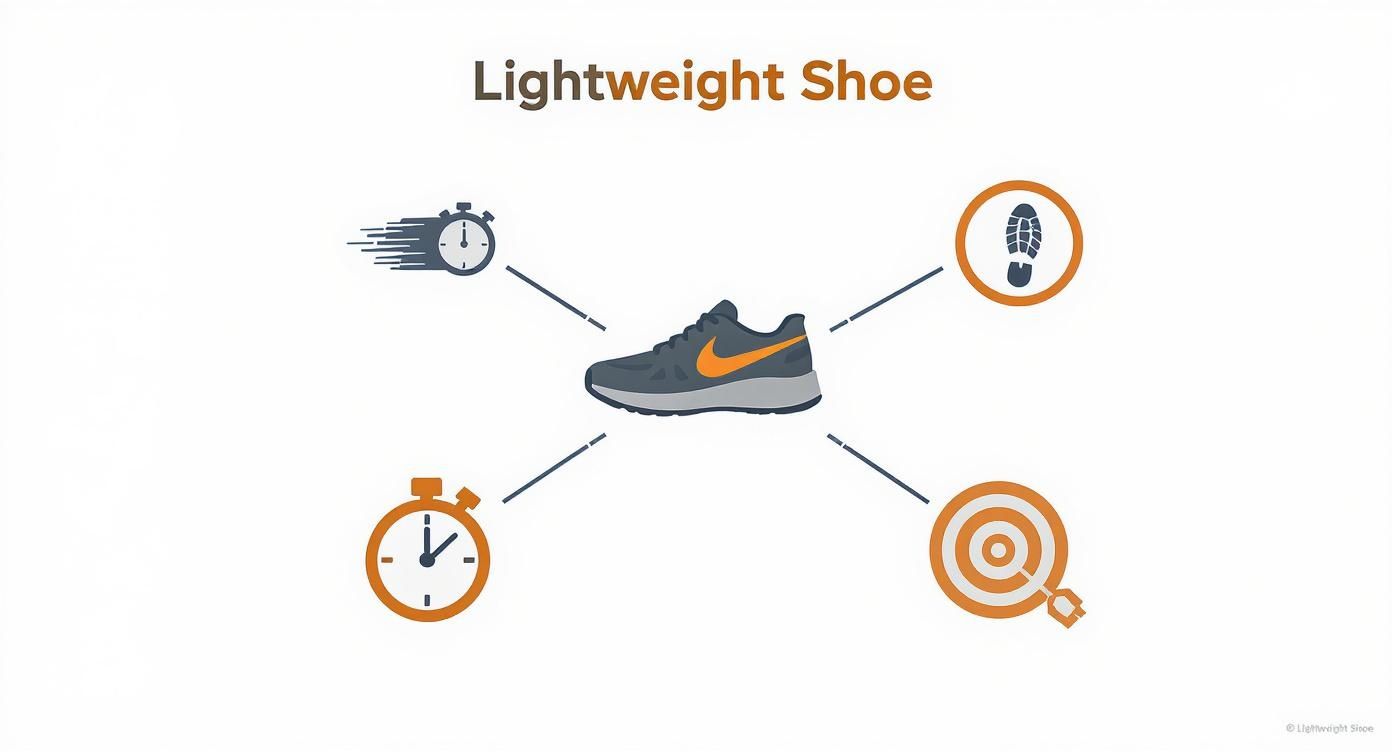
As you can see, speed, ground feel, and purpose combine to define the lightweight running shoe experience.
The Outsole: Strategic Traction
Finally, the outsole is the rubber part that hits the ground. A traditional trainer might have rubber covering the entire bottom for durability, but that adds weight. Lightweight models are smarter, placing thin, tough rubber only in high wear zones, like under the heel and the ball of your foot. The rest of the midsole foam is often left exposed to save every possible gram.
In essence, the anatomy of a lightweight running shoe is an exercise in purposeful minimalism. Every material and design choice is made to strip away the non-essential, leaving only what is needed for speed.
Finding The Right Lightweight Shoe For You
Choosing the perfect pair of lightweight running shoes can be a structured process. The goal is to find a shoe that feels like a natural extension of your foot. To do that, focus on your foot shape, running style, and intended use.
Understanding Your Foot and Gait
Before trying on shoes, get to know your feet. Everyone’s are different, which is why a shoe that works for one person might not work for another.
Foot Shape: Are your feet wide or narrow? A cramped toe box can lead to blisters and discomfort.
Arch Type: Use the "wet test." Wet your foot and step on cardboard. A flat footprint suggests a low arch, while a print showing just your heel and the ball of your foot indicates a high arch.
Gait (Pronation): This refers to how your foot rolls inward upon landing. A gait analysis at a specialty running store can determine if you have a neutral stride, overpronation (rolling in too much), or supination (rolling outward).
For a more detailed look, check out our guide on how to choose running shoes.

The Fitting Process
Now it’s time to try on shoes. How a shoe "feels" is personal, but a few best practices can help.
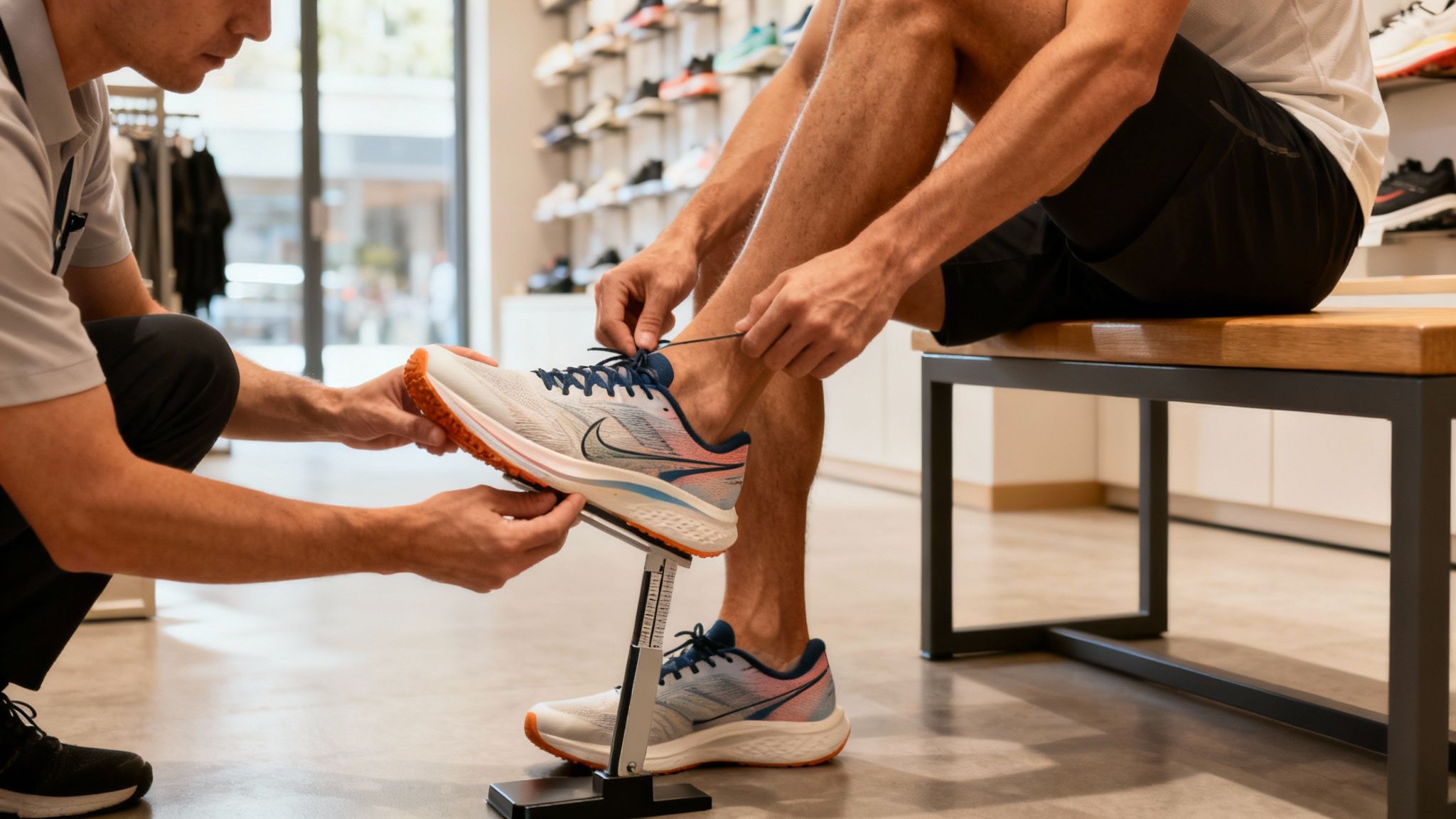
Always try on running shoes at the end of the day or after a run. Your feet naturally swell, so fitting them at their largest helps avoid buying shoes that are too tight.
Ensure there’s about a thumb's width of space between your longest toe and the end of the shoe. This extra room is crucial to accommodate foot swell and prevent toe jamming.
Top Lightweight Running Shoe Models for Men and Women
Here is a list of popular lightweight models, broken down by what they do best. This is a great starting point for finding your next pair.
Brand & Model | Primary Use | Key Feature | Best For |
|---|---|---|---|
Race Day | High-rebound ZoomX foam and a carbon fiber plate for maximum energy return. | Men/Women | |
Tempo / Speed Work | A versatile shoe with a winged nylon plate that is great for fast training days. | Men/Women | |
Efficient Daily Trainer | A responsive and lightweight option that balances speed with sufficient cushioning for daily miles. | Men/Women | |
Race Day | Designed for runners who increase their stride length to go faster. | Men/Women | |
Tempo / Speed Work | A no-frills, lightweight trainer focused on quick turnover and ground feel. | Men/Women |
These models represent top engineering from leading brands, each designed to give you an edge on race day or during a tough tempo session.
Smart Training and Injury Prevention
Switching to lightweight running shoes can feel amazing, but it requires an adaptation period for your body. Moving suddenly from a plush trainer can put new stress on your feet, calves, and Achilles tendons. The secret to unlocking their speed without getting injured is a slow, steady transition.
Building Your Transition Plan
Think of this as breaking in your body, not just the shoes. Introduce the new demands gradually to allow your muscles and tendons to strengthen.
Start Short and Slow: Wear your new lightweight shoes for just the last 10-15 minutes of an easy run.
Alternate Your Shoes: Keep your old trainers for long runs and recovery days. Use the lightweight pair for shorter, faster workouts, slowly increasing the time you spend in them.
Listen to Your Body: Pay attention to any new soreness. A little muscle fatigue is normal, but sharp or lingering pain is a signal to slow down.
A smart transition isn’t about speed; it's about adaptation. Gradual exposure allows your lower leg muscles to build the specific strength needed.
Strengthening for Prevention
Lightweight shoes have less built-in support, so your body must do more work to stay stable. Proactive strength training is key to staying injury free. For more detail, see our article on how to prevent running injuries with top tips for safe running.
Focus on these areas:
Foot Intrinsic Muscles: Exercises like towel scrunches build natural arch support.
Calf Muscles: Calf raises (with both straight and bent knees) target the gastrocnemius and soleus muscles, essential for shock absorption.
Glutes and Hips: Strong hips stabilize your stride. Exercises like glute bridges and clamshells prevent your knees from caving in, reducing stress on your lower legs.
Using data from wearable devices can help you track performance and recovery, giving you another tool to reduce injury risk (2).
How to Care For Your Lightweight Shoes
To get the most out of your high performance shoes, proper care is essential. Their delicate materials and advanced foams require a different touch than sturdy daily trainers. The high heat and tumbling of a washing machine can warp the shoe's shape and ruin the midsole's ability to bounce back.
The Right Way to Clean Your Shoes
A gentle hand cleaning is the only way to keep your shoes performing at their best.
Knock Off Debris: After a run, clap the outsoles together to shake loose mud. Use a soft brush to scrub away any remaining dirt.
Hand Wash the Uppers: Mix mild soap with cool water. Use a cloth or soft brush to gently clean the uppers. Avoid harsh detergents.
Air Dry Naturally: Stuff your shoes with newspaper to absorb moisture and help them hold their shape. Let them air dry at room temperature, away from direct heat.
Extending Shoe Lifespan
Proper cleaning is just one piece of the puzzle. Rotating shoes is one of the best things you can do to extend their life. Giving your shoes at least 24-48 hours to rest between runs allows the midsole foam to fully decompress.
Think of midsole foam like a memory foam pillow. It needs time to expand back to its original state. Rotating shoes ensures you always have a fresh, responsive ride.
Knowing when to retire a pair is also critical. As a shoe ages, its ability to absorb shock plummets. For a complete breakdown, check out your guide to running shoe lifespan. The global sports footwear market reflects this demand, projected to grow significantly in the coming years (3). To learn more, discover more insights about the sports footwear market on Fortune Business Insights.

Common Questions About Lightweight Shoes
Here are answers to some of the most common questions runners have about lightweight shoes.
How Long Do Lightweight Running Shoes Last?
Because they're built with less material, expect a shorter lifespan. A good range for lightweight running shoes is typically between 250 to 400 miles. This is less than the 300-500 miles you might get from traditional trainers. Factors like your running style, running surfaces, and the shoe's specific purpose can affect this number.
Can I Use These Shoes For Walking?
You can, but it's not recommended. A lightweight running shoe is a specialized tool engineered for the forward motion of running. Using them for walking wears them down in ways they weren't designed for, drastically shortening their lifespan. It's best to save them for running fast.
Are Lightweight Shoes Good For Marathon Training?
Absolutely, but they should be used strategically. Think of them as a specific tool in your training toolbox. They are best reserved for your quality workouts like tempo runs, intervals, and race pace long runs. For easy recovery days, a more cushioned shoe is often a better choice to aid recovery.
Do All Lightweight Shoes Have A Low Heel-To-Toe Drop?
This is a common myth. While many minimalist shoes have a low drop, a shoe's weight and its heel drop are separate features. You can easily find modern lightweight performance trainers with a traditional drop of 8mm, 10mm, or even 12mm. These offer the best of both worlds: responsive foams and a geometry most runners are used to.
References
Polaris Market Research. (2024). Running Shoes Market Share, Size, Trends, Industry Analysis Report.
Outlive. (n.d.). Wearable Devices Market Statistics. https://outlive.bio/blog/wearable-devices-market-statistics
Fortune Business Insights. (2023). Sports Footwear Market Size, Share & COVID-19 Impact Analysis. https://www.fortunebusinessinsights.com/sports-footwear-market-102216
At Flourish-Everyday.com, we believe the right shoe is a key part of your wellness journey. We're here to provide the information and recommendations you need to feel empowered, whether you're chasing a new personal best or simply enjoying a run. Explore our guides and find everything you need to support a healthier, happier you at https://www.flourish-everyday.com.
