Best Exercises for Runner's Knee: Quick Relief Tips

Updated: Nov 25, 2025
We have all heard of the nagging runner’s knee, characterized by a dull, aching pain around the front of the kneecap (patella), can sideline even dedicated athletes. Medically known as patellofemoral pain syndrome (PFPS), this discomfort often stems from muscular imbalances, particularly weakness in the hips and quadriceps, which disrupts proper knee tracking. This guide provides an actionable plan to overcome this injury and return to your activities pain free.

Index of Sections
Top 8 Exercises for Runner's Knee * 1. Quadriceps Strengthening - Straight Leg Raises * 2. Clamshells - Hip Abductor Strengthening * 3. Single-Leg Squats / Pistol Squats (Modified) * 4. Monster Walks - Lateral Band Walks * 5. Glute Bridges - Gluteus Maximus Activation * 6. VMO-Specific Exercises - Step-Ups and Short-Arc Quads * 7. Hip Internal/External Rotation Exercises - Clamshells and 90/90 Stretches * 8. Core Stabilization - Planks and Dead Bugs
By focusing on targeted strengthening, you can correct the underlying biomechanical issues causing your pain. A holistic approach can accelerate recovery; for example, targeted sports massage therapy can release tension in the IT Band and surrounding muscles, reducing strain on the knee. Let’s begin the journey to stronger, more resilient knees.
1. Quadriceps Strengthening - Straight Leg Raises
Strengthening the quadriceps is a cornerstone of runner's knee rehabilitation. The straight leg raise specifically targets the vastus medialis obliquus (VMO), the teardrop shaped muscle on the inner thigh that is a primary stabilizer for the patella. A weak VMO can cause the patella to track improperly, leading to the pain of patellofemoral pain syndrome. This non weight bearing exercise builds support without stressing the irritated knee joint.
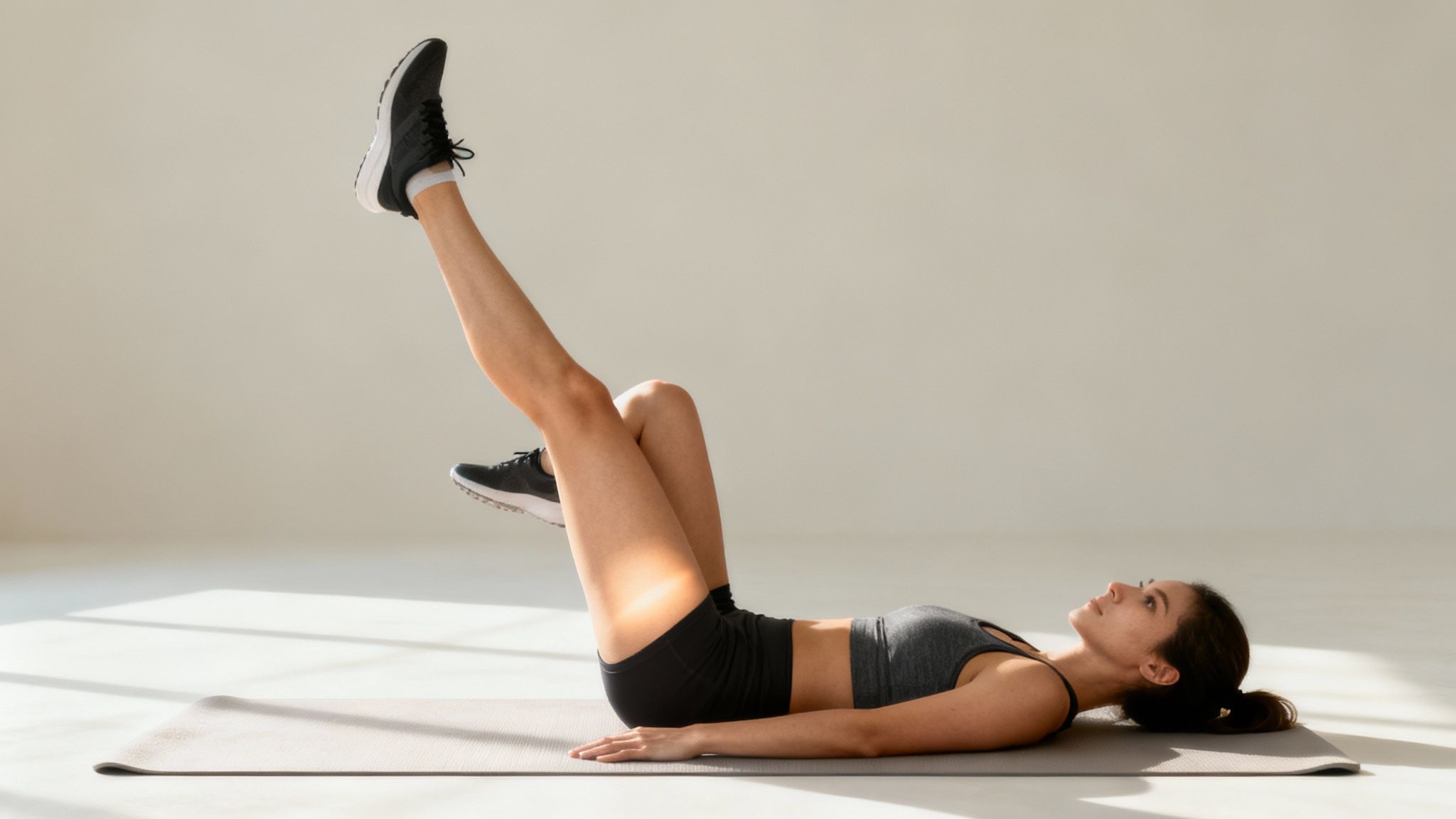
How to Perform a Straight Leg Raise
Starting Position: Lie on your back. Bend the knee of your unaffected leg, planting the foot flat. Keep the leg you intend to work completely straight.
Engage the Quad: Consciously tighten the quadriceps muscle of your straight leg. Your kneecap should pull slightly upward.
Lift: Keeping your leg straight and quad engaged, slowly lift your leg until it is about 12-18 inches off the floor.
Hold and Lower: Hold this position for 2-3 seconds, maintaining the quad contraction. Then, slowly lower the leg back to the start.
Key Insight: Quality of movement is more important than quantity. A slow, controlled motion with a fully engaged quadriceps yields better results than rushing through repetitions.
Sets, Reps, and Progression
Reps/Sets: Aim for 3 sets of 15-20 repetitions on each leg.
Frequency: Perform daily, especially during initial rehabilitation.
Progression: Once pain free for a week, add a light ankle weight (1-3 lbs).
Regression: If you feel pain, reduce the lift height or reps. If needed, just tighten the quad without lifting (a quad set).
2. Clamshells - Hip Abductor Strengthening
A stable knee begins at the hip. The clamshell exercise strengthens the hip abductors, particularly the gluteus medius. This muscle stabilizes your pelvis during the single leg stance of each running stride. Weakness here often leads to the knee collapsing inward (knee valgus), a primary driver of runner's knee. By isolating this hip stabilizer, clamshells directly combat this issue and teach proper alignment, reducing abnormal forces on the knee.
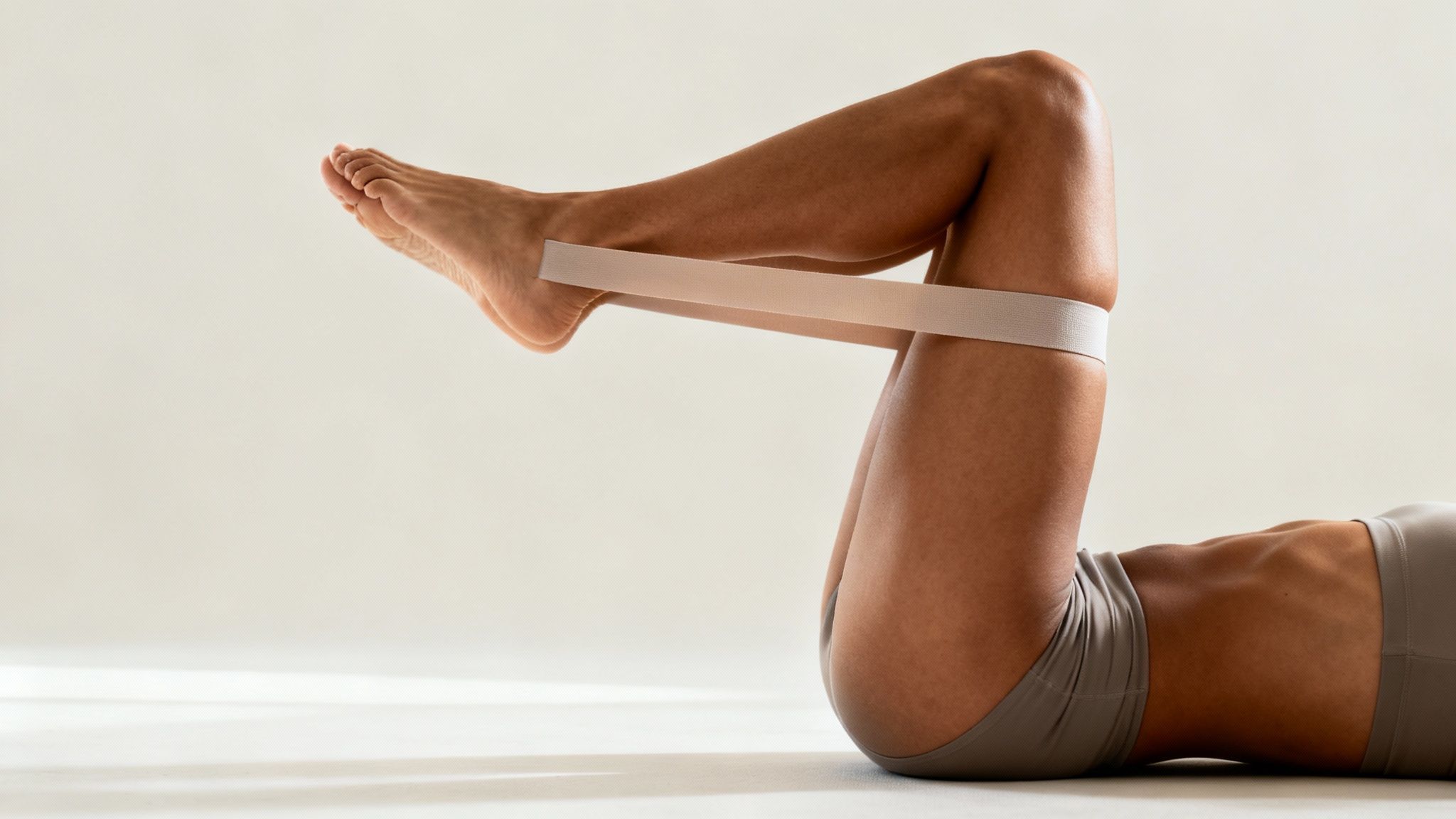
How to Perform a Clamshell
Starting Position: Lie on your side with legs stacked and knees bent to about a 45-degree angle, feet together. Your hips should be stacked vertically.
Engage the Core: Brace your core to prevent your torso from rocking.
Lift: Keeping feet touching, slowly raise your top knee as high as you can without your hips rolling backward. The movement should originate from your glutes.
Hold and Lower: Pause for 2-3 seconds at the top, squeezing your glute. Slowly lower your knee back to the start.
Key Insight: To ensure you're using your gluteus medius, place a hand on your top hip. You should not feel it rocking back as you lift your knee. The movement is small but concentrated.
Sets, Reps, and Progression
Reps/Sets: Aim for 3 sets of 20-25 repetitions on each leg.
Frequency: Perform 3-4 times per week on nonconsecutive days.
Progression: When you can complete reps with perfect form, add a resistance band around your thighs (just above the knees).
Regression: If painful, reduce the range of motion. If still challenging, perform isometric holds by contracting the glute without movement.
3. Single Leg Squats / Pistol Squats (Modified)
The modified single leg squat is an advanced functional exercise that builds robust knee stability. It mimics the single leg loading of running, strengthening the entire kinetic chain from the foot to the core. This movement challenges the quadriceps, glutes, and smaller stabilizer muscles around the knee and hip, which are crucial for maintaining alignment under load. It directly translates to better running form and reduced stress on the patellofemoral joint.
How to Perform a Modified Single-Leg Squat (Bench Assisted)
Starting Position: Stand a few feet in front of a sturdy bench or chair. Balance on one leg, extending the other leg straight out. Extend your arms for balance.
Engage Core and Hips: Brace your core and keep your chest up.
Descend with Control: Hinge at your hips and bend your standing knee to slowly lower yourself toward the bench, focusing on a 3-second descent.
Sit and Ascend: Lightly tap the bench without putting your full weight on it. Powerfully drive through your heel to return to the start, ensuring your knee tracks over your second toe.
Key Insight: The descent is the most critical part. A slow, controlled eccentric phase builds the strength needed to absorb impact during running.
Sets, Reps, and Progression
Reps/Sets: Aim for 3 sets of 8-12 repetitions on each leg.
Frequency: Perform 2-3 times per week on non-consecutive days.
Progression: Lower the bench height or remove it entirely. You can also hold a light dumbbell.
Regression: Use TRX handles for support or reduce the range of motion, squatting only a few inches initially.
4. Monster Walks - Lateral Band Walks
Monster walks, or lateral band walks, are a dynamic exercise essential for addressing the root causes of runner's knee. Using a resistance band, this movement strengthens the hip abductors and external rotators, especially the gluteus medius. Weakness in these muscles is a primary cause of poor running mechanics, leading to inward rotation of the femur and knee collapse, which stresses the patellofemoral joint. These walks build functional strength that directly improves running form.
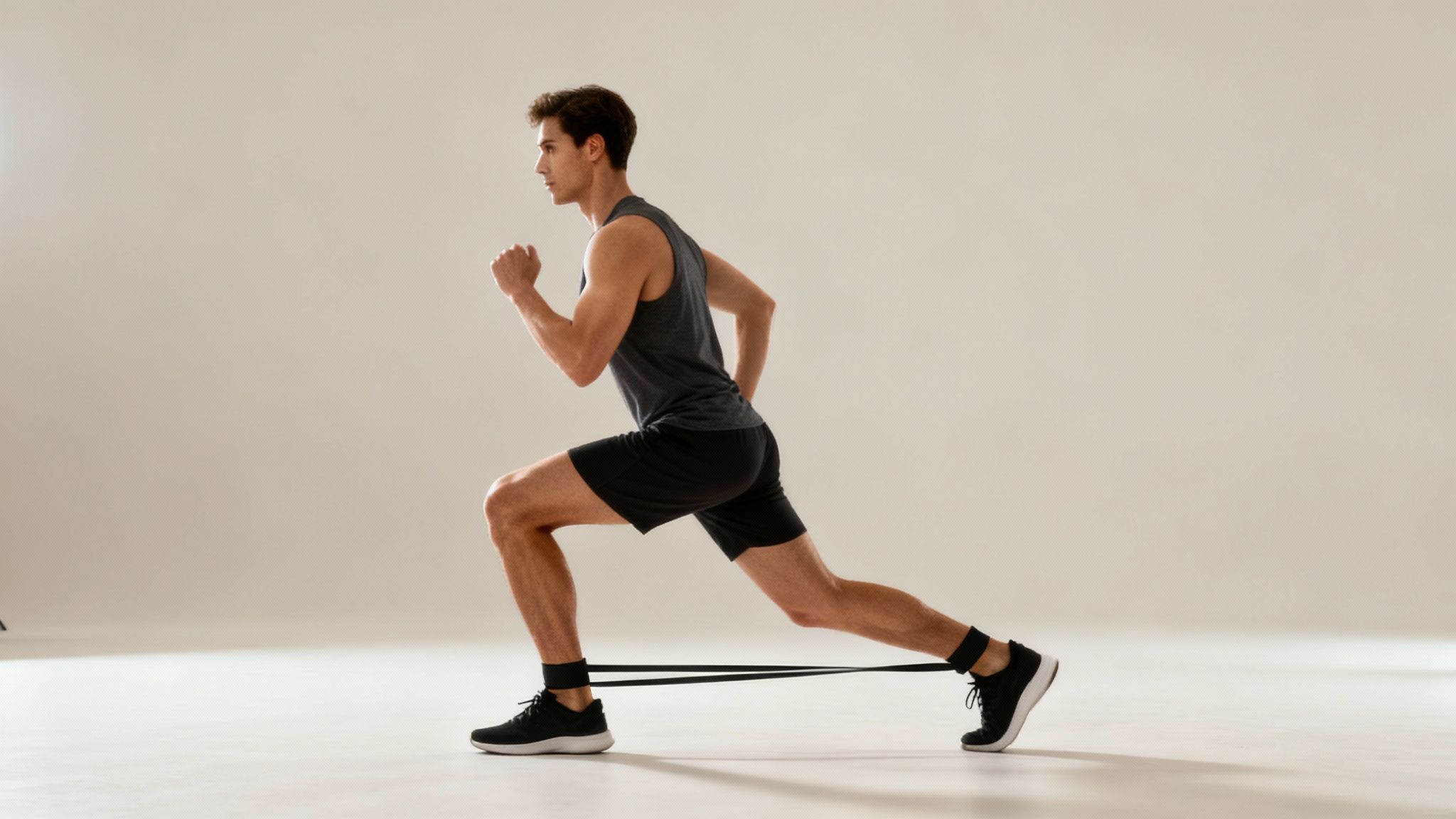
How to Perform a Monster Walk
Starting Position: Place a looped resistance band around your legs (above knees is easiest, ankles is harder).
Step Sideways: Take a controlled, deliberate step sideways with one foot (about 8-12 inches). Keep toes pointed forward.
Follow Through: Slowly bring your trailing foot inward to a hip width stance. Do not let your feet touch, as this releases tension. Continue stepping.
Key Insight: Maintain constant tension on the band. Avoid rocking your upper body; the movement should be driven entirely by your hips.
Sets, Reps, and Progression
Reps/Sets: Aim for 2-3 sets of 12-15 steps in each direction.
Frequency: Perform 2-3 times per week. This complements other activities detailed in guides on cross-training for runners to boost performance and prevent injuries.
Progression: Use a stronger band, place the band lower on your legs, or add forward and backward monster walks.
Regression: Use a lighter band or place it above your knees. Reduce the size of your steps for better control.
5. Glute Bridges - Gluteus Maximus Activation
Strengthening the posterior chain is vital, and the glute bridge is fundamental for this. It targets the gluteus maximus, the body's largest muscle, responsible for hip extension. Many runners, particularly those with sedentary jobs, have underactive or "sleepy" glutes. This forces other muscles like the quadriceps to overcompensate, disrupting the kinetic chain and stressing the patellofemoral joint. The glute bridge isolates and activates the glutes in a safe position, improving running mechanics and stability.
How to Perform a Glute Bridge
Starting Position: Lie on your back with knees bent and feet flat on the floor, hip width apart. Rest your arms at your sides.
Engage the Core and Glutes: Brace your core and squeeze your gluteal muscles before lifting.
Lift: Driving through your heels, lift your hips until your body forms a straight line from shoulders to knees. Avoid arching your lower back.
Hold and Lower: At the top, pause and squeeze your glutes for 2-3 seconds. Slowly lower your hips back to the start.
Key Insight: To ensure you're using your glutes, focus on pushing your heels into the ground. If your hamstrings cramp, bring your feet slightly closer to your body.
Sets, Reps, and Progression
Reps/Sets: Aim for 3 sets of 15-20 repetitions.
Frequency: Perform daily or at least 5 days per week. It is an excellent pre-run activation exercise.
Progression: Progress to a single leg glute bridge or add resistance by placing a dumbbell across your hips.
Regression: Reduce the height of your lift or decrease reps. Focus on the initial glute squeeze without fully lifting.

6. VMO-Specific Exercises - Step Ups and Short Arc Quads
To address the muscular imbalances of runner's knee, we must focus on the vastus medialis obliquus (VMO). This muscle on the inner thigh is the primary dynamic stabilizer of the patella. When the VMO is weak, stronger outer quad muscles can pull the kneecap laterally, causing pain. VMO specific exercises like short arc quads and step ups isolate and strengthen this crucial muscle, restoring the coordination needed for a healthy knee.
How to Perform Short Arc Quads and Step Ups
Short Arc Quads:
Starting Position: Lie on your back. Place a rolled up towel or foam roller (about 6 inches in diameter) under the knee of the leg you want to exercise.
Engage and Lift: Tighten your quadriceps, focusing on the inner VMO. Slowly lift your heel until your knee is completely straight.
Hold and Lower: Hold the straightened position for 3-5 seconds, squeezing the VMO. Slowly lower your heel.
Step Ups:
Starting Position: Stand before a low step (4-6 inches). Place the foot of your affected leg squarely on the step.
Engage and Step Up: Push through your heel to straighten your leg and bring your other foot up onto the step. Keep your knee aligned over your second toe.
Controlled Lowering: Slowly lower your nonworking leg back to the floor. This eccentric phase is critical for building strength.
Key Insight: For step ups, try a slight toe inward stance (10-15 degrees) on the step. This can increase VMO activation and improve patellar tracking.
Sets, Reps, and Progression
Reps/Sets: For Short Arc Quads, aim for 3 sets of 20 repetitions. For Step Ups, start with 3 sets of 10-15 repetitions on each leg.
Frequency: Perform daily, especially in early stages.
Progression: For short arc quads, add a light ankle weight. For step ups, gradually increase the platform height as you get stronger.
Regression: If step ups cause pain, stick with short arc quads. If those are painful, perform isometric quad sets (tightening the muscle without moving).
7. Hip Internal/External Rotation Exercises - Clamshells and 90/90 Stretches
Improving hip mobility is as critical as strengthening muscles. The hip is a ball and socket joint designed for rotation; limitations here can force the knee to compensate, leading to improper patellar tracking. Exercises enhancing hip rotation, like clamshells and 90/90 stretches, address this issue. Improving your hip's range of motion allows your femur to rotate properly, preventing stress from traveling down to the knee. For more, learn how to improve hip flexibility on flourish-everyday.com.
How to Perform a Clamshell
Starting Position: Lie on your side with hips and knees bent at a 45-degree angle. Stack your legs with heels together.
Engage the Core: Tighten your abdominal muscles to keep your pelvis stable and prevent your back from arching.
Lift: Keeping feet touching, raise your top knee as high as you can without rotating your pelvis.
Hold and Lower: Pause for 1-2 seconds at the top, squeezing your glutes. Slowly lower your knee.
Key Insight: Avoid rocking your body back to lift the knee higher. A smaller, controlled motion is far more effective than a larger, sloppy one.
Sets, Reps, and Progression
Reps/Sets: Aim for 3 sets of 15-20 repetitions on each side.
Frequency: Perform daily or as part of your pre-run warm-up.
Progression: Add a light resistance band around your thighs (just above the knees).
Regression: Reduce the range of motion. Focus on just the initial muscle activation.

8. Core Stabilization - Planks and Dead Bugs
A strong, stable core is nonnegotiable for runner's knee recovery. Your core muscles act as the central anchor for your body. When weak, this allows for excessive trunk motion and hip drop with each stride, creating instability that travels down the leg and stresses the knee joint. Exercises like planks and dead bugs train your core to stabilize the spine and pelvis, reducing abnormal forces that contribute to patellofemoral pain.
How to Perform a Plank and Dead Bug
Plank:
Starting Position: Position yourself on your forearms and toes. Elbows should be directly under your shoulders.
Engage the Core: Brace your abdominal muscles and glutes, creating a straight, rigid line from your head to your heels.
Hold: Maintain this position, breathing steadily, for the prescribed time.
Dead Bug:
Starting Position: Lie on your back with knees bent at 90 degrees, shins parallel to the floor (tabletop). Extend your arms straight up.
Engage the Core: Press your lower back gently into the floor.
Movement: Slowly lower your opposite arm and opposite leg toward the floor, moving with control. Go only as far as you can without letting your back arch.
Return and Repeat: Return to the starting position and repeat on the other side.
Key Insight: The goal of these exercises is to resist motion. This anti-extension training is crucial for building a stable core for running. For a deeper dive, explore these 5 essential core strengthening exercises for runners.
Sets, Reps, and Progression
Reps/Sets: For planks, aim for 3 sets of 30-60 second holds. For dead bugs, perform 3 sets of 10-12 repetitions per side.
Frequency: Integrate these into your routine 3-4 times per week.
Progression: For planks, increase hold time or try variations like side planks. For dead bugs, add light weights.
Regression: For a plank, start from your knees. For dead bugs, reduce range of motion or move only your arms or legs.
Runners Knee: 8-Exercise Comparison
Exercise | Implementation Complexity 🔄 | Resource Requirements ⚡ | Expected Outcomes ⭐📊 | Ideal Use Cases 💡 | Key Advantages ⭐ |
|---|---|---|---|---|---|
Quadriceps Strengthening - Straight Leg Raises | Low — easy to learn; requires attention to form | Minimal — bodyweight; optional ankle weights | Moderate VMO activation; early-phase knee stability improvements (2–3 weeks) — ⭐⭐⭐ | Acute pain / early rehab; beginners; home programs 💡 keep other knee bent to protect low back | Accessible; low joint stress; safe in initial recovery |
Clamshells - Hip Abductor Strengthening | Low–Moderate — simple but form-dependent | Minimal — bodyweight; band/ankle weights for progression | Strong gluteus medius activation; reduces valgus collapse over 4–6 weeks — ⭐⭐⭐⭐ | Hip abductor weakness, injury prevention, rehab protocols 💡 keep hips stacked and limit lift to 45–60° | Directly addresses primary biomechanical dysfunction; easily progressed |
Single-Leg Squats / Pistol Squats (Modified) | High — requires balance, mobility, control | Low — may use bench, TRX, or wall for assistance | High functional carryover; improves single-leg strength and stability; risk if too early — ⭐⭐⭐⭐ | Late-stage rehab, advanced runners, functional performance training 💡 begin with assisted versions | Trains kinetic chain in running-specific pattern; identifies compensations |
Monster Walks - Lateral Band Walks | Low–Moderate — dynamic but technique-sensitive | Minimal — resistance band (various tensions) | Improves dynamic hip stability and proprioception; good warm-up carryover — ⭐⭐⭐⭐ | Pre-run warm-up, injury prevention, female runners at risk of valgus collapse 💡 use light–moderate band and controlled steps | Functional, combines activation and warm-up; easy to program |
Glute Bridges - Gluteus Maximus Activation | Low — very easy to teach and perform | Minimal — bodyweight; add weight for progression | Rapid improvement in glute activation (1–2 weeks); supports hip extension — ⭐⭐⭐⭐ | Activation before running, early rehab, sedentary runners with inhibited glutes 💡 squeeze at top for 2s; progress to single-leg | Simple, safe, immediate neuromuscular feedback |
VMO-Specific Exercises - Step-Ups & Short-Arc Quads | Low–Moderate — requires precise hip/foot positioning | Minimal — low step, towel roll, optional weights | Targets patellar tracking; measurable biomechanical gains in weeks (6–8 for strength) — ⭐⭐⭐⭐ | Patellar tracking issues, targeted physio rehab, post-op protocols 💡 emphasize hip adduction and slight toe-in | Directly addresses VMO weakness; research-supported intervention |
Hip Internal/External Rotation Exercises | Low — varied exercises; demands consistency | Minimal — bodyweight; optional props for stretching | Improves hip ROM and rotational control; reduces compensatory knee stress — ⭐⭐⭐ | Mobility deficits, warm-up routines, runners with limited hip rotation 💡 90/90 stretch 2 min/side daily | Addresses commonly overlooked mobility restriction; combines strength and mobility |
Core Stabilization - Planks & Dead Bugs | Low–Moderate — many progressions; needs consistency | Minimal — bodyweight; optional stability tools | Improves trunk stability in 2–3 weeks; reduces downstream compensations — ⭐⭐⭐⭐ | Foundation work for injury prevention, reducing hip drop that affects knees 💡 start with short holds and progress duration | Addresses root cause of many biomechanical faults; long-term injury prevention benefit |
Building a Resilient Runner: Your Path Forward
Navigating runner's knee can feel like a setback, but it’s a powerful signal from your body highlighting areas that need attention. You now have a toolkit of the best exercises for runner's knee, from Straight Leg Raises to Single Leg Squats, each designed to address the root muscular imbalances that cause patellofemoral pain. This is about building a more resilient, balanced body for the long haul. The journey away from knee pain is holistic, beginning with the understanding that the issue rarely originates at the knee. Weak hips, inactive glutes, and an unstable core are the primary culprits.
Key Takeaways for a Pain Free Future
Consistency Over Intensity: Daily activation and strengthening yield better results than one intense weekly session.
Form is NonNegotiable: Prioritize perfect form over higher reps. If your form breaks down, regress the movement.
Listen to Your Body's Feedback: Differentiate between muscle fatigue and joint pain. Sharp or increasing pain is a signal to stop.
Strength is a System: The most effective plans address the entire kinetic chain from your core to your feet.

Your Action Plan for Lasting Relief
Start by integrating 2-3 of these exercises into your routine, focusing on ones that are challenging yet pain free. Progressively add more variety and difficulty as you build strength. Balance this targeted work with smart cross-training and adequate recovery. Incorporating self-care like foam rolling techniques specifically for knee pain relief can also reduce muscle tension around the knee. Ultimately, overcoming runner's knee is about becoming a smarter athlete. You are building a foundation of strength that will support countless miles of healthy running.
References
Powers, C. M. (2010). The Influence of Abnormal Hip Mechanics on Knee Injury: A Biomechanical Perspective. Journal of Orthopaedic & Sports Physical Therapy, 40(2), 42–51.
Bolgla, L. A., & Boling, M. C. (2011). An update for the conservative management of patellofemoral pain syndrome: a systematic review of the literature from 2000 to 2010. International Journal of Sports Physical Therapy, 6(2), 112–125.
Stillwaters Healing & Massage. (n.d.). Sports Massage Therapy. Retrieved from https://www.stillwatershealing.ca/sports-massage-therapy
Ready to support your body's recovery and enhance your overall well-being? Flourish-Everyday offers a curated line of wellness products, including premium supplements designed to support joint health and reduce inflammation. Give your body the nutritional foundation it needs to complement your hard work by visiting Flourish-Everyday to explore our holistic health solutions.
