What Causes IT Band Syndrome and How to Prevent It

Updated: Jan 31
That sharp pain on the outside of your knee isn't just a random occurrence, it's your body signaling an issue. What causes IT Band Syndrome and how to prevent It? If you're a runner, cyclist, or anyone who stays active, you may have encountered Iliotibial (IT) Band Syndrome. It’s one of the most common overuse injuries out there.
Think of your IT band as a thick, fibrous cable running down your outer thigh, not a muscle you can easily stretch. The pain flares up when this band gets irritated from rubbing against your thigh bone, usually because supporting muscles, like your glutes and core, aren't doing their job. Understanding how it fits into the broader picture of knee pain is key to addressing the root cause.

This guide is your complete roadmap to understanding and preventing ITBS. We'll build your knowledge from the ground up, empowering you to fix the cause, not just chase symptoms.
In This Guide
Before we look further, let's get a quick snapshot of the key players involved in IT band syndrome. This table breaks down the main contributing factors to give you a clear overview.
Quick Guide to IT Band Syndrome Key Factors
Causative Factor | Brief Explanation | Who Is Most at Risk? |
|---|---|---|
Training Errors | Increasing mileage or intensity too quickly, excessive hill running, or sudden changes in routine. | New runners, marathon trainees, or anyone rapidly escalating their workout volume. |
Muscle Imbalances | Weak gluteus medius, hip abductors, and core muscles, leading to poor pelvic stability. | Desk workers, athletes with quad dominant movement patterns, and individuals who neglect strength training. |
Poor Biomechanics | Issues like excessive foot pronation, leg length discrepancy, or a crossover gait pattern. | Individuals with specific anatomical traits or running form that needs correction. |
Footwear & Surfaces | Worn out shoes, improper footwear for your foot type, or consistently running on banked surfaces. | Runners who don't replace their shoes often enough or frequently run on uneven roads. |
Understanding these factors is the first step toward building a smarter, more resilient training plan. Now, let's explore these ideas in more detail.

A Common and Treatable Injury
ITBS is not a new phenomenon. It was first described in 1975 by Dr. James Renne, who observed it in U.S. Marine Corps recruits (Renne, 1975). Today, research shows ITBS accounts for up to 12% of all running injuries and is a leading cause of lateral knee pain in athletes (van der Worp et al., 2012). It's especially prevalent during high mileage training, highlighting how easily overuse can trigger it.
The pain often begins as a minor annoyance but can quickly escalate, sidelining you from activities you enjoy. The good news? ITBS is highly treatable and, even better, preventable.
The secret is to shift your focus. Stop obsessing over the sore spot on your knee and start strengthening the weak links in the chain, which almost always means your hips and glutes. This proactive approach is the foundation for lasting relief.
By getting to the bottom of what causes your IT band to flare up, you can take targeted action, fix the underlying problem, and get back to moving pain free.
The Real Culprits Behind IT Band Syndrome
That nagging pain on the outside of your knee rarely just shows up out of the blue. It’s almost always a signal that something in your kinetic chain, the network of muscles and joints that work together, is off kilter. To figure out what’s causing IT band syndrome, we have to look past the pain point and dig into the real issues tied to your training, movement patterns, and muscle strength.
Think of your IT band like a rope in a tug of war. If one team (your muscles) isn’t pulling its weight, the rope gets yanked and strained. Over time, this imbalance creates friction and irritation right where the band crosses your knee, sparking that all too familiar sharp pain of ITBS.
The infographic below breaks down the main triggers, training mistakes, muscle imbalances, and wonky biomechanics, that all feed into this frustrating condition.
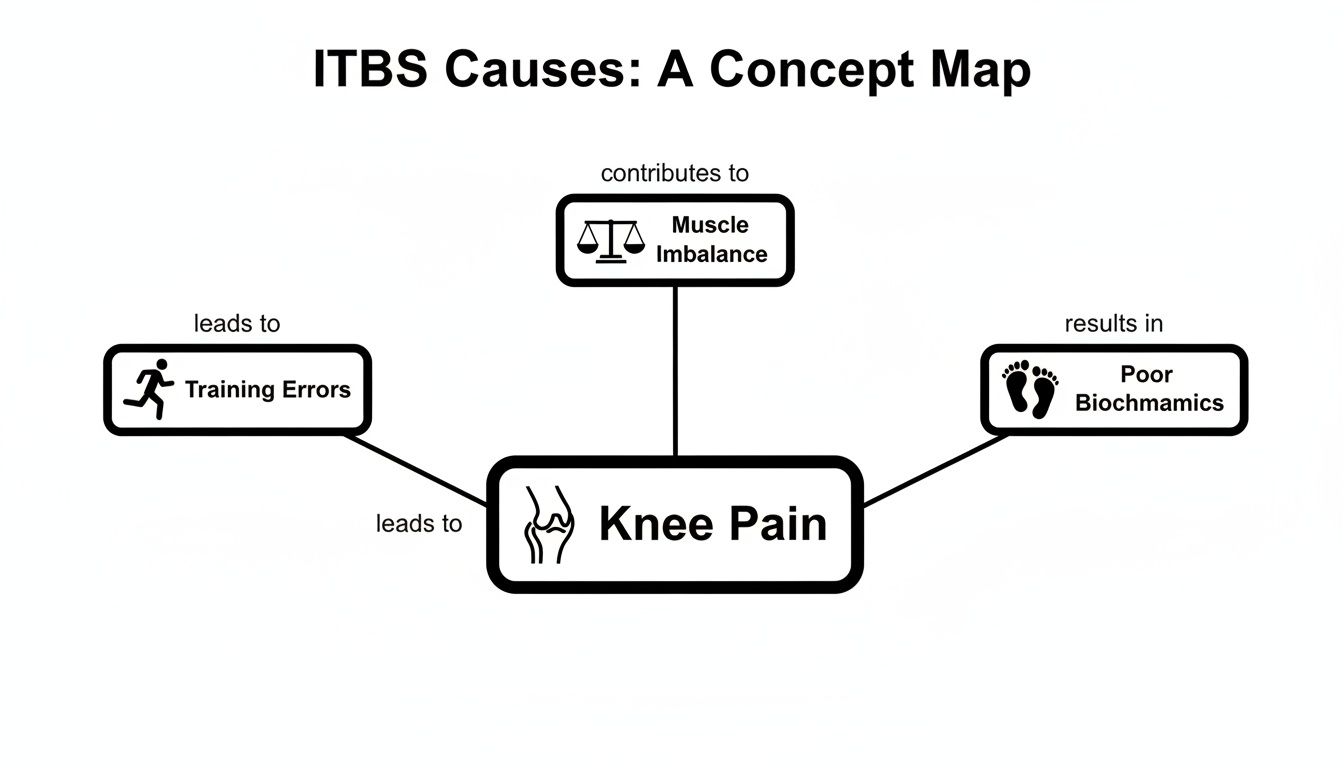
As you can see, it’s usually not just one thing. Several factors often team up, creating the perfect storm for IT band irritation.
Training Errors That Overload Your Body
One of the most common reasons ITBS flares up is simply doing too much, too soon. Your connective tissues, like the IT band, adapt to stress much slower than your muscles or your cardiovascular system. When you jack up your training volume or intensity too quickly, you're basically outpacing your body’s ability to repair itself.
This is a huge issue in repetitive, one directional activities. For runners and cyclists, the constant bending and straightening of the knee makes them prime candidates. A sudden jump in weekly mileage or throwing in a bunch of intense hill workouts can send your risk through the roof.
Common training mistakes include:
Jumping up in mileage too fast without letting your body adjust.
Too much downhill running, which puts a ton of braking force on the structures around your knee.
Adding intense speed work or hill repeats without a gradual buildup.
Skimping on recovery days, allowing all that micro damage to pile up.

The Critical Role of Muscle Weakness
While training errors often light the match, it’s usually underlying muscle imbalances that provide the fuel. The number one offender? Weak hip abductor muscles, especially the gluteus medius. This muscle sits on the side of your hip and is absolutely vital for keeping your pelvis stable every time you're on one leg, which, for a runner, is every single step.
When your gluteus medius is weak, it can't stop your opposite hip from dropping. This "pelvic drop" makes your thigh angle inward, which in turn yanks on the IT band and increases tension right over the outside of your knee.
Here’s the key takeaway: ITBS is often not a problem with the IT band itself, but a symptom of weak hips. Your body is a master of compensation. When your glutes aren't doing their job, the IT band and other small muscles have to work overtime to provide stability they were never designed for.
Fixing these weaknesses is nonnegotiable. If you're looking for a starting point, our guide on how to improve hip flexibility and unlock movement is a great complement to the strengthening work needed to stabilize your pelvis.
Biomechanical Flaws and Environmental Factors
Your unique anatomy and the way you move, your biomechanics, also play a huge part. Certain habits or physical traits can set you up for ITBS by changing the forces acting on your knee.
For instance, a "crossover gait," where your feet cross over the midline of your body when you run, puts a lot of extra strain on the outside of your leg. Likewise, excessive foot pronation (when your foot rolls too far inward) can set off a chain reaction that travels all the way up your leg, messing with knee alignment and stressing the IT band.
Finally, something most people don't consider is that always running on the same side of a sloped road or on a track in the same direction can create an artificial leg length difference, putting uneven stress on your body. Also, if your shoes are worn out and they’ve lost their cushioning and support, it forces your tissues to absorb more impact than they should. These outside factors can be the final straw that pushes an already stressed system over the edge into injury.
How to Recognize the Symptoms of ITBS
If you've been dealing with a nagging pain on the outside of your knee, there's a good chance you've wondered if IT band syndrome is the culprit. The good news is that identifying ITBS is usually pretty straightforward because the symptoms are distinct and tend to pop up in predictable patterns, especially when you're active. Knowing these clues can help you decode what your body is trying to tell you.
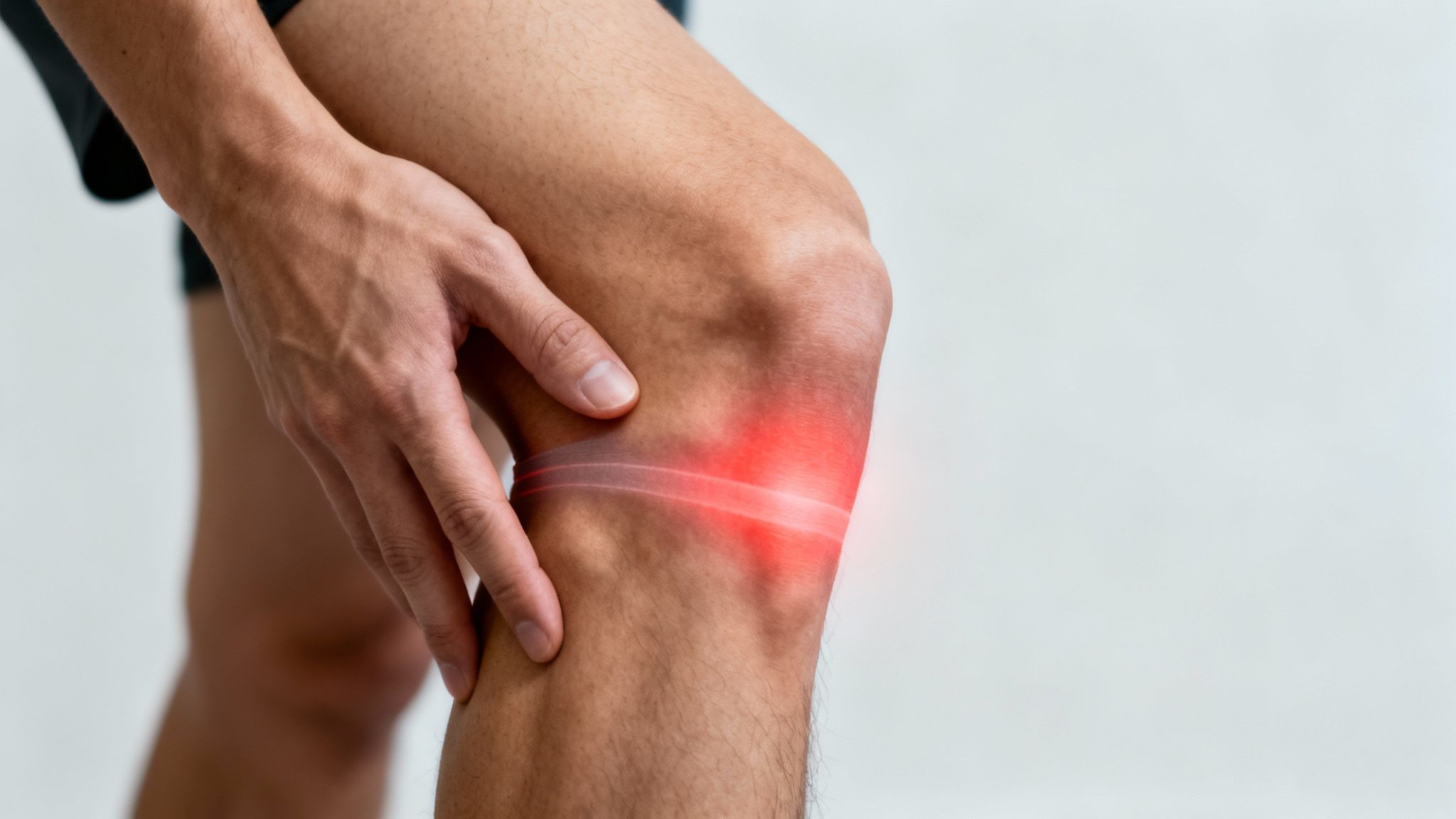
The classic sign of ITBS is a sharp or burning pain located specifically on the outer side of the knee. This isn't some vague, all over ache; it's a pinpoint pain you can often touch with a single finger. For runners, this pain famously flares up at a consistent point during a run, maybe ten minutes in, and often fades away not long after you stop.

Pinpointing Your Specific Symptoms
Beyond that primary pain point, a few other tell tale signs can help you connect the dots. If ITBS is what you're dealing with, you'll probably notice a few of these:
Tenderness to the Touch: The spot on the outside of your knee where the IT band connects will likely feel sore or tender when you press on it.
Pain with Downhill Movement: Walking or running downhill, or even just tackling a flight of stairs, often cranks up the pain because of the increased braking forces.
A Snapping or Popping Sensation: Some people report feeling a weird snapping or clicking on the outside of the knee as they bend and straighten it.
Pain That Travels: While the main event is definitely at the knee, the discomfort can sometimes radiate up the outer thigh toward your hip.
A key diagnostic clue is how the pain behaves. It often starts as a mild annoyance but can quickly escalate to a sharp, debilitating sensation that forces you to stop your activity. At rest, the pain usually fades, which is a hallmark of this overuse injury.
When to Suspect It's Something Else
Nailing down the source of your pain is the first step toward fixing it. But knee pain can be tricky, and several other conditions can mimic IT band syndrome. It's smart to be aware of these so you can get a proper diagnosis if your symptoms don't quite line up.
For example, a lateral meniscus tear can also cause pain on the outside of the knee, but it’s often joined by clicking, locking, or a feeling that your knee might give out. Another common one, patellofemoral pain syndrome (runner's knee), usually causes pain around or behind the kneecap itself, not on the outer edge. To read more about runners knee see, What Causes Runner's Knee and How to Fix It for Good
If your pain is severe, came on suddenly after a specific incident, or isn't getting better with rest, it's really important to see a healthcare professional. A doctor or physical therapist can perform a thorough physical exam to give you an accurate diagnosis. They might use specific tests, like the Noble Compression Test, to confirm ITBS and rule out other possibilities, making sure you get on the right recovery plan from the start.
Building Your Body's Defense Against Injury
The best way to beat IT Band Syndrome? Stop it before it even starts. Building a resilient body isn’t just about logging more miles; it’s about making sure your body’s support system is strong enough to handle the work you're putting in. Prevention is all about getting proactive with two key pillars: targeted strengthening and smart mobility.
This isn't about some generic, one size fits all advice. We’re going to zero in on the specific movements that build stability in your hips and pelvis, what I like to call the true command center for fending off ITBS. By reinforcing this area, you directly reduce the strain and friction that angers the IT band.
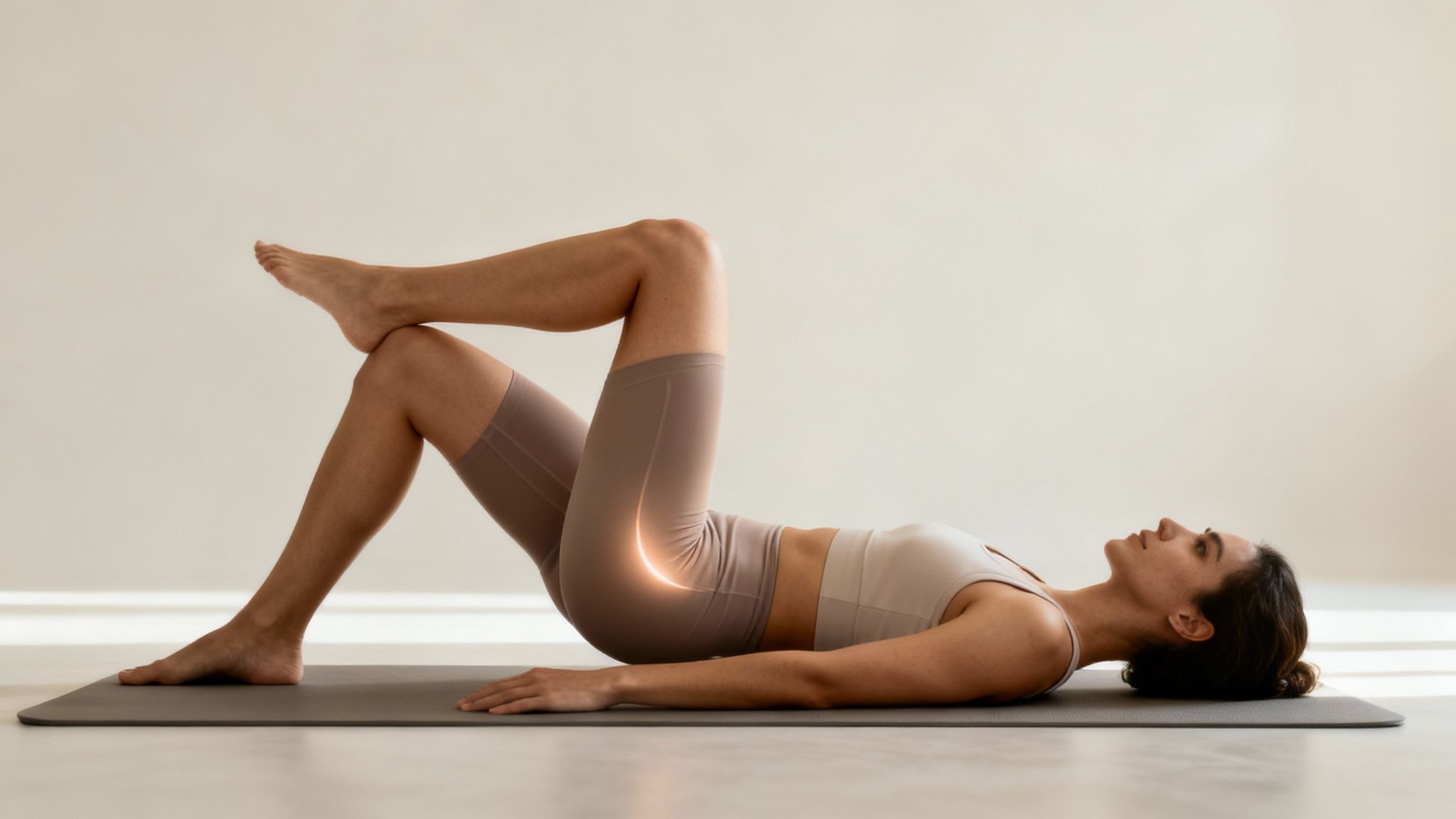
Fortifying Your Foundation with Targeted Strength
Think of your glutes and core muscles as the anchor that keeps your pelvis from rocking side-to-side while you run or cycle. When these muscles are weak, your pelvis can dip with each step, causing your upper leg to angle inward and tug on the IT band. Our goal is to wake up these crucial stabilizers and strengthen them so they can do their job properly.
There are three foundational exercises that are particularly effective for building this kind of stability. Try to work them into your routine two to three times per week.
Clamshells: Lying on your side with your knees bent, keep your feet glued together and lift your top knee. This simple move specifically targets the gluteus medius, the primary muscle that stops that infamous pelvic drop.
Hip Bridges: Lying on your back, you'll drive through your heels to lift your hips toward the ceiling. This one strengthens the entire glute complex and hamstrings, improving your overall power and stability from the back.
Side Planks: This exercise is an absolute powerhouse for your core and hip abductors. It literally teaches your body to maintain a neutral, stable torso and pelvis, which is essential for solid running form.
The "why" behind these exercises is simple: a strong and stable core and hip structure acts as a shock absorber. It distributes force evenly throughout your lower body, preventing any single structure, like the IT band, from taking on too much stress.
Unlocking Movement with Smart Mobility
Here’s where many people go wrong: they try to aggressively stretch the IT band itself. But the IT band is an incredibly tough piece of connective tissue, not a flexible muscle. You simply can't lengthen it with stretching, and trying to force it often just increases inflammation and pain.
A much smarter approach is to focus on the muscles that attach to it, especially the glutes and the Tensor Fasciae Latae (TFL), a small muscle at the front of your hip. Releasing the tension in these areas is where you’ll find real, lasting relief. This is where a foam roller becomes your best friend. For more in-depth techniques, you might want to check out our foam rolling for runners guide.
To directly tackle the tightness that contributes to ITBS, incorporating specific TFL release exercises with a foam roller can be the answer. Instead of rolling directly on the painful side of your knee, concentrate your efforts on these two key spots:
Glutes: Sit on the foam roller and cross one ankle over the opposite knee. Gently lean into the side of the crossed leg to massage those deep gluteal muscles.
TFL: Lie on your side and place the roller just below your hip bone, slightly toward the front of your body. Roll gently back and forth over this small area to release that built up tension.
To make things even clearer, this table breaks down the core components of a solid prevention plan.

Essential Exercises for IT Band Syndrome Prevention
Exercise Type | Specific Exercise | Primary Goal/Benefit |
|---|---|---|
Strengthening | Side Plank | Builds core stability and strengthens hip abductors to prevent pelvic drop. |
Strengthening | Clamshell | Isolates and activates the gluteus medius to improve hip stabilization. |
Mobility | Foam Roll Glutes | Releases tension in the gluteal muscles, reducing the pull on the IT band. |
Mobility | Foam Roll TFL | Loosens the Tensor Fasciae Latae, a key muscle connected to the IT band. |
By consistently weaving this simple combo of strengthening and mobility work into your weekly schedule, you’re not just chasing symptoms away. You are fundamentally rewiring your body's mechanics to build a more resilient, balanced, and injury proof foundation for all your activities.
Choosing the Right Footwear for Prevention
Your shoes are literally where the rubber meets the road. They’re the first line of defense between your body and the hard ground, making them a massive factor in preventing IT band syndrome. Every single foot strike sends shockwaves up your leg, and your shoes are supposed to manage that impact and guide your foot’s movement.
When shoes are worn out or just plain wrong for your feet, that whole system gets thrown out of whack. A shoe that has lost its cushioning and support forces your muscles and tissues, yes, including your IT band, to pick up the slack and work overtime just to keep you stable. That extra stress, repeated thousands of times over a run, is a classic recipe for ITBS irritation.
Decoding Shoe Features That Matter
Walking into a running store can feel a bit like trying to read a foreign language, but you only need to focus on a few key features that directly affect how force travels up your leg. Getting a handle on these will help you make a much smarter choice.
Here are the three most important things to look at:
Cushioning: This is simply the shoe's ability to absorb shock. The right amount of cushioning can soften the blow to your knees and hips, but be careful—too much can sometimes feel mushy and unstable.
Stability Control: These are features, often bits of firmer foam on the inside of the shoe, designed to control excessive foot motion. They’re specifically for people who overpronate (when your foot rolls too far inward).
Heel-to-Toe Drop: This is the height difference between the shoe's heel and the forefoot. A higher drop can put more pressure on the knees, while a lower drop tends to shift the workload down to your calves and Achilles tendon.
The goal isn't to find the one "perfect" shoe on the market. It's to find the right shoe for your unique body and mechanics. A shoe that’s perfect for your friend could be the very thing that causes you problems.
Neutral vs. Stability: What Your Foot Type Needs
The biggest decision you'll make is whether you need a neutral shoe or a stability shoe. This choice is all about how your foot naturally moves when you run, and getting it right sets a proper foundation for your entire body.
Neutral Shoes: These are for runners with a "normal" pronation pattern. This means your foot rolls inward just the right amount to absorb shock on its own. Neutral shoes provide cushioning without trying to "fix" your foot's motion.
Stability Shoes: These are built for overpronators, people whose feet roll too far inward. By adding extra support on the inner side, stability shoes help keep your foot, ankle, and leg in better alignment. This can dramatically reduce the kind of rotational stress that irritates the IT band. Our detailed article on how to choose running shoes can give you more pointers here.
Making an Informed Choice for Injury Prevention
So, how do you figure all this out? The absolute best way is to go to a specialty running store and get a gait analysis. They'll watch you run on a treadmill and can pinpoint your foot type, pointing you toward the right category of shoe.
Keep these simple tips in mind when you're ready to buy:
Replace them regularly: Most running shoes have a lifespan of about 300-500 miles. After that, the foam is shot, even if the shoe still looks good from the outside.
Shop in the afternoon: Your feet swell during the day, so trying on shoes later on gives you a much better chance of getting the right fit.
Comfort is king: At the end of the day, the best shoe is the one you don't even notice you're wearing. If you feel any weird pressure points or it just feels "off" in the store, it's not the one for you.
By picking shoes that work with your body's natural mechanics, you’re creating a stable base that takes unnecessary strain off your knees and hips. It’s one of the simplest and most effective things you can do to keep IT band syndrome from sidelining you.

Common Questions About IT Band Syndrome
Dealing with an injury like IT Band Syndrome can be confusing. You’re probably wondering how to change up your workouts, how long it’ll be before you feel better, or if you’re even doing the right things to get back on your feet. To help clear the air, I’ve put together some straightforward answers to the most common questions about ITBS.
Think of this as your quick reference guide to bust some myths and lock in the key lessons from this guide. The goal is to give you the confidence you need to manage your recovery and stay injury free down the road.
Can I Still Work Out with IT Band Syndrome?
Yes, but you have to be smart about it. The main thing is to stop doing whatever is aggravating the IT band, which is usually any activity that involves repeatedly bending and straightening the knee under load. This means that for now, high impact exercises like running and cycling are off the table.
Instead, shift your focus to low impact cross-training that keeps your cardio up without making the problem worse. A few great options include:
Swimming: This is a fantastic zero impact workout that puts absolutely no stress on the knee joint.
Using the Elliptical: The smooth, gliding motion is much kinder to your knees than the pounding of running.
Upper Body and Core Work: There’s no better time to build strength everywhere else.
Most importantly, this is the perfect opportunity to double down on those hip and glute strengthening exercises we talked about earlier. These are the moves that tackle the root cause of ITBS, the muscle imbalances. Just remember to always listen to your body; if something hurts, stop immediately.
How Long Does Recovery from IT Band Syndrome Take?
There's no magic number here; recovery can take anywhere from a few weeks to several months. It really depends on how bad your symptoms are and, frankly, how disciplined you are with your recovery plan.
For milder cases, you could feel significant relief within four to eight weeks by sticking to a routine of rest, ice, and targeted exercises. But the most critical factor is fixing the underlying problem. Just resting until the pain goes away, without strengthening your weak glutes or correcting your form, is a recipe for disaster. Jumping back into your full training schedule too soon is the number one reason people get stuck in that frustrating cycle of pain.
The goal isn't just to be pain free; it's to become resilient. Real recovery means you've built a stronger, more stable body so the problem doesn't pop up again the moment you start pushing yourself.
Is Foam Rolling Directly on My IT Band a Good Idea?
This is probably one of the biggest myths out there when it comes to ITBS. It might feel like you're "breaking up" knots and tightness, but aggressively foam rolling right on your IT band is not helping. The IT band is an incredibly tough strap of connective tissue, it’s not a muscle, so you can't actually stretch or lengthen it this way.
Pushing hard on an area that's already inflamed and angry can often do more harm than good by making the irritation even worse. A much better strategy is to use the foam roller on the muscles that connect to the IT band. You'll want to focus your efforts on:
The glutes (your butt muscles).
The Tensor Fasciae Latae (TFL), which is a small muscle up on the front and side of your hip.
By loosening up these surrounding muscles, you take the tension off the IT band, which gets to the real source of the problem.
When Should I See a Doctor or Physical Therapist?
While you can manage many mild cases of ITBS on your own, there are definitely times when you need to call in a professional. It's time to make an appointment if the pain is severe, if it isn't getting any better after a week or two of rest and specific exercises, or if you're just not 100% sure what's going on.
A physical therapist, especially, can be essential for your recovery. They can do a full biomechanical assessment and watch you move to pinpoint the exact weaknesses or movement patterns causing the issue. From there, they'll build a personalized rehab plan designed to get you back to your favorite activities safely and, more importantly, keep ITBS from coming back.
References
Renne, J. W. (1975). The iliotibial band friction syndrome. The Journal of Bone and Joint Surgery. American volume, 57(8), 1110–1111.
van der Worp, M. P., van der Horst, N., de Wijer, A., Backx, F. J., & Nijhuis-van der Sanden, M. W. (2012). Iliotibial band syndrome in runners: a systematic review. Sports medicine, 42(11), 969–992.
At Flourish-Everyday, we believe that the right information and the right gear are essential for a healthy, active lifestyle. From finding the perfect running shoes to understanding how to prevent common injuries, we're here to support your journey toward wellness. Explore our guides and reviews to empower your fitness goals.
Find your inspiration at https://www.flourish-everyday.com.
