Best Running Shoes for Pavement: A Guide for Hard Surfaces

Updated: Jan 22
Finding the best running shoes for pavement is all about cushioning and durability. You need something that can handle unforgiving surfaces. Top contenders like the Brooks Ghost 17, HOKA Clifton 10, and New Balance Fresh Foam 1080 v14 are favorites because they deliver the shock absorption needed for concrete and asphalt, protecting your joints mile after mile.

This guide provides a complete roadmap to finding that perfect pair. For a more general look at shoe selection, our expert guide on how to choose running shoes is a great place to start.
Index of Sections
Top Shoe Recommendations (Men & Women): Reviews of our top picks.
Running Health & Wellness: Tips for injury prevention and shoe care.
FAQs & Final Thoughts: Common questions answered.
The Unforgiving Nature of Running on Pavement
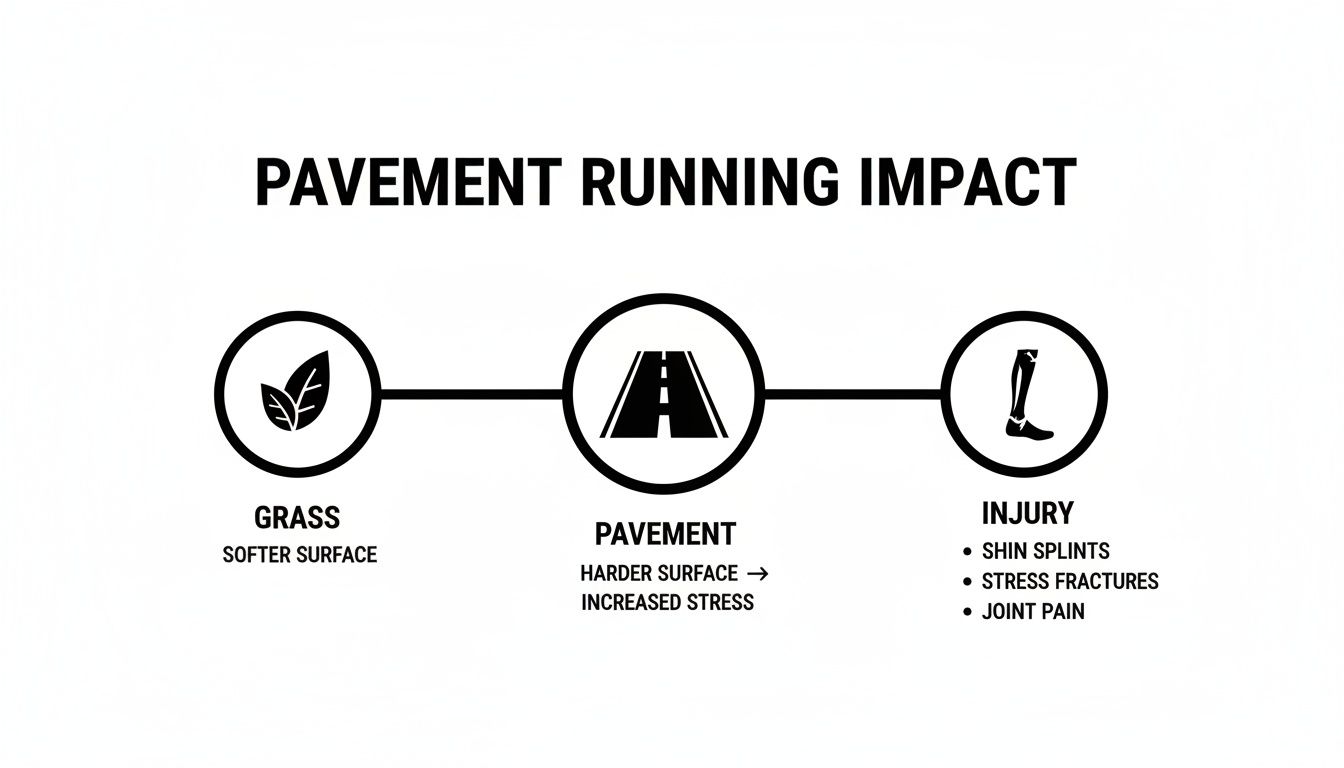
Running on pavement is a different challenge compared to softer surfaces like trails. With every stride on concrete, a significant shockwave travels up your body. This constant impact is why finding the best running shoes for pavement is essential for staying off the injured list.

The Science of Impact Forces
Harder surfaces return more energy back into the runner's body. A 2023 study published in Scientific Reports found that running on concrete generates significantly higher peak impact forces compared to softer surfaces like grass or a synthetic track. This increased impact is directly tied to overuse injuries common among runners (Agresta et al., 2023).
Without proper cushioning, every mile on pavement delivers thousands of tiny, forceful blows to your joints. It's the accumulation of that stress that often leads to chronic pain.
Common Pavement Related Injuries
The unyielding nature of hard surfaces contributes to specific aches that can halt your training.
Shin Splints: This sharp pain along the shin bone is frequently caused by the repetitive stress of pounding the pavement. Our guide on how to prevent shin splints and run pain-free can help.
Stress Fractures: These tiny bone cracks develop from cumulative strain. Pavement running increases the risk, especially in the feet and lower legs.
Joint Pain (Knees & Hips): Constant pounding can wear down cartilage, leading to aches and inflammation.
Choosing shoes with advanced cushioning and durable, shock absorbing outsoles is your most effective defense, acting as a suspension system for your body.
Decoding the Anatomy of a Great Pavement Shoe
Shopping for road running shoes can feel complex. Let's break down the essential features you need to know for running on hard surfaces. Pavement doesn't give, it pushes back. Your shoe’s construction is your first line of defense.
Cushioning: Your First Line of Defense
Cushioning is the foam in the midsole that absorbs shock. Pavement shoes offer a spectrum of cushioning:
Maximum Cushioning: Plush, cloud like shoes (e.g., HOKA Clifton, Brooks Ghost) ideal for long runs or recovery days.
Responsive Cushioning: Bouncier, energetic foam that returns energy, great for faster paced training.
Stack Height and Heel Drop
Stack height is the amount of material between your foot and the ground. A higher stack usually means more cushion. Heel-to-toe drop is the height difference between the heel and forefoot, which influences your running mechanics. You can learn more in our guide explaining what heel-to-toe drop is and why it matters.
Outsole: Durability and Grip
The outsole is the rubber bottom of the shoe. For road running, you need an outsole that is tough enough for abrasive asphalt and grippy in wet conditions. Look for durable carbon rubber in high wear areas to ensure longevity.

Matching Your Shoes to Your Running Style
The best running shoe for your friend could be the worst one for you. Finding the right shoe for pavement depends on understanding your biomechanics, particularly your pronation, the natural inward roll of your foot as it strikes the ground.

Some feet roll inward too much (overpronation), while others don't roll in enough (supination). A neutral gait is the ideal, distributing impact forces efficiently.
Understanding Your Arch Type at Home
Your arch type (high, normal, or flat) heavily influences your pronation. You can use the "wet test" at home to get a good idea:
Dip the sole of one foot in a shallow pan of water.
Step firmly onto a piece of cardboard.
Examine the footprint. A full footprint suggests a flat arch (overpronation), while seeing only the heel and ball of the foot suggests a high arch (supination). A balanced footprint with a distinct curve indicates a neutral arch.
Top Athletic Shoe Reviews for Pavement
Let's put theory into practice. I've broken down top recommendations into three categories: the Daily Cruiser, the Speed Demon, and the Comfort King.

Top Men's Pavement Running Shoes
Shoe Model | Category | Key Feature | Best For |
|---|---|---|---|
Daily Cruiser | DNA LOFT v3 foam for balanced cushion | Reliable workhorse for all types of runs | |
Speed Demon | Responsive PWRRUN+ midsole | Tempo runs and faster-paced training | |
Comfort King | High-volume EVA foam for max absorption | Long distances and joint protection |
Top Women's Pavement Running Shoes
Shoe Model | Category | Key Feature | Best For |
|---|---|---|---|
Daily Cruiser | Fresh Foam X for soft, versatile cushion | Everyday training and high-mileage comfort | |
Speed Demon | FF BLAST+ ECO foam for a bouncy ride | Up-tempo efforts and energetic daily runs | |
Comfort King | Maximum stack height for ultimate protection | Recovery runs and runners prioritizing plushness |
Informative Health Information & Wellbeing Trends
The right shoes are just one piece of the wellness puzzle. A holistic approach is key to long term running health. A simple strategy is rotating between two pairs of shoes, allowing the midsole foam to decompress and extend the life of both pairs.
Comparison Review: Traditional Training vs. Heart Rate Zone Training
A major trend in runner wellbeing is the shift towards data driven training.
Traditional Training: Focuses on pace and distance (e.g., "run 5 miles at a 9-minute pace"). It's simple but can lead to overtraining.
Heart Rate Zone Training: Uses a heart rate monitor to guide effort levels, ensuring easy days are truly easy and hard days are effective. This method promotes better recovery and reduces injury risk by preventing runners from pushing too hard too often. While it requires more equipment, zone training provides a more personalized and sustainable approach to improvement.

Knowing When to Retire Your Shoes
Most running shoes last between 300 and 500 miles. Pushing them further increases injury risk as the protective foam degrades. Watch for these signs:
Visible Midsole Wrinkles: Deep creases in the foam indicate it has lost its cushioning.
Worn Down Outsoles: When the rubber tread is worn to the midsole, grip and durability are gone.
New Aches and Pains: If your feet or shins suddenly hurt after runs, your shoes are likely the cause.
Building a Body Built for Pavement
Your body is your best defense against the pounding of pavement. Cross-training (swimming, cycling) gives your joints a break, while consistent strength training for your core, hips, and legs builds a powerful support system. For a complete picture, consider exploring the best recovery tools for athletes.

Answering Your Pavement Running Shoe Questions
Let's clear up some final doubts so you can buy with confidence.
Can I Use My Trail Running Shoes on Pavement?
You can, but it's not recommended. Trail shoes have deep lugs designed for soft surfaces. On pavement, these lugs wear down quickly and can feel unstable. Road shoes have flatter, more durable rubber outsoles designed for the friction of asphalt.
How Do I Know When It's Time to Replace My Shoes?
The 300-500 mile rule is a good guideline, but also look for physical signs. Deep creases in the midsole foam or a worn smooth outsole are clear indicators. Most importantly, listen to your body. New, nagging aches are often a sign that your shoes are finished.
What's the Deal with Zero-Drop Shoes for Concrete?
Zero-drop shoes can promote a more natural running form but require a very slow transition. They place more demand on calves and Achilles tendons, and jumping into them too quickly on hard surfaces is a recipe for injury. They are best suited for experienced runners already adapted to a minimalist style.
References
Agresta, C., Giacomazzi, C., Harrast, M., & Zendler, J. (2023). The effects of running surface on running kinetics. Scientific Reports, 13(1), 2235. https://doi.org/10.1038/s41598-023-28941-5
Jenkins, D. W., & Cauthon, D. J. (2011). Barefoot running claims and controversies: a review of the literature. Journal of the American Podiatric Medical Association, 101(3), 231–246. https://doi.org/10.7547/1010231
Here at Flourish-Everyday, our goal is to help you find the perfect gear for your fitness journey. We have expert reviews and guides to help you lock in the ideal pair for your runs.
