Foam Rolling for Runners A Practical Guide

Updated: Dec 3, 2025
If you've ever felt that post run stiffness settle deep into your legs, you know the struggle for effective recovery. Foam rolling, also called Self Myofascial Release, is the remedy. Think of it as giving yourself a deep tissue massage exactly where you need it most.
It’s a straightforward way to keep your muscles healthy, flexible, and ready for whatever your training schedule throws at you.

Introduction: Your Roadmap to Better Recovery
This guide is your complete playbook for mastering foam rolling. We'll get straight to the point with actionable information you can start using today. No fluff, just practical advice.
Index of Sections
The Science: Understand why rolling actually works to boost flexibility and cut down recovery time.
Mastering Technique: Learn the right way to roll your calves, quads, glutes, and other key running muscles.
Perfect Timing: Figure out when to roll for the best results before your run or after.
Common Mistakes: We'll help you avoid the pitfalls that could slow your progress or even cause injury.

A Quick Look at Roller Types
Before we dive in, it helps to know your options. Foam rollers come in different densities and textures, and each one offers a unique experience.
Soft Density: These are perfect for beginners or anyone who's particularly sensitive to pressure. They provide a gentler massage.
Standard Density: This is your typical option, giving a great balance of comfort and effectiveness for most runners.
Firm Density: Reserved for more experienced users, these rollers deliver intense pressure to work out those deep, stubborn knots.
Textured Rollers: With grids, knobs, or bumps, these are designed to mimic a massage therapist's hands for highly targeted relief.
The right foam roller can make a world of difference. If you're just starting out, a standard density roller is usually the best bet. You can always move up to something firmer as your muscles adapt.
Ultimately, consistent foam rolling for runners is an investment in your body's long term performance. And remember, healthy running isn't just about your legs. Proper hip mobility is a huge piece of the puzzle, and you can learn more about how to improve hip flexibility and unlock movement in our detailed guide.
Next up, we'll get into the science that makes this simple tool so powerful.
The Science Behind Better Recovery
To really get why foam rolling is so valuable, it helps to look past the immediate post run relief and understand what's actually happening inside your muscles. This isn't just a simple massage; it's a science backed way to boost your flexibility, improve performance, and seriously speed up recovery. For runners, those benefits mean more consistent training and fewer frustrating setbacks.
When you roll, you're putting pressure on your muscles that helps break down fascial adhesions, those stubborn knots that make you feel tight and can cause pain. This process gets more blood flowing to the area, delivering the oxygen and nutrients your muscles are screaming for after a tough run. It also helps flush out all the metabolic junk that builds up during a hard effort.
Unlocking Greater Flexibility and Mobility
One of the first things you'll notice with foam rolling is a big improvement in your flexibility and range of motion. Tight muscles, especially in the hips, glutes, and calves, can really mess with your running stride, making you less efficient and opening the door to injuries. By releasing that tension, foam rolling helps your muscles get back to their normal, happy length and function.
This isn't just about feeling looser; it's about real, measurable gains. When you have better mobility in your ankles and hips, you get a more powerful push off and a smoother, more economical gait.
Research consistently shows that combining foam rolling with a dynamic stretching routine before a run can lead to significant improvements in joint range of motion, preparing your body for the demands of the miles ahead.
Enhancing Performance and Power Output
The perks go beyond just feeling good, they can actually impact how you perform on the road or trail. A quick rolling session before you head out can "wake up" your muscles, a process called neuromuscular facilitation. Basically, it primes the connection between your brain and your muscles, helping them fire more effectively and powerfully.
Think of it like tuning an instrument before a performance. By making sure your muscles are responsive and ready to go, you can generate more force with every step. This can lead to better running economy and a stronger finish, whether you're doing a short speed workout or tackling a long distance race.
Speeding Up Post Run Recovery
This is where foam rolling truly shines for dedicated runners. That deep ache you feel a day or two after a hard workout is called Delayed Onset Muscle Soreness (DOMS), and foam rolling is a powerful tool to fight it, helping you get back to training sooner.
The impact of foam rolling on recovery is backed by solid research. One study on post exercise recovery found that a 20-minute foam rolling session significantly reduced muscle tenderness and sped up recovery. Another detailed study looked at blood lactate levels after intense squats and found huge advantages for the foam rolling groups. Just thirty minutes after the workout, the blood lactate levels in the foam rolling groups were about 25-28% lower than in the group that just rested, showing it helps clear lactate much faster.
Getting a handle on muscle soreness is key for consistent training. For more strategies, check out our guide on how to prevent muscle soreness with top tips for faster recovery. Many runners also like to pair their foam rolling routine with other recovery methods, like taking Epsom Salt baths for muscle recovery, to help muscles repair and relax even more.

Mastering Your Foam Rolling Technique
Let’s be honest, proper technique is everything when it comes to foam rolling. Just flopping on the roller and wiggling back and forth isn’t going to cut it. This guide is all about the nitty gritty details, how to roll the specific muscles that take a real beating from running, so you can do it right from day one.
The trick is to move slowly, breathe deep, and actually listen to what your body is telling you. Your mission is to apply steady, controlled pressure to release that built-up muscle tightness, not to cause yourself a bunch of unnecessary pain. Think of it as a DIY deep tissue massage where you’re in complete control.
This visual guide shows how foam rolling contributes to better flexibility, which in turn boosts performance and leads to more efficient recovery. Unlocking that flexibility is often the first domino to fall on the path to better performance and faster recovery from your runs.
Targeting Your Calves
Your calves are the unsung heroes of every run, absorbing a massive amount of impact with every single stride. That work makes them highly susceptible to tightness, so maintaining their flexibility is crucial for preventing problems like Achilles tendonitis or shin splints..
Here’s how to get it done:
Sit down on the floor, legs straight out, and pop the foam roller under one calf.
Plant your hands behind you to support your weight and lift your hips off the ground.
Slowly roll all the way from just above your ankle to just below the knee. Don't rush it.
Want more pressure? Cross your other leg over the one you're rolling. You can also get creative by rotating your leg inward and outward to hit different angles of the muscle.
Releasing Your Hamstrings
Ah, tight hamstrings. It’s a classic runner's complaint and for good reason, they can cause a whole chain reaction of problems, from lower back pain to knee trouble. Foam rolling is one of the best ways to tackle that chronic tightness.
Get started by sitting on the floor with the roller under your thighs. Using your hands for support, gently roll from the bottom of your glutes down to the back of your knees. A crucial point: never roll directly over the back of your knee joint.
Pro-Tip: To really dig into the hamstrings, roll one leg at a time. This lets you apply more focused pressure and gives you way more control to hunt down and release those stubborn knots.
Working on Your Quadriceps
Your quads, those big muscles on the front of your thighs, are constantly working to control your knee with every step you run. It's no surprise they get tight and develop trigger points that can send pain shooting around your knee.
Here’s the right way to roll them:
Get into a plank position, but on your forearms, with the roller under the front of one thigh.
Use your arms and your other leg to control the movement, rolling slowly from the top of your knee all the way up to your hip.
To hit the whole muscle, slightly rotate your body from side to side to target the inner and outer parts of the quad.

Focusing on Glutes and Hip Flexors
Your glutes and hip flexors are the engine of your running stride. When they get tight, your form and efficiency can go right out the window. So many runners forget about these spots, but they are absolutely critical for healthy movement.
For Your Glutes: Sit right on the roller and cross one foot over the opposite knee, making a figure four shape. Gently lean into the hip of the crossed leg, using one hand on the floor for balance. Roll over that glute muscle, searching for any tender spots.
For Your Hip Flexors: Lie on your stomach and position the roller just below your hip bone on one side. Prop yourself up on your forearms and your other leg. You don’t need big movements here, just small, controlled rolls to gently release that tension.
The Truth About the IT Band
Here's a common misconception: you shouldn't be aggressively rolling your Iliotibial Band(IT) . The IT band is a super thick band of connective tissue, not a muscle. Trying to roll it directly is often incredibly painful and doesn’t really work. In fact, research shows it would take a ridiculous amount of force to actually lengthen it.
So, what should you do instead? Focus on the muscles that attach to it. They're the real culprits behind the tension.
Tensor Fasciae Latae (TFL): This is a small muscle on the front and side of your hip. Lie on your side and place the roller right there to release that tightness.
Gluteus Medius: This is part of your glute complex. The glute rolling technique we just covered will hit this spot perfectly.
By targeting these surrounding muscles, you get to the root of the problem and relieve that IT band related discomfort without putting yourself through unnecessary pain.
Foam rolling is a fantastic recovery tool, but it's even better when combined with other smart habits. To build out a complete cool down, check out the ideas in our guide on creating a smarter post-run stretching routine.
When to Foam Roll for Peak Performance
Knowing how to use a foam roller is a great start, but the real secret weapon for runners is knowing when to use it. The timing makes all the difference, transforming your roller from a simple massage tool into a strategic asset for boosting performance and slashing recovery time.
Think about it this way: you wouldn't do a long, sleepy stretching session seconds before a race, would you? The same logic applies here. The way you roll before you head out the door should be worlds apart from your routine after you get back.
Pre-Run Rolling for Activation
Before you even think about lacing up, your goal is to wake up your muscles and get them primed for action. A pre-run foam rolling session needs to be quick, dynamic, and focused on firing up key muscle groups. This is absolutely not the time for a deep, painful massage.
You’ll want to spend just 30-60 seconds on each major area, like your quads, glutes, and calves. Use shorter, rhythmic motions to increase blood flow and get that neuromuscular system humming. This process sharpens the connection between your brain and your muscles, helping them contract more effectively once you start your run.
And this isn't just about feeling good; it's backed by some impressive data. One study looked at runners who did dynamic stretching versus those who added foam rolling to their warm up. The results were pretty convincing: the foam rolling group saw their vertical jump height improve by 7.4%, long jump distance by 3.9%, and sprint performance by 3.1%. In contrast, static stretching alone resulted in an average performance increase of only 0.60%, highlighting why pre-run rolling is transformative. You can dig deeper and read the full research on its performance benefits.
Post-Run Rolling for Recovery
Once the run is over, your mission changes completely. The focus shifts from activation to pure recovery. Your post run routine should be slower and much more deliberate, aimed at releasing all that built up tension, breaking down adhesions, and kickstarting your body's natural repair process.
This is your chance to spend more time, at least 60-90 seconds per muscle group, slowly working through any tightness. When you hit a particularly tender spot (what we call a trigger point), just pause there for about 20-30 seconds. Take a deep breath and let the muscle relax and release under the pressure. This targeted approach helps flush out metabolic waste and brings fresh, oxygenated blood to your tired muscles.
A classic mistake is rushing through the post-run roll. I tell runners to think of it as a cool down for their muscles. Slow, intentional movements give your nervous system the signal to calm down and tell your muscles it's time to let go of that tension.
Building a Consistent Routine
So, how often should you actually be doing this? For most runners, the sweet spot is rolling after every single run, even if it's just for five minutes. Consistency is what really builds long term flexibility and faster recovery. On your rest days or after a killer workout, you might want to settle in for a longer, more thorough session.
To make it crystal clear, here’s a simple breakdown of how these two approaches stack up against each other.
Pre-Run vs Post-Run Foam Rolling Routines
This table gives a juxtaposed look at how you should approach foam rolling before and after your run to get the best possible results for performance and recovery.
Attribute | Pre-Run Routine (Activation) | Post-Run Routine (Recovery) |
|---|---|---|
Primary Goal | Increase blood flow and activate muscles. | Release muscle tension and aid repair. |
Duration | 5-10 minutes total. | 10-20 minutes total. |
Pace | Quicker, more dynamic rolling motions. | Slow and deliberate, pausing on knots. |
Time per Muscle | 30-60 seconds. | 60-90 seconds or more. |
Key Focus Areas | Glutes, Quads, Calves. | Hamstrings, Hip Flexors, Glutes, Calves. |
Ultimately, tailoring your foam rolling to the specific demands of your workout, whether you're warming up or cooling down, is the key to unlocking its full potential.
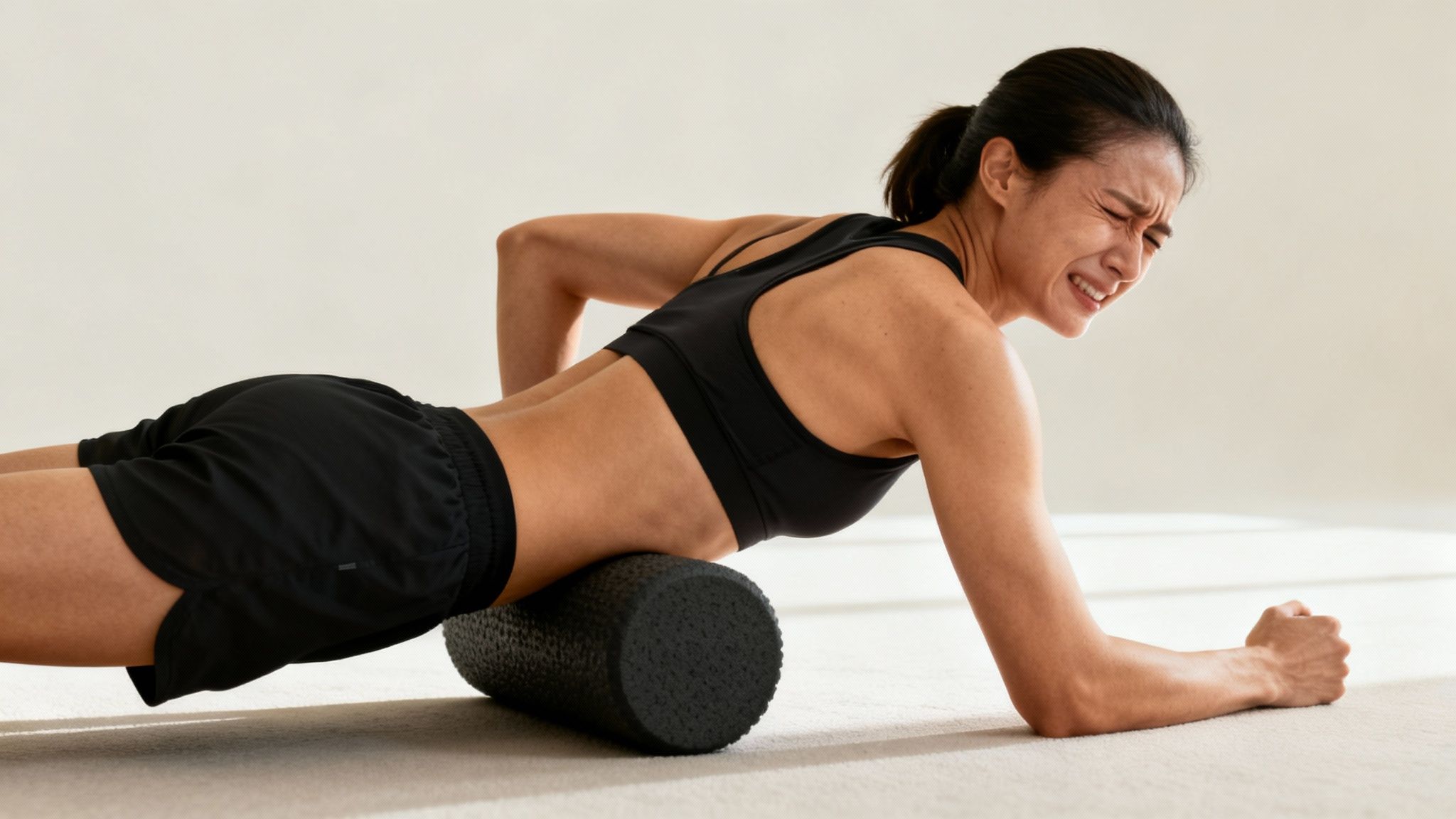
Common Foam Rolling Mistakes to Avoid
To get the most out of every session, knowing what not to do is just as important as mastering the right techniques. Proper form turns your foam roller into a powerful recovery tool. But a few common mistakes can sabotage your efforts, reduce effectiveness, or even lead to injury.
Think of foam rolling as a conversation with your muscles, not an all out assault. One of the biggest pitfalls I see is treating it like a race. Flying back and forth over a tight muscle just doesn't give your nervous system or muscle tissue enough time to respond. Instead of releasing, the muscle might just tense up in defense.
Mistake 1 Rolling Way Too Fast
The goal here is to move at a snail's pace, about one inch per second. This slow, deliberate movement lets you scan for those tender spots and gives your muscle receptors time to adapt to the pressure and finally relax. When you hit a trigger point, just pause on it for 20-30 seconds. Breathe deeply and wait for that feeling of tension starting to melt away.
This patient approach isn't just anecdotal. Research shows that for runners, flexibility and recovery are significantly better when rolling sessions last at least 120 seconds per muscle group. For long term gains, consistency is key. One study even noted an 11% increase in ankle mobility after just five weeks. You can find more insights on the impact of foam rolling on flexibility at HealthandFitness.org.
Mistake 2 Applying Too Much Pressure
More pain does not equal more gain here. Gritting your teeth and pushing through agonizing pressure can cause bruising and inflammation, which is the exact opposite of what we're trying to achieve. The discomfort should feel productive, not excruciating.
You should be able to breathe comfortably and keep the muscle you're working on relaxed. If you find yourself tensing up your entire body just to withstand the pain, you're going too hard.
Practical Fix: Use your arms and the leg that's not being rolled to control how much body weight you put on the roller. If a spot is intensely painful, start by rolling the surrounding area first. This can help it release indirectly, and then you can gradually work your way closer.
Mistake 3 Rolling Over Joints and Bones
Your foam roller is designed for soft tissue, your muscles and fascia, not for bones or joints. Rolling directly over sensitive areas like your knee, ankle, or hip bone can cause serious irritation without providing any real benefit.
Along the same lines, never roll your lower back. Your spine isn't protected by large muscle groups like your quads are, and applying that direct pressure can put dangerous force on your vertebrae.
Instead, focus your efforts on the muscles that connect to these sensitive spots.
For knee pain: Roll your quadriceps, hamstrings, and calves.
For lower back pain: Focus on releasing tension in your glutes, hip flexors, and hamstrings.
By targeting the source of the tension in the surrounding muscles, you can relieve joint stress safely. This targeted approach is a cornerstone of effective foam rolling for runners.

Your Foam Rolling Questions Answered
As you get ready to make foam rolling a regular part of your training, a few questions will probably pop up. Let's clear up some of the most common ones runners have so you can roll with confidence.
How Do I Choose the Right Foam Roller?
Picking the right roller is your first move, and it really comes down to your experience level and how much pressure your muscles can handle. Think of it like a progression.
Beginners: Start with a soft, low density roller. It’s much gentler, which is exactly what you need to get your muscles used to the pressure without wincing in pain.
Intermediate Runners: A standard, medium density roller is the workhorse for most athletes. It hits that sweet spot of being firm enough to release tight muscles but comfortable enough for regular use.
Experienced Users: If you're no stranger to deep tissue massage, a firm, high density roller or one with a textured surface can deliver the intense, targeted pressure you need to break up those stubborn, deep seated knots.
Can Foam Rolling Replace Stretching?
This is a big one, and the answer is a hard no. Foam rolling and stretching are partners in recovery, not rivals. They just do different jobs.
Foam rolling is a type of Self Myofascial Release, which is a fancy way of saying it breaks up adhesions, or "knots", in your muscle tissue and the fascia surrounding it. It’s like giving yourself a massage to improve tissue quality. Stretching, on the other hand, is all about elongating the muscles to improve your flexibility and range of motion.
The best approach is to use them together. Foam roll first to iron out the knots and get the muscle tissue ready, then follow it up with stretching to lengthen those now receptive muscles. It's a powerful one, two punch for better mobility.
What if Foam Rolling Is Painful?
You have to learn the difference between productive discomfort and actual pain. Let's be real, rolling over a tight, knotted muscle is rarely going to feel like a spa day. There will be some soreness, much like a deep tissue massage. This "good pain" should feel like a deep pressure that slowly starts to fade as you hold the position and breathe into it.
Sharp, stabbing, or radiating pain, however, is a huge red flag. That's your body screaming at you to stop immediately.
Here’s how to tell the difference and what to do:
Productive Discomfort: Feels like a deep, dull ache right on a specific knot. It should ease up after about 20-30 seconds of sustained pressure.
Harmful Pain: Is sharp, shooting, or feels electric. If the pain gets worse as you roll or hangs around long after you're done, you need to back off.
If you hit a spot that causes sharp pain, don't just keep grinding away on it. Instead, work on the surrounding areas to gently release the tension around that sensitive spot. This approach helps make sure your foam rolling for runners routine is always helping, not hurting.
References
Cheatham, S. W., Kolber, M. J., Cain, M., & Lee, M. (2015). The effects of self-myofascial release using a foam roll or roller massager on joint range of motion, muscle recovery, and performance: a systematic review. International journal of sports physical therapy, 10(6), 827–838.
Chaudhry, H., Schleip, R., Ji, Z., Bukiet, B., Maney, M., & Findley, T. (2008). Three-dimensional mathematical model for deformation of human fasciae in manual therapy. JAOA: Journal of the American Osteopathic Association, 108(8), 379-390.
MacDonald, G. Z., Penney, M. D., Mullaley, M. E., Cuconato, A. L., Drake, C. D., Behm, D. G., & Button, D. C. (2013). An acute bout of self-myofascial release increases range of motion without a subsequent decrease in muscle activation or force. Journal of strength and conditioning research, 27(3), 812–821.
Healey, K. C., Hatfield, D. L., Blanpied, P., Dorfman, L. R., & Riebe, D. (2014). The effects of foam rolling and static stretching on recovery from induced muscle damage. Journal of strength and conditioning research, 28(1), 61-68.
At Flourish-Everyday, we believe wellness is a lifestyle. From finding the perfect running shoes to providing reliable health and fitness information, we're here to support every step of your journey toward a healthier, happier you. Discover more at https://www.flourish-everyday.com.


