How to Improve Grip Strength: A Complete Guide for Athletes

Updated: Jan 23
Hi, workout artists. There has been a lot of talk about grip strength lately, especially how the determination of life expectancy can be measured by your overall grip strength. Grip strength is essential for lifting heavy or for endurance lifting so that you keep form and prevent injuries.
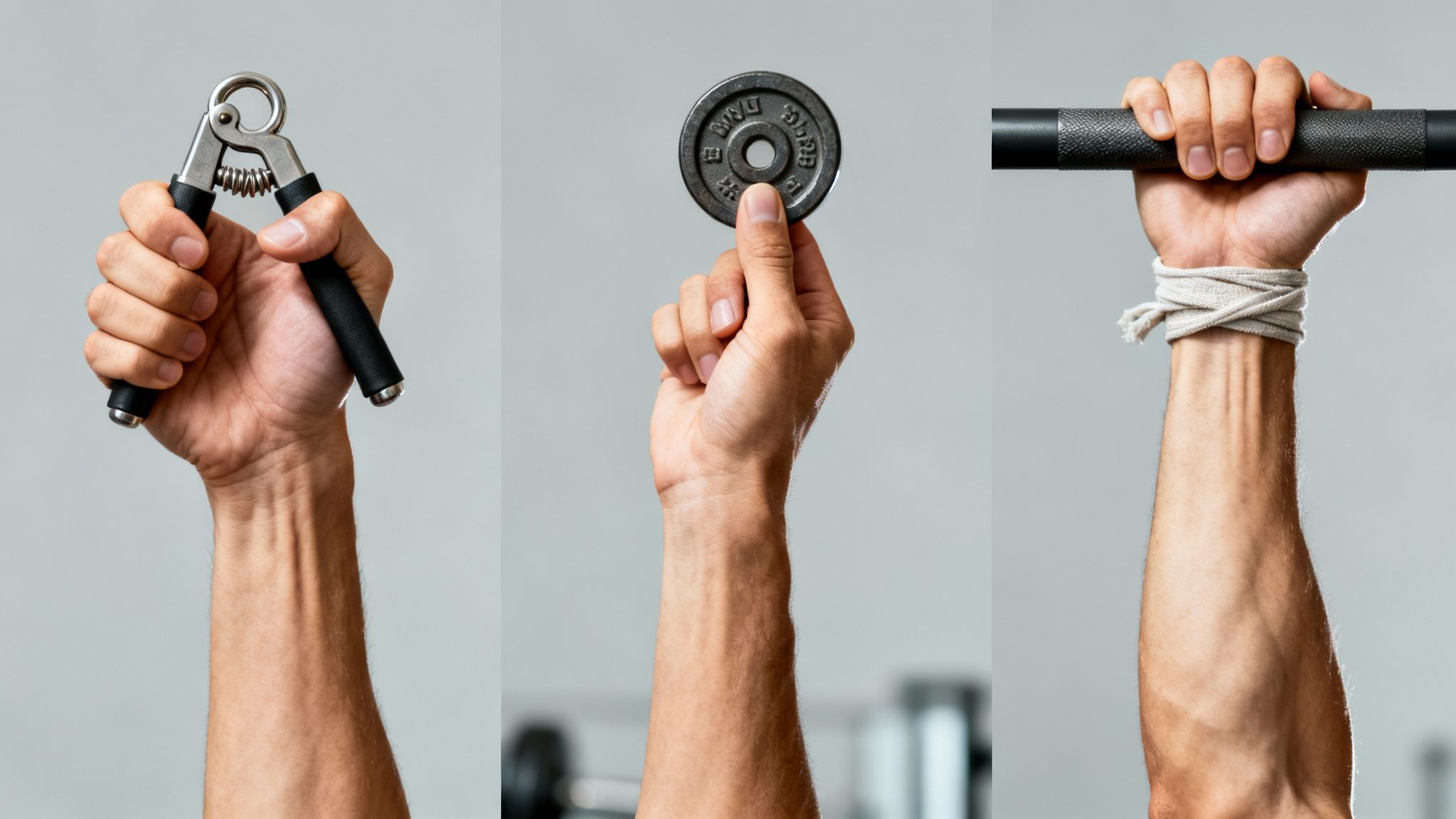
If you want to build a truly powerful grip, you need a plan that hits all three types of strength: crush, pinch, and support. How to Improve Grip Strength? This goes beyond just squeezing a hand gripper. We're talking about adding exercises like heavy carries, timed hangs, and plate pinches to build functional power that translates to everything you do.

Table of Contents
Why Grip Strength Is Your Secret Performance Metric
Real world strength, the kind that helps you dominate a CrossFit WOD or stay steady on a trail run, begins in your hands. Grip strength is more than a firm handshake; it's a powerful indicator of your overall health and athletic potential. Your grip is the critical link between your body and whatever you're trying to move. Whether it's a barbell, a kettlebell, or your own body on a pull-up bar, the moment your grip gives out, the lift is over.

More Than Just Muscle
But its importance goes far beyond the gym. A meta analysis of studies involving 2.4 million adults found a direct link between hand strength and longevity. Grip strength tends to peak between ages 30-39 before declining. For every 5-kg increase in handgrip strength, researchers found a 14% lower risk of all cause mortality (Duchowny, 2019).
Grip strength isn’t just about performance; it’s a practical biomarker for your health. A weaker grip is consistently linked to a higher risk of health issues, making it a key metric to track as you age.
Understanding this reframes grip training from a niche hobby to a core part of any fitness plan. It’s a foundational piece of effective strength and conditioning to boost athletic performance and supports long-term wellness.

The Three Pillars of Functional Grip
To build a grip that performs, you must understand its three main components. Each plays a unique role in your daily life and athletic goals. Training all three builds balanced, truly functional strength.
Grip Type | What It Measures | Athletic Application |
|---|---|---|
Crush | The force of your fingers closing against your palm. | Squeezing a hand gripper, crushing a can, or gripping a thick rope for a pull-up. |
Pinch | Strength between your thumb and fingertips. | Holding a weight plate by its edge or carrying a heavy book. |
Support | Your ability to hold onto an object for an extended time. | Performing a dead hang, carrying heavy groceries, or a farmer's walk. |
When you address each of these pillars, you aren't just getting stronger hands—you're building a more capable and resilient body from the ground up.
How to Test Your Grip Strength at Home
Before starting a training plan, establish a baseline to track your progress. You don't need expensive gear for a solid read on your current grip strength. Perform these simple at-home tests after a quick warm-up and when you're feeling fresh, not right after a workout, for accurate results. Record your numbers to re-test in a few weeks and see your hard work paying off.
Testing Your Support Grip: The Timed Dead Hang
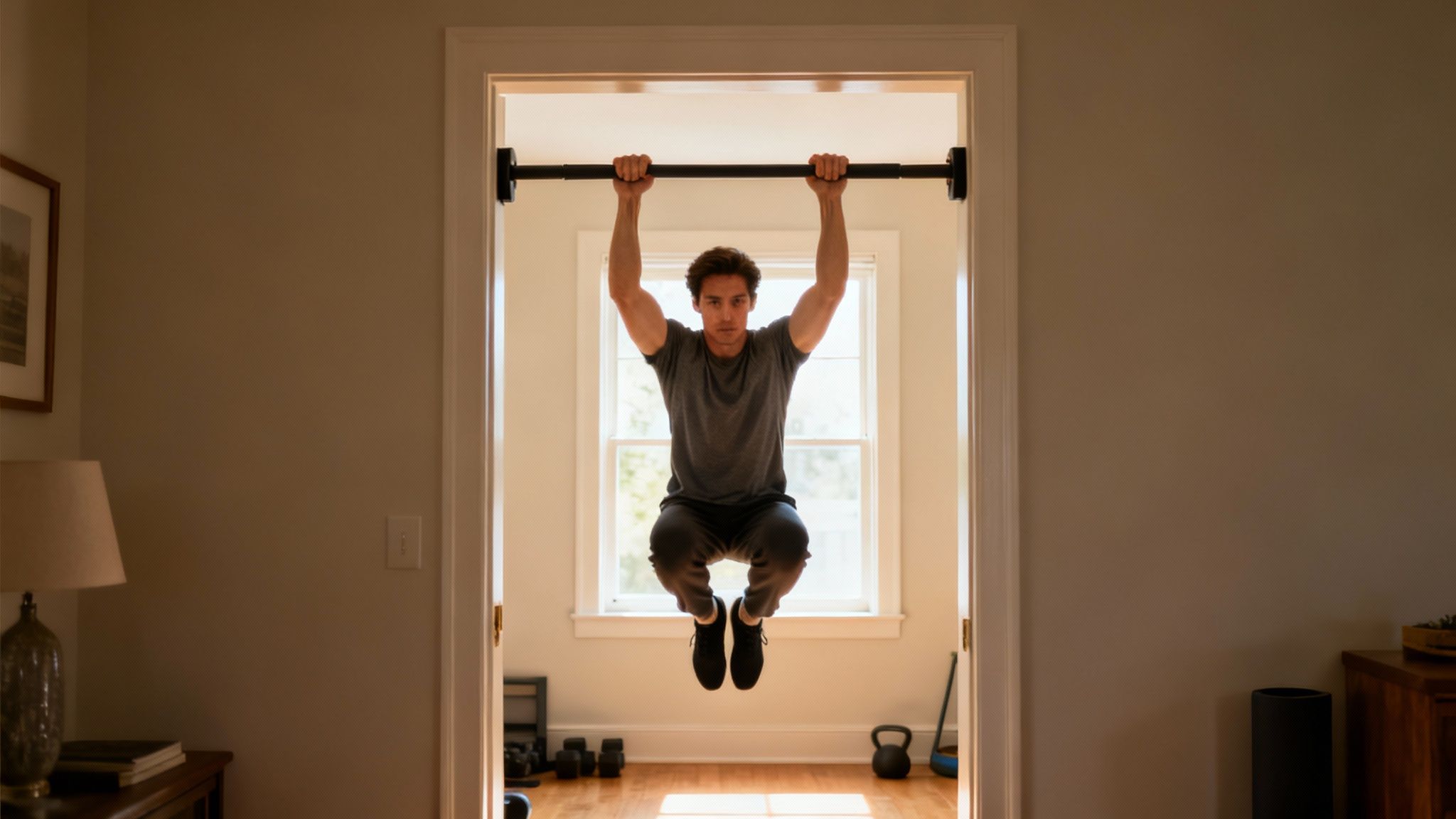
Your support grip is about endurance. The dead hang is the gold standard for testing this at home.
Find a sturdy pull-up bar or a solid tree branch.
Grab the bar with both hands, palms facing away, shoulder width apart.
Lift your feet so you're hanging freely with your arms completely straight.
Start a timer and hang for as long as you can. The test ends when your hands slip off.
Jot down your maximum time. This is a fantastic, no frills way to measure your starting point.
Gauging Your Pinch Strength: The Plate Pinch Hold
Pinch strength is the power between your thumb and fingertips, used for fine control and dexterity. Test this with a single weight plate or a thick, heavy book.
How to do it: Stand straight and hold a weight plate (a 10 lb plate is a good start) or a large book in one hand.
The key: Grip it only with your fingertips and thumb. Let your arm hang straight by your side, ensuring your palm isn't supporting the weight.
Measure it: Time how long you can hold the object before it slips. Test both hands and record the time for each.
This test isolates the muscles in your thumb and fingers. It’s common to find that one hand is stronger than the other, revealing an imbalance you can work on.
Approximating Your Crush Grip (Without a Dynamometer)
Crush grip is the raw power you feel in a firm handshake. While a dynamometer gives the most precise reading, you can get a good estimate with a bathroom scale.
The Scale Squeeze Test: Place a bathroom scale on a sturdy table at waist height. Make a fist and press down on the scale with your knuckles as hard as you can for about 5 seconds.
Get Your Number: Note the peak weight displayed on the scale. While not a perfect scientific measurement, it’s a consistent and repeatable way to track progress. Test both hands to check for differences.
Core Exercises for Building a Vice Like Grip
Forget endless forearm curls; a targeted plan that challenges your hands in different ways is key to improving your grip. We'll cover essential exercises for support, crush, and pinch strength, focusing on good form and real world application. These aren't just isolated drills; they are fundamental strength movements that build resilience from your fingertips to your shoulders.

Mastering the Support Grip
Support grip is your foundation, crucial for everything from carrying groceries to hanging from a pull-up bar. The two pillars of support grip training are dead hangs and farmer's walks.
Dead Hangs: Deceptively simple yet incredibly effective, the dead hang targets endurance muscles, teaching your hands to stay clamped under tension.
How to Perform: Grab a pull-up bar with an overhand, shoulder width grip. Let your arms fully extend and relax your shoulders. The goal is to hold on for as long as possible with perfect form.
Progression: Start with timed holds. If you can only hang for 15 seconds, aim for multiple sets of 15 seconds. Gradually increase the hold time until you can hang for a minute or more.
Common Mistake: Avoid shrugging your shoulders or bending your elbows. This exercise is about isolating the grip.
Farmer's Walks: This total body movement builds a powerful support grip while strengthening your core, back, and legs.
How to Perform: Pick up heavy dumbbells or kettlebells, one in each hand. Stand tall with your shoulders back and core tight. Walk forward with controlled steps for a set distance or time.
Progression: Simply increase the weight or the distance you walk. Challenge your grip to the point where it’s about to give out by the end of each set.
Real World Benefit: This directly translates to carrying heavy items and maintaining good posture under load.
Beyond building muscle, exercises like heavy farmer's walks impact long-term health. The Prospective Urban Rural Epidemiology (PURE) study found a strong link between grip strength and longevity. It showed that for every 5-kg drop in handgrip strength, the risk of all cause mortality increased by 16%. Conversely, a 5-kg increase was linked to a 14% drop in mortality (Leong et al., 2015). You can read more in their full study on grip strength and mortality.
Developing a Powerful Crush Grip
Crush grip is the force you generate between your fingers and palm, essential for big lifts and gymnastic movements.
Gripper Training: Hand grippers are a classic tool because they work. Adjustable grippers allow for precise, measurable progress.
How to Perform: Squeeze the gripper until the handles touch. Control the movement on the way back to the start; don't just let it spring open.
Progression: Start with a gripper you can close for 8-10 reps. Once you can hit 12-15 reps, move up to the next resistance level.
Common Mistake: The eccentric (opening) part of the movement is just as important as the squeeze.
Towel Pull-ups or Hangs: This brutal variation forces your hands to work harder. Draping a towel over a pull-up bar significantly increases the challenge.
How to Perform: Throw one or two towels over a pull-up bar. Grip the towels and either perform a pull-up or hang for time.
Progression: Start with timed hangs. Once you can hang for 30 seconds, try to incorporate pull-ups.
Real World Benefit: This is fantastic for climbers, martial artists, and anyone whose sport requires gripping awkward objects.
Pro Tip: When starting with towel hangs, use a thick, sturdy towel. The thicker the material, the tougher the grip.
Honing Your Pinch Strength
Pinch strength is the power between your thumb and fingertips, essential for dexterity and control.
Plate Pinches: This is the gold standard for pinch strength, directly targeting the thumb and finger pads.
How to Perform: Place two weight plates together, smooth sides out. Pinch them with one hand using only your fingertips and thumb. Lift them and hold for as long as possible.
Progression: Start with two 10 lb plates. Increase the hold time or move to heavier plates.
Common Mistake: Don't let your palm support the bottom of the plates. The work must be done entirely by the pinch.
Hex Dumbbell Holds: This exercise provides a different angle for pinch training.
How to Perform: Stand a hex dumbbell on its end. Grip the head of the dumbbell with your fingertips and thumb. Lift it and hold it by your side for time.
Progression: Increase the dumbbell's weight or the hold's length to make it harder.
Real-World Benefit: This movement simulates picking up awkward objects and builds exceptional thumb strength.
For a deeper dive into structuring these movements, check our guide on the top resistance training exercises to unleash your strength.
Weaving Grip Training Into Your Weekly Routine
Knowing the right exercises is a great start, but a smart, consistent plan is where the magic happens. Weave grip work into your existing schedule so it enhances, not competes with, your primary training. You don't need to dedicate hours a week; a little focused effort goes a long way.
A pilot study in The Sport Journal found that a simple 12-week handgrip program boosted strength by a significant 7%. Participants trained three times a week with a few sets of maximum effort reps, proving you can get measurable results without overhauling your routine (Hussain & Satar, 2021). You can check out the full handgrip training program study for details.
An effective grip program is built on three pillars: Support, Crush, and Pinch. Neglecting one leaves a hole in your strength.
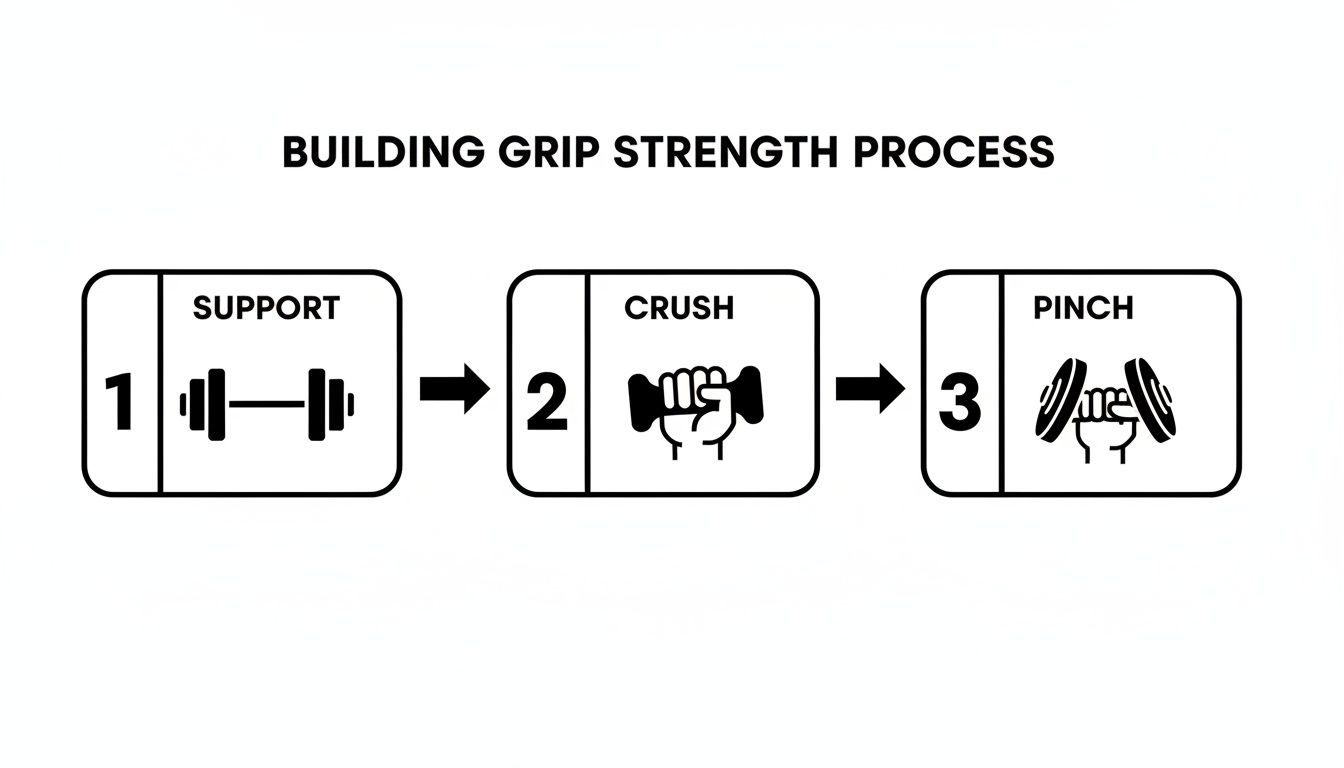
This process shows why you need dedicated exercises for each grip type to build well rounded, functional strength.
Sample Weekly Grip Training Schedules
Here’s how different athletes can fit targeted grip training into their week. These schedules are designed to complement existing programs without causing burnout.
Athlete Profile | Day 1 Focus | Day 2 Focus | Integration Tip |
|---|---|---|---|
General Fitness | Support Grip (Farmer's Walks) | Crush & Pinch (Grippers, Plate Pinches) | Add as finishers at the end of your main workouts twice a week. |
Runner | Support & Stability (Dead Hangs) | Dynamic Grip (Kettlebell Swings) | Perform once or twice a week on cross-training days to build resilience. |
CrossFitter | Thick Bar/Towel Work (Towel Hangs) | Heavy Carries (Farmer's Walks) | Use as warm-up activators or intense post-WOD finishers. |
These are starting points. Listen to your body and find a rhythm that helps you get stronger without feeling overworked.
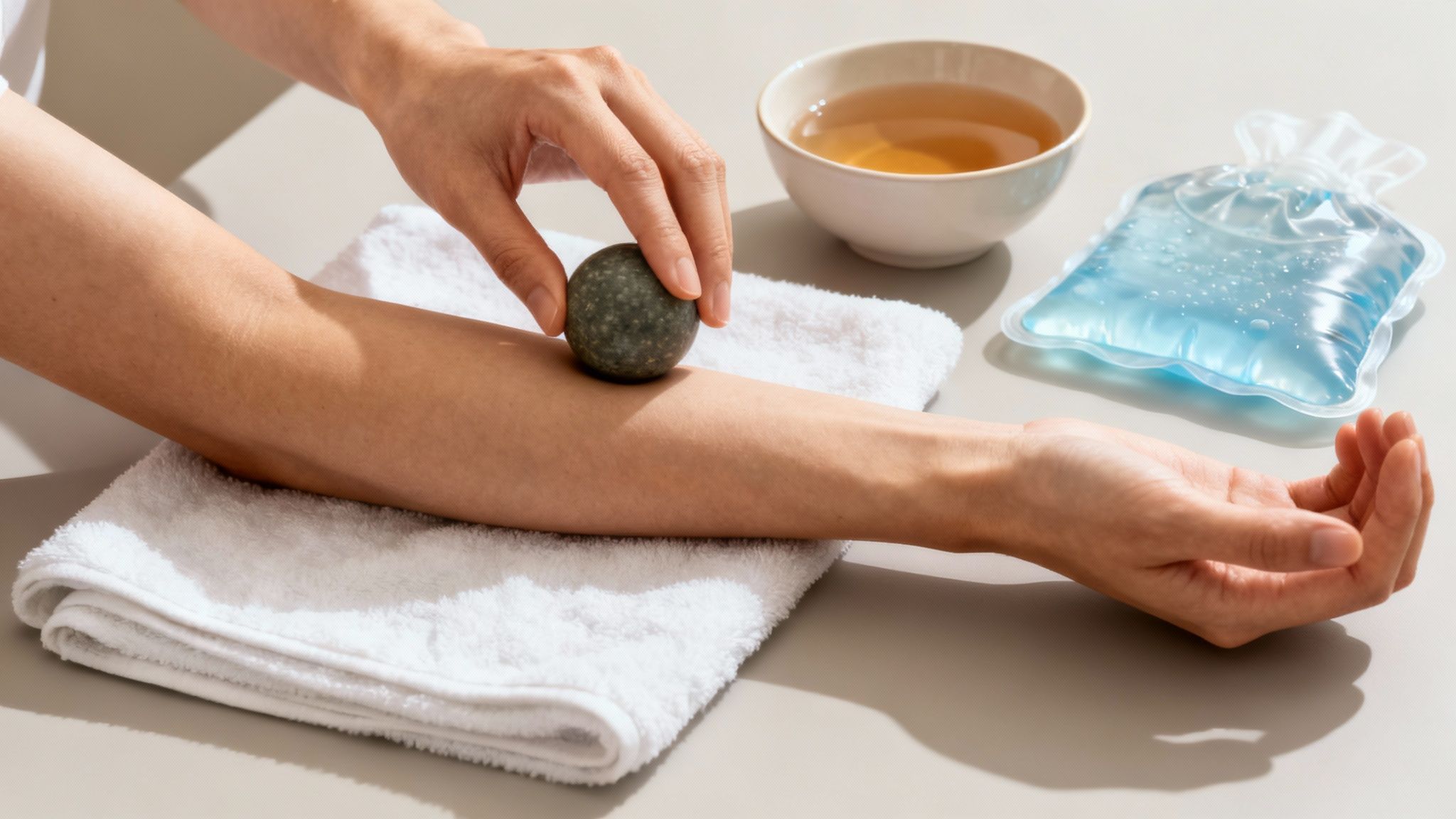
Smart Recovery for Healthy Hands and Forearms
Pushing your grip is only half the battle. Smart recovery is nonnegotiable for preventing injuries and coming back stronger. Intense grip work stresses the small muscles and tendons in your hands, wrists, and forearms. Without proper care, you risk issues like tendonitis or elbow pain that can derail your progress. This section covers preparation and restoration, preventative maintenance for your most important lifting tools.
Priming Your Hands for Performance
Before lifting, prepare the tissues for action. A good dynamic warm-up gets blood flowing to the muscles and improves joint mobility.
Wrist Circles: Gently roll your wrists clockwise for 10-15 seconds, then switch directions.
Finger Extensions: Squeeze your hand into a tight fist, then extend your fingers as wide as you can. Repeat 10 times.
Tendon Glides: Move your fingers through their full range of motion—from a flat hand to a hook fist, then a full fist.
A proper warm-up isn't just about avoiding injury; it's about performance. Prepped muscles and tendons produce more force, meaning you'll get more out of your grip training session.
Effective Post Workout Restoration Strategies
What you do after your workout is just as critical. Recovery is an active process that helps your muscles repair, adapt, and grow stronger. Set aside a few minutes after a tough grip session for these practices.
Essential Stretches and Mobility Work
Stretching helps ease tension and brings muscles back to their natural resting length.
Prayer Stretch: Place your palms together in front of your chest. Slowly lower your hands toward your waist until you feel a gentle stretch in your forearms. Hold for 20-30 seconds.
Extensor Stretch: Hold one arm straight out, palm facing down. With your other hand, gently bend your wrist downward. Hold for 20-30 seconds, then switch sides.

Advanced Recovery Techniques
For a full rundown of how elite athletes stay in the game, check out these proven recovery techniques for athletes.
Massage Ball Release: Use a lacrosse or massage ball to roll out tight spots in your forearms.
Contrast Baths: Alternate soaking your hands and forearms in cold water for one minute, then warm water for one minute. Repeat 3-4 times to help reduce soreness.
Many athletes also explore the benefits of magnesium oil spray for muscle comfort to help ease soreness after tough workouts.
Got Grip Questions? We’ve Got Answers
This section tackles the most common questions about improving grip, providing clear, straightforward answers to keep you moving forward.
How Long Until I See Real Improvements in Grip Strength?
While you might feel a difference after a few sessions, significant, measurable gains take time. Studies show a consistent program can increase strength by a noticeable 7% in as little as 12 weeks (Hussain & Satar, 2021). The keys are consistency and progressive overload, training two to three times a week and always pushing to do a little more than last time.
Can I Build My Grip Without Special Equipment?
Absolutely. You can build a strong grip using just your body weight and common household items.
For Support Grip: Timed dead hangs from a pull-up bar, tree branch, or even the top of a door.
For Crush Grip: Drape a thick towel over a bar for hangs or pull-ups.
For Pinch Grip: Hold a heavy book or two smooth weight plates by your side for time.
The principle is always the same: consistently challenge your hands to hold, squeeze, and pinch.
Should I Use Lifting Straps on Heavy Lifts?
Lifting straps are a tool, not a crutch. If you use them for every set, you are holding back your grip development. A balanced approach is smarter.
The best strategy? Do all your warm-up sets and as many main working sets as you can without straps. This is where you actively train your grip under heavy loads.
Only use straps for your absolute heaviest sets where your grip is the only thing stopping you from finishing the lift.
What Is the Difference Between Grip and Forearm Strength?
Many use these terms interchangeably, but they are slightly different.
Forearm Strength involves the larger muscles between your wrist and elbow that power wrist flexion and extension.
Grip Strength is more specific to what your hands and fingers can do: crushing, pinching, and supporting an object.
While strong forearms are crucial for a powerful grip, you need direct grip training to target the smaller, intrinsic muscles inside your hands.
References
Duchowny, K. (2019). Untangling the Association Between Grip Strength and Cognitive Health in a National Sample of Older Adults. SSM - population health, 7, 100371.
Hussain, J., & Satar, M. (2021). Efficacy of 12-week Handgrip Strength Training Program Amongst Older Adults: A Pilot Study. The Sport Journal.
Leong, D. P., Teo, K. K., Rangarajan, S., Lopez-Jaramillo, P., Avezum, A., Jr, Orlandini, A., Seron, P., Ahmed, S. H., Rosengren, A., Kelishadi, R., Rahman, O., Swaminathan, S., Iqbal, R., Dagenais, G. R., Lear, S. A., & Yusuf, S. (2015). Prognostic value of grip strength: findings from the Prospective Urban Rural Epidemiology (PURE) study. Lancet (London, England), 386(9990), 266–273.
At Flourish-Everyday, we believe functional strength is the foundation of a healthy, active life. Whether you're a runner, a CrossFitter, or just starting out, a powerful grip supports everything you do. Find the gear, guidance, and inspiration you need to hit your goals at https://www.flourish-everyday.com.