How to Stay Consistent with Exercise and Build a Lifelong Habit

Updated: Jan 8
The secret to sticking with exercise isn't about having superhuman motivation or crushing yourself with insane workouts from day one. It’s about something much simpler: building a smart, sustainable system that you can actually stick with. The real key to long term fitness is a forgiving approach that values showing up over going all out every single time. This guide offers concise, informative health information to help you stay consistent with exercise and build that routine.

Article Index
Why Consistency Matters More Than Intensity
The biggest challenge isn't the first workout; it's the fortieth. Many fall into the trap of chasing sporadic, high intensity sessions, only to burn out. This cycle is fueled by the myth that fitness demands constant, maximum effort.
Focusing on consistent, moderate activity is a better way to build a lasting habit. Think of it like learning an instrument: practicing for 20 minutes daily is more effective than one three hour session monthly. This steady approach allows your body to adapt, builds momentum, and helps you avoid the burnout that stops so many people.
The Motivation and Discipline Gap
Motivation is the initial spark that gets you started, but it's temporary. Discipline is the system you build to keep going when excitement fades. True progress is measured by your ability to show up on the days you don't feel like it.
This gap is reflected in global health statistics. According to a 2023 HFA Global Report, fitness participation is at a high, yet the World Health Organization warns that physical inactivity is also rising, projected to affect 35% of adults by 2030 (1, 2). People are starting, but they aren't staying consistent.
Crafting Your Personal Exercise Blueprint
Forget generic workout plans. The secret to making exercise a permanent part of your life is designing a routine that fits seamlessly into your world. This requires moving past vague goals like "get in shape" and building a concrete, personalized strategy founded on realism.

Start Small and Scale Smart
Your initial goal is to make showing up effortless. An ambitious plan can lead to burnout, while a manageable one builds confidence and creates a positive feedback loop.
Consider these starting points:
Three 20-minute sessions per week: A brisk walk, a short bodyweight circuit, or a light jog. The focus is on completion, not intensity.
One group fitness class a week: This provides built-in accountability and structure.
Ten minutes of movement daily: Stretching in the morning, a walk on your lunch break, or a simple yoga flow before bed.

True, lasting progress happens when you ditch the "all-or-nothing" mindset and embrace steady, repeatable effort.
Uncover Your Deeper Motivation
Initial excitement fades. You need to connect your exercise habit to a powerful, personal "why" that will motivate you on low energy days. Your "why" must be specific and meaningful.
Vague goals produce vague results. A specific, emotionally resonant 'why', like having more energy for your kids or managing stress to be more present at home, is the fuel that sustains long term consistency.
Maybe your "why" is to boost mental clarity, manage a health condition, or be a healthy role model. Write it down and place it where you'll see it daily. For more help, see our guide on how to set fitness goals that actually stick.
Master the Art of Habit Stacking
Habit stacking is an effective technique for building consistency. Anchor your new workout habit to an existing part of your daily routine to remove the need for constant decision making.
Here are some real world examples:
For the Home-Gym User: After your morning coffee, head straight to your workout space for a 15-minute strength session.
For the Runner: Place your running gear next to your bed. Get dressed and head out the door as soon as your alarm goes off.
For the Group Fitness Fan: Drive directly to the gym after work without going home first to avoid distractions.
Creating automatic triggers reduces the mental energy required to start, making exercise a necessary part of your life.
Finding the Right Gear to Support Your Goals
The right equipment is an investment in your ability to be consistent. While you don't need expensive gear, proper tools, especially good shoes, can prevent injuries and make exercise more enjoyable. Bad shoes can lead to shin splints, knee pain, or blisters that derail your progress.
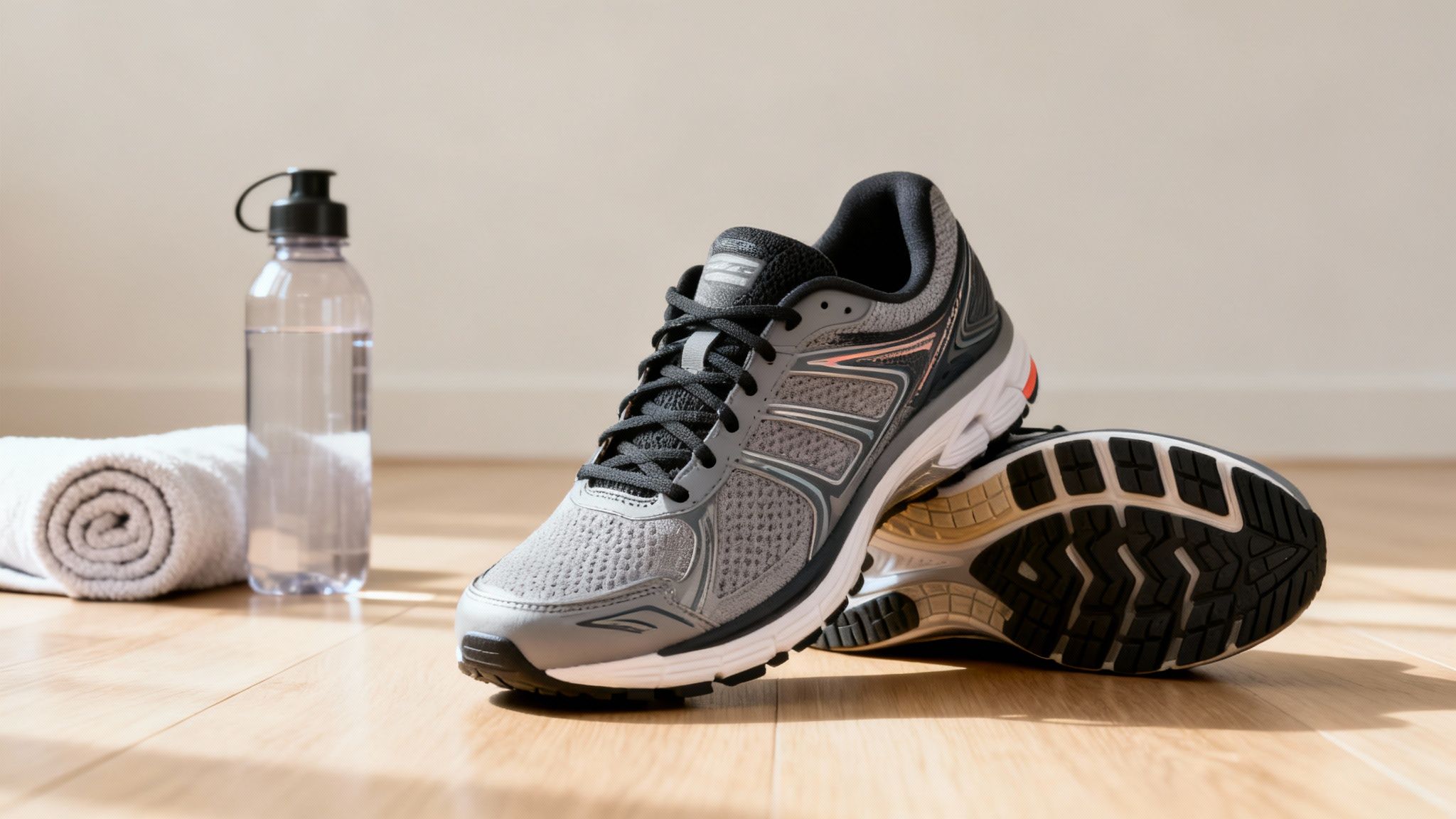
Top Athletic Shoes for Men and Women: An Overview
For mixed activities like gym sessions, HIIT classes, or walking, a cross-training shoe offers a balance of support, flexibility, and cushion.
Men's Top Athletic Shoes: Nike Metcon: Known for its stable base for lifting and flexibility for agility work. A durable, versatile gym shoe. Reebok Nano: Offers a stable platform and a wide toe box, making it excellent for heavy lifts and dynamic movements.
Women's Top Athletic Shoes: Brooks Ghost: Technically a running shoe, its superb cushioning and support make it a top choice for walking and general gym use. HOKA Clifton: Famous for its maximum cushioning, providing exceptional comfort for running, walking, and standing activities.
Choosing the right shoe isn’t about brand loyalty; it's about matching the shoe's design to your primary activity. A runner needs impact absorption, while a weightlifter needs a flat, stable base.
Individual Brand Shoe Reviews for Specific Activities
As your fitness becomes more focused, your footwear should too. Specialized shoes are engineered to enhance performance and prevent injury during specific movements.
Best for Runners: Cushion and Support
Running generates impact forces up to three times your body weight with each stride, making proper cushioning essential (3).
ASICS GEL-Kayano: A top stability shoe for runners who overpronate (foot rolls inward). Its structured cushioning helps guide the foot, reducing strain on ankles and knees.
Saucony Kinvara: A lightweight, responsive option for neutral runners. It offers a "fast" feel without sacrificing essential cushioning, ideal for distances from 5Ks to half marathons.
Best for CrossFit: Stability and Grip
CrossFit combines weightlifting, gymnastics, and cardio, requiring a shoe that offers stability for lifts and flexibility for dynamic movements.
NOBULL Trainer: Renowned for its durability and minimalist design. The flat, grippy sole provides excellent traction for rope climbs and stability during Olympic lifts.
Wellness Trends: High-Intensity Interval Training (HIIT) vs. Low Intensity Steady State (LISS)
Understanding different exercise methods can help you find what works best for you. Two popular trends are HIIT and LISS.
Feature | High Intensity Interval Training (HIIT) | Low Intensity Steady State (LISS) |
|---|---|---|
Description | Short bursts of all out effort followed by brief recovery periods. (e.g., 30s sprint, 60s walk) | Maintained, moderate intensity for a sustained period. (e.g., 45-min jog) |
Duration | Typically 10-30 minutes. | Typically 30-60+ minutes. |
Benefits | Highly time efficient, boosts metabolism (EPOC effect), improves cardiovascular health quickly. | Lower impact on joints, aids in recovery, improves endurance, can be meditative. |
Best For | Individuals short on time, those seeking to break through plateaus. | Beginners, individuals with joint issues, active recovery days, building an aerobic base. |
Comparison: HIIT is more time efficient and can burn more calories in a shorter period, but it's also more physically demanding and carries a higher risk of injury if form is compromised. LISS is safer, more sustainable for daily activity, and excellent for building foundational endurance. A balanced routine often includes both. For example, 2-3 HIIT sessions and 2-3 LISS sessions per week can provide comprehensive benefits.
Overcoming Common Roadblocks and Staying Motivated
Even the best plans face challenges. Consistency is about navigating hurdles like a busy schedule, low energy, or a lack of enthusiasm. Research shows that breaking activity into smaller chunks, like three 10-minute walks, can be as effective as one continuous 30-minute workout (4). This makes exercise feel more manageable. For more ideas, our guide on 7 proven strategies for how to find time to workout in 2025 offers actionable tips.
The Difference Between Motivation and Discipline
Motivation is the spark that starts you; discipline is the system that keeps you going. Relying on motivation alone leads to inconsistency because feelings are temporary. A disciplined habit functions even on days you don't feel like it. Building discipline isn't about forcing yourself through workouts you hate. It's about making the right choice the easiest one and learning how to overcome lack of motivation and reclaim your drive.
Solutions for Common Exercise Barriers
Here’s how to turn common excuses into actionable solutions.
Common Barrier | Psychological Hurdle | Actionable Solution |
|---|---|---|
"I'm too tired." | Decision Fatigue: A full workout feels overwhelming. | Do a 10-minute version. A short walk, a few stretches, or one set of exercises. The goal is to just start. |
"I don't have time." | All-or-Nothing Mindset: Believing short workouts are pointless. | Find 15 minutes. Walk during a phone call, do squats while waiting for coffee, or do a quick HIIT circuit. |
"I'm bored." | Lack of Novelty: Your brain craves a new stimulus. | Change one variable. Try a new route, a different class, or a new playlist. |
"I'm not seeing results." | Impatience: Expecting visible changes too quickly. | Focus on non-scale victories. Track energy levels, sleep quality, or strength gains. |
Leveraging Accountability for Unstoppable Consistency
Sharing your goals with an accountability partner or joining a fitness community creates a sense of shared purpose. Knowing someone is expecting you makes it harder to skip a session. This support system turns a solo effort into a team sport, providing encouragement on tough days and celebrating your wins.
Using Progress to Fuel Your Motivation
Tracking tangible progress creates a positive feedback loop that reinforces your habit. The secret is to focus on "process goals" (the actions you take) rather than "outcome goals" (the final result). For example, aim to complete three 20-minute workouts this week. This approach builds momentum and provides frequent, confidence boosting wins.
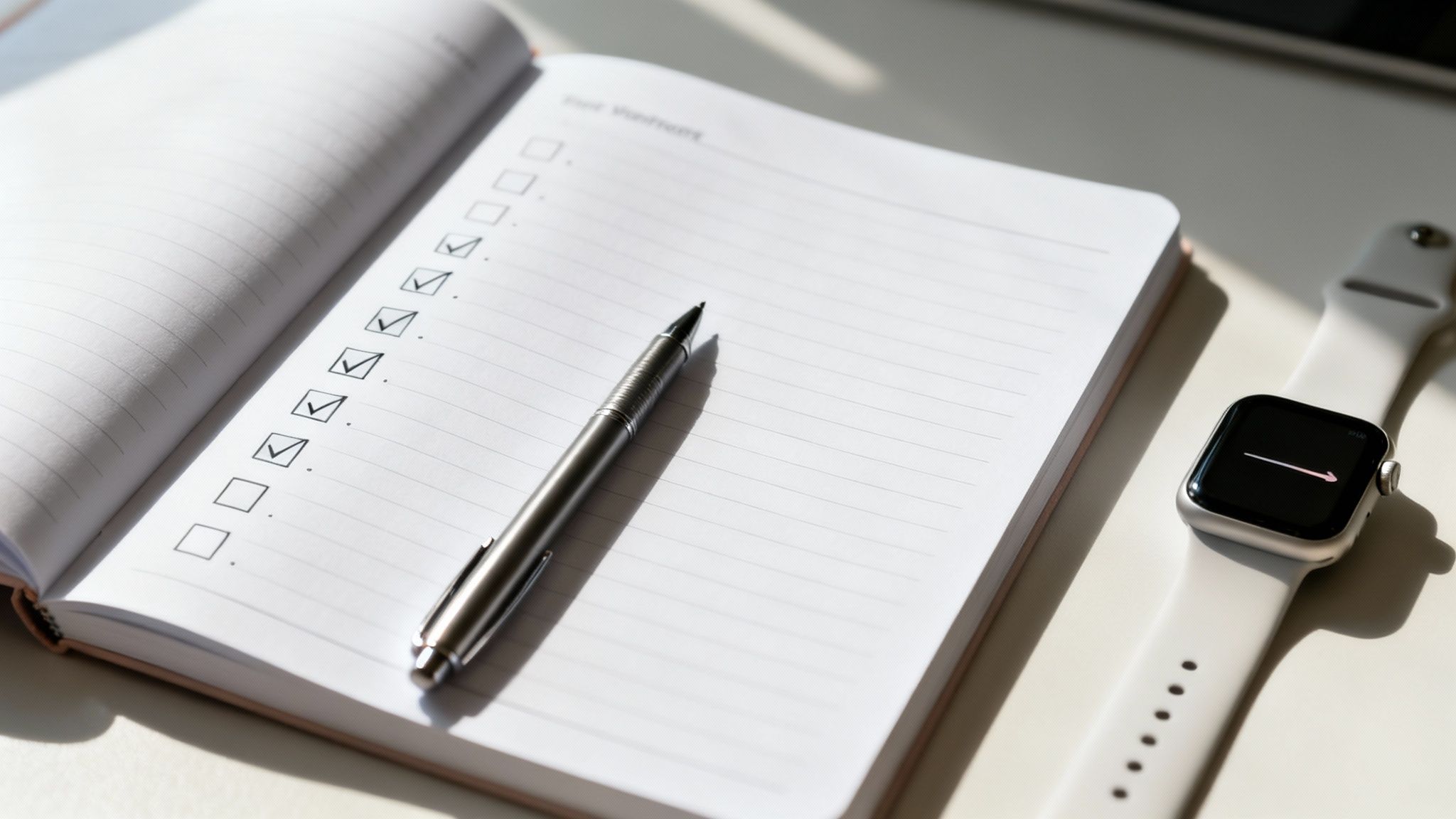
The Power of Tracking Your Journey
Logging your workouts makes your efforts feel concrete. Whether using an app or a notebook, this record is a powerful reminder of your progress. A workout journal helps you see how far you've come, which can be motivating on difficult days. Consider tracking your progress with a dedicated workout journal.
Tracking isn’t about judging your performance; it’s about acknowledging your commitment. Every logged workout is proof that you are putting in the work.
Celebrate Non-Scale Victories
The scale is not the only measure of progress. Celebrating "non-scale victories" (NSVs) is crucial for staying positive. NSVs are real world improvements in your health and well being. Recognizing them helps you appreciate the full benefits of exercise. For more insight, our guide on how to measure body composition accurately offers a deeper look at your body's changes.
Powerful non-scale victories to celebrate:
Increased Energy: Having more stamina for daily activities.
Improved Sleep: Falling asleep faster and waking up feeling rested.
Better Mood: Experiencing less stress and a more positive outlook.
Strength Gains: Lifting heavier or completing more reps.
Clothes Fitting Better: Your favorite clothes feeling more comfortable.

Your Fitness Consistency Questions Answered
Even the best plans encounter obstacles. Here are answers to common questions about maintaining a consistent workout habit.
How Long Does It Really Take to Form an Exercise Habit?
There's no magic number. A 2009 study found the average was 66 days, but the range was from 18 to 254 days (5). Habit formation is a personal journey. Instead of fixating on a timeline, focus on winning today. Each workout strengthens the habit, making it easier to show up tomorrow.
What Should I Do If I Miss a Workout… or a Whole Week?
It will happen. The worst response is falling into the "all-or-nothing" trap. Missing one workout doesn't erase your progress. The key is to jump back in without guilt.
Don't wait for Monday. Return on your next scheduled day.
Make it easy. Your first workout back should be light, like a 15-minute walk.
Count it as a win. Getting back on track is a victory in itself.
Is It Better to Work Out in the Morning or at Night?
The best time to work out is when you will actually do it.
Morning: Fewer obstacles can derail your plans. Best for those with unpredictable evenings.
Evening: A great way to relieve stress from the day. Best for those who feel stronger later or use exercise to decompress.Experiment to see what fits your schedule and energy levels. For more tips, see what health experts suggest for making exercise a regular part of your day.
How Do I Stay Consistent When Traveling?
Adapt your routine to keep the habit of daily movement alive.
Pack light: A resistance band or jump rope is versatile and portable.
Have a go-to bodyweight circuit: Master a 15-minute routine (squats, push-ups, planks) you can do anywhere.
Build activity into your plans: Explore a new city on foot, plan a hike, or rent a bike.
References
Health & Fitness Association. (2024). 2024 HFA Global Report. Retrieved from https://healthandfitnessassn.org/press-release/global-report-shows-health-club-industry-serves-210-million-members/
World Health Organization. (2022, October 19). WHO highlights high cost of physical inactivity in first-ever global report. Retrieved from https://www.who.int/news/item/19-10-2022-who-highlights-high-cost-of-physical-inactivity-in-first-ever-global-report
Lieberman, D. E., Venkadesan, M., Werbel, W. A., Daoud, A. I., D'Andrea, S., Davis, I. S., ... & Pitsiladis, Y. (2010). Foot strike patterns and collision forces in habitually barefoot versus shod runners. Nature, 463(7280), 531-535.
Murphy, M. H., Lahart, I., Carlin, A., & Murtagh, E. (2019). The effects of continuous vs. accumulated exercise on health: a meta-analytic review. Sports Medicine, 49(10), 1585-1607.
Lally, P., van Jaarsveld, C. H. M., Potts, H. W. W., & Wardle, J. (2010). How are habits formed: Modelling habit formation in the real world. European Journal of Social Psychology, 40(6), 998-1009.
At Flourish-Everyday, we're here to help you on every step of your wellness journey. From practical guides like this to honest shoe reviews, we give you the tools and motivation to build a fitness habit that lasts. https://www.flourish-everyday.com