Finding Comfortable Shoes For Flat Feet: A Pain-Free Guide
- penny.par591+abc123
- 16 hours ago
- 8 min read
If you have flat feet, you know the search for comfortable shoes can feel endless. It’s about more than just cushioning; it’s about finding structured support that works with your foot, not against it. To achieve all-day relief, your best bet is to look at stability shoes from brands that understand this, like Brooks, New Balance, and Hoka. They build shoes with a firm heel, a supportive midsole, and dedicated arch support that keeps your foot from rolling inward. This combination is the key to reducing pain and realigning your body.
Your First Step Toward Pain-Free Days
Living with flat feet can be a constant battle against aches and fatigue. Simple activities like a walk in the park or a gym session can be sidelined by nagging pain that starts in your feet and travels up to your knees and hips. It's a very common issue, and for many, the first sign is wondering why your feet hurt when you wake up.
Let's be clear: the right footwear isn't a luxury. It's a foundational tool for your long-term joint health. This guide provides practical knowledge to help you pick shoes that offer genuine relief, cutting through marketing fluff to show you what really makes a shoe work for flat feet. The real key is structured, intentional support, not maximum softness.
Index of Sections
Understanding Your Feet: Explaining the mechanics of a flat foot and why proper arch support is critical for your entire body's alignment.
Anatomy Of The Ideal Shoe: Highlighting the non-negotiable components of a truly supportive shoe, from the heel counter to the midsole.
Top Athletic Shoe Picks: A curated review of top-rated shoes for men and women, broken down by activity.
Deep Dive Into Top Footwear Brands: An analysis of leading brands and their unique support technologies.
Wellness Strategies Beyond The Shoe Box: Simple stretches, exercises, and information on orthotics to complement your footwear.
Your Common Questions Answered: Addressing frequently asked questions about footwear for flat feet.
Understanding Your Feet: Why Arches Matter
Before discussing shoes, it's essential to understand why your feet may be causing trouble. Your foot's arch acts as your body’s personal suspension system, flexing to absorb the impact of every step. When you have flat feet, or "fallen arches," this system collapses. Instead of being absorbed, the force from each step travels up your body, creating a chain reaction of stress on your ankles, shins, knees, hips, and lower back.
The Problem With a Collapsed Arch
A collapsed arch often leads to a biomechanical issue called overpronation, where the ankle rolls too far inward and downward during movement. Your body does this to find stability, but it comes at a cost.
Overpronation doesn't just stay in the foot; it disrupts your body's entire alignment. This misalignment is frequently the root cause of chronic pain that seems unrelated to your feet, such as persistent knee soreness or an aching lower back.
Studies show that the prevalence of flat feet can range from 13.6% to over 50% in adults, depending on the population studied (Gijon-Nogueron et al., 2017). This wide range highlights how many people deal with these structural challenges.
Common Conditions Linked to Flat Feet
The constant strain from a collapsed arch and overpronation can lead to specific and painful conditions:
Plantar Fasciitis: A sharp, stabbing pain in the heel, often worst in the morning. The plantar fascia tissue is overstretched and inflamed.
Shin Splints: Overpronation forces lower leg muscles to overwork for stability, causing pain along the shin bone.
Achilles Tendinitis: The Achilles tendon is put under excessive strain, resulting in painful inflammation and stiffness.
Recognizing these issues is the first step toward relief. While our focus is on flat feet, understanding other foot types can be useful. For comparison, see our guide on the best running shoes for high arches. The goal is to find shoes with smart, intentional structure that rebuilds the support your natural arch was meant to provide.
Anatomy Of The Ideal Shoe For Flat Feet
Choosing shoes for flat feet is about structure, not just softness. A supportive shoe acts like a brace, gently guiding your foot into a better position with each step. This is crucial because flat feet can set off a chain reaction of pain throughout your body.
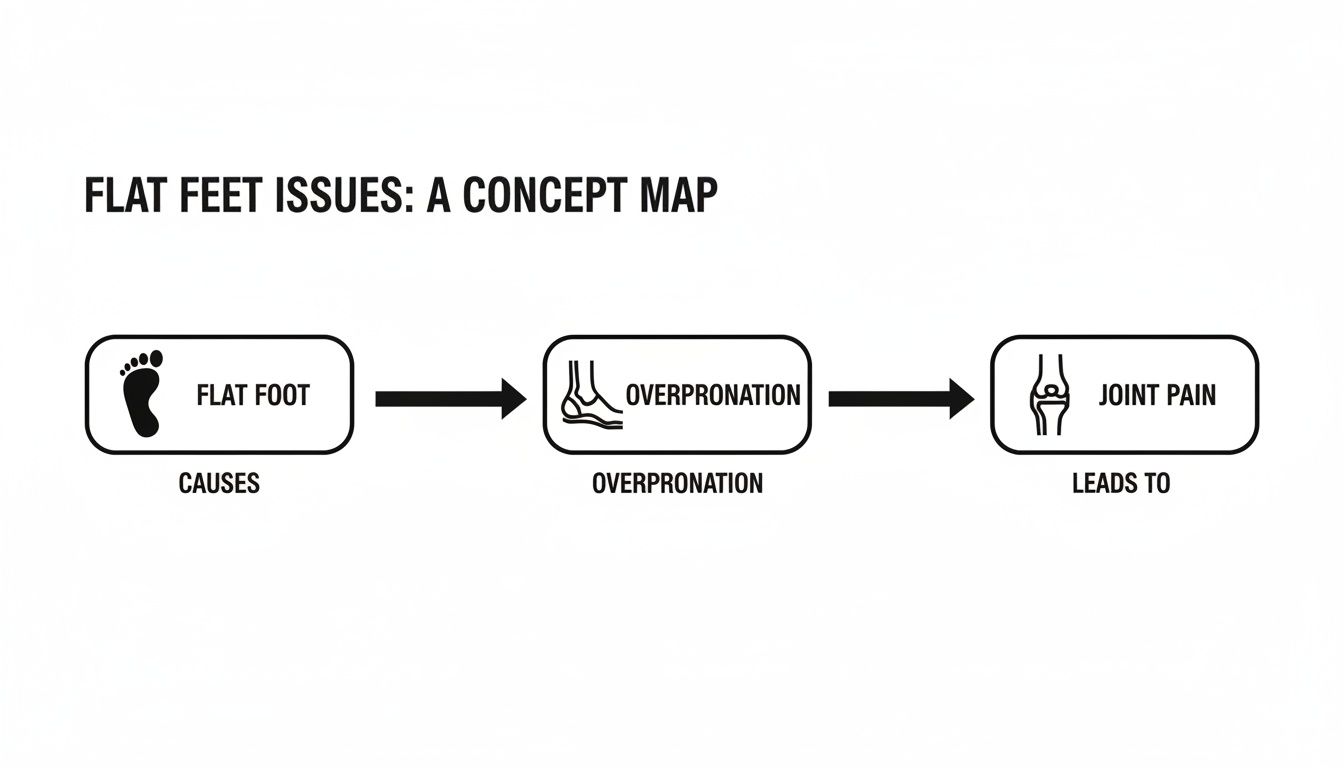
When an arch collapses, the ankle rolls inward (overpronation), throwing off alignment and causing stress to knees, hips, and back. The right shoe acts as a buffer to stop this cycle.
Key Supportive Features
Supportive Midsole: The midsole is the shoe's core. For flat feet, it must be firm and resist twisting. A flimsy shoe offers no help. Test: Try twisting the shoe like a wet towel. A good stability shoe will feel rigid.
Rigid Heel Counter: The firm piece cupping your heel is the heel counter. It locks your heel down to prevent wobbling and control pronation. Test: Pinch the top of the heel collar. A supportive shoe will feel stiff and solid.
Balanced Cushioning: Cushioning is important for shock absorption, but it must be balanced with stability. Overly soft, mushy cushioning lacks the structure to prevent arch collapse. Look for responsive foam that absorbs impact without feeling wobbly. For more on shoe construction, our article on what heel-to-toe drop is and why it matters is a great resource.
Stability vs. Motion Control Shoes
Supportive shoes for overpronation fall into two main categories:
Stability Shoes: Ideal for mild to moderate flat feet. They use features like firmer foam on the inside edge of the midsole to gently guide the foot. They balance support, flexibility, and cushioning.
Motion Control Shoes: The maximum-support option. These are more rigid and heavier, built for those with severe overpronation or very flat feet who need serious correction.
Top Athletic Shoe Picks For Men And Women
Now that you know what to look for, let's examine specific models engineered to counteract overpronation. We'll review top athletic shoes that consistently deliver stability, support, and comfort for both men and women. For more in-depth advice on running footwear, check out our guide on how to choose running shoes.
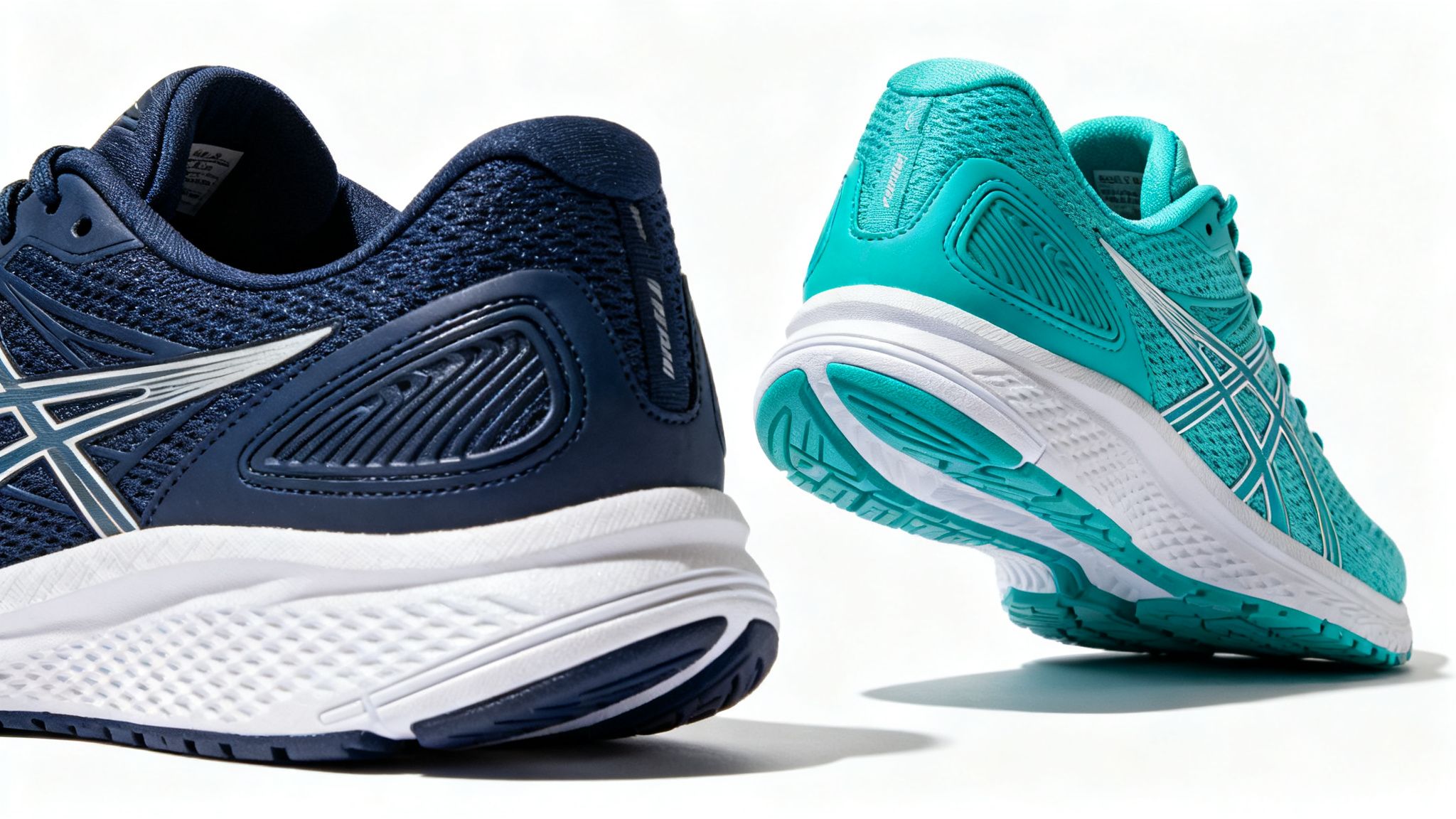
Top Stability Running Shoes for Women
These models provide solid support without feeling heavy, making them ideal for running, walking, or daily wear.
Brooks Adrenaline GTS: A stability legend featuring Brooks' GuideRails technology. This system acts like bumpers, gently steering your foot to a neutral path only when needed, perfect for moderate overpronators.
Hoka Arahi: Combines Hoka's signature plush cushioning with stability via a J-Frame design—firmer foam wrapping the heel and inner foot. It’s a top choice for soft landings with reliable support.
ASICS GEL-Kayano: A workhorse known for structured cushioning and robust support. It combines shock-absorbing GEL technology with a firm medial post to control overpronation effectively.
Top Stability Running Shoes for Men
These picks are celebrated for their sturdy construction and effective pronation control.
New Balance Fresh Foam X 860: A stability powerhouse with a supportive medial post and a roomy toe box. It’s a go-to choice for daily training and long-distance comfort.
Brooks Beast / Ariel: The pinnacle of motion control. The Beast (men) and Ariel (women) are built on a straighter last with extended GuideRails for maximum support, ideal for severe flat feet or heavier runners.
Saucony Guide: A modern, flexible take on stability. It uses a TPU guidance frame for gentle support that doesn't feel clunky, great for mild to moderate overpronators seeking a responsive feel.
Comparison of Wellbeing Trends: Stability vs. Barefoot
Trend | Philosophy | Pros for Flat Feet | Cons for Flat Feet |
|---|---|---|---|
Stability Shoes | Provide external structure to control pronation and support the arch. | Corrects alignment, reduces strain on joints, provides immediate comfort. | Can feel rigid; relies on external support rather than building foot strength. |
Barefoot/Minimalist | Encourage natural foot movement to strengthen intrinsic foot muscles. | May improve proprioception and strengthen foot muscles over time. | Lacks necessary support, can worsen symptoms of overpronation, high risk of injury. |
For individuals with symptomatic flat feet, stability shoes are the recommended approach for managing pain and preventing further issues.
Deep Dive Into Top Footwear Brands
Understanding a brand's core philosophy can make you a smarter shopper. Companies like Brooks, New Balance, and Saucony invest heavily in biomechanical research to solve the problems faced by people with flat feet.
Brooks: Guiding Your Stride
Brooks' signature GuideRails technology is a key innovation. Instead of a rigid post, GuideRails act like bumpers on both sides of the heel, engaging only when your foot rolls too far inward or outward. This holistic support system gently guides your foot into alignment, helping reduce pain in your knees and hips.
New Balance: The Perfect Fit
New Balance is celebrated for offering shoes in multiple widths, a critical feature for those with flat feet, which are often wider. A shoe that's too narrow negates any supportive benefits. By providing options from narrow to extra-wide, New Balance ensures their stability features, like medial posts and firm midsoles, work as intended.
Saucony: Stability Meets Responsiveness
Saucony balances traditional stability with a modern, flexible feel. Models like the Guide series use a TPU guidance frame or a hollowed-out medial post. This provides the necessary structure to control overpronation without making the shoe feel heavy or stiff, offering a responsive and energetic ride.
Much of the academic research focuses on the medical condition of flat feet rather than specific footwear efficacy. You can learn more about these research trends to see why understanding brand technology is so vital for making an informed choice.
Wellness Strategies Beyond The Shoe Box
The right shoes are a crucial first step, but a holistic approach yields the best results. Combining supportive footwear with targeted exercises and, if needed, orthotics, creates a total support system for your feet.
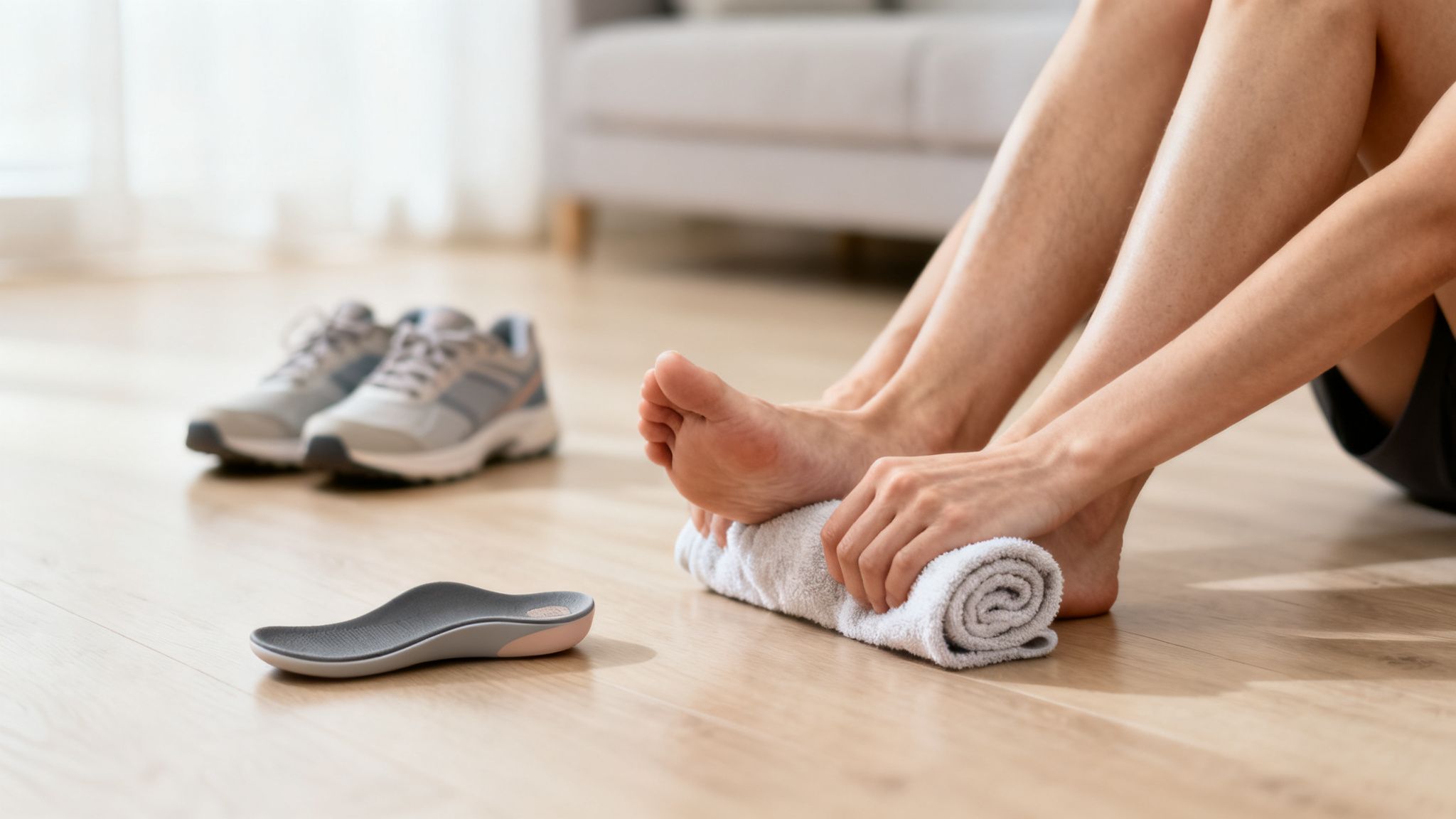
Informative Health Information: Stretches and Exercises
Strengthening the intrinsic muscles that support your arches is key. A consistent routine can significantly improve foot function.
Towel Curls: Sit in a chair with a small towel on the floor. Use your toes to bunch up and pull the towel toward you. Aim for 10-15 reps.
Calf Stretches: Tight calf muscles can worsen flat feet. Stand facing a wall, step one foot back, and lean in to feel a gentle stretch. Hold for 30 seconds per leg.
Arch Lifts: While sitting with feet flat, lift your arch without curling your toes. This small movement activates key arch-supporting muscles.
The Role Of Orthotics And Inserts
Orthotics, or shoe inserts, provide an extra layer of customized support. They act as a scaffold for your foot, filling the gap where the natural arch has fallen to reduce strain.
For mild cases, an over-the-counter (OTC) insert may suffice. For significant pain or severe overpronation, a custom orthotic from a podiatrist offers precise, molded support. This is especially important considering how common flat feet are. Some studies on pediatric flatfoot show a prevalence between 21-59% in children (Uden et al., 2017), highlighting the importance of early support.
Your Common Questions Answered
Navigating the world of supportive footwear can be confusing. Here are answers to some common questions.
Can The Right Shoes Actually Correct Flat Feet?
No, supportive shoes cannot permanently create an arch. Like glasses for vision, they provide support and proper alignment while you wear them. This is crucial for managing pain and preventing strain, but they do not change the foot's underlying structure.
How Often Should I Replace My Shoes?
Due to the extra stress from overpronation, the supportive midsole of shoes breaks down faster. A good rule of thumb is to replace athletic shoes every 300-500 miles, or every 6-8 months of consistent use. Look for signs of wear, like a compressed midsole or a heavily worn outsole on the inner edge.
Are Minimalist Or Barefoot Shoes A Good Idea?
Generally, minimalist or barefoot shoes are not recommended for symptomatic flat feet. They lack the essential features needed—arch support, a solid heel counter, and a stable midsole. Wearing them can worsen symptoms by allowing the foot to collapse, increasing strain on the entire kinetic chain.
Do I Need Different Shoes For Walking And Running?
Yes, it's a smart move. Running generates much greater impact forces than walking. Running shoes are built with more cushioning and stability features to handle this shock. While a stability running shoe can work for walking, using a walking shoe for running does not provide adequate shock absorption and can lead to injury.
References
Gijon-Nogueron, G., Martinez-Nova, A., Alfageme-Garcia, P., Montes-Alguacil, J., & Evans, A. M. (2017). International normative data for the Foot Posture Index (FPI-6). Journal of foot and ankle research, 10, 9.
Uden, H., Scharfbillig, R., & Causby, R. (2017). The supportive evidence for supported employment in the pediatric flatfoot and a proposal for a new approach: a narrative review. Journal of foot and ankle research, 10(1), 1-10.
At Flourish-Everyday, we believe the right information empowers you to make the best choices for your wellness journey. Find expert reviews and guides on the best supportive footwear for your active lifestyle at https://www.flourish-everyday.com.
Comments