Ankle Mobility Exercises for Squats to Unlock Deeper Squats

Updated: Jan 27
Many health influencers on social media are recommending heavy weight exercises for life longevity and overall health. One of the best exercises is the squat. Regardless of which form of squat you prefer, the squat has long been an essential part of weightlifting.
If you’ve hit a wall with your squat depth, the problem might not be your hips or your back, it’s often your ankles. Poor range of motion in the ankle, specifically dorsiflexion (pulling your toes toward your shin), can prevent a deep, full range squat. When you can't bend your ankle enough, your body compensates in ways that can hinder progress and increase injury risk. This guide provides targeted ankle mobility exercises for squats to help you build a stronger, deeper, and safer squat.

Table of Contents
Why Ankle Mobility Is the Foundation of a Better Squat
Many lifters focus on hip flexibility and core strength, overlooking the critical role of the ankles. Your body is a kinetic chain; if one link is stiff, the others must compensate. In a squat, your ankles are the first link. When ankle dorsiflexion is limited, a cascade of form breakdowns begins as your body finds risky ways to get lower.
Here’s what that compensation looks like:
Heels Lift Off the Ground: This is the most obvious sign. Your body tries to create artificial dorsiflexion by lifting your heels, which throws your weight forward and makes the lift unstable.
Chest Collapses Forward: Because your knees can't track forward, your torso leans over to keep you from falling backward. This puts unnecessary strain on your lower back.
Knees Cave Inward (Valgus Collapse): As your body struggles for stability with restricted ankles, the knees often buckle inward, which can lead to knee injuries over time.

The Real World Biomechanics
Proper ankle dorsiflexion lets your shins travel forward over your feet, allowing your hips to sink down between your heels. Without it, your hips get pushed too far back, killing your depth and robbing you of power. This is a solvable problem. By adding specific ankle mobility exercises into your routine, you can directly address these restrictions and build a safer, stronger squat from the ground up.
Before you start, you need a baseline. The Knee-to-Wall Test is a simple diagnostic to measure your ankle dorsiflexion.
How to Do the Knee-to-Wall Test
You will need a wall and a tape measure.
Get Set: Face a wall in a half kneeling position, with your front foot's big toe a few inches from the wall.
Drive the Knee: Slowly push your knee straight forward to touch the wall, keeping your front foot completely flat. Do not let your heel lift up.
Find Your Max: Inch your foot backward until you find the furthest point where your knee can still touch the wall with your heel glued to the floor.
Measure and Switch: Measure the distance from your big toe to the wall. Test the other side to check for imbalances.
What Your Results Mean
Good Mobility (5+ inches): If you can get your big toe more than 5 inches from the wall, your ankle mobility is likely not holding back your squat.
Restricted Mobility (Less than 5 inches): Anything under 5 inches points to a significant restriction in ankle dorsiflexion that is likely impacting your squat form.
It is common to have a difference between ankles, often due to an old injury or movement habits. A study found that poor ankle mobility directly affected the ability of subjects to perform deep squats (1). Using this test provides a clear path to improving your squat.
The Most Effective Ankle Mobility Exercises for Squats
You have your baseline; now it's time to improve it. The following exercises tackle both tight muscles and stiff joint capsules, which is key for effective mobility work. Performing these drills for just a few minutes before your leg days can make a significant difference.
Weighted Goblet Squat Ankle Stretch
This exercise uses a weight (kettlebell or dumbbell) as a counterbalance to help you sit deep into a squat and focus on dorsiflexion.
Grab a light kettlebell and sink to the bottom of your squat, keeping your heels on the floor. Gently use your elbows to press your knees outward and rock side to side. Breathe and relax into the stretch. This helps your ankles get comfortable in that end-range of motion under load.
Kettlebell Assisted Ankle Dorsiflexion
This movement targets one ankle at a time for an intense, focused stretch, addressing tightness in the calf muscles and Achilles tendon.
Get into a half kneeling position.
Rest a kettlebell on top of your front knee.
Keeping your heel planted, let the kettlebell's weight gently push your knee forward over your toes.
Hold for a couple of seconds, then ease off. Pulse into the stretch for several reps.
The targeted pressure helps release soft tissue restrictions. For more ways to boost performance, see our guide on the top 8 mobility exercises for athletes to unlock performance.

Banded Joint Mobilization
This drill targets the joint capsule itself. Sometimes the talus bone in your ankle gets "stuck" and needs help gliding properly.
Loop a heavy resistance band around a low anchor point. Step your foot into the band, positioning it where your foot meets your shin. Walk forward to create tension, then drop into a lunge. As you drive your knee forward, the band pulls the talus bone backward, helping restore proper joint mechanics.
Wall Calf Stretch (Gastrocnemius and Soleus)
Tight calf muscles are a major cause of poor ankle mobility. Your calf has two main muscles, the gastrocnemius and soleus, which require different stretches.
To stretch both muscles:
Gastrocnemius Stretch: Face a wall and step one foot back. Keep the back leg straight and heel pressed to the floor. Lean in to feel the stretch in your upper calf.
Soleus Stretch: From the same position, bend the knee of your back leg while keeping your heel down. The stretch will shift lower, targeting the soleus.
Eccentric Calf Raises
Mobility requires strength and control. Eccentric calf raises build control in the stretched position.
Stand on the edge of a step with your heels off. Press up with both feet into a calf raise. Lift one foot off and slowly (3-5 seconds) lower the other heel down as far as mobility allows. This controlled lowering strengthens muscles and tendons while they are stretched, building resilient, mobile ankles. Integrate these drills into a well rounded beginner gym workout plan for the best results.

Ankle Mobility Exercise Programming Guide
Exercise | Focus | When to Perform | Sets & Reps / Duration |
|---|---|---|---|
Weighted Goblet Squat Stretch | Muscle | Warm-up (before squats) | 2 sets of 30-60 seconds |
Kettlebell-Assisted Dorsiflexion | Muscle | Warm-up or cool-down | 2 sets of 10-12 reps per side |
Banded Joint Mobilization | Joint | Warm-up (before squats) | 2 sets of 15-20 reps per side |
Wall Calf Stretch (Gastroc/Soleus) | Muscle | Cool-down or on rest days | 2 sets of 30 sec holds (each) per leg |
Eccentric Calf Raises | Muscle | After workout | 3 sets of 10-15 reps per side |
Common Squat Flaws That Signal Poor Ankle Mobility
Your squat form tells a story. Learning to spot common form breakdowns that indicate poor ankle mobility is the first step to fixing the problem. Once you identify these compensations, you can apply targeted mobility work for better progress and long term joint health.
Heels Lifting Off the Floor
This is the most obvious red flag. If your heels lift, your body is faking dorsiflexion to allow your shins to travel forward. Squatting on your toes is unstable, shifts tension away from your glutes and hamstrings, and puts excessive pressure on your knees.
Excessive Forward Lean
If your squat resembles a "good morning," your ankles may be locked up. When your knees can't track forward, your body must shoot your hips backward to maintain balance, causing your chest to collapse. This turns a leg dominant movement into one that stresses your lower back. Research confirms that limited ankle dorsiflexion is strongly correlated with forward lean in a squat (2).
Knees Caving Inward
Knee valgus, where your knees collapse inward, is often a direct result of stiff ankles, though weak glutes can also contribute. When ankles can't bend, your feet often roll inward (pronate) to gain extra range. This starts a chain reaction up the leg, forcing the knees to follow and placing dangerous stress on knee ligaments. Improving hip flexibility can also help address this issue; learn more in our guide on how to improve hip flexibility and unlock movement.
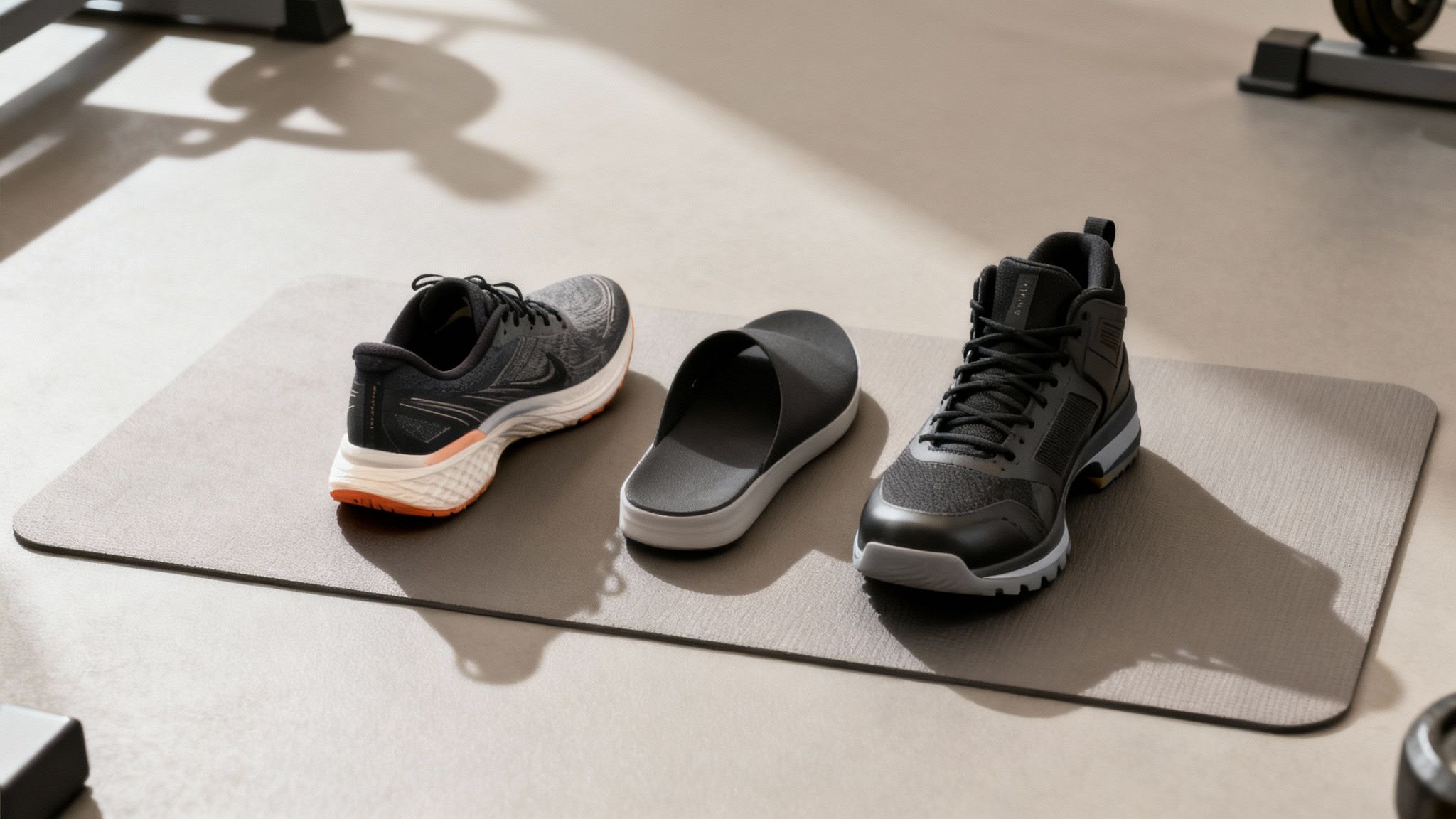
How Your Choice of Shoes Impacts Your Squat
While ankle mobility exercises for squats create lasting change, your footwear can significantly impact your performance right now. The right shoes support your mechanics, while the wrong ones work against you. A soft running shoe creates instability, whereas a solid lifting shoe provides a firm base to generate power.
The Role of Heel Elevation
The most important feature of a squatting shoe is the heel-to-toe drop. A raised heel provides artificial ankle mobility, reducing how much your own ankles must bend to keep your chest up and heels down. For those with tight ankles, this can make all the difference, but it should be seen as a tool, not a permanent fix.
Comparing Common Gym Footwear
Different gym shoes are designed for different purposes and will affect how you move.
Athletic Shoe Comparison for Squatting
Shoe Type | Key Feature | Impact on Ankle Mobility | Best For |
|---|---|---|---|
Soft, cushioned sole; high 8-12mm drop | Creates instability, negating the benefit of the heel drop. | Running, walking—anything but heavy squats. | |
Zero-drop, thin sole | Requires maximum natural ankle mobility; unforgiving. | Lifters with excellent mobility who want to build foot strength. | |
Stable base, modest 4-7mm drop | Provides a stable foundation with slight assistance. | All-around gym use, CrossFit, and general strength training. | |
Hard sole, high 15-25mm drop | Significantly reduces the need for ankle mobility. | Heavy squatting, Olympic weightlifting, and powerlifting. |
For a deeper dive, check out our breakdown of good shoes for squats and deadlifts.
Making the Right Choice for Your Goals
The best shoe depends on your current mobility and goals. A cross-trainer is often a good middle ground, offering support without masking the mobility problem. For competitive lifters, a dedicated weightlifting shoe is essential for stability and force transfer. The right shoe supports your training while you work on improving your natural range of motion.

Common Questions About Squat Mobility
Here are answers to some common questions about improving ankle mobility for squats.
How Often Should I Be Doing These Drills?
Consistency is more important than intensity. Aim for 5-10 minutes of focused work 3-5 times per week. Integrating the drills into your warm-up on leg days is an effective strategy, as it prepares your ankles for the session ahead. A light mobility session on rest days can also aid recovery.
Can This Ankle Stuff Actually Help My Knee Pain?
Yes, it often makes a significant difference. When ankles are locked up, the knees often compensate by caving inward or tracking improperly, which puts unhealthy stress on the joint. Improving ankle dorsiflexion allows the knees to track correctly over the feet, distributing the load more evenly across your hips, knees, and ankles, which can alleviate strain related knee pain.
Why Does One of My Ankles Feel Way Tighter Than the Other?
Imbalances are very common and can be caused by old injuries, your dominant side, or sport specific movement patterns. If you notice one side is tighter during the Knee-to-Wall Test, give that ankle extra attention by performing an extra set of mobility drills on that side. The goal is to ensure your tighter side has enough mobility to squat correctly without forcing compensation.
Will Lifting Shoes Fix My Ankle Mobility Problem?
Weightlifting shoes with a raised heel are a tool that works around poor ankle mobility; they do not fix it. The elevated heel reduces the dorsiflexion required for a deep squat, which can instantly improve your form. Use them as a training aid to practice better squat patterns while you continue to perform your ankle mobility exercises for squats. Relying solely on the shoes masks the underlying issue.
At Flourish-Everyday, we believe that having the right information and gear is essential for your wellness journey. From detailed shoe reviews to practical fitness guides, we provide the resources you need to perform at your best. Explore our site to find everything you need to support a healthier, happier you. https://www.flourish-everyday.com
References
Lima, Y. L., Ferreira, V. M. L. M., de Paula Lima, P. O., Bezerra, M. A., de Oliveira, R. R., & Almeida, G. P. L. (2018). The association between ankle mobility and deep squatting in asymptomatic individuals. Gazzetta Medica Italiana - Archivio per le Scienze Mediche, 177(4), 143-148. Sourced from https://www.ncbi.nlm.nih.gov/pmc/articles/PMC5036723/.
Nuckols, G. (2017). Ankle Mobility and Squat Form. Stronger By Science. Sourced from https://www.strongerbyscience.com/research-spotlight-ankle-mobility/.
