A Runner's Guide to Proper Running Shoe Fit
- Flourish Everyday Health And Fitness
- 7 hours ago
- 16 min read
A good running shoe fit is everything. It means finding a shoe that feels like a natural extension of your foot—one that supports your unique shape and running style without getting in the way. We’re talking about leaving a half-inch of space at the toe, getting that heel and midfoot locked in, and giving your toes enough room to spread out. Get these wrong, and a great run can turn into a painful mess.
Introduction: Your Foundation for a Better Run
Before you even start your watch or think about your pace, let's talk about the single most important piece of gear you own: your shoes. Finding the right fit isn’t about chasing the latest colorway or brand hype. It's about preventing injuries, running more efficiently, and actually enjoying your miles. A bad fit can lead to all sorts of trouble, from blisters and blackened toenails to more serious problems like plantar fasciitis.
This guide is your roadmap to getting it right. I'll walk you through everything, from how to measure your feet at home to understanding what your gait means for your shoe choice.
Table of Contents
The Importance of the Right Fit
We’re going to bust the myth that your casual shoe size is your running shoe size (it’s almost never the same). I'll give you the inside scoop on how to properly test-drive a shoe in-store and how to pick one that truly supports your foot type. Think of this as a personal consultation to find the perfect running partner for your feet.
And it’s not just us runners who know how critical this is. The global demand for quality athletic footwear is massive—the market was valued at USD 110.91 billion and is expected to hit nearly USD 169 billion by 2032 (Fortune Business Insights, 2024). You can discover more insights about the growing sports footwear market and its trends, but the bottom line is clear: good shoes matter.
A lot of people think running shoes should feel tight. That's a huge mistake. Your feet naturally swell when you run, so a shoe that feels snug at the start will feel like a vice by the end of your workout.
Before we dive into the nitty-gritty of measurements and tests, here’s a quick-glance table to keep in your back pocket. It covers the absolute essentials of a good fit—the things you should check for every single time.
Quick Fit Checklist At a Glance
Fit Checkpoint | What to Look For | Why It Matters |
|---|---|---|
Toe Room | About a thumb's width (1/2 inch) of space. | Prevents bruised toenails and blisters as feet swell. |
Heel Security | Snug fit with no slipping or rubbing. | Stops blisters and ensures stability on uneven ground. |
Midfoot Hold | Secure but not tight; the shoe should move with you. | Keeps your foot from sliding, providing a stable platform. |
Width | No bulging or pinching at the sides. | Allows your foot to splay naturally for better balance. |
This table is your starting point. Now, let's get into the details of how to check each of these points like a pro.
How to Accurately Measure Your Feet at Home
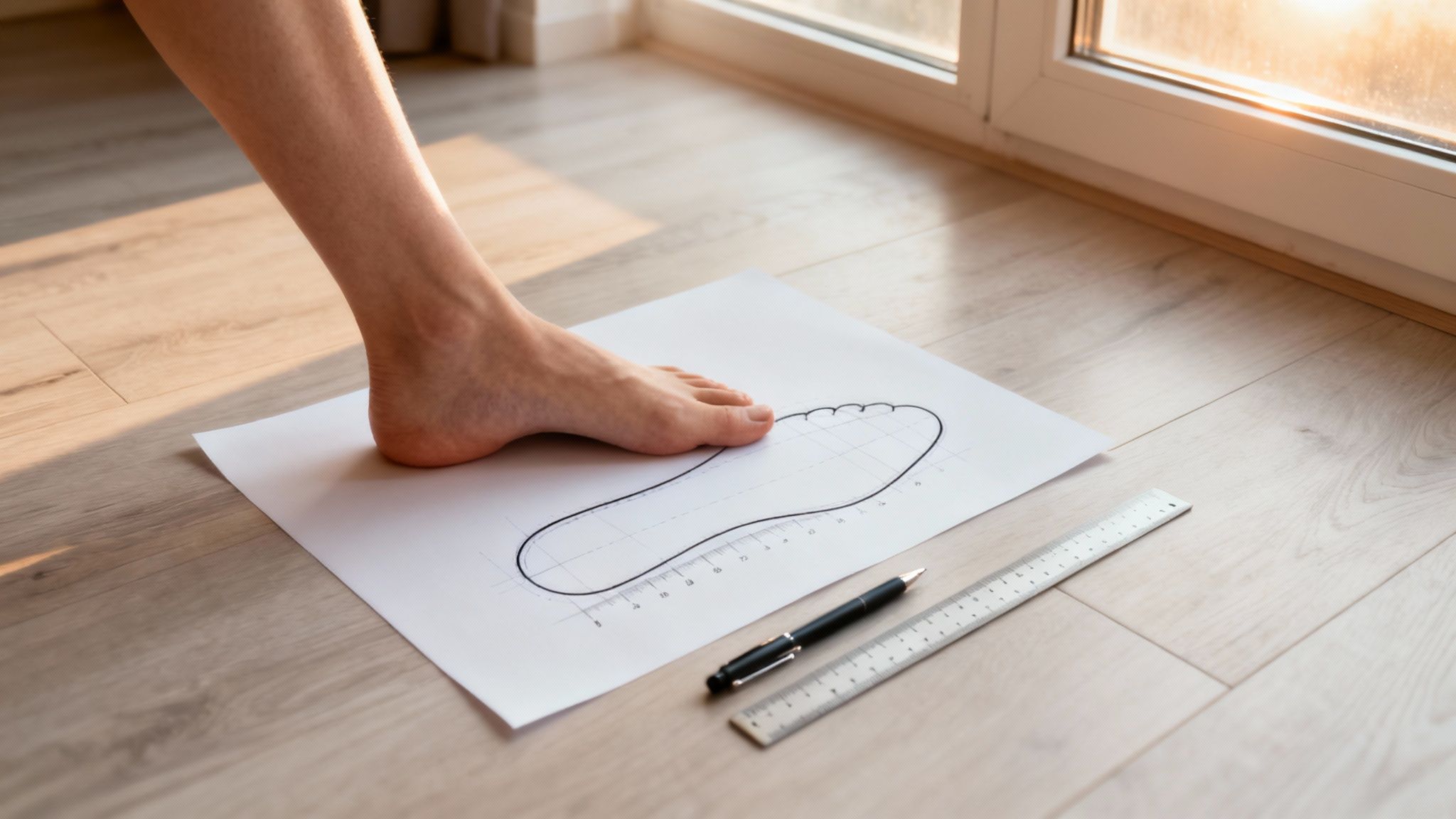
Before you even start looking at shoe models, the very first step is figuring out your true size. I can't tell you how many runners make the mistake of relying on a shoe size they wore years ago. Your feet change—it's a fact of life. Age, how active you are, and even weight changes can affect their size and shape.
Here’s a pro tip I always share: measure your feet in the evening. They naturally swell throughout the day from being on them. A measurement taken in the afternoon or evening gives you the most realistic size for a running shoe, preventing that all-too-common feeling of a shoe that's perfect in the morning but painfully tight by mile three.
The Simple Tracing Method
You don’t need any fancy gadgets to get this right. Just grab a few things you probably already have at home.
Here's what you'll need:
A piece of paper that’s bigger than your foot.
A pen or a fine-tipped marker.
A ruler or measuring tape.
The same socks you’d normally wear for a run.
Got everything? Good. Now, find a hard, flat surface. Sit down in a chair and stick the paper on the floor right in front of you. Place one foot firmly on the paper, making sure you're wearing your running socks.
Lean forward just a bit. You want to put your full weight on that foot because it mimics the natural splay that happens when you're running. Now, carefully trace the outline of your foot. Keep the pen as straight up and down as you can, hugging your foot closely. This helps avoid an outline that's bigger than your actual foot. Once you’re done, do the exact same thing for your other foot.
Don't be surprised if you get two different measurements. It's incredibly common for one foot to be slightly larger than the other. Always, always go with the size of your larger foot. It guarantees both feet will be comfortable.
Measuring Length and Width
Okay, now grab your ruler and let's measure that tracing. For the length, measure from the very back of the heel to the tip of your longest toe. And don't just assume your big toe is the longest one—for a lot of people, it's actually the second toe.
Next up is the width. Measure the distance between the two widest points on your foot's outline. This is usually right across the ball of your foot. Jot down both the length and width for each foot in either inches or centimeters.
To turn these numbers into a shoe size, you’ll need to check a brand's specific sizing chart since they can vary. To get it just right, it’s really helpful to know how to accurately measure your shoe size at home for the perfect fit. These measurements are your personal baseline, giving you the power to make a much smarter choice, whether you’re shopping in a store or online.
Putting Shoes to the Test in the Store
Okay, you’ve got your foot measurements. Now for the most important part: trying on shoes in person. This is more than just seeing if it fits; you’re giving that shoe a proper test drive. Getting this right is what separates a pretty good shoe from your perfect shoe.
One of the first things to check is what we runners call the "rule of thumb." Once you've got the shoe on and laced it up, you need about a half-inch of space between the end of your longest toe and the tip of the shoe. That's roughly the width of your thumb. This space is absolutely essential. It gives your foot room to swell and slide forward as you run, which prevents your toes from slamming into the front—the culprit behind those dreaded black toenails.
Checking the Width and Heel Lock
With the length sorted, let's look at the width. The shoe should feel snug and secure over the ball of your foot, but it shouldn't feel squeezed or pinched. Your foot has to be able to splay out naturally when it hits the ground; that's critical for stability. If you look down and see the sides of your foot bulging over the midsole, that’s a dead giveaway the shoe is too narrow.
Next up is the heel. Lace the shoes up snugly, using all the eyelets, and stand up. Your heel should feel locked in and secure. As you walk around the store, pay close attention to any slipping or rubbing. A tiny bit of movement can sometimes be okay, but if your heel is noticeably sliding up and down, that’s a recipe for blisters and a wobbly, unstable ride.
The Motion Test is Everything
Here’s the thing: you can't really know a shoe just by standing in it. A static fit check only gives you part of the picture. The real test comes when you actually start moving.
This is why you absolutely have to take the shoes for a quick jog. Most specialty running shops will have a treadmill just for this reason. If not, don't be shy—ask if you can take them for a quick jog on the sidewalk outside.
During this mini test run, you're looking for a few key things:
No Hot Spots: Do you feel any weird pinching or rubbing anywhere? Check around your toes, arch, and especially the heel.
A Smooth Ride: The shoe should feel like it’s working with you, not against you. It should complement your natural stride from the moment your heel hits the ground to when your toe pushes off.
Pure Comfort: Honestly, the best shoe is one you forget you're even wearing. If anything feels awkward or "off," trust your gut. It's not the right shoe for you.
Don't forget to bring the socks you normally run in! The thickness of your running socks can make a huge difference in how a shoe fits compared to thin everyday socks. It’s a small detail that can turn a perfect fit into one that’s just a little too tight.
When you carefully check all these boxes—length, width, heel security, and how it feels in motion—you can leave the store knowing you've found a shoe that will have your back, mile after mile.
Matching Your Shoe to Your Foot Type and Gait
Finding the perfect fit is about more than just length and width. It's about finding a shoe that works with your body, not against it. Your unique movement patterns are the key to unlocking real comfort and preventing those frustrating running injuries, like a nagging back of knee pain. This whole conversation starts with a concept called pronation.
Pronation is just the natural way your foot rolls inward when you move, from the moment your heel hits the ground to when you push off with your toes. It’s a completely normal shock-absorbing process. The amount your foot rolls, however, determines the kind of support you’ll need from your shoes. Get this right, and you'll have technology that supports you instead of fighting you.
Understanding Your Pronation Style
There are three main flavors of pronation. Figuring out which one is yours is the first real step to narrowing down your shoe search.
Neutral Pronation: This is the ideal. Your foot rolls inward about 15 percent, which is just right for absorbing shock and keeping your legs and knees happy and aligned.
Overpronation: Your foot rolls inward a bit too much, which can create instability. This often goes hand-in-hand with flat or low arches and can put extra strain on your shins, knees, and even hips.
Supination (or Underpronation): The opposite of overpronation. Your foot doesn't roll inward enough, forcing the outer edge of your foot to take most of the impact. This is pretty common for runners with high arches and can lead to things like IT band syndrome.
So many runners don't even realize their chronic aches are directly tied to wearing the wrong shoe for their pronation. For a runner with flat feet who overpronates, a stability shoe isn't just a gimmick—it's a potential game-changer.
Find Your Arch Type with the Wet Test
You can get a surprisingly good read on your arch profile right at home with the simple "wet test." It's a quick, easy way to see your footprint, which gives you a great clue about your pronation.
Find a shallow pan and pour a thin layer of water into it.
With one bare foot, step into the water.
Carefully step out onto a piece of cardboard or a dark towel—anything that will show a clear outline of your wet foot.
Take a look at the footprint you left.
The shape of that wet spot tells a story. If you see a full, wide footprint, it suggests you have flat or low arches, which often means you overpronate. If you can see about half of your arch, you probably have neutral arches. And if you only see your heel and the ball of your foot connected by a thin line, you have high arches—a classic trait of supinators.
Connecting Your Foot Type to Shoe Categories
Once you have a better idea of your arch and pronation style, you can start matching it to the right running shoe category. This is where you can really see how the industry has focused on delivering a proper running shoe fit.
The global running shoe market is set to hit USD 35.81 billion by 2033 (Transparency Market Research, n.d.), and that growth is fueled by people like us who understand that one size does not fit all. Brands are constantly innovating with different types of shoes for every need imaginable.
Neutral Shoes: These are your go-to if you have neutral pronation or maybe just a little supination. They're all about cushioning and flexibility without any extra corrective tech.
Stability Shoes: Perfect for runners who have mild to moderate overpronation. These shoes use features like guide rails or firmer foam on the inside of the midsole to gently control that inward roll. If this sounds like your foot, you should check out our guide to running shoes for stability.
Motion Control Shoes: These are the heavy-hitters, built for severe overpronators. They are the most supportive shoes you can get, with stiff heels and dense materials to keep excessive foot motion in check.
This flowchart can help you visualize the steps to finding a shoe that really works for your foot.
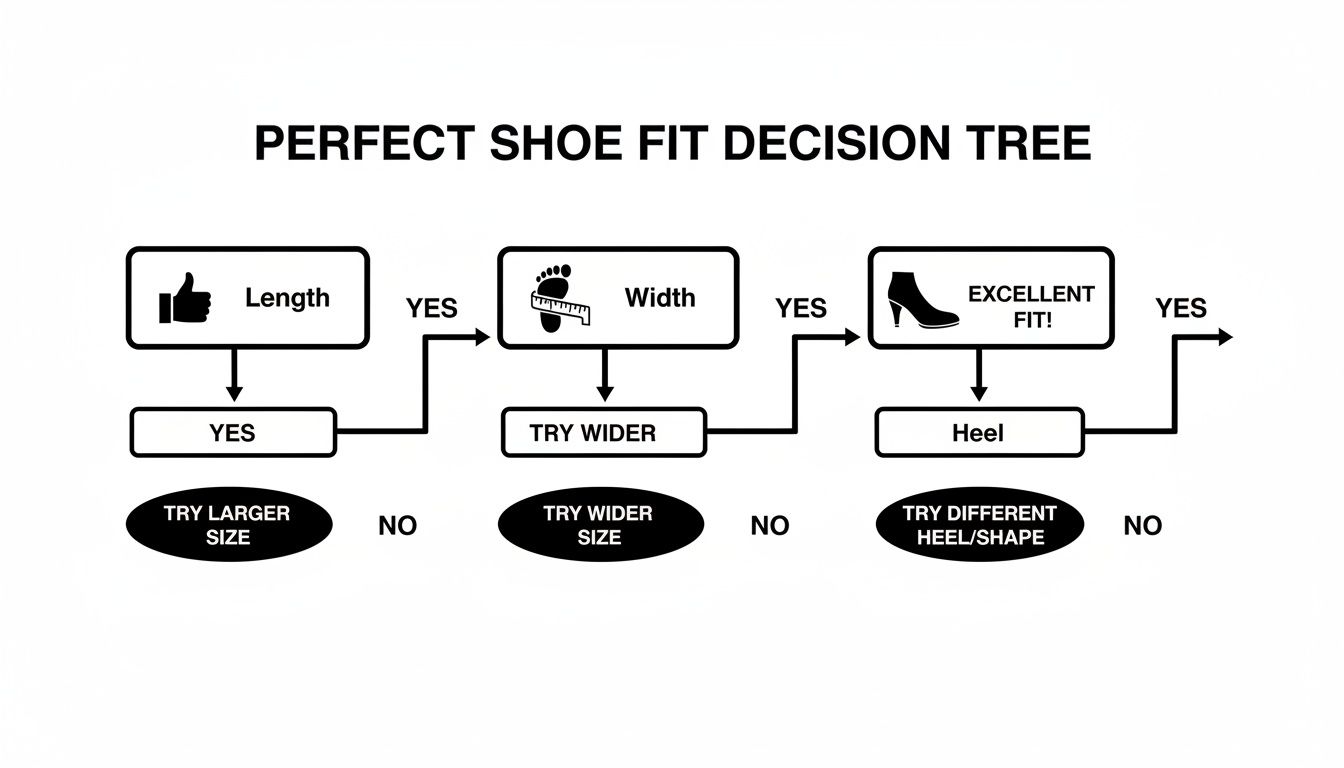
As the chart shows, a great fit is a process. You have to move from checking the overall length to the width, and finally, making sure your heel is locked in securely. Skipping a step can mean the difference between a great run and a painful one.
Navigating Online Shopping and Special Considerations
Sometimes, getting the perfect running shoe fit means dealing with a few extra curveballs. You might be working with custom orthotics or trying to pick the right pair from an online store without ever trying them on. Let's walk through how to handle these special scenarios like a pro.
If you rely on custom orthotics or even over-the-counter inserts, finding a shoe that plays nice with them is a top priority. The single most important thing to remember is to always remove the shoe's original insole before you slide yours in. This makes room inside the shoe, stopping your foot from being smashed against the top and ensuring your orthotic can do its job properly.
Buying Running Shoes Online
The convenience of shopping online is hard to beat, but it definitely comes with the risk of getting a shoe that just doesn't fit. With a bit of smart strategy, though, you can seriously lower your chances of a frustrating return. It's all about doing your homework first.
Read Fit-Specific Reviews: Don't just look at star ratings. Hunt down reviews where people talk about sizing. Do they say the shoe runs true to size, small, or large? Pay close attention to comments about the toe box width and how secure the heel feels.
Stick with What You Know: If you're new to buying shoes online, a great starting point is to buy an updated model of a shoe you already own and love. Brands usually keep a similar fit and feel within the same shoe line from year to year.
Check the Return Policy: This is a deal-breaker. Only buy from a retailer that has a generous, no-fuss return policy. Ideally, you want one that lets you jog around your living room to test them out.
Here's a pro tip for online shoppers: try to find the same model—or at least the same brand—at a local store to try on first, even if you plan to buy it online. This gives you a real feel for how that brand's sizing works and can save you a world of trouble. Knowing a brand's quirks is key, which is why our definitive sizing guide on how Asics fit can be a huge help.
Deciding where to buy can be tough, as both online and in-store options have their perks.
Online vs In-Store Shoe Shopping
Feature | In-Store Shopping | Online Shopping |
|---|---|---|
Fit Expertise | Access to trained staff for gait analysis and personalized recommendations. | Relies on reviews, size charts, and your own knowledge. |
Try-On Ability | You can try on multiple pairs and test the fit immediately. | You have to wait for shipping and handle returns if they don't fit. |
Selection | Limited to the inventory the store has on hand. | Virtually unlimited selection of brands, models, and colors. |
Price & Deals | Prices may be higher, though sales and loyalty programs exist. | Often more competitive pricing and easier to find discounts. |
Convenience | Requires a trip to the store during business hours. | Shop anytime, anywhere, and have shoes delivered to your door. |
Ultimately, the best choice depends on what you value most—expert guidance and a guaranteed fit, or selection and convenience.
Considering Your Running Terrain
The ground beneath your feet massively changes what you need from a shoe. A cushy road shoe just won't cut it on a rocky, uneven trail, and a rugged trail shoe will feel clunky and stiff on the pavement.
Brands are now making hyper-specialized shoes for every kind of runner and terrain imaginable. This is fantastic news for us, as it means you can find a shoe dialed in for exactly what you need. You can dig into the full research on the expansion of the running shoe market to see how this trend is playing out.
Here’s a quick rundown of what to look for based on where you run:
Feature | Road Running Shoes | Trail Running Shoes |
|---|---|---|
Fit Focus | Comfort and breathability with a forgiving feel. | A snug, secure lockdown to prevent your foot from sliding around. |
Upper Material | Lightweight mesh for maximum airflow. | Durable, often water-resistant materials with protective overlays. |
Outsole | Flatter, designed for grip on asphalt and concrete. | Deep, aggressive lugs for traction on dirt, mud, and rocks. |
Midsole | Primarily focused on cushioning and shock absorption. | Often includes a rock plate to protect you from sharp objects. |
Picking the right shoe for your terrain isn't just about a better fit—it's about having a safer, more enjoyable run. You'll be grateful you did.
Knowing When It Is Time for a New Pair
Even the most perfectly fitted running shoes have an expiration date. It's a hard truth, but pushing your shoes past their prime is one of the most common and avoidable causes of nagging injuries. Over time, the internal cushioning and support structure break down, and they stop absorbing impact like they used to.
The most common guideline you'll hear is to replace your shoes every 300 to 500 miles. If you're running about 15 miles a week, that means you'll be shopping for a new pair every five to eight months. Keeping a simple log in a running app or even a notebook is a fantastic way to stay ahead of the game.
Inspecting Your Shoes for Wear
Mileage is a great benchmark, but the real story is written on the shoe itself. Your weight, running form, and the surfaces you run on all play a huge role in how fast a shoe breaks down. It's time to start looking for a replacement when you notice these tell-tale signs.
A quick visual inspection can tell you a lot. Here's what to look for:
Outsole Wear: Flip your shoes over. Are the treads worn smooth like a bald tire? If you see significant wear in your key impact zones, the shoe has lost its grip and a good deal of its structural integrity.
Midsole Compression: Check out the foam on the sides of the shoe. If it's covered in deep, pronounced wrinkles, that foam is permanently compressed and isn't giving you the cushioning you need.
Loss of Responsiveness: A new shoe has a certain spring in its step. If your current pair feels flat, dead, or just less bouncy than you remember, the midsole has likely given up the ghost.
Here's a simple test I like to do: place your shoes on a flat table. If they wobble or lean to one side, it's a dead giveaway that the support structure has broken down unevenly. That imbalance can mess with your gait and lead to strain.
Listening to Your Body’s Feedback
Beyond what the shoe looks like, your body is the ultimate expert. Are you suddenly feeling new aches and pains in your feet, shins, or knees after a run? Your worn-out shoes are often the culprit. These new pains are your body's way of telling you it's taking more of a pounding than it should be.
Ultimately, being proactive about replacement is the final piece of the puzzle for a healthy running routine. To dive deeper into this topic, check out our evidence-based guide on how often to replace running shoes. By paying attention to mileage, physical wear, and your body's signals, you can ensure your feet always have the support they need to keep you running strong and comfortably.
Common Questions About Running Shoe Fit
Navigating the world of running shoes can stir up a lot of questions. It's a big investment in your comfort and health, so it's natural to want to get it right. Let's tackle some of the most common fitting questions I hear from runners to help you choose your next pair with total confidence.
Should I Size Up for Running Shoes?
Yes, this is one of those rules that almost always holds true. Plan on going up at least a half-size from what you wear in your everyday casual or dress shoes.
When you run, your feet naturally swell and also spread out every time they hit the ground. You need that extra space—about a thumb's width between your longest toe and the end of the shoe—to avoid things like black toenails and painful blisters.
So, if you wear a size 9 in your work shoes, a 9.5 is the perfect place to start your search for a running shoe. A great pro tip is to always try on shoes later in the day, when your feet are at their largest, to get the most accurate fit.
Forget about the number on the box for a second. Sizing is all over the place between different brands. A size 10 in a Brooks might feel completely different from a size 10 in a Hoka. What matters is how the shoe actually feels on your foot, not what the label says.
How Snug Should the Heel and Midfoot Be?
Think "secure and locked-in" but never tight or constricted.
When you're walking around or doing a light jog, your heel shouldn't be slipping up and down. Any major movement back there is a one-way ticket to blisters and can make you feel unstable on your runs.
A good fit means the shoe's upper material wraps around the middle of your foot snugly, almost like a firm handshake. It should hold you securely onto the shoe's platform without pinching or creating weird pressure points. You want the shoe to feel like it’s a part of your foot.
What If a Shoe Feels Perfect Except for One Small Spot?
We've all been there. You find a shoe that feels amazing everywhere else, but there's just one tiny spot that rubs or puts on a little pressure. Don't write it off just yet.
Before you give up, try a couple of quick fixes:
Mess with the Laces: You'd be amazed what different lacing patterns can do. A quick search for "runner's lacing techniques" will show you tricks to relieve pressure on the top of your foot or lock your heel in better.
Swap Your Socks: The thickness of your running socks can make or break a shoe's fit. Sometimes, a slightly thinner or thicker sock is all it takes to make that problem spot disappear.
If you've tried these tricks and it still isn't right, it's time to move on. That "small" issue will feel a lot bigger a few miles into a run. The right shoe for you won't ask you to just put up with discomfort.
References
Fortune Business Insights. (2024, February). Sport Footwear Market Size, Share & COVID-19 Impact Analysis. Retrieved from https://www.fortunebusinessinsights.com/sport-footwear-market-102213
Transparency Market Research. (n.d.). Running Shoes Market - Global Industry Analysis, Size, Share, Growth, Trends, and Forecast, 2023-2033. Retrieved from https://www.transparencymarketresearch.com/running-shoes-market.html
At Flourish-Everyday, we believe the right gear empowers your wellness journey. Find expert reviews and curated selections of the best running shoes to match your unique needs by visiting us at https://www.flourish-everyday.com.