How to Improve VO2 max: A Practical Guide

Updated: Jan 9
Improving your VO2 max requires getting comfortable with being uncomfortable. This means incorporating high intensity training that pushes your heart rate to 80-95% of its maximum. The most effective methods are structured workouts like High Intensity Interval Training (HIIT), tempo runs, and long, steady state cardio sessions. These workouts signal your heart, lungs, and muscles to adapt and become more efficient at using oxygen.

Table of Contents
What Is VO2 Max and Why Does It Matter
Before diving into workouts, let's define VO2 max. Think of it as the horsepower rating for your body's aerobic engine. Technically, it’s the maximum volume of oxygen (in milliliters) you can consume per minute per kilogram of body weight during maximal exertion.
A higher VO2 max is optimal for performance. It allows you to sustain a faster pace for longer because your body is better at delivering oxygen rich blood to your working muscles. This benefits everyone, from elite athletes to individuals wanting more energy for daily activities.
Understanding Your Starting Point
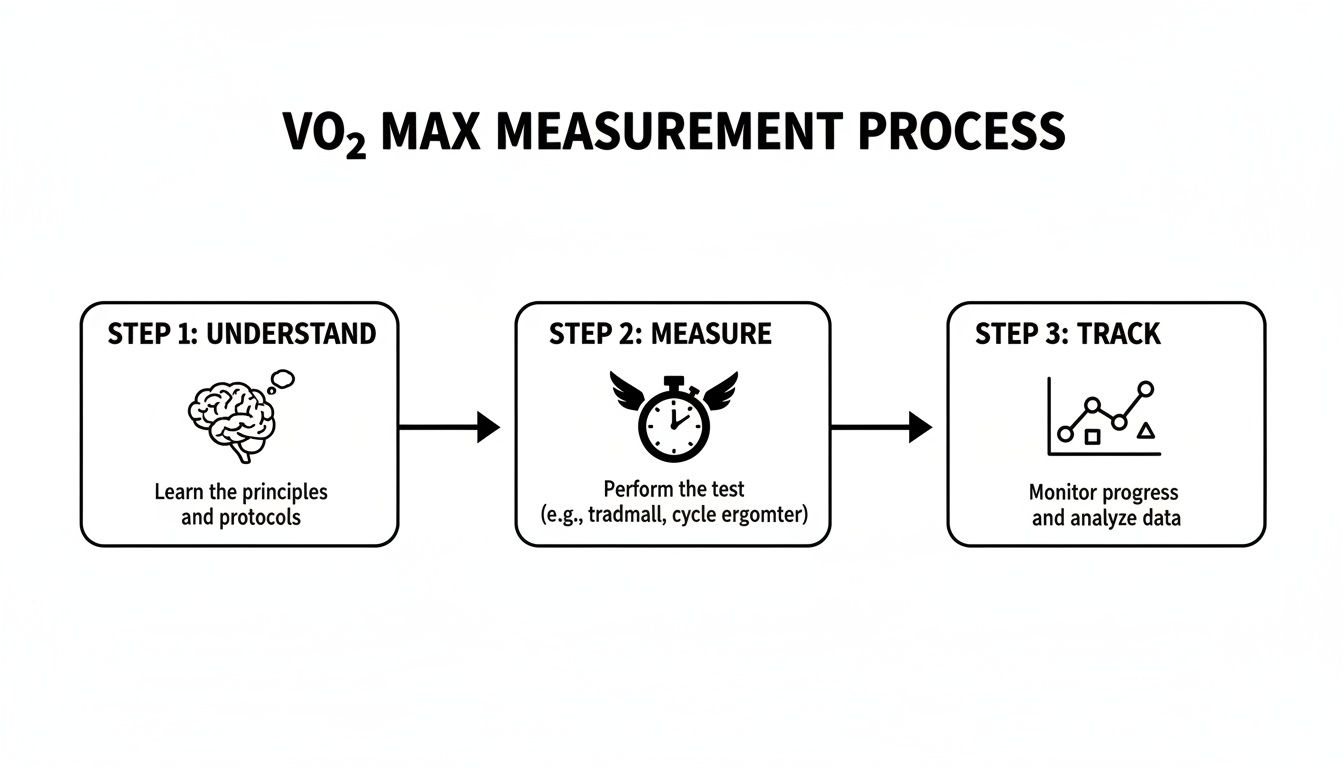
You can't improve what you don't measure. The first step is determining your current VO2 max. This baseline helps you set realistic goals and track progress.
There are several ways to measure your aerobic fitness:
Laboratory Testing: The gold standard. It involves running on a treadmill with a mask that analyzes your oxygen intake and carbon dioxide output.
Field Tests: The Cooper 12-minute run provides a good estimate. Run as far as you can in 12 minutes, then use a formula to estimate your VO2 max.
Wearable Technology: Most modern GPS watches and fitness trackers estimate VO2 max using your heart rate data. While not as precise as lab tests, they are excellent for tracking trends.
A strong VO2 max is a key component of overall cardiovascular health. It reflects the efficiency of your entire cardiorespiratory system, from your lungs to your heart and circulatory network.
How Much Improvement Is Possible
Genetics play a role in your aerobic potential, but consistent training can lead to significant gains. The well known HERITAGE Family Study found that participants improved their VO2 max by an average of about 20 percent after a 20-week training program, though individual responses varied. Your VO2 max is a dynamic number reflecting your current fitness. To learn more about the benefits, read our guide on what cardiovascular fitness is and why it matters.
Core Training Strategies to Boost Your VO2 Max
With your baseline established, it's time to train. Improving your VO2 max is about targeted training that makes your heart and lungs more efficient. You need to spend time above 90% of your maximum heart rate. This high intensity signals your body to adapt, causing your heart to pump more blood per beat and your muscles to extract oxygen more effectively.

The Power of High Intensity Interval Training
High Intensity Interval Training (HIIT) is a powerful tool for boosting VO2 max. It involves short, all out efforts followed by brief recovery periods, allowing you to spend more total time at high intensity.
A classic running HIIT workout:
Warm-up: 10-15 minutes of easy jogging.
Main Set: 4 repetitions of 4-minute runs at high intensity, followed by 3 minutes of active recovery (slow walk or jog).
Cool-down: 10-15 minutes of easy jogging.
This "4x4" protocol is supported by research. The key is pushing hard enough during the intervals to elevate your heart rate and breathing. For more ideas, see our list of 10 interval running workouts to supercharge your speed.
Building Strength with Tempo Runs
Tempo runs involve sustaining a "comfortably hard" pace, an effort you could hold for about an hour. This type of workout improves your lactate threshold, the point where lactic acid accumulates faster than it can be cleared. A higher threshold allows you to run faster for longer before fatigue sets in.
A simple tempo workout:
Warm-up: 10 minutes, easy pace.
Tempo Portion: 20-30 minutes at a 7 out of 10 effort.
Cool-down: 10 minutes of easy jogging.
The Foundation of Long Slow Distance
Long Slow Distance (LSD) runs are the foundation of endurance. Performed at a conversational pace, these runs focus on time on your feet rather than speed. They trigger adaptations that shorter workouts cannot.
LSD runs improve fuel efficiency by enhancing fat utilization, increasing mitochondrial density, and strengthening the heart muscle, all critical for a high VO2 max.
Sample Weekly Training Split to Improve VO2 Max
Day | Beginner Plan | Intermediate Plan | Advanced Plan |
|---|---|---|---|
Monday | Rest or Active Recovery | Rest or Active Recovery | Active Recovery (easy 20-30 min run) |
Tuesday | HIIT: 4x2 min hard, 2 min easy | HIIT: 4x4 min hard, 3 min easy | HIIT: 5-6x4 min hard, 3 min easy |
Wednesday | Easy Run (30-40 min) | Easy Run (40-50 min) | Easy Run (50-60 min) |
Thursday | Tempo: 15 min at tempo pace | Tempo: 25 min at tempo pace | Tempo: 2x15 min at tempo pace |
Friday | Rest | Rest or light cross-train | Easy Run (30-40 min) |
Saturday | LSD Run: 45-60 min easy | LSD Run: 60-75 min easy | LSD Run: 75-90+ min easy |
Sunday | Rest or Active Recovery | Easy Run or Cross-Train | Rest or Active Recovery |
Supporting Habits That Amplify Your Training
The real VO2 max improvements happen during recovery. Supporting habits like cross-training, strength work, nutrition, and rest are crucial for maximizing your training adaptations.
Strategic Cross-Training for Aerobic Depth
Cross-training with activities like swimming, cycling, or rowing builds your aerobic base without the high impact stress of daily running. This helps prevent burnout and overuse injuries.
Cycling: Builds leg strength and cardiovascular endurance with zero impact.
Swimming: A full body workout that improves lung capacity and core strength.
Rowing: A low impact option engaging over 85% of your body's muscles.
Building a Resilient Engine with Strength Training
Strength training improves running economy, how efficiently your body uses oxygen at a given pace. Stronger muscles mean each stride requires less energy, allowing you to run faster and longer. Focus on compound movements.
Strength training builds durability by strengthening the muscles and connective tissues around your joints, creating a more resilient frame.
Essential Strength Movements:
Squats: Build powerful quads, glutes, and hamstrings.
Deadlifts: Develop strength through your entire posterior chain.
Lunges: Improve single leg stability and balance.
Planks: A strong core is the foundation for efficient running form.
Fueling and Recovery: The Final Pieces of the Puzzle
Your body can only adapt to the training you recover from. Proper nutrition provides the energy to perform and the materials to rebuild. Use tools to determine your optimal protein intake and adjust your diet to your training load.
Prioritize 7-9 hours of quality sleep per night. During deep sleep, your body releases human growth hormone, which is critical for muscle repair and adaptation. These habits are essential for translating your hard work into a higher VO2 max.

Finding the Right Shoes for Your Workouts
The right gear is a tool that helps you stay consistent, perform better, and avoid injuries. When pushing your limits, your shoes can make or break a training cycle. Building a small rotation of shoes, each designed for a specific type of workout, is more effective than using a single do-it-all trainer.
Shoes for Intense Interval Days
For HIIT sessions and track repeats, you need a shoe that is fast, light, and responsive. Look for lightweight construction, responsive midsole foam (like Pebax), and a lower heel-to-toe drop (0-8mm) to promote a midfoot strike.
For women, some brands offer gender specific fits that account for differences in foot shape, such as a narrower heel. Always check for a women's specific model for better comfort and performance.
Long Run and Recovery Day Champions
For long, slow distance runs and recovery days, the goal is comfort and protection. These workhorse shoes should feature maximum cushioning, a stable and supportive fit, and a durable outsole to handle high mileage.
Top Athletic Shoe Recommendations for VO2 Max Training
Navigating the shoe market can be overwhelming. This table highlights well regarded models that fit different training needs.
Shoe Model | Best For | Key Features | Gender Focus |
|---|---|---|---|
Interval & Tempo Runs | Responsive PWRRUN PB foam, nylon plate for propulsion. | Men's and women's specific fits available. | |
Long & Easy Runs | Maximalist cushioning, smooth rocker geometry. | Popular with both men and women. | |
Cross-Training & Lifting | Wide, stable heel; flexible forefoot; durable upper. | Tailored men's and women's versions. | |
Daily Training & Recovery | Balanced DNA LOFT cushioning, smooth and durable. | A go-to for male and female runners. | |
Race Day & Key Workouts | Aggressive rocker, Lightstrike Pro foam, carbon-infused rods. | High performance unisex and specific models. |
How to Track Progress and Adjust Your Plan
Improving fitness requires smart adaptation. Your training plan should be a dynamic guide that evolves with you. Listening to your body and analyzing data is key to making sustainable progress and avoiding plateaus or injury.
Interpreting Your Fitness Data
Modern smartwatches provide a wealth of data. Focus on long term trends rather than daily fluctuations.
Key metrics to watch:
VO2 Max Estimate: Look for a slow, steady upward trend over several weeks.
Resting Heart Rate (RHR): A dropping RHR over time is a classic sign of improving aerobic fitness.
Heart Rate Variability (HRV): A higher HRV generally indicates good recovery.
Pace at a Given Heart Rate: Running faster at the same heart rate is a clear sign your aerobic engine is improving.
Applying Progressive Overload Intelligently
Progressive overload is the principle of gradually increasing the demands on your body. You can do this by increasing intensity, duration, or frequency.
The biggest mistake is increasing everything at once. Focus on one variable for a few weeks, let your body adapt, then adjust another. This methodical approach is key to consistent, injury-free gains.
Listening to Your Body and Adjusting
Data is a tool, but subjective feelings are just as critical. On days when your watch gives a green light but your body feels fatigued, it's wise to take it easy. Learning to auto regulate is a vital skill. Swapping a hard workout for a recovery day is a smart, strategic move for long term progress. To understand your effort levels, learn how to calculate target heart rate for workouts.

Your Top Questions About Improving VO2 Max
Here are answers to common questions about improving VO2 max.
How Long Does Improvement Take?
Most people see a noticeable difference in their VO2 max within 4 to 12 weeks of consistent, structured training. Initial gains can be significant, especially for beginners. While studies show an average increase of about 20% over 20 weeks, your personal timeline depends on your starting point, genetics, and consistency.
Do I Need a Lab Test?
A laboratory test provides the most precise VO2 max number, but it is not necessary for tracking progress. The trend is more important than the exact number. Seeing your watch's estimate climb from 42 to 45 over a few months is a clear indicator that your training is effective. Field tests like the Cooper 12-minute run and wearable technology are sufficient for most individuals.
Can I Just Walk or Lift Weights?
While beneficial for overall health, walking and strength training are not the most direct methods for improving VO2 max. The key is pushing your heart rate into high training zones (80-95% of your max). Activities like running, cycling, rowing, and HIIT are most effective because they directly challenge your cardiorespiratory system to deliver more oxygen.
References
Bouchard, C., et al. (1999). "Familial aggregation of VO2max response to exercise training: results from the HERITAGE Family Study." Journal of Applied Physiology, 87(3), 1003-1008.
Helgerud, J., et al. (2007). "Aerobic high-intensity intervals improve VO2max more than moderate training." Medicine & Science in Sports & Exercise, 39(4), 665-671.
Jones, A. M., & Carter, H. (2000). "The effect of endurance training on parameters of aerobic fitness." Sports Medicine, 29(6), 373-386.
Here at Flourish-Everyday, we know that having the right gear and knowledge makes all the difference in hitting your fitness goals. From in-depth shoe reviews to training advice backed by science, we give you the tools you need for your journey. Check out all our resources at https://www.flourish-everyday.com and take the next step toward a stronger, healthier you.


