Your Ultimate Functional Fitness Workout Plan for Real World Strength

Updated: Dec 20, 2025
A functional fitness workout plan isn't about training for the gym; it's about training for your life. It's built around compound exercises that copy the real world things you do every single day, lifting, pushing, and pulling, so that those daily tasks feel easier and safer.

Introduction
This guide offers a comprehensive look into creating an effective ultimate functional fitness workout plan. We will cover the core principles of functional movement, how to build a workout from scratch, and how to structure your weekly routine for optimal results. You'll also find advanced techniques, nutrition advice, and answers to common questions.
Index of Sections
What Exactly Is Functional Fitness Training?
Functional fitness is less about building mirror muscles and more about improving how your entire body works together as one cohesive unit. Think of it as prep for life's physical tests, like hauling grocery bags in one trip or lifting a heavy suitcase into an overhead bin.
Unlike traditional weightlifting that often targets one muscle at a time, functional exercises get multiple muscle groups and joints working in harmony. This is why it's become so popular for people who want to perform well and stay healthy for the long haul.
It's not just a fad. The American College of Sports Medicine (ACSM) highlighted Functional Fitness Training as a major trend for 2025, showing a clear shift toward practical, life ready strength (Thompson, 2024).

The Core Principles of Functional Movement
Any solid functional fitness plan is built on fundamental human movement patterns. Training these patterns makes your daily life feel smoother and more effortless.
These primary patterns are:
Squat: Mimics sitting and standing or picking up a heavy box correctly.
Hinge: The movement you use when you bend at the hips to grab something, like a deadlift.
Push: Involves moving objects away from you, whether it's a heavy door or a push-up.
Pull: The action of bringing things toward you, like starting a lawnmower or doing a pull-up.
Carry: Replicates holding onto groceries or luggage, which builds grip strength and solid posture.
By focusing on these patterns, you build a resilient body that's less prone to injury. The goal isn't just to look fit but to be functionally capable.
How Functional Training Builds Real Strength
Functional training improves your neuromuscular efficiency, the communication between your brain and your muscles. It teaches your body to activate the right muscles in the right order for safe and powerful movement. You can explore the muscles engaged in high-intensity functional training like CrossFit to understand this better.
This style of training builds a rock solid core, which is the center of all movement. A strong core means better posture, less back pain, and more power in everything you do.

Building Your Workout Foundation From Scratch
Before starting a functional fitness routine, you must know your starting point. You wouldn't build a house without checking the foundation. A simple self assessment can reveal your mobility, stability, and current strength, helping you prevent injuries.
Simple Self Assessment Tests You Can Do Now
These quick tests will give you a read on your body's basic movement patterns. Pay attention to what you feel.
Deep Squat Test: Stand with feet shoulder width apart. Squat as low as you can while keeping your chest up and heels flat on the floor. If your heels lift or your torso pitches forward, it may indicate tight calves or limited hip mobility.
Overhead Reach Test: Stand with your back flat against a wall. Raise both arms overhead, trying to get your biceps next to your ears without arching your lower back. If your back arches, you likely have tight shoulders or lats.
Your results are data, not a pass/fail grade. This information helps you choose exercises that address your limitations.
Improving your range of motion is crucial. For more on this, see our guide on what mobility training is and how it boosts performance.
Mastering Foundational Functional Exercises
With your baseline established, focus on mastering the essential movements. Perfecting your technique is more important than lifting heavy weight. Quality over quantity is key, especially at the beginning.
This focus on mastering basics is a huge reason for the growth in functional fitness at home. The market for functional fitness equipment is projected to grow from $17.0 billion in 2023 to over $25.17 billion by 2030, according to Accio Business research.
Here are key exercises to master:
Goblet Squat: Holding a dumbbell or kettlebell against your chest acts as a counterbalance, making it easier to keep an upright torso and achieve a deep squat.
Kettlebell Deadlift (Hinge): Place a kettlebell between your feet. Hinge at your hips with a flat back to grip the handle. Drive through your heels to stand tall, squeezing your glutes at the top.
Push-up Variations: Start where you can maintain perfect form, such as incline push-ups against a wall. Progress to knee push-ups and then full push-ups as you get stronger.
Farmer's Walk (Carry): Pick up a challenging weight in each hand and walk. This builds grip strength, a solid core, and better posture. Keep your shoulders pulled back and down.
Nailing these foundational movements builds a resilient body ready for advanced training and life's demands.
Structuring Your Weekly Functional Fitness Plan
Consistency drives progress. A clear weekly structure removes guesswork and ensures a balance of work and recovery. Your plan must be built around your current fitness level to prevent burnout or plateaus.
The process is simple: assess where you are, learn the movements correctly, and master them over time.
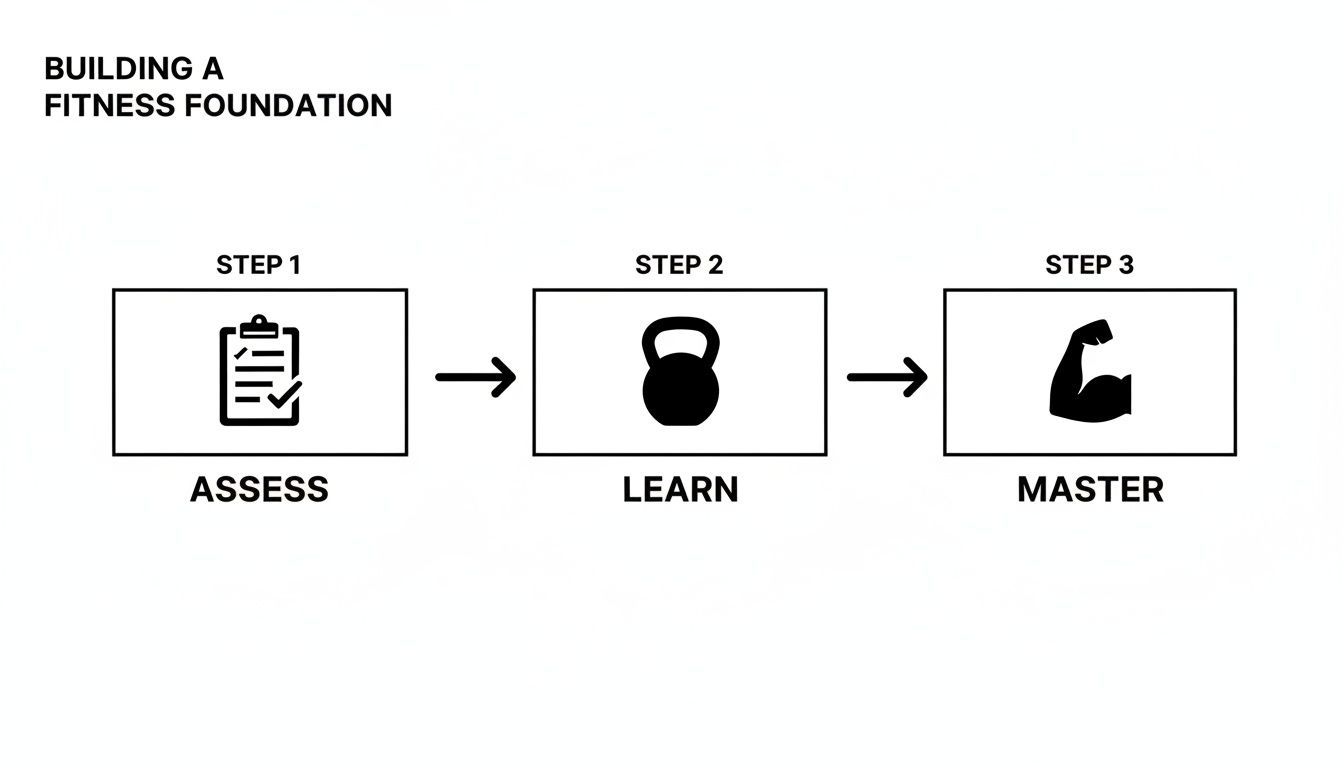
A successful plan prioritizes good technique before intensity. Here’s how this looks for different experience levels.
The Beginner Template: 3 Days Per Week
For newcomers, a three days a week, full body routine is ideal. It provides enough stimulus for strength and coordination without compromising recovery. Space workouts with at least one rest day in between.
A typical week:
Monday: Full-Body Workout A
Tuesday: Active Recovery (walk, stretching)
Wednesday: Full-Body Workout B
Thursday: Active Recovery
Friday: Full-Body Workout C
Saturday & Sunday: Rest
Each session should focus on squat, hinge, push, pull, and carry patterns. Mastering form is the primary goal. For exercise ideas, see our guide on compound exercises for beginners.
The Intermediate Split: 4 Days Per Week
Once you have a solid foundation, a four days a week, upper/lower body split can drive further progress. This allows for increased training volume for specific muscle groups while ensuring adequate recovery.
An intermediate schedule:
Day 1: Upper Body Strength (Push/Pull)
Day 2: Lower Body Strength (Squat/Hinge)
Day 3: Rest or Active Recovery
Day 4: Upper Body Strength
Day 5: Lower Body Strength
Day 6 & 7: Rest
This split allows you to dedicate more focus to each session, adding variety and volume.
The Advanced Schedule: 5 Days Per Week
For experienced trainees, a five day plan allows for greater specialization. This structure is demanding and requires a sharp focus on recovery, nutrition, and sleep to avoid overtraining.
An advanced template:
Monday: Lower Body Strength (Squat Focus)
Tuesday: Upper Body Strength (Push Focus)
Wednesday: Active Recovery & Mobility
Thursday: Lower Body Strength (Hinge Focus)
Friday: Upper Body Strength (Pull Focus)
Saturday: Full-Body Conditioning
Sunday: Complete Rest
The most important part of any plan is listening to your body. Don't be afraid to swap a strength day for an active recovery day. A smart plan is a flexible one.
Progressing with Advanced Training Techniques
Once you've mastered the basics, you must introduce new challenges to continue making progress. This is where advanced training techniques and the principle of progressive overload come in. Progressive overload means systematically making your workouts tougher over time.
You can do this by:
Increasing the Weight: Adding more load to the bar.
Adding Reps or Sets: Increasing your total work volume.
Reducing Rest Time: Making workouts more metabolically demanding.
Introducing More Complex Exercises
As you get stronger, incorporate more complex, dynamic movements that demand power, stability, and control.
Kettlebell Swings: A dynamic hip hinge that builds explosive strength in your glutes and hamstrings while elevating your heart rate.
Overhead Presses: A true test of upper-body pushing strength and shoulder stability that builds strong shoulders, triceps, and a solid core.
The Turkish Get-Up: A slow, deliberate movement from lying on the floor to standing while holding a weight overhead. It challenges mobility, stability, and strength from head to toe.
Form is everything with advanced movements. Use a lighter weight with perfect technique rather than a heavy weight with sloppy form.
Using Training Styles to Boost Conditioning
Structuring your workouts differently can challenge your conditioning. EMOMs and AMRAPs are two popular and effective methods. The results from these training styles are a key reason specialized functional training studios are so popular, often commanding premium prices (Pvolve, 2024). You can learn more about trends in the fitness industry.
Here's how to incorporate these styles into your functional fitness workout plan:
EMOM (Every Minute on the Minute): Perform a set number of reps at the top of each minute. The remaining time is your rest. This forces you to work efficiently and manage fatigue.
AMRAP (As Many Rounds as Possible): Complete as many rounds of a circuit of exercises as possible within a specific time limit. This builds work capacity and mental grit.
By intelligently adding these techniques, you ensure your fitness journey remains challenging and effective.
Fueling Your Body for Performance and Recovery
Progress is built during recovery. Fueling your body correctly and helping it repair itself is as important as the workout. It’s about building simple, sustainable habits that support your training.
Smart Nutrition for Functional Strength
Your body needs the right building blocks to repair muscle and restore energy. First, understand what macronutrients are and their roles.
Focus on these key areas:
Protein for Repair: Crucial for repairing muscle micro tears. Sources include lean meats, fish, eggs, dairy, and plant based options like lentils.
Carbohydrates for Energy: Complex carbs are your body’s primary fuel. Oats, sweet potatoes, and brown rice replenish glycogen stores.
Healthy Fats for Function: Vital for hormone production and reducing inflammation. Sources include avocados, nuts, and olive oil.
Think of nutrition as an extension of your training. A well-fueled body performs better and recovers faster.
For more details, see our guide to pre and post-workout nutrition for maximum results.
Active Recovery and Mobility Work
Low intensity activities can speed up the repair process by increasing blood flow to sore muscles.
Practical strategies for your week:
Foam Rolling: 5-10 minutes on tight spots like quads, hamstrings, and your upper back can release knots and improve tissue quality.
Static Stretching: After your workout, hold gentle stretches for major muscle groups for 30-60 seconds to improve flexibility.
Active Recovery Days: On "off" days, engage in light activity like a brisk walk, gentle bike ride, or swimming to keep blood flowing without adding stress.
Pairing smart nutrition with active recovery creates a powerful system that supports your workout plan.

Common Questions About Functional Fitness
Getting clear answers to common questions is key to staying motivated and ensuring your training is effective.
How Is Functional Fitness Different From CrossFit?
While they use similar exercises, their core philosophies differ. Functional fitness focuses on building practical strength for daily life, emphasizing good form. A functional fitness workout plan is tailored to your individual goals and abilities.
CrossFit is a branded program that uses functional movements in competitive, high-intensity workouts (WODs). It's typically done in a group setting with standardized daily programming.
The simplest distinction: All CrossFit workouts use functional fitness exercises, but not all functional fitness training is CrossFit. Functional fitness is the principle; CrossFit is one specific application.
What Equipment Do I Need To Start?
You need very little to start. Bodyweight exercises like air squats, push-ups, and planks are foundational and effective. As you get stronger, a few key pieces of equipment can expand your exercise options:
Kettlebells: For swings, goblet squats, and loaded carries.
Dumbbells: For presses, rows, and weighted lunges.
Resistance Bands: For warm-ups, mobility, and adding challenge to bodyweight exercises.
A pricey gym membership is not necessary. A solid functional fitness workout plan is highly adaptable.
How Often Should I Change My Workout Plan?
Consistency with a good program is more important than constant variety. Stick with a program for at least 8-12 weeks to allow your body time to adapt and get stronger.
Focus on progressive overload, finding small ways to make workouts harder over time, like lifting slightly heavier, adding a rep, or reducing rest. Change your plan only when you hit a true plateau or feel unmotivated. Even then, you can simply swap in a few different exercises that train the same movement patterns.
References
Pvolve. (2024). The Explosive Growth of the Fitness Industry. Pvolve Franchise.
Thompson, W. R. (2024). Worldwide Survey of Fitness Trends for 2025. ACSM’s Health & Fitness Journal.
At Flourish-Everyday, we believe that the right information and gear can elevate your fitness journey from a chore to a lifestyle. We're here to provide expert insights and recommend the best shoes for your training, helping you build a foundation for a stronger, healthier life. Discover your potential with us.https://www.flourish-everyday.com