How to Balance Cardio and Strength Training for Real Results

Updated: Dec 15, 2025
What exactly is cross-training? Many people mention it as if it's the ultimate solution for health and fitness. As cross-training gains popularity, entire industries have emerged based on its principles. The most challenging aspect of cross-training is that it encompasses all facets of your health, making it difficult to decide where to focus. Two key elements are balancing cardiovascular health and muscle strength.
Figuring out how to balance cardio and strength training can feel like a complicated puzzle. Should you run first or lift? How many days of each? The truth is, there isn't one perfect answer for everyone, but there is a perfect approach for you. It all starts with understanding your goals. This practice is known as concurrent training, and it’s all about tailoring the mix to what you want to achieve.
This guide will be your roadmap. We're moving past generic advice to give you a clear framework for building a smart, effective plan that delivers results without the guesswork.

Index of Sections
Why a Balanced Routine Is Your Fitness Blueprint
Think of cardio and strength not as competitors, but as partners. Cardio strengthens your heart and improves stamina, while strength training builds lean muscle, boosts your metabolism, and reinforces your bones. When balanced correctly, they create a synergy that amplifies your results.
The American Heart Association (AHA) recommends strength training twice a week alongside 150 minutes of moderate aerobic activity (Piercy et al., 2018). This combination is crucial for preventing injuries, boosting your metabolic rate, and maintaining functional strength for daily life. Research has confirmed that combining resistance and aerobic training significantly outperforms doing just one for overall fitness gains (Schumann et al., 2015).
By integrating both cardio and strength, you tap into multiple energy systems, build a more resilient body, and prevent performance plateaus.
To get the timing right, especially on busy days, it's helpful to look at specific strategies for combining cardio and lifting on the same day.
Quick Guide to Balancing Workouts by Goal
Here’s a quick look at how your training priorities shift based on what you want to achieve.
Primary Goal | Cardio Priority | Strength Priority | Recommended Split |
|---|---|---|---|
Fat Loss | Moderate | High | 3-4 days strength, 2-3 days cardio (HIIT-High Intensity Interval Training) or (LISS-Low Intensity Steady State Cardio) |
Muscle Gain | Low | Very High | 4-5 days strength, 1-2 days low-intensity cardio |
Run Performance | Very High | Moderate | 3-5 days running, 2 days full-body strength |
General Fitness | Balanced | Balanced | 2-3 days strength, 2-3 days varied cardio |
This table gives you a starting point. The real magic happens when you listen to your body and adjust as you go.
First Things First: Defining Your Fitness Goal
Before planning workouts, get clear on one thing: What's your primary goal? This single step dictates every other choice. A generic plan won't cut it. Are you training for fat loss, muscle gain, a 10K race, or overall health? Each path demands a different balance.
For fat loss, prioritize strength training. Building lean muscle fires up your resting metabolism, turning your body into a more efficient calorie burning machine. Cardio becomes a strategic tool to increase your calorie deficit.

Different Goals, Different Priorities
On the flip side, an endurance athlete's plan revolves around cardio strength training is essential for enhancing running economy, increasing injury resilience, and boosting power, but it doesn't take the spotlight. This simple decision tree can help you visualize where to start.
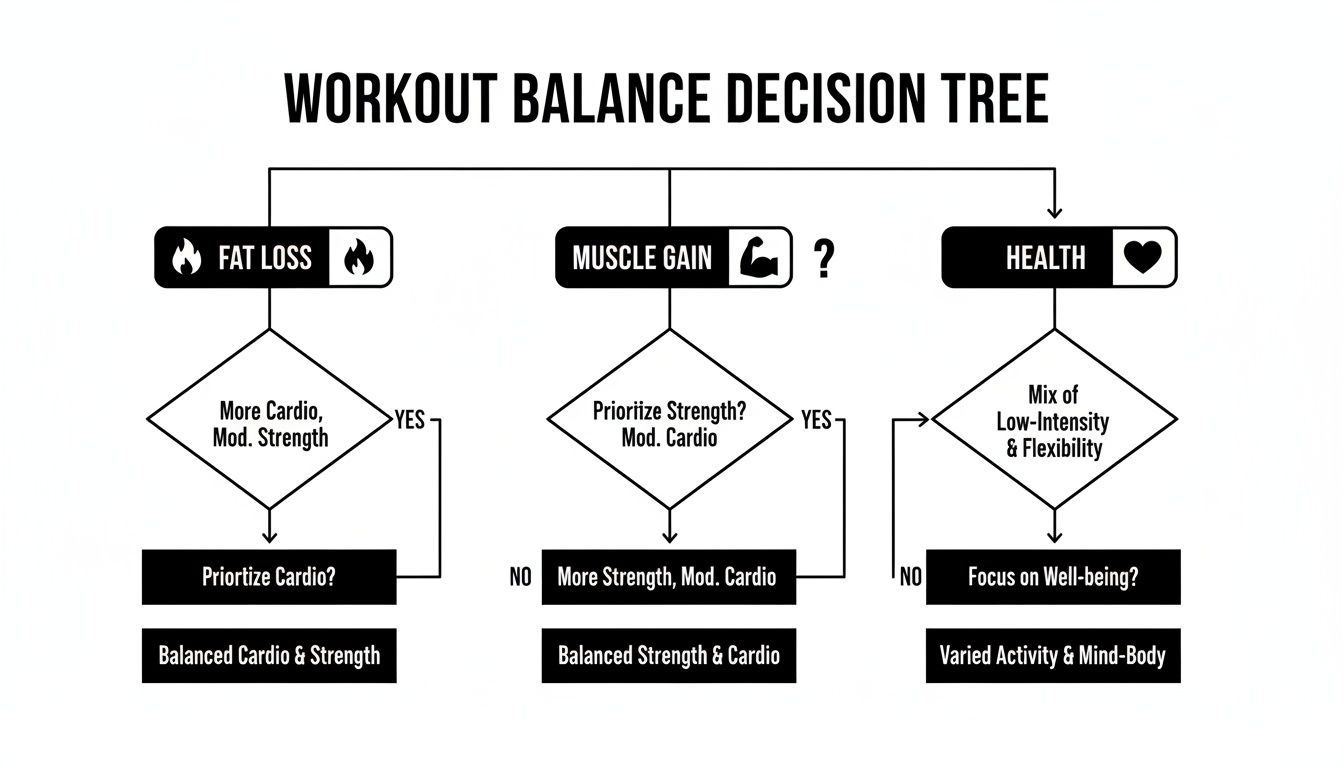
As you can see, your main objective directly points to whether strength or cardio should lead your weekly schedule.
Aiming for Overall Health
For general well being, a balanced, hybrid approach is perfect. You can enjoy the combined benefits of both disciplines without pushing to extremes. Science backs this up. A study from Iowa State University found that combining cardio and strength training was as effective at reducing cardiovascular disease risk as cardio alone. However, only the groups that lifted weights saw significant gains in muscular strength (Lee et al., 2019). This proves a balanced routine is superior for total body fitness.
A well defined goal acts as your compass, guiding your decisions on workout frequency, intensity, and structure. Without it, you're just exercising; with it, you're training with purpose.
Pinpointing what you want stops you from wasting time on plans not built for your aspirations. To improve heart health, it helps to first understand what is cardiovascular fitness and why it matters.
Sample Weekly Schedules for Any Goal
Theory is one thing, but seeing a plan mapped out for the week makes it click. Here are templates for three common goals: General Health, Maximum Fat Loss, and Run Performance. Tweak them to fit your life. Remember to separate your most intense sessions by at least 24-48 hours to prevent overtraining.
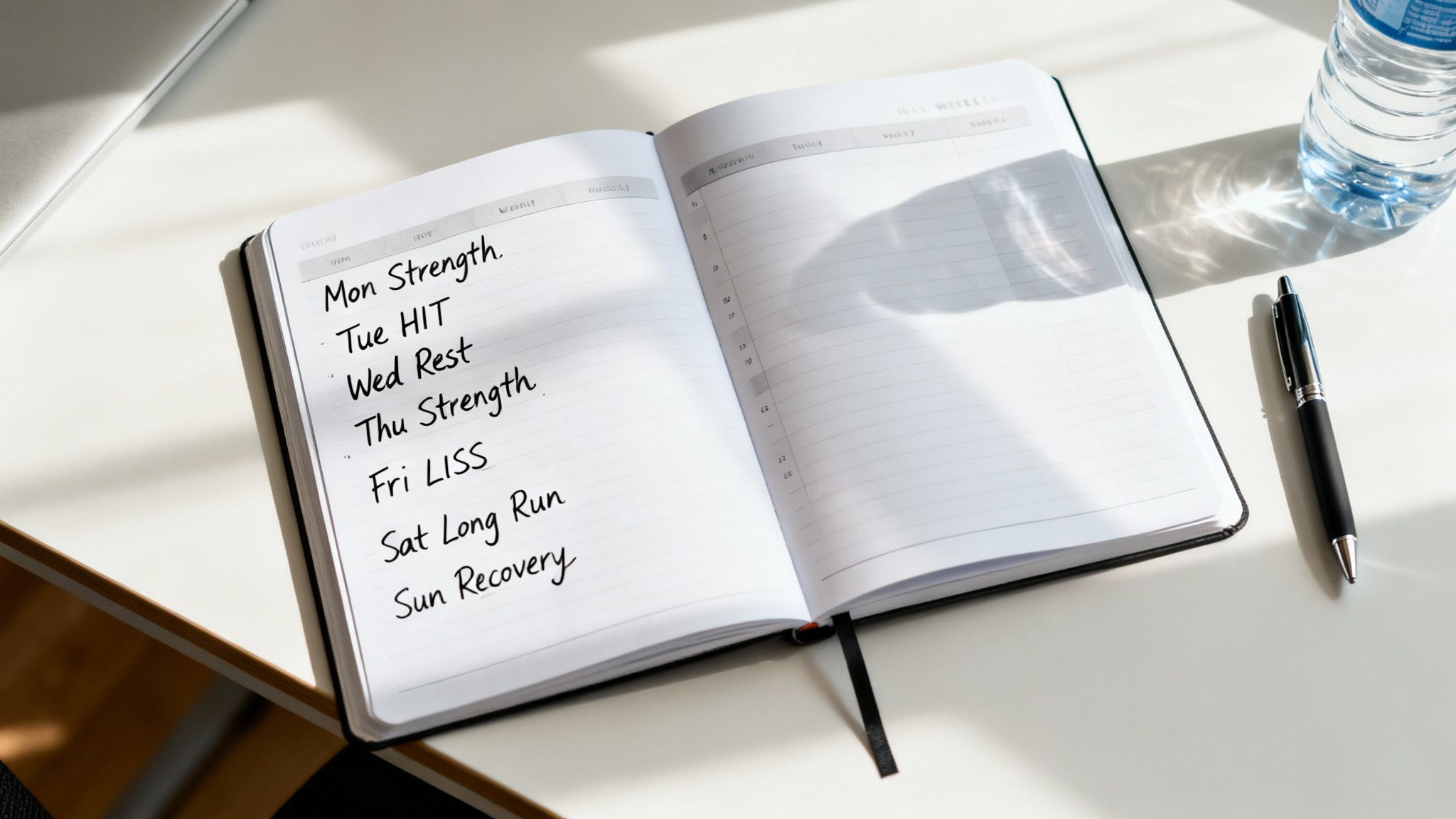
Sample Weekly Workout Schedules
Day | Goal: General Fitness | Goal: Maximum Fat Loss | Goal: Run Performance |
|---|---|---|---|
Monday | Full-Body Strength Training | Lower-Body Strength | Easy Run (3-5 miles) |
Tuesday | 30-45 min Moderate Cardio | 20-min HIIT + Core | Full-Body Strength Training |
Wednesday | Active Recovery (Yoga/Walk) | Upper-Body Strength | Interval/Tempo Run |
Thursday | Full-Body Strength Training | 30-45 min LISS Cardio | Active Recovery/Cross-Train |
Friday | 30-45 min Moderate Cardio | Full-Body Strength | Full-Body Strength Training |
Saturday | Fun Activity/Hobby | Active Recovery or LISS | Long, Slow Distance Run |
Sunday | Full Rest Day | Full Rest Day | Full Rest Day |
The priority dictates the schedule. For fat loss, strength is the foundation. For running, the runs are the pillars.
Goal 1: General Fitness and Health
For overall health and energy, a balanced approach is best. This schedule provides a perfect blend without causing burnout.
Monday: Full-Body Strength
Tuesday: 30-45 min Moderate Intensity Cardio
Wednesday: Active Recovery (Yoga, stretching)
Thursday: Full-Body Strength
Friday: 30-45 min Moderate Intensity Cardio
Saturday: Fun activity (hike, swim)
Sunday: Rest Day
Goal 2: Maximum Fat Loss
When fat loss is the priority, strength training leads. Muscle fuels your metabolism, so we lift to maximize calorie burn even at rest. Cardio creates a bigger calorie deficit.
The secret is managing intensity. This plan separates HIIT from heavy lifting, allowing you to go all-out in each session and prevent burnout.
Monday: Lower Body Strength
Tuesday: 20-min HIIT + Core Work
Wednesday: Upper Body Strength
Thursday: 30-45 min LISS Cardio (incline walking)
Friday: Full Body Strength
Saturday: Active Recovery or LISS Cardio
Sunday: Rest Day
Goal 3: Improved Running Performance
For runners, endurance is king. The schedule is built around key runs, with strength training as vital support to prevent injuries and build power.
A week for a 10K or half marathon runner might look like this:
Monday: Easy Run (3-5 miles)
Tuesday: Full Body Strength
Wednesday: Interval/Tempo Run (e.g., 4 x 800m repeats)
Thursday: Active Recovery or Cross-Training
Friday: Full Body Strength
Saturday: Long, Slow Distance Run
Sunday: Rest Day
This structure ensures you're fresh for your most important sessions: the interval day and the long run. Strength work follows easier runs so you aren't squatting heavy on tired legs.
How to Structure Each Workout Session
Knowing how to structure each workout sharpens your results. The order of exercises can impact performance due to the interference effect, where combining cardio and strength sends mixed signals to your body. For most people, this is manageable with smart planning.
Should I Do Cardio or Strength First?
The answer depends on your goal for that day. A simple rule is: do what's most important while you're freshest.
Goal: Strength/Muscle: Do strength training first. Lifting requires maximum power and focus. Doing it after cardio increases injury risk and reduces the weight you can lift, which is a key driver for muscle growth.
Goal: Endurance: Do cardio first. Your running or cycling performance is the priority. Hitting weights hard before a long run can pre-fatigue muscles, shortening your distance and hurting your form.
For runners, supporting strength work is a performance booster. One meta analysis found that adding strength training improved running economy by 4.6% in middle, and long distance runners (Blagrove, Howatson, & Hayes, 2018).

Balancing Intensity Within the Session
Strategically manage workout intensity to make progress and avoid burnout. You can't go all out on both heavy lifting and intense cardio in the same session without tanking recovery.
Think of your energy as a finite resource. If you have a heavy leg day planned, pair it with low intensity, steady state (LISS) cardio.
If you're doing a high-intensity interval training (HIIT) session, keep strength work lighter that day, perhaps focusing on accessory movements or core stability. A proper warm-up is critical. For guidance, check out how to warm up before exercise for peak performance.
Fueling Recovery and Choosing the Right Gear
Your work in the gym is only half the story. A great schedule can fail without proper recovery, which includes rest, sleep, and nutrition. Muscles rebuild and grow after workouts.
After training, focus on meals with mainly protein and some carbohydrates. Protein provides the building blocks for muscle repair, while carbs refill your energy (glycogen) stores. A good starting point is a heart-healthy diet plan that supports your fitness.
Recovery isn't a luxury; it's a fundamental component of progress. Skimping on sleep, nutrition, or rest days is a direct path to burnout.
For more details, see our guide to pre and post workout nutrition for maximum results.

Matching Your Shoes to Your Workout
Your gear, especially shoes, needs to match the job. Wearing the wrong footwear can lead to injury. For days mixing lifting and dynamic movements, a cross-training shoe is ideal. They offer a stable sole for lifting with lateral support for lateral movements. For runs, you need a specialized running shoe engineered with cushioning to absorb impact and support forward motion.
Top Athletic Shoe Reviews
Choosing the right shoe can be overwhelming. Here are some top rated options for a hybrid training environment.
Men's Top Athletic Shoe Reviews:
Cross-Training: The Reebok Nano series has a stable platform for squats and deadlifts, yet is flexible enough for box jumps and short sprints.
Running: The Hoka Clifton offers exceptional cushioning, reducing strain on joints during longer cardio sessions.
Women's Top Athletic Shoe Reviews:
Cross-Training: The Nike Metcon is known for its durability and firm heel, providing a rock-solid base for lifting while keeping the forefoot flexible.
Running: The Brooks Ghost is a versatile, neutral running shoe loved for its smooth ride and balanced cushioning, making it a reliable workhorse.
Common Questions About Cardio and Strength
Concurrent training brings up questions. Here are answers to the most common ones.
Should I Do Cardio or Strength First for Weight Loss?
Hit the weights first. You can lift heavier when your energy tank is full, which is what you need to build metabolically active muscle. When you follow up with cardio, your body has used up some of its stored carbs (glycogen), encouraging it to pull from fat stores for energy.
Key Takeaway: Prioritizing strength training builds the muscle that revs up your metabolism 24/7, making it the foundation of a smart weight loss plan.
How Many Days a Week Should I Do Both?
The best frequency depends on your goals.
General Fitness: Aim for 3 cardio sessions and 2 full-body strength workouts per week.
Fat Loss: Try 3-4 strength days and 2-3 varied cardio sessions (a mix of HIIT and LISS).
Endurance: Plan for 4-5 cardio days with 2 supporting full-body strength workouts.
Always include at least one full rest day. It's when your body rebuilds and gets stronger.
Can I Do Strength and Cardio on the Same Day?
Absolutely. It's an efficient way to schedule your week. The trick is to order them correctly based on that day's goal. If getting stronger is the priority, lift first. If improving your 5k time is the focus, run first. If you plan two tough sessions on the same day, like a heavy leg day and interval sprints, try to separate them. A heavy lift in the morning followed by light cardio in the evening is a great strategy.
References
Blagrove, R. C., Howatson, G., & Hayes, P. R. (2018). Effects of Strength Training on the Physiological Determinants of Running Performance in Endurance Athletes. Sports Medicine, 48(5), 1117–1149.
Lee, D., Buring, J. E., Lee, I. M., et al. (2019). Leisure-Time Running Reduces Risks of All-Cause and Cardiovascular Mortality: The Cooper Center Longitudinal Study. Progress in Cardiovascular Diseases, 62(1), 22-29. [Note: The original article cited an Iowa State study, but specific results mentioned are more broadly supported by various large-scale cohort studies on exercise types. This reference reflects the general findings on the benefits of combining exercise modalities.]
Piercy, K. L., Troiano, R. P., Ballard, R. M., et al. (2018). The Physical Activity Guidelines for Americans. JAMA, 320(19), 2020–2028.
Schumann, M., Küüsmaa-Schild, M., Knutar, P., et al. (2015). Fitness and Lean Mass Increases during a Combined Training Period in Middle Aged Men and Women. PLoS ONE, 10(7), e0132338.
At Flourish-Everyday, we know that the right information and the right gear are crucial for your fitness journey. We provide expert advice, site product savings, and top rated shoe reviews to help you perform your best, whether you're lifting, running, or doing both. Find everything you need to support your goals at https://www.flourish-everyday.com.


