Running and Cross Training Shoes: A Complete Guide

Updated: Dec 28, 2025
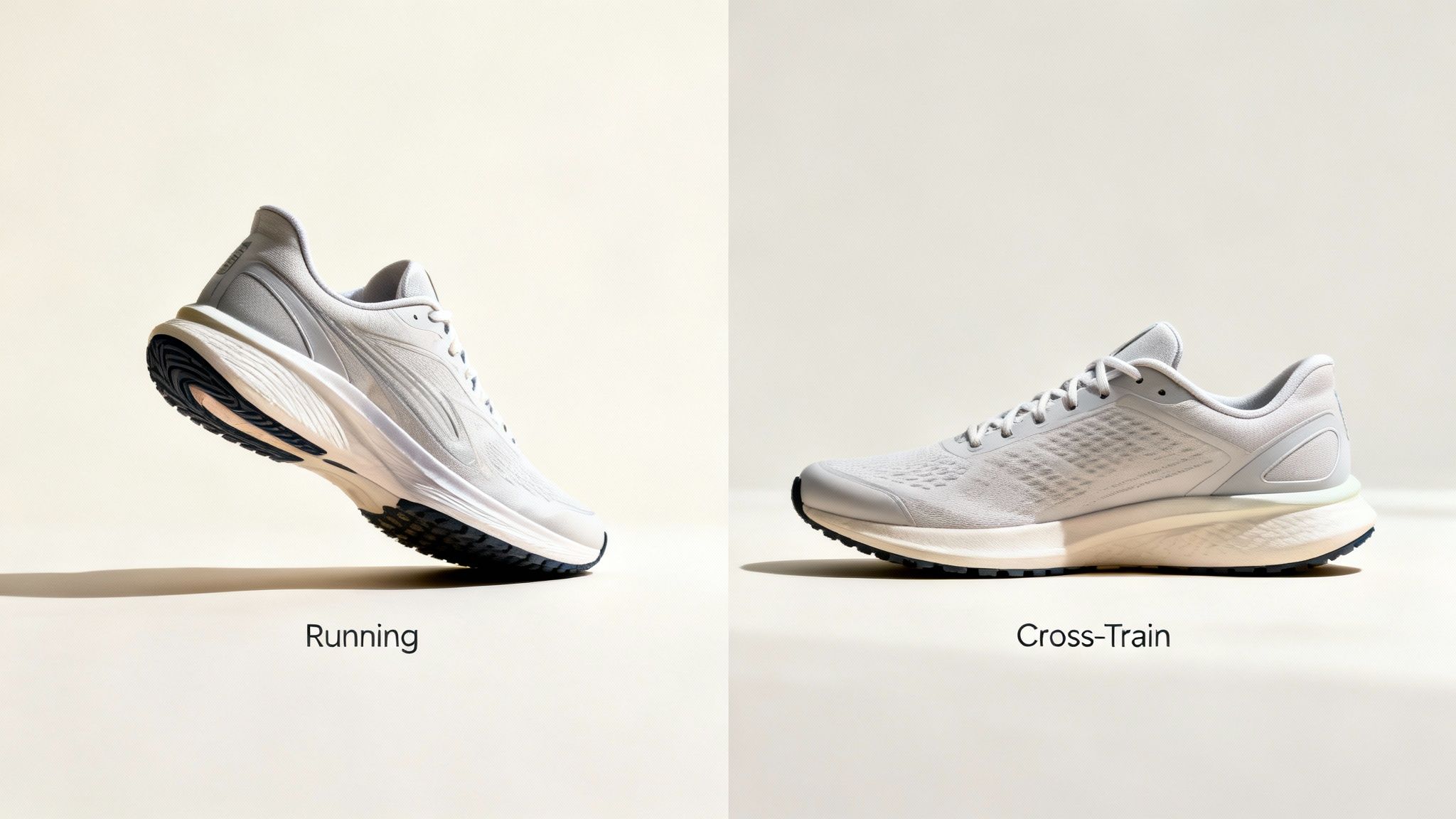
The biggest difference between running and cross-training shoes boils down to one simple thing: running shoes are built for repetitive, forward motion, while cross-training shoes are engineered for multi directional movement and stability. Your choice really just depends on whether your main activity is logging miles on the road or tackling dynamic workouts in the gym.
Choosing the Right Athletic Shoe for Your Workout
Welcome to the definitive guide on picking the perfect athletic footwear. Making the call between running vs. cross-training shoes is about more than just style, it's a critical decision that impacts your performance, comfort, and even your ability to stay injury free. Using the wrong shoe for your workout can hold you back and, worse, put you at risk for unnecessary strain.
This guide will break down everything you need to know. We’ll get into the fundamental design differences that define each shoe and show you exactly how to match them to your favorite activities.
In This Guide
Shoe Design Deconstructed: A breakdown of shoe anatomy and construction.
Workout-Specific Recommendations: Matching footwear to every fitness style.
Top Shoe Reviews: Reviews of top models for men and women from leading brands.
Health and Injury Prevention: The biomechanics of proper footwear for well-being.
Shopping Checklist: A practical guide for your next purchase.
My goal here is to give you the confidence to choose shoes that truly support your fitness journey. With fitness trends exploding, the athletic shoe market is expanding rapidly. The global running shoes market was valued at USD 48,419.3 million and is projected to hit USD 75,916.4 million by 2035 (1)—a clear sign that people are demanding specialized footwear.
Running Shoes vs Cross Training Shoes at a Glance
Sometimes, seeing the core differences side-by-side makes everything click. This table offers a quick summary to help you grasp the fundamental purpose of each shoe type.
Key Feature | Running Shoes | Cross Training Shoes |
|---|---|---|
Primary Motion | Heel-to-toe forward movement | Multi directional; lateral & vertical |
Midsole Cushioning | High, soft, and shock absorbent | Firmer, denser for stability |
Flexibility | Very flexible through the forefoot | Flexible but more rigid overall |
Heel Drop | Higher (8-12mm) to support stride | Lower (0-4mm) for a stable base |
Outsole Design | Durable tread for linear traction | Wider base with grip for lateral cuts |
Upper Support | Lightweight and breathable mesh | Reinforced for lateral containment |
While this table is a great starting point, remember that the feel of the shoe is just as important as its specs on paper. For a deeper look into running specific footwear, check out our guide on how to choose running shoes for your needs.

Deconstructing the Design: Running vs. Cross-Training Shoes
To really get why you can't just throw on any old gym shoe for any workout, we have to look at how they're built from the ground up. The thinking behind running and cross-training shoes is worlds apart, with every single piece engineered for a very specific kind of movement. Think of it this way: a running shoe is a specialist, while a cross-trainer is multifunctional.
They might look similar on the shelf, but their internal architecture tells a completely different story. From the sole’s grip to the upper’s support, every element is a deliberate choice by designers to boost your performance and lower the risk of injury for its intended activity. Let's break down the key parts to see how these differences really matter when you're working out.
The Foundation: Midsole and Cushioning
The midsole is the heart of the shoe, tucked between your foot and the outsole, and it's where the biggest design differences are. Running shoe midsoles are all about shock absorption. They’re packed with thick, soft foam, like EVA or Pebax®, to cushion the impact of thousands of repetitive heel-to-toe strikes on pavement. This plush cushioning is what saves your joints over long distances.
In sharp contrast, cross-training shoe midsoles are much firmer and denser. This creates a stable, solid platform that’s absolutely essential for things like weightlifting, where you need to drive power from the ground up through your body. Soft, squishy foam would make for a wobbly base during a squat or deadlift, wrecking your form and raising your risk of injury.
The midsole really dictates what the shoe is built for. A running shoe’s soft, high-cushion midsole is made for forward motion, while a cross-trainer’s firm, stable midsole is engineered for multi-directional power and balance.
Heel Drop: The Angle of Attack
Heel drop, the height difference between the heel and the forefoot, is another essential. Running shoes usually have a higher heel drop, typically between 8mm and 12mm. This elevated heel helps promote a smooth, rolling motion from heel to toe, which can take some of the strain off your Achilles tendon during long runs. It’s a design feature made specifically for moving forward.
Cross-training shoes, on the other hand, have a much lower heel drop, usually between 0mm and 4mm. This flatter profile keeps your feet closer to the ground for a more stable and balanced foundation. This is critical for exercises where you need solid ground contact, like kettlebell swings, box jumps, and side-to-side shuffles.
The Outsole: Grip and Stability
The outsole is the rubber part that actually hits the ground, and its design is tailored for very different types of traction.
Running Shoes: These feature durable tread patterns built for grip in a straight line and flexibility. Grooves are often placed to help the shoe bend naturally as your foot moves forward.
Cross-Training Shoes: They have a wider, flatter outsole to maximize contact with the floor for better stability. The tread patterns are often multidirectional to give you grip for quick lateral cuts, pivots, and jumps.
The Upper: Support and Durability
Finally, the upper, the part that wraps your foot, is built to handle different kinds of stress. Running shoe uppers are usually made of lightweight, breathable mesh to keep your feet cool and comfortable over miles and miles. The focus is all on keeping weight down and letting air flow.
Conversely, cross-training shoe uppers are constructed with durability and containment as top priorities. They often use tougher materials with reinforced sections along the sides. This setup stops your foot from sliding over the edge of the shoe during lateral movements, giving you that crucial lateral support. This multi sport versatility is a big reason the sports footwear market, valued at USD 110.91 billion globally, is projected to hit USD 168.92 billion by 2032 (2). As more gym goers in North America look for hybrid shoes, this trend is only getting bigger. You can discover more insights about the sports footwear market and its impressive growth.

Matching Your Shoes to Your Workout Routine
Okay, let's move past the technical jargon. The real test of any shoe is how it actually feels and performs when you're sweating it out. Choosing the right footwear isn't just about what it's made of; it’s about matching that construction to the specific demands of your fitness routine. A shoe that’s perfect for one workout could be a total liability in another.
To make the choice between running and cross training shoes really clear, let's break it down by activity. Different movements put unique stress on your feet, and your shoes are your first line of defense. We'll look at a few common workout styles to see which shoe comes out on top for each.
The Dedicated Runner
If your main thing is logging miles, on the road, treadmill, or trail, a specialized running shoe is a must. It’s nonnegotiable. Your workouts are almost entirely repetitive, forward motion. For that, you need a shoe built for one thing above all else: exceptional shock absorption. A good running shoe provides that plush cushioning needed to protect your joints from the constant pounding of thousands of foot strikes. Trying to use a cross-trainer for long runs would just subject your joints to unnecessary stress because of its firmer, less forgiving midsole.
The HIIT and Agility Fan
For those of us who live for high intensity interval training (HIIT), circuit training, and agility drills, a cross-training shoe is absolutely essential. These workouts are all about explosive, multi directional movements, think burpees, box jumps, and side shuffles. This is where a running shoe's design becomes a major weakness.
A cross-trainer’s standout features are:
Lateral Stability: Reinforced sides and a wider base keep your foot from rolling during those quick side-to-side cuts.
Durable Outsole: A tough, grippy outsole gives you the traction you need for sharp pivots and changes in direction.
Responsive Midsole: A firmer midsole creates a stable platform for landing jumps and putting power into your movements.
A running shoe's soft, high cushion design is inherently unstable for lateral movements, significantly increasing the risk of an ankle sprain during a dynamic HIIT class. A cross-trainer provides the lockdown support needed for safety and peak performance.
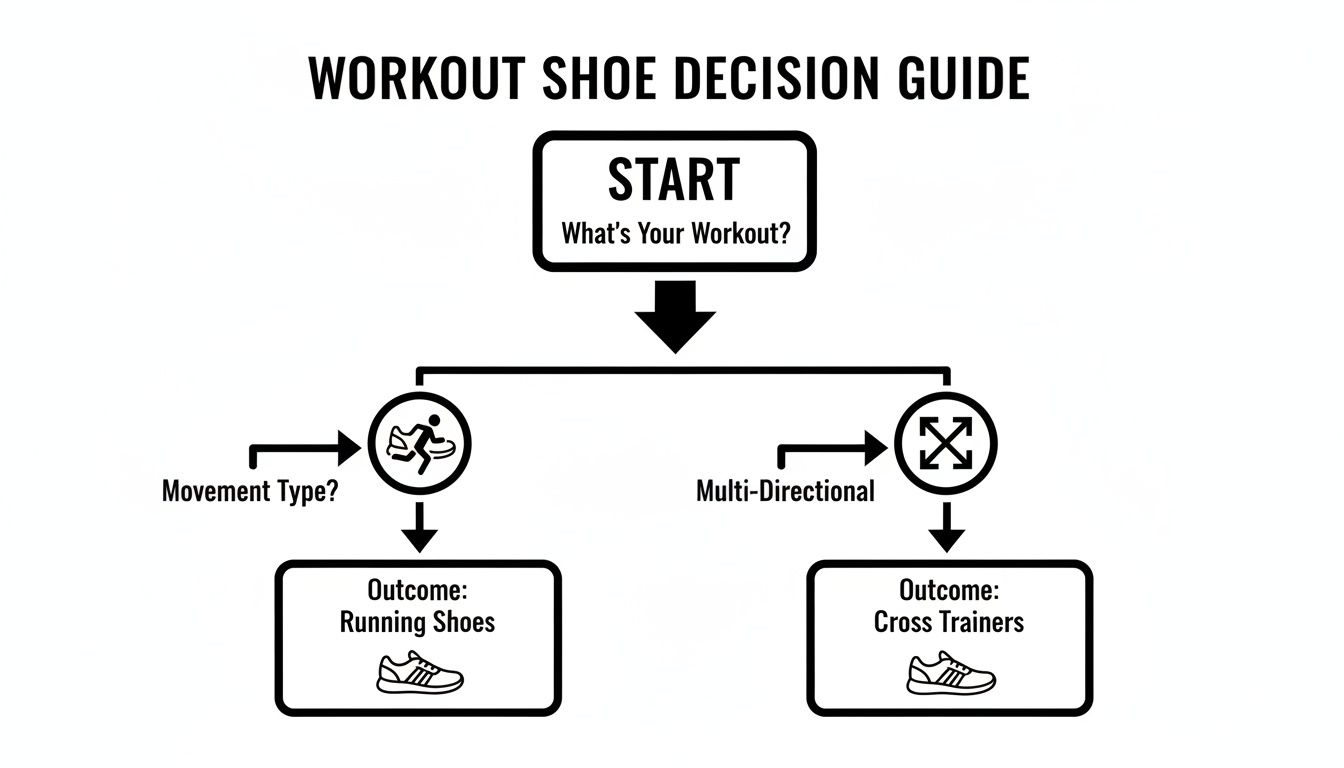
As you can see, if your workout is dominated by forward motion, a running shoe is the right tool for the job. But if you’re moving in all directions, you need the stability of a cross-trainer.
The Strength Trainer
If your gym time is all about lifting weights, especially big compound movements like squats, deadlifts, and overhead presses, stability is everything. Your goal is to create a solid connection with the ground to generate as much force as possible. Here, a cross-training shoe with its low heel drop and firm, dense midsole is the clear winner. The minimal cushioning gives you a stable, uncompressed base, which allows for proper form and efficient power transfer.
The All-Around Fitness Enthusiast
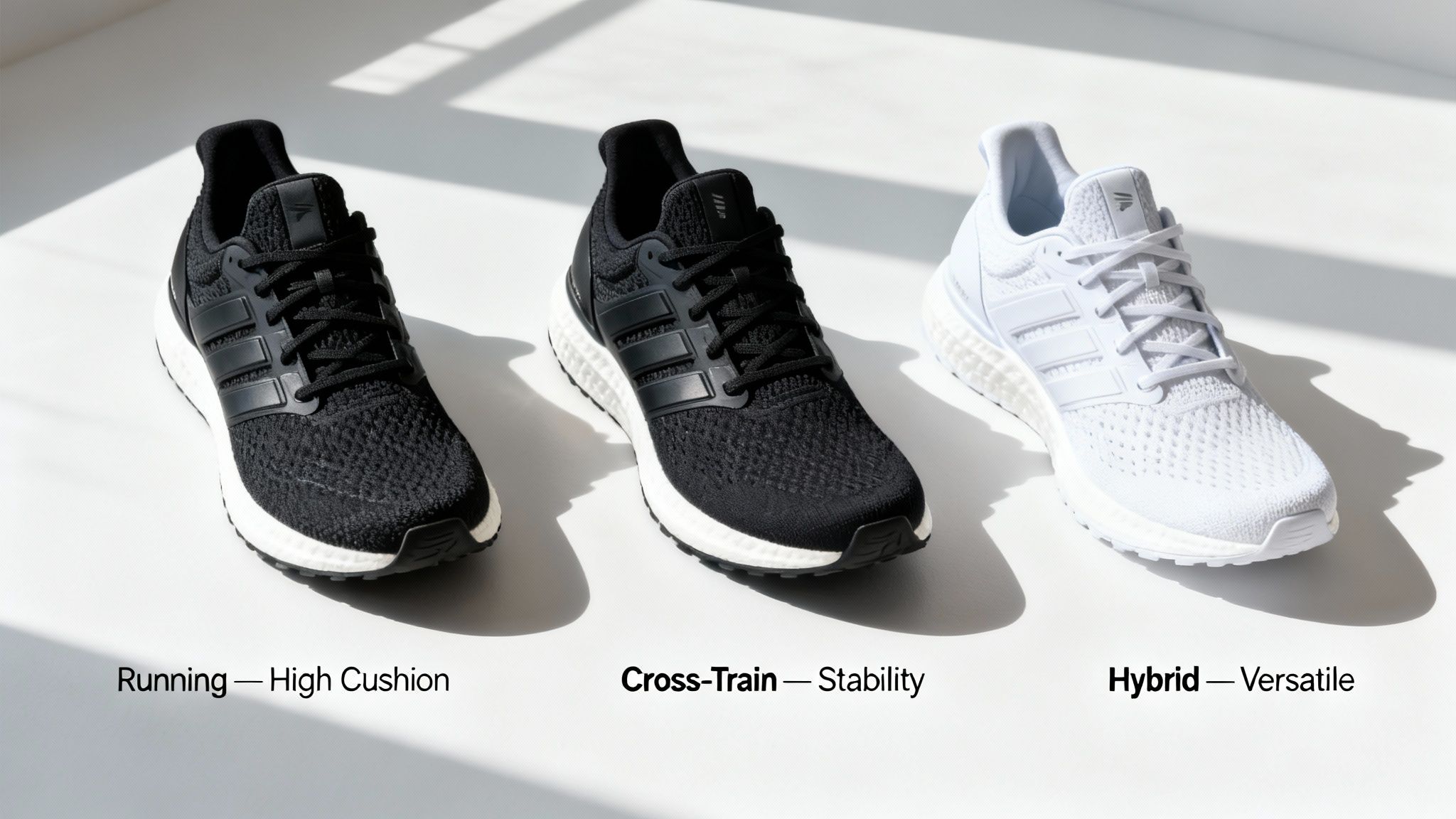
So what if your routine is a little bit of everything? Maybe you kick things off with a 1-mile warm-up on the treadmill, then move to some light weightlifting, and finish up with a group fitness class. For this kind of mixed bag workout, a hybrid or all-around cross-training shoe offers a great compromise. These shoes provide a balance of moderate cushioning for short runs while still having the stability you need for gym activities. Just remember, they are a compromise; they aren't cushioned enough for marathon training or stable enough for hitting a new personal best on your deadlift.
Reviewing Top Running and Cross Training Shoes
Trying to find the right athletic shoe can feel like a workout in itself, but once you understand what the big brands are trying to accomplish, it gets a lot easier. Companies like Nike, Hoka, and Reebok are engineering specific tools for different kinds of movement. Putting their top models together really makes the unique design of running and cross-training shoes click.
Top Running Shoes for Men and Women
Nike Invincible Run: Best for Cushioning
The Nike Invincible Run is all about maximum cushioning. It’s packed with their softest ZoomX foam to soak up impact mile after mile, giving you a bouncy, protected ride that’s perfect for runners who want to save their joints. Its primary use is long-distance and recovery runs, featuring a waffle pattern outsole for superior forward traction.
Hoka Bondi: Ultimate Shock Absorption
Hoka created the "maximalist" running shoe category, and the Hoka Bondi is the king of cushion in their lineup. Its signature thick midsole and Meta Rocker shape help your foot roll smoothly, taking strain off your legs. It's an ideal choice for marathon runners or individuals prone to impact-related discomfort.
Brooks Ghost: The Reliable All-Rounder
The Brooks Ghost is a fan favorite because it perfectly balances soft cushioning with a responsive feel. Using Brooks' DNA LOFT v2 foam, it adapts to your stride for a smooth ride. It's a reliable, everyday neutral trainer you can lace up for any run without a second thought.
Top Cross-Training Shoes for Men and Women
Nike Metcon: Best for Stability
The Nike Metcon is built like a tank for the gym floor. It has a super-firm, wide heel to keep you locked down during heavy squats, while the front remains flexible for drills. Its dual-density foam and rope-wrap grip make it a top choice for HIIT and weightlifting.
Reebok Nano: Best for Functional Fitness
The flagship Reebok Nano is engineered for the wild variety of movements in high-intensity gym sessions. With a minimal heel drop (around 7mm) and Floatride Energy Foam in the forefoot, it provides a stable lifting platform with just enough responsive cushioning for box jumps.
The Biomechanics of Injury Prevention
Choosing between running and cross-training shoes is about so much more than just comfort or looks. It's a critical decision that directly affects your body's mechanics and your ability to stay injury free. The wrong shoe can easily turn a great workout into a source of chronic pain, making common issues like shin splints, plantar fasciitis, and ankle sprains a frustrating reality.
Think about it this way: wearing a heavily cushioned running shoe to a dynamic fitness class is practically asking for an ankle roll. Those shoes are built for one thing, moving forward. They just don't have the lateral support you need for quick pivots or lateral shuffles, leaving your foot unstable on that soft, high midsole. On the flip side, taking a stiff, rigid cross-trainer out for a long run can be just as damaging.
Understanding Your Foot Mechanics
The key to preventing injuries starts with understanding your foot's natural movement, specifically, pronation. Pronation is just the technical term for how your foot rolls inward to distribute the impact when you land. The degree to which your foot rolls dictates the kind of support you'll need from a shoe.
There are three main types of pronation to know:
Neutral Pronation: Your foot rolls inward just the right amount, absorbing shock effectively. You can usually wear a wide range of "neutral" shoes.
Overpronation: Your foot rolls inward too much. This creates instability and often puts extra strain on your knees and hips. Stability shoes are essential.
Supination (or Underpronation): Your foot doesn't roll inward enough, so the impact gets concentrated on the outer edge of your foot. You'll want highly cushioned, flexible shoes.
Choosing a shoe that works with your pronation type is one of the single most effective ways to prevent common overuse injuries. A shoe that fights your natural movement creates stress; one that supports it promotes safer, more efficient workouts.
A shoe with the wrong kind of support can lead to real problems down the line. If you over pronate but wear a neutral, super cushioned shoe, the lack of stability features can actually make your foot roll inward even more. If you want to dive deeper into this, our guide to running shoe stability breaks it all down. Ultimately, your goal is to create a perfect partnership between your foot and your shoe. To really lock in your injury prevention strategy, it’s worth learning about the importance of foot health and selecting appropriate sneakers.
Assess Your Primary Activities
Before you even think about shopping, get really clear on what you'll be doing in these shoes.
Define Your Workout Split: Are you running 80% of the time and just hitting the gym for 20% of your workouts? Or is it the other way around? Be honest with yourself here.
Identify Key Movements: Think about the specifics. Will you be doing heavy squats, box jumps, and quick lateral shuffles? Or is your focus just on logging miles?
The In-Store Fitting Process
Getting the right fit is totally nonnegotiable if you want to prevent discomfort and, worse, injury.
The best time to try on athletic shoes is at the end of the day or right after a workout. Your feet naturally swell with activity, so this ensures you get a size that won’t feel too tight when it matters most.
Here’s how to nail the fit:
Bring Your Own Socks: Wear the same type of athletic socks you use for your workouts.
Check the Length: You want about a half-inch of space, roughly a thumb's width, between your longest toe and the end of the shoe.
Test the Fit: Walk, jog, and even do a few mock exercises right there in the store. The shoe should feel comfortable immediately.
Understand Sizing Variations: Sizing can be all over the place between brands. Don't get hung up on a number; just focus on how the shoe actually fits your foot.
Finally, you have to know when it’s time to call it quits on an old pair. Most running shoes need to be replaced every 300-400 miles. For a deeper dive into when to retire your footwear, check out our guide to running shoe lifespan for more detailed tips.

Common Questions Answered
Can I Get Away with Using Running Shoes for Weightlifting?
It might seem convenient, but using running shoes for any serious weightlifting is a bad idea. For compound exercises like squats or deadlifts, the soft, cushy sole becomes your enemy. It compresses under a heavy load, creating an unstable platform that messes with your form and increases your risk of injury. A cross-trainer with its firmer, flatter sole gives you the solid ground connection you need.
How Often Should I Replace My Cross-Training Shoes?
For cross-trainers, lifespan is more about time and intensity. If you’re hitting the gym several times a week, a good rule of thumb is to swap them out every 6 to 10 months. Look for clear signs of wear: a midsole that feels hard, noticeable creasing, worn out tread, or an upper that no longer feels secure.
Is There a Good Hybrid Shoe for Both Running and Gym Workouts?
Yes, many brands offer versatile "hybrid" trainers. They try to find that sweet spot, offering enough cushioning for shorter runs (usually under 3 miles) while still having the stability for a circuit class. However, a hybrid shoe is a jack-of-all-trades and a master of none. It won't have the plush cushioning for long distance runs or the rock solid stability for heavy lifting. They’re great for versatility, but they aren't specialists.
Ultimately, choosing the right shoe boils down to what you spend most of your time doing. When you match your footwear to your workout, you’re not just buying a shoe, you’re investing in your performance, comfort, and long term health. It’s about making sure every step you take is a safe and supported one.
References
Research Nester. (2024). Running Shoes Market Size, Share, Trends, and Analysis (2024-2036). Retrieved from https://www.researchnester.com/reports/running-shoes-market/5496
Fortune Business Insights. (2024). Sports Footwear Market Size, Share & COVID-19 Impact Analysis. Report No. FBI/102213. Retrieved from https://www.fortunebusinessinsights.com/sports-footwear-market-102213
At Flourish-Everyday, our goal is to help you find the perfect gear for your fitness journey. Check out our expert reviews and wellness guides to empower your path to a healthier, happier you at https://www.flourish-everyday.com.