Unlock Shoulder Power with Scapular Mobility Exercises for Injury Prevention

Updated: Feb 15
Many workout enthusiasts forget how important the shoulder blades are when it comes to upper body fitness. The many muscles and ligaments that are attached to the scapula regulate the cohesion between vital functions of movement and back strength.
The scapular mobility exercises are all about improving how your shoulder blades move and function. These aren't just stretches; they're active drills like wall slides and scapular push-ups that strengthen supporting muscles. The goal is to improve the coordination between your shoulder blade and arm, a partnership that's absolutely vital for preventing injuries and hitting your performance goals.
Article Index
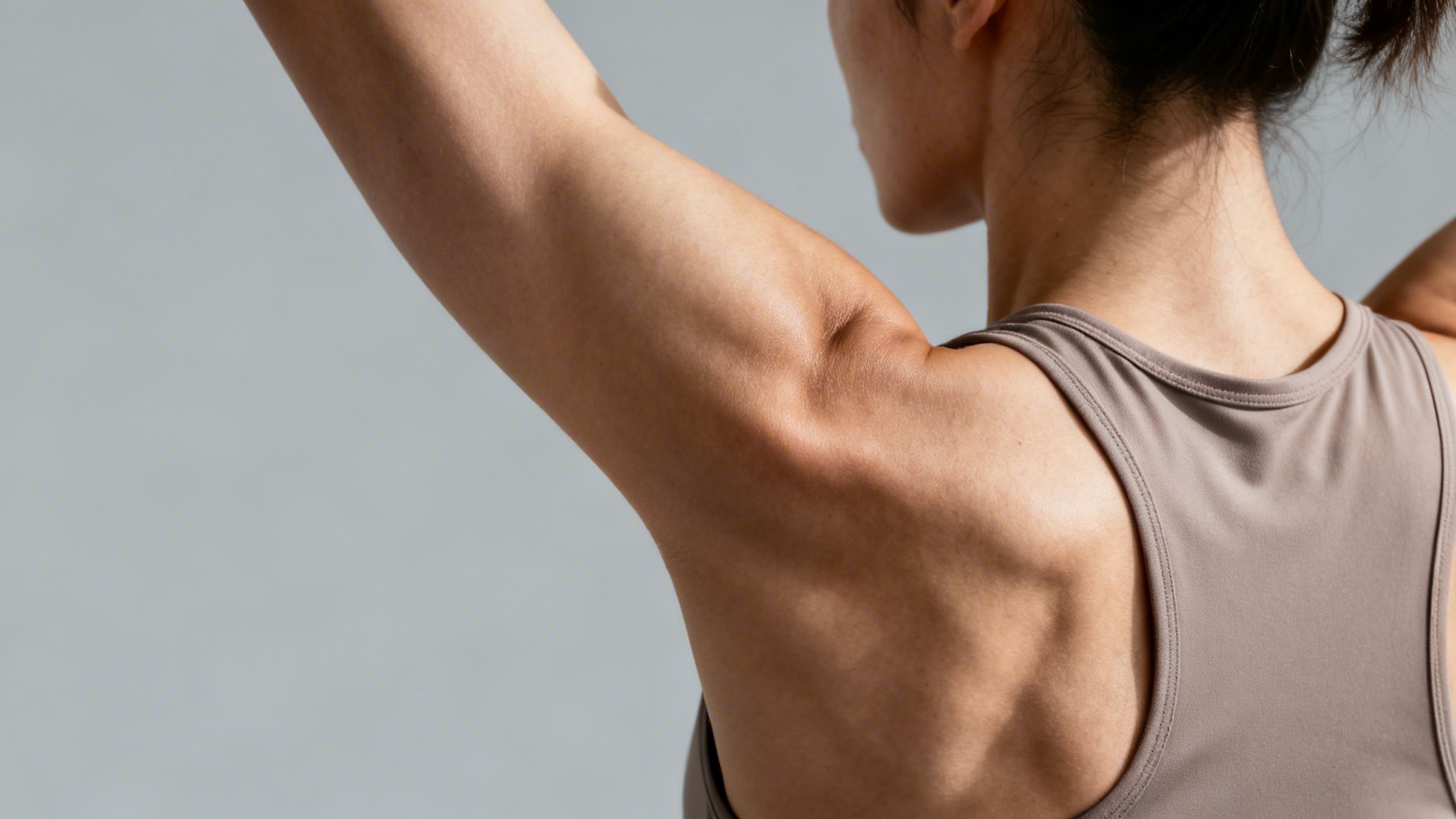
The Hidden Key to Your Athletic Performance
Nagging stiffness in your neck and shoulders after a tough workout is often a signal from your shoulder blades (scapulae) that they aren't moving correctly. For runners, cross-trainers, and gym-goers, scapular mobility is a crucial component of athletic performance, influencing everything from lifting power to running form.
Understanding the Scapulohumeral Rhythm
Your scapula acts as a dynamic platform for your arm. Every time you move, your shoulder blade must glide and rotate in perfect sync with your arm bone (the humerus). This coordination is known as the scapulohumeral rhythm.
When this rhythm is off, your shoulder joint compensates, stressing smaller muscles. This is a primary reason for gym injuries. Research shows that a high percentage of individuals with shoulder pain have some form of scapular dyskinesis, a term for faulty movement patterns (Cools et al., 2007).

Why Poor Mobility Leads to Pain
When shoulder blades get "stuck," the consequences affect your entire upper body. For a broader look, our guide on the top mobility exercises for athletes is a great resource.
Here’s how poor scapular function causes common problems:
Rotator Cuff Strain: If the scapula is unstable, the rotator cuff muscles work overtime, leading to tendonitis and tears.
Shoulder Impingement: Improper upward rotation of the scapula narrows the subacromial space, pinching rotator cuff tendons during overhead movements.
Neck and Upper Back Pain: When primary scapular muscles are weak, others like the upper traps and levator scapulae compensate, causing chronic tension and pain.
The scapula is the foundation for all arm movements. A weak or immobile foundation forces the rest of the structure to become unstable, leading to inevitable breakdowns and injuries over time.
By adding targeted scapular mobility exercises into your routine, you are re-educating your neuromuscular system, teaching the right muscles to fire at the right time.
How to Check Your Shoulder Blade Mobility at Home
Before starting a new routine, establish a baseline to track progress. These quick, equipment free self checks will highlight your specific limitations, helping you focus on the most beneficial drills.
The Wall Angel Test
This classic test reveals thoracic spine tightness and limitations in shoulder external rotation.
Here's how you do it:
Stand with your back flat against a wall, feet about six inches away.
Ensure your head, upper back, and glutes are pressed into the wall.
Bend your elbows to 90 degrees and raise your arms to shoulder height, pressing the backs of your hands and forearms against the wall.
Slowly slide your hands up the wall, keeping everything in contact.
If your lower back arches, ribs flare, or elbows and wrists lift off the wall, you've identified an area for improvement.
The Overhead Reach Assessment
A simple overhead reach assesses scapular upward rotation, which is crucial for lifting and running form.
Stand with your back to a wall, ensuring heels, glutes, and upper back are touching. Keep one arm straight and raise it overhead, aiming to touch the wall behind you with your thumb without bending your elbow or arching your back.
Pay close attention to compensation. Bending your elbow or arching your back indicates your scapula isn't rotating upward correctly for a full, clean overhead motion.
The Wall Push-Up for Scapular Winging
This test looks for "scapular winging," where the inner border of the shoulder blade lifts off the rib cage, often indicating a weak serratus anterior muscle.
Here’s the setup:
Face a wall and place your hands on it at shoulder height.
Slowly perform a push-up motion.
Have a friend watch or record a video of your back.
As you push away, look for any lifting or "winging" of either shoulder blade. Ideally, your scapula should stay flat against your rib cage throughout the movement.

The Four Most Effective Scapular Exercises
Now that you have a baseline, let's focus on four foundational scapular mobility exercises. We'll emphasize the feel of each movement, proper form, and progressions to challenge you as you get stronger.
Scapular Controlled Articular Rotations (CARs)
Scapular CARs re-establish the brain shoulder blade connection. The goal is to draw the largest, smoothest circle possible with your scapula, isolating its movement.
How to Perform It:
Start on all fours, hands under shoulders, knees under hips. Lock your elbows.
Without bending your arms, pinch your shoulder blades together (retraction), then push them apart (protraction).
Shrug your shoulder blades up toward your ears (elevation), then pull them down your back (depression).
Connect these four points into a slow, fluid circle. Aim for 5-8 rotations in each direction.
Common Mistake: Bending the elbows. Keep arms locked to isolate the scapulae. Progression: Perform from a high plank position for a greater stability challenge. Regression: Do these standing or seated with arms straight out in front.

Wall Slides and Scapula Slides
Wall Slides are excellent for training scapular upward rotation and activating the serratus anterior and lower trapezius muscles. For more specific drills, consider exercises like Scapula Slides.
How to Perform It:
Stand with your back flat against a wall, ensuring your head, upper back, and glutes are in contact.
Bring your arms into a "goalpost" position with forearms on the wall, elbows bent at 90 degrees.
Slowly slide your arms up the wall, keeping your back, elbows, and wrists pressed firmly into the surface.
Feel your shoulder blades rotate upwards and outwards. Hold the top position before sliding back down with control.
Common Mistake: Arching the lower back. Engage your core to keep your spine neutral. Progression: Loop a light resistance band around your wrists to engage external rotators. Regression: If you can't keep your arms flat, step away from the wall and perform the motion in open space.
Prone Y-T-W-L Raises
This sequence strengthens the entire scapular support system, targeting the often-neglected middle and lower trapezius muscles.
Targeting the middle trapezius (MT) and serratus anterior (SA) helps correct muscle imbalances linked to shoulder pain, as scapular dyskinesis affects a high percentage of patients with shoulder issues (Cools et al., 2007).
How to Perform It: Lie face down. For each letter, lift your arms by squeezing your shoulder blades together and down. Hold for 2-3 seconds.
Y: Arms overhead at a 45-degree angle, thumbs up.
T: Arms straight out to your sides, palms down.
W: Bend elbows and pull them back, squeezing shoulder blades.
L: Arms at your sides, palms facing your body, lift straight back.
Common Mistake: Using the lower back to lift. Keep your chest on the floor and initiate from your mid-back. Progression: Hold light dumbbells (1-3 lbs). Regression: Perform the sequence without lifting your arms, focusing on the isometric squeeze.
Scapular Push-Ups
Also known as a "push-up plus," this drill targets the serratus anterior, which holds your shoulder blade flat against your rib cage and prevents "scapular winging."
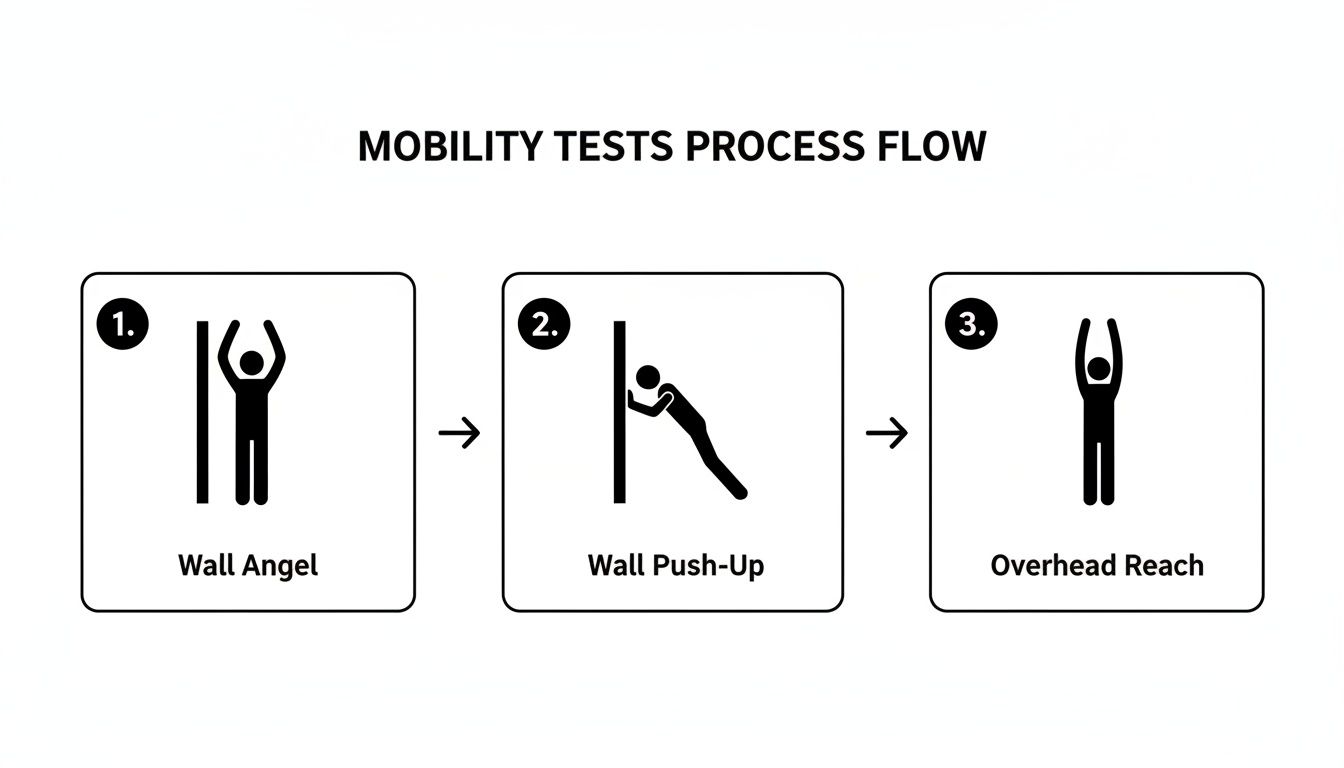
This flowchart illustrates how self assessments can pinpoint specific weaknesses in your shoulder's movement patterns before you begin these exercises.
How to Perform It:
Get into a high plank or tabletop position with straight arms.
Without bending elbows, sink your chest by pinching your shoulder blades together (retraction).
Press the floor away, rounding your upper back and spreading your shoulder blades apart (protraction). This is where the serratus anterior works.
Research using electromyography has shown how different scapular mobility exercises create specific muscle activation patterns to optimize shoulder rhythm, which is key for creating balance and preventing pain (Ludewig & Cook, 2000).
Integrating Scapular Work into Your Weekly Routine
The key to lasting change is consistently weaving these exercises into your regular training schedule, tailored to your specific activity.
Programming for Runners
For runners, posture and arm swing are paramount. Stiff upper backs and immobile shoulder blades lead to inefficient, tense running form.
Pre-Run Warm-Up: Spend 3-5 minutes waking up your upper back. Try 1 set of 8-10 Scapular CARs and 1 set of 10 Wall Slides. For more ideas, see our guide on how to warm up before exercise for peak performance.
Recovery Days: Use off days for gentle mobility. Light sets of Scapular Push-Ups or Prone Y-T-W-Ls can counteract the hunched posture from long runs.

Programming for CrossFitters and Lifters
For those lifting heavy, especially overhead, a mobile and stable scapula is essential for movements like the snatch and overhead squat.
Pre-Lift Activation: Dedicate 5-7 minutes to activating stabilizers. A great combination is 2 sets of 10 Scapular Push-Ups followed by 2 sets of 8 Wall Slides to prepare your shoulder blades for heavy loads.
Clinical trials support this, showing that scapular stabilization exercises lead to significant gains in shoulder range of motion and muscle recruitment (Ellenbecker & Cools, 2010).
Programming for General Gym-Goers
For general fitness, sprinkle scapular work throughout your week to build a resilient foundation.
For general wellness, "little and often" is key. Five minutes of focused work three times a week is more effective than one long session.
Here’s a sample week:
Upper Body Day: Include Wall Slides and Scapular Push-Ups in your warm-up.
Lower Body Day: Perform a set of Scapular CARs between sets of squats or lunges.
Rest/Active Recovery Day: Create a mobility flow with 1 set of 10-12 reps of all four key exercises.
Scapular Exercise Programming Guide
Athlete Type | Goal | Frequency | Key Exercises | When to Perform |
|---|---|---|---|---|
Runner | Improve posture & arm swing | 2-3x per week | Scapular CARs, Wall Slides | Before runs & on recovery days |
CrossFitter/Lifter | Enhance overhead stability | 3-4x per week | Scapular Push-Ups, Wall Slides | Before upper-body lifts & on separate mobility days |
General Gym-Goer | Build resilience & prevent pain | 3x per week | CARs, Push-Ups, Y-T-W-Ls | During warm-ups, between sets, & on rest days |

How Better Scapular Health Supercharges Your Workouts
Understanding how scapular mobility exercises directly improve your favorite activities helps make the habit stick. Stable and mobile shoulder blades allow for efficient force transfer, boosting performance.
Impact on Strength Training
For lifters, a stable scapula is the bedrock of strength. During a bench press, retracting and locking your shoulder blades creates a solid platform, allowing your chest and triceps to generate maximum power.
For overhead movements like squats or snatches, proper upward rotation of the scapula is crucial. Without it, the shoulder joint becomes unstable, limiting strength and increasing injury risk. Proper mobility is key to preventing chronic issues; for more on this, see this resource on understanding frozen shoulder treatment.
The difference between a failed lift and a new personal record often lies in scapular stability. When they're locked in, your body can focus on moving weight, not fighting instability.
Benefits for Runners and Cross-Trainers
An efficient arm swing, originating from the smooth glide of the shoulder blades, propels runners forward and maintains balance. Mobile scapulae allow arms to swing freely, reducing tension in the neck and upper back. This means less wasted energy and a more powerful stride. This foundational movement also speeds up recovery, a topic covered in our guide on how to prevent muscle soreness.
One study demonstrated that an 8-week program focused on scapular exercises led to significant functional improvements and pain reduction in patients with chronic shoulder pain (Tate et al., 2008).

Got Questions About Shoulder Blade Mobility?
Here are answers to some common questions about improving scapular function.
How Long Until I See Improvement?
While many feel better muscle activation immediately, noticeable changes in range of motion typically take 4 to 6 weeks of consistent work (3-4 times per week). Lasting tissue adaptations take time, but you will likely feel improved control and stability much sooner.
Can I Do These Exercises With Shoulder Pain?
This depends on the type of pain. For sharp, radiating, or persistent pain, consult a physical therapist first. However, for general stiffness or dull aches, these exercises can be very beneficial.
The golden rule is to always work within a pain-free range. If a movement causes sharp pain, stop or modify it. Never push through that kind of pain.
Are Scapular Mobility Drills Just Stretching?
No. While both are valuable, they serve different purposes.
Stretching is generally passive, holding a position to lengthen a muscle and increase flexibility.
Scapular mobility exercises are active, focusing on improving neuromuscular control and strengthening muscles through their full range of motion.
Stretching helps you gain range, while mobility work teaches you how to use that range effectively.
How Often Should I Do Scapular Exercises?
Consistency is more important than intensity. Aim for 5-10 minutes of focused work, 3-5 days a week. Integrating these drills into your warm-ups is an efficient way to make it a sustainable habit.
References
Cools, A. M., Witvrouw, E. E., Declercq, G. A., Vanderstraeten, G. G., & Cambier, D. C. (2007). Scapular muscle recruitment patterns: trapezius muscle latency with and without shoulder impingement syndrome. The American Journal of Sports Medicine, 31(4), 542–549.
Ellenbecker, T. S., & Cools, A. (2010). Rehabilitation of shoulder impingement syndrome and rotator cuff injuries: an evidence-based review. British Journal of Sports Medicine, 44(5), 319-327.
Ludewig, P. M., & Cook, T. M. (2000). Alterations in shoulder kinematics and associated muscle activity in people with symptoms of shoulder impingement. Physical Therapy, 80(3), 276-291.
Tate, A. R., McClure, P., Kareha, S., & Irwin, D. (2008). A clinical method for identifying scapular dyskinesis, part 2: validity. Journal of Athletic Training, 43(2), 165–173.
At Flourish-Everyday, we believe a strong, pain-free body is your ticket to a more vibrant life. By weaving smart mobility work into your routine, you’re setting yourself up to run farther, lift heavier, and just move with more confidence. Check out our other resources and find the perfect gear to support your entire wellness journey at https://www.flourish-everyday.com.