Back Workout At Home: For A Stronger Core

Updated: Feb 13
Let's be honest, getting to the gym can be a real hassle some days. The great news is you don't need a fancy commercial gym to sculpt a strong, healthy back. A simple but effective back workout at home is one of the best ways to build foundational strength and fix your posture for good. You can get incredible results with just your body weight or a few key pieces of gear.

Building a Powerful Back in Your Living Room
This guide is your complete roadmap to crafting a back routine you can actually stick with at home, focusing on movements that deliver real world results. We'll dive into why a resilient back is the foundation for everything, better posture, less pain, and a boost in overall strength. Forget the guesswork; this is your clear plan.
The shift to home fitness isn’t just a passing trend. People are fundamentally changing how they approach their health, and the numbers don't lie. Data shows a massive preference for working out at home over hitting the gym.
In fact, 52% of U.S. adults now exercise regularly at home, while only 28% do the same at a gym. People who train at home also tend to be more consistent, showing they're over 21% more likely to get their workouts in every week.

What This Guide Covers
To get you started, here's a quick look at everything we're going to cover:
Know Your Muscles for a Smarter Workout: An easy to follow breakdown of the key back muscles you'll be targeting.
The Best Back Exercises You Can Do at Home: Detailed instructions for both bodyweight and minimal-equipment movements.
Your Weekly At Home Back Workout Plan: Beginner, intermediate, and advanced templates to give your training some structure.
How to Warm Up and Cool Down for a Healthy Back: The essential routines you need to prevent injury and help your body recover.
Common Questions About Home Back Workouts: Clear, straightforward answers to the questions I hear most often.
This approach gives you everything you need to train safely and see progress. If you're just starting to build out your space, you might also want to check out our guide on the essential workout equipment for an epic home gym experience.
Your At Home Back Workout Blueprint
This table summarizes the fundamental movement patterns you need for a balanced and effective back workout you can do right from your living room.
Component | Focus | Bodyweight Example | Equipment Example |
|---|---|---|---|
Horizontal Pull | Building back thickness and targeting rhomboids and mid-traps. | Inverted Row (using a table) | Dumbbell Row |
Vertical Pull | Creating back width by focusing on the latissimus dorsi (lats). | Pull-Up (using a doorframe bar) | Banded Pulldown |
Spinal Extension | Strengthening the lower back (erector spinae) for stability and posture. | Superman | Good Morning (with a band) |
Scapular Retraction | Activating the upper back muscles to improve shoulder health. | Scapular Push-Up | Band Pull-Apart |
By making sure your workout includes an exercise from each of these categories, you’ll be well on your way to building a strong, functional, and injury resistant back.
To really crush your back workout at home, you first need to know what you’re working with. It’s not just about going through the motions; understanding the muscles you're targeting builds a stronger mind muscle connection. That’s the secret to making every single rep count.
Forget complicated anatomy charts. Let's break it down to the four key muscle groups that are the foundation of a powerful, functional back. Each one has a specific job to do, and knowing them will change how you train.

The Lats: The Engine for a Wider Back
Your latissimus dorsi, or "lats," are the biggest muscles in your back. Picture them sweeping from under your armpits down the sides of your body. These are the muscles that create that classic "V-taper" look, giving you the illusion of a wider back and a slimmer waist.
Your lats are your primary pulling muscles. Every time you pull a heavy door open, lift a heavy box off the floor, or do a pull-up, your lats are firing on all cylinders. They are the true workhorses of your back.
The Traps and Rhomboids: Your Posture Powerhouse
Tucked away in your upper and mid-back are your trapezius (traps) and rhomboids. While your lats build width, these guys are all about building thickness and density. More importantly, they’re your ticket to better posture.
The traps are a big, diamond shaped muscle group stretching from your neck down your mid-back. The smaller rhomboids sit right underneath them, connecting your shoulder blades to your spine. Their main gig? Pulling your shoulder blades back and down, an action called scapular retraction. This is the direct antidote to the slumped, desk jockey posture so many of us fight against.
Key Takeaway: If you want to stand taller and build a thick, impressive upper back, focusing on your traps and rhomboids is non-negotiable. It's one of the best ways to combat shoulder strain from daily life.
The Erector Spinae: Your Core Stabilizer
Finally, let's talk about the unsung heroes: the erector spinae. This group of muscles runs straight up along your spine. You might not see them pop like your lats or traps, but they are absolutely critical for a healthy, injury free back. Think of them as the foundational support system for your entire upper body.
These muscles are responsible for extending and stabilizing your spine, protecting it during pretty much everything you do. Moves like the Superman or Good Morning are perfect for strengthening this area, building the resilience you need to support all your other lifts safely and effectively.

The Best Back Exercises You Can Do at Home
Alright, now that you've got the anatomy down, it's time for the fun part, putting that knowledge to work. This is where we build your back workout at home with moves designed to deliver real results, whether you've got a full set of gear or just your own body weight to work with.
It can be tough to know where to start, so I've put together a simple decision tree to help you match your exercises to what you really want to achieve. Are you aiming for that classic V-shape, better posture, or rock-solid core stability? This will point you in the right direction.
Bodyweight Back Exercises
Think you need a rack of weights to build a strong back? Think again. Your own body is one of the most powerful tools you have for developing foundational strength.
Superman This exercise is an absolute must for targeting the erector spinae. These are the muscles running right alongside your spine, and they're crucial for good posture and keeping you stable.
How to Do It: Lie face down, extending your arms and legs. In one smooth motion, lift your arms, chest, and legs off the floor. Keep your neck in a neutral position, don't crane it up. Squeeze your lower back at the top for a beat, then slowly lower everything back down.
Make it Easier: Just starting out? Lift only your arms, or only your legs, to get the feel for it.
Make it Harder: Amp it up by holding that top position for longer or adding a tiny pulse at the peak of the movement.
Inverted Row When it comes to building back thickness with just your body weight, the inverted row is king. It's fantastic for hitting your lats, rhomboids, and traps all at once.
How to Do It: Find a sturdy table or desk you can get under. Grip the edge with both hands, a little wider than your shoulders. Keeping your body as straight as a board from your head to your heels, pull your chest up towards the table. Really focus on squeezing your shoulder blades together at the top, then lower yourself back down with control.
Make it Easier: Bend your knees to 90 degrees. This reduces how much of your body weight you're lifting and makes the movement more manageable.
Make it Harder: Ready for a challenge? Pop your feet up on a chair or stool. This increases the load and really tests your strength.
Pro Tip: As you pull, think about driving your elbows down and back. This little mental cue is a game-changer for making sure your back muscles are firing properly, instead of letting your biceps take over.
Minimal Equipment Back Exercises
Adding a couple of simple tools like dumbbells or resistance bands can completely transform your back training. With the U.S. home fitness equipment market growing from $4.81 billion in 2022 to an estimated $8.50 billion by 2030, getting your hands on this gear has never been easier.
Dumbbell Row This classic dumbbell move is a true powerhouse for building a strong, thick back. It primarily hammers the lats and the muscles in your mid-back.
How to Do It: Plant your left knee and left hand on a bench or a solid chair, keeping your back flat and parallel to the floor. Grab a dumbbell in your right hand with your arm hanging straight down. Pull that dumbbell up toward your chest, making sure to keep your elbow tucked in close to your body. Give your back a good squeeze at the top before lowering the weight slowly. Do all your reps on one side, then switch.
Make it Easier: Go with a lighter weight or slightly reduce the range of motion until you build more strength.
Make it Harder: The answer is simple: increase the weight. You can also add a two-second pause at the top of each rep to really feel the burn.
On tough exercises like rows, your grip can sometimes give out before your back does. If that's happening, you might want to find ways to enhance your grip performance so you can push your back muscles to their true limit on every set.
Banded Pull Apart This is one of the best, and most overlooked, exercises for fixing your posture. It directly strengthens the smaller, often neglected muscles in your upper back, like the rhomboids and rear delts.
How to Do It: Stand with your feet shoulder width apart. Hold a resistance band out in front of you at chest height with an overhand grip, hands also shoulder width apart. Keeping your arms straight, pull the band apart by squeezing your shoulder blades together like you're trying to crack a nut between them. Hold for a second when the band touches your chest, then slowly return to the start.
Make it Easier: Use a band with less resistance or simply move your hands further apart on the band you have.
Make it Harder: Grab a heavier band or dramatically slow down the movement. Try a 3-4 second count as you pull and another 3-4 seconds as you return.
These foundational movements are the perfect starting point for your back workout at home. To see how they fit into a bigger picture, you should check out our guide on the top resistance training exercises to unleash your strength. By mastering these, you’ll be well on your way to building a powerful, resilient back right from your living room.
Your Weekly At Home Back Workout Plan
Having a list of great exercises is just the start. The real magic happens when you know how to string them together into a smart, consistent plan that actually gets you results. A good routine makes sure you hit all the important back muscles without burning yourself out, giving your body that perfect mix of work and rest to get stronger. Think of this as your blueprint for a solid back workout at home.
My goal here isn't just to hand you a workout and send you on your way. It's to give you a framework you can grow with. We'll kick things off with the basics and then I'll show you exactly how to level up. It all comes down to progressive overload, the simple idea of gradually asking more from your muscles over time. That might mean doing more reps, adding another set, or graduating to a tougher exercise.

The Beginner Back Blast
If you're new to this, your entire focus should be on one thing: mastering good form. This isn't the time to go all out. The real win is staying consistent and teaching your body how to move correctly.
I've designed this beginner routine to be done 2-3 times per week. Just make sure you have a day off in between, like hitting it on a Monday and Thursday. That schedule gives your muscles plenty of time to recover and come back stronger.
Superman: 2 sets of 10-12 reps (Really focus on a slow, controlled lift and give your back a good squeeze at the top.)
Inverted Row (with bent knees): 2 sets of 8-10 reps (Make sure you're pulling your chest, not your stomach, toward the table.)
Banded Pull Aparts: 2 sets of 15 reps (Keep those arms straight and start the movement by pulling your shoulder blades together.)
Glute Bridges: 2 sets of 12-15 reps (This move is clutch for strengthening the muscles that support your lower back.)
Take about 60-90 seconds of rest between each set. Once you can nail all the sets and reps with perfect form and it feels pretty manageable, you know it's time to progress. You can either add a third set to each exercise or jump up to the intermediate plan.
The Intermediate Back Builder
Ready for the next level? The intermediate plan dials things up with tougher exercises and a bit more volume. You've built your foundation, and now it's time to start building some serious strength.
Stick with training your back 2-3 times per week. A great way to schedule this is to split your workouts into upper and lower body days, slotting this routine into your upper body sessions.
Inverted Row (with straight legs): 3 sets of 10-12 reps
Dumbbell Row: 3 sets of 8-10 reps per arm
Banded Pull-Aparts: 3 sets of 15-20 reps
Good Mornings (bodyweight or with a light band): 3 sets of 12 reps
At this stage, try to shorten your rest periods to 60 seconds between sets. This keeps the intensity high. If those dumbbell rows start feeling easy, it's a clear sign you need to grab a heavier weight.
Progressive Overload in Action Here’s a real world example. Let's say you're doing dumbbell rows with a 20-pound dumbbell and can hit 3 sets of 8 reps. Your mission for the next couple of weeks is to work up to 3 sets of 10 reps with that same weight. Once you achieve that, grab a 25-pound dumbbell and start back at 8 reps. That’s the cycle of getting consistently stronger.
The Advanced Back Attack
This one's for those who have put in the work and are ready to really push their limits. The advanced plan uses more complex movements and higher volume to force maximum muscle growth and strength. This is where you find out what you're truly made of.
I recommend 2 dedicated back workouts per week at this level. This allows you to go all out during each session while still getting enough recovery time for your muscles to repair and grow.
Pull-Ups (or Banded Pull-Ups): 3 sets to failure (as many reps as possible with good form)
Inverted Row (feet elevated): 3 sets of 10-15 reps
Single Arm Dumbbell Row: 4 sets of 6-8 reps per arm (Go heavy here, but don't sacrifice your form.)
Face Pulls (with band): 3 sets of 15-20 reps
Your rest time will vary here. For the heavy strength stuff like pull ups and rows, give yourself 90 seconds. For the higher rep exercises like face pulls, keep it tighter at 45-60 seconds. This combo of heavy lifting and higher rep work is an incredible stimulus for growth. Your back workout at home just got a serious upgrade.
Sample Weekly Back Workout Templates
To help you visualize how this all fits together, here’s a quick breakdown of the different templates. Find the one that matches your current fitness level and use it as your starting point.
Level | Frequency | Core Exercises | Sets x Reps |
|---|---|---|---|
Beginner | 2-3 days/week | Superman, Inverted Row (bent knee) | 2 sets x 8-12 reps |
Intermediate | 2-3 days/week | Inverted Row (straight leg), Dumbbell Row | 3 sets x 8-12 reps |
Advanced | 2 days/week | Pull-Ups, Single-Arm Dumbbell Row | 3-4 sets x 6-15 reps |
Remember, these are templates, not rigid rules. The most important thing is to listen to your body, focus on form, and strive for consistent progress each week. That's the real secret to building a strong, impressive back.
How to Warm Up and Cool Down for a Healthy Back
Your workout doesn't begin with the first pull-up or end after your last set of rows. If you want to build a strong, resilient back for the long haul, especially when doing a back workout at home, smart prep and recovery are nonnegotiable.
Skipping these crucial steps is like trying to drive your car on a frosty morning without letting the engine warm up. You might get away with it once or twice, but you're just asking for trouble down the road.
With the home fitness market booming from $6.76 billion in 2020 to $9.49 billion post-pandemic, more people are training on their own than ever before. This shift makes knowing how to properly prepare and recover even more critical, since you're your own coach.

The Dynamic Warm-Up Your Back Needs
Let’s get one thing straight: static stretching (the old bend and hold) has no place before you lift. Your pre-workout goal is to get the blood flowing and wake up the very muscles you’re about to train. This is where a dynamic warm-up comes in.
These active movements prime your body for what’s ahead. If you really want to prepare your body to prevent injury and maximize performance, take some time to learn how to warm up before lifting.
Here are a few of my go-to moves:
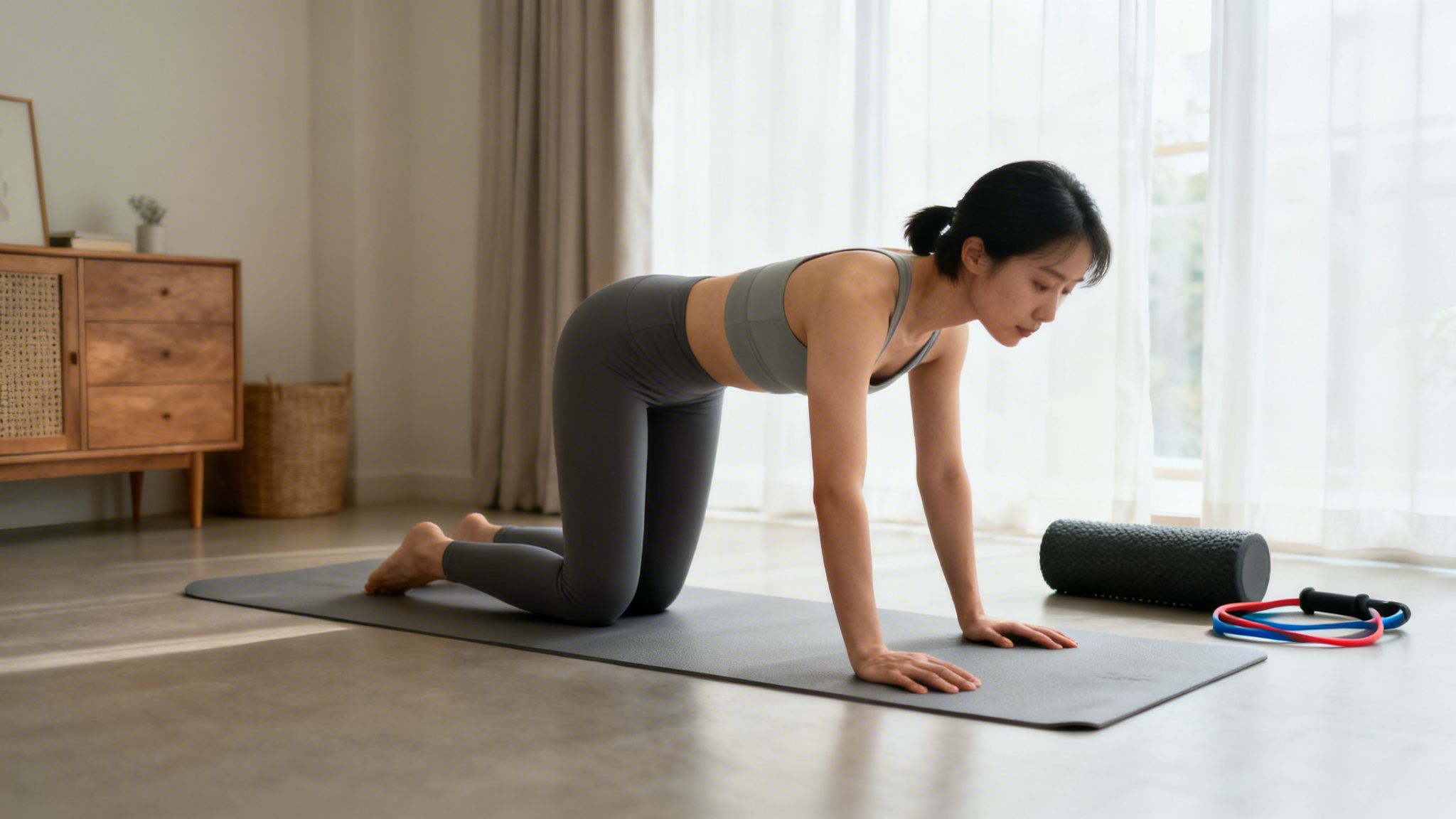
Cat-Cow: Get on all fours and slowly move between arching your back up like a Halloween cat and then letting your stomach drop toward the floor. Do 10-12 controlled reps to gently get your spine moving.
Thoracic Rotations: Staying on your hands and knees, put one hand behind your head. Rotate that elbow down towards your opposite wrist, then open it up toward the ceiling, letting your eyes follow your elbow. Aim for 8-10 reps on each side to loosen up your upper back.
Bird Dog: This one is great for firing up your core and the small muscles that keep your spine stable. From all fours, extend your right arm forward and your left leg straight back at the same time. Keep your back flat, no arching! Hold for a beat, then switch.
Smart Cool Down Strategies for Recovery
Once you’ve finished that last rep, you're not done yet. A proper cool down is your body's off-ramp, helping it transition from high gear back to a resting state. This simple habit helps reduce soreness and actually improves your flexibility over time.
This is where static stretching shines. Now that your muscles are warm and pliable, you can hold stretches for longer periods to release tension.
Key Insight: Think of your muscles like a rubber band. If you try to stretch a cold rubber band, it might snap. But a warm one? It's much more pliable. That's exactly why we hold stretches after the workout, not before.
Try this simple cool down sequence:
Child's Pose: From a kneeling position, sit your hips back onto your heels and reach your arms forward, resting your forehead on the floor. You'll feel a great stretch in your lats and lower back. Breathe deep and hold for 30-60 seconds.
Knees to Chest Stretch: Lie on your back and pull both knees into your chest, giving them a good hug. You can even rock gently from side to side for a nice little lower back massage. Hold for 30-60 seconds.
Foam Rolling: If you have one, a foam roller is your best friend post-workout. Spend a few minutes slowly rolling out your lats (under your armpits), mid-back, and upper back to work out any knots and boost recovery.
For a deeper look into the science behind this, check out our complete guide on how to warm up before exercise for peak performance. Make these routines a non-negotiable part of every session, and your back will thank you for years to come.

Top Questions About Home Back Workouts
How Often Should I Train My Back at Home?
For most people, targeting your back two to three times per week is the sweet spot. This hits that perfect balance of providing enough stimulus for muscle growth and strength gains without pushing you into overtraining territory.
If you're just starting out, two solid sessions a week is more than enough to build a great foundation. As you get more experienced and your body gets better at recovering, you might bump it up to three. Just make sure you always have at least one full day of rest between those back-focused workouts.
Can I Actually Build Muscle Without Heavy Weights?
Absolutely. You don't need a barbell loaded with plates to build a strong back. The key principle here is progressive overload, which is just a fancy way of saying you need to consistently challenge your muscles a little bit more over time. Lifting heavier is one way to do that, but it’s far from the only one.
At home, you can get fantastic results by focusing on these methods:
Increase Reps: Just aim to do one more rep than you did last time. It’s that simple.
Add Sets: Once you can comfortably hit your target reps for all your sets, tack on an extra one.
Slow Down the Tempo: This is essential. Try a three second lowering phase on a dumbbell row. It dramatically increases the time your muscles are under tension, making the move much harder.
Reduce Rest Time: Shaving 15 seconds off your rest period between sets forces your muscles to work harder with less recovery.
How Do I Know If I'm Doing an Exercise Correctly?
This is probably the biggest hurdle when training alone. Without a coach watching over you, you have to become your own form critic. Your best tool? Your smartphone.
Seriously, set up your phone and record your sets from the side. After your workout, watch the playback and compare your form to videos of the exercise being done correctly. Look for the key checkpoints: Is your back flat during rows? Are you pulling your shoulder blades together? This kind of self assessment is crucial for preventing injury and making sure you're actually working the muscles you intend to.
Here's a huge tip: Pay attention to where you feel the exercise. During a row, you should feel a strong squeeze in your mid-back, not just a burn in your biceps. If your arms are doing all the work, you need to adjust your form or lighten the load.
What If I Feel Pain in My Lower Back?
Let's be clear: a little muscle soreness the next day is fine. Sharp or nagging pain during an exercise is not. If you feel pain in your lower back during your back workout at home, stop what you're doing immediately. Pain is your body’s alarm system telling you something is wrong.
More often than not, lower back pain during exercises like rows is a sign that your core isn't engaged or you're using momentum to swing a weight that's too heavy. Dial it back. Spend some time strengthening your core with planks and bird dogs, and focus on nailing perfect form with a lighter weight before you even think about moving up.
At Flourish-Everyday, we believe a strong, healthy body starts with the right knowledge and the right gear. Whether you're building out your home gym or just looking for the perfect pair of training shoes, we're here to support your journey. Find everything you need to inspire your fitness goals at https://www.flourish-everyday.com.