The Ultimate Guide: 8 Powerful Exercises for Hamstrings in 2026

Updated: Dec 20, 2025
Welcome to your definitive guide for building powerful, resilient hamstrings. More than just the muscles on the back of your thighs, the hamstrings are a crucial powerhouse for everything from sprinting and jumping to maintaining proper posture and preventing lower back pain. Neglecting them can lead to muscular imbalances, injuries, and untapped athletic potential. This is a common issue, as many traditional workout plans overemphasize the quadriceps, leaving the posterior chain underdeveloped and vulnerable.

This guide, "8 Powerful Exercises for Hamstrings in 2026", dives deep into the most effective exercises for hamstrings, providing detailed instructions, common mistakes to avoid, and actionable programming advice. We will explore a curated list of movements that target the hamstrings' two primary functions: hip extension and knee flexion, ensuring you build comprehensive strength. To truly maximize the performance benefits of strong hamstrings, consider integrating broader strategies to get stronger faster into your routine.
Whether you're a seasoned athlete looking to improve your explosive power or just starting your fitness journey, strengthening your posterior chain is nonnegotiable. This article provides the blueprint to do it right.

Article Index
Top 8 Exercises for Hamstrings:
1.Romanian Deadlift (RDL)
2. Nordic Hamstring Curl
3. Lying Leg Curl
4. Good Morning Exercise
5. Glute-Ham Raise (GHR)
6. Single-Leg Deadlift (SLD)
7. Swiss Ball Hamstring Curl
8. Trap Bar Deadlift (Hex Bar Deadlift)
Your Next Steps to a Stronger Posterior Chain
Key Takeaways for Hamstring Mastery
Building Your Hamstring Focused Routine
1. Romanian Deadlift (RDL)
The Romanian Deadlift, or RDL, is a cornerstone movement for building powerful and resilient hamstrings. Unlike the conventional deadlift which involves lifting the weight from the floor, the RDL focuses on the eccentric (lowering) phase of the lift, creating an intense stretch and contraction in the hamstring muscles and glutes. This hip hinge exercise is one of the most effective exercises for hamstrings, prized for its ability to isolate the posterior chain and develop strength, hypertrophy, and flexibility.

Its effectiveness lies in its direct stress on the hamstrings. As you hinge at the hips and lower the weight with a nearly straight leg, you place the hamstrings under significant tension throughout a large range of motion. This is crucial for muscle growth and injury prevention, making it a staple for everyone from powerlifters strengthening their deadlift lockout to runners looking to improve their stride and prevent pulls.
Why It Works So Well
The RDL's magic is in the hip hinge. By pushing your hips backward while maintaining a neutral spine, you force the hamstrings and glutes to control the descent and power the ascent. This movement pattern directly translates to athletic performance and everyday functional strength.
Key Insight: The primary goal of the RDL is not just lifting weight, but controlling its descent. This controlled negative movement is what stimulates the most muscle adaptation and makes it a superior hamstring builder.
How to Implement the Romanian Deadlift
Mastering the form is critical to reaping the benefits and avoiding lower back strain.
Starting Position: Stand with your feet hip width apart, holding a barbell or dumbbells in front of your thighs with an overhand grip. Maintain a "soft" bend in your knees, about 5-15 degrees, and keep it consistent throughout the lift.
The Hinge: Initiate the movement by pushing your hips backward as if you are trying to close a car door with your glutes. Keep your back straight and your chest up.
Lowering Phase: Lower the weight by continuing to push your hips back, keeping the bar close to your shins. You should feel a deep stretch in your hamstrings. Lower the weight until you feel the stretch peak or your back starts to round, whichever comes first.
The Ascent: Drive your hips forward, squeezing your glutes to return to the standing position.
To ensure stability and proper force transfer during this lift, wearing the right footwear is essential. You can find more information about good shoes for squats and deadlifts to support your training. For a hamstring focused workout, aim for 3-4 sets of 6-12 repetitions, focusing on control over heavy weight.
2. Nordic Hamstring Curl
The Nordic Hamstring Curl is one of the most challenging yet effective bodyweight exercises for hamstrings, renowned for its ability to build eccentric strength and drastically reduce injury risk. This exercise involves kneeling and slowly lowering your torso toward the floor, using only your hamstrings to control the descent. Unlike traditional curls that focus on the concentric (shortening) phase, the Nordic curl overloads the eccentric (lengthening) phase, which is where most hamstring injuries occur.
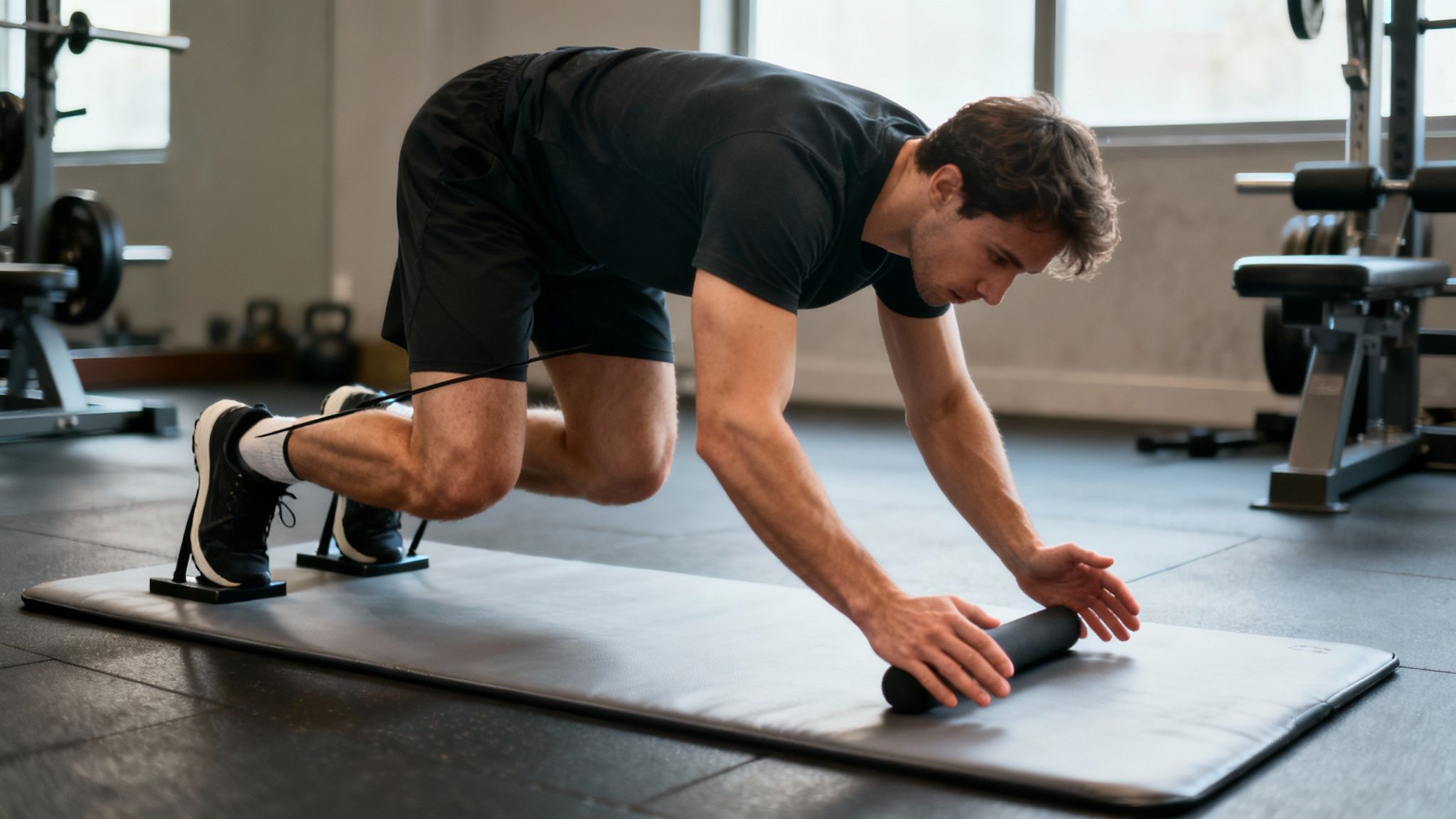
Its immense value has been proven in athletic settings, particularly in professional soccer, where it is a staple in injury prevention programs. Research has consistently shown that incorporating Nordic curls can significantly lower the incidence of hamstring strains. This powerful movement builds muscle fibers that are more resilient to the rapid lengthening and powerful contractions required in sprinting, jumping, and cutting movements, making it an essential tool for athletes and fitness enthusiasts alike.
Why It Works So Well
The Nordic curl's effectiveness stems from its intense focus on eccentric overload. As you lower your body, your hamstrings work at their longest muscle lengths under high tension, a potent stimulus for strengthening the muscle tendon junction and promoting hypertrophy. This specific type of strength is difficult to replicate with other exercises.
Key Insight: The Nordic Hamstring Curl directly trains the hamstrings' "braking" mechanism. By strengthening their ability to decelerate your body's momentum, you build elite level resilience against common athletic injuries.
How to Implement the Nordic Hamstring Curl
Proper form and gradual progression are crucial for this advanced movement. Most people cannot perform the concentric (upward) phase initially, which is perfectly normal.
Starting Position: Kneel on a padded surface with your ankles securely anchored by a partner, a heavy dumbbell, or a piece of gym equipment. Keep your body in a straight line from your knees to your head.
The Descent: Engage your core and glutes, then slowly lower your torso toward the floor. Control the movement for as long as possible using only your hamstrings.
Catch and Reset: Once you can no longer control the descent, catch yourself with your hands in a push-up position.
The Ascent: Push yourself back up to the starting position using your arms. As you get stronger, you can try to pull yourself up using your hamstrings, but focus first on mastering the lowering phase.
Due to its high intensity, start with 2-3 sets of 3-5 repetitions, focusing entirely on a slow, controlled negative. Perform this exercise once or twice a week at most to allow for adequate recovery.
3. Lying Leg Curl
The Lying Leg Curl is a classic isolation exercise that places direct and focused stress on the hamstring muscles. Performed on a dedicated machine, this movement involves lying face down and curling your lower legs up against a weighted pad. Its primary advantage is the ability to target the hamstrings with constant tension throughout the entire range of motion, something that is difficult to achieve with free weight compound exercises. This makes it an invaluable tool for hypertrophy (muscle growth) and for strengthening the knee flexion function of the hamstrings.

Its effectiveness comes from its simplicity and ability to isolate. By pinning the body against the machine's pad, you minimize the involvement of other muscle groups like the glutes or lower back. This forces the hamstrings to perform all the work, making it one of the best exercises for hamstrings when the goal is pure muscular development. It’s a staple in bodybuilding programs for creating detailed hamstring separation and is also frequently used in physical therapy to safely rebuild hamstring strength after an injury.
Why It Works So Well
The Lying Leg Curl excels at creating a strong mind muscle connection. Because the movement is so controlled and isolated, you can focus entirely on the quality of the hamstring contraction at the top of the lift and the controlled stretch on the way down. This targeted tension is a powerful stimulus for muscle growth.
Key Insight: The machine provides continuous tension, but the user must control the tempo. A slow, deliberate eccentric (lowering) phase lasting 2-3 seconds can dramatically increase time under tension and lead to superior muscle building results.
How to Implement the Lying Leg Curl
Proper setup and execution are crucial for isolating the hamstrings and protecting the lower back.
Starting Position: Adjust the machine so the pad rests comfortably on your lower Achilles tendon, just above your ankles. Your knees should be just off the edge of the bench. Lie face down, gripping the handles provided for stability.
The Curl: Exhale and forcefully contract your hamstrings to curl your feet up towards your glutes in a smooth, controlled arc. Keep your hips pressed firmly into the pad throughout the movement.
Peak Contraction: Squeeze your hamstrings hard at the top of the movement for a one second pause to maximize muscle fiber recruitment.
The Descent: Inhale and slowly lower the weight back to the starting position, resisting the pull of the weight. Avoid letting the weight stack crash.
This is an excellent finishing exercise in a leg workout after your main compound lifts. For hypertrophy, aim for 3-4 sets of 12-20 repetitions, focusing on perfect form and feeling the muscle work.
4. Good Morning Exercise
The Good Morning is a classic, yet often underutilized, posterior chain developer that acts as a pure hip hinge movement. Named for its resemblance to a bowing motion, this exercise places a barbell across the upper back and demands a controlled hinge at the hips, creating a powerful eccentric stretch and concentric contraction in the hamstrings and glutes. It is a formidable tool for building raw strength and improving hip mobility, making it one of the most respected exercises for hamstrings among serious lifters.

Its effectiveness comes from its direct loading of the hip hinge pattern with the weight placed high on the body. This creates a long lever arm, forcing the hamstrings, glutes, and spinal erectors to work overtime to stabilize and control the movement. Popularized by legendary strength coach Louie Simmons of Westside Barbell and used extensively in Soviet weightlifting programs, the Good Morning is a proven builder of posterior chain power that translates directly to stronger squats and deadlifts.
Why It Works So Well
The Good Morning's power lies in its ability to teach and strengthen the hip hinge under load, forcing strict form and developing incredible hamstring tension. By keeping the spine neutral and pivoting only at the hips, you isolate the posterior chain and build the foundational strength needed for nearly all athletic movements.
Key Insight: The Good Morning is a humbling exercise that demands respect for the weight. Its primary value is in mastering the movement pattern and building control, not lifting maximal loads. It directly trains the muscles responsible for maintaining posture and generating power from the hips.
How to Implement the Good Morning Exercise
Proper form is nonnegotiable to target the hamstrings effectively and protect your lower back. Always start with just the empty barbell.
Starting Position: Set up like a high bar back squat, with the barbell resting across your upper traps. Stand with your feet shoulder width apart, maintain a soft bend in your knees, and brace your core.
The Hinge: Initiate the movement by pushing your hips straight back, just as you would in an RDL. Keep your spine rigid and your chest up.
Lowering Phase: Continue hinging at the hips until your torso is nearly parallel to the floor, or until you feel a maximal stretch in your hamstrings without your back rounding. Keep your weight balanced over the midfoot.
The Ascent: Drive your hips forward aggressively, squeezing your glutes to return to the upright position.
For building strength and hypertrophy, focus on controlled execution. A good starting point is 3-4 sets of 5-8 repetitions, prioritizing form above all else.
5. Glute Ham Raise (GHR)
The Glute Ham Raise (GHR) is a highly praised, advanced bodyweight movement that is unmatched for developing hamstring strength, hypertrophy, and resilience. Performed on a specialized glute ham developer machine, this exercise forces the hamstrings to function as both a knee flexor and a hip extensor simultaneously. This dual action, combined with a brutal eccentric (lowering) phase, makes the GHR one of the most potent exercises for hamstrings available, building bulletproof posterior chains in athletes.
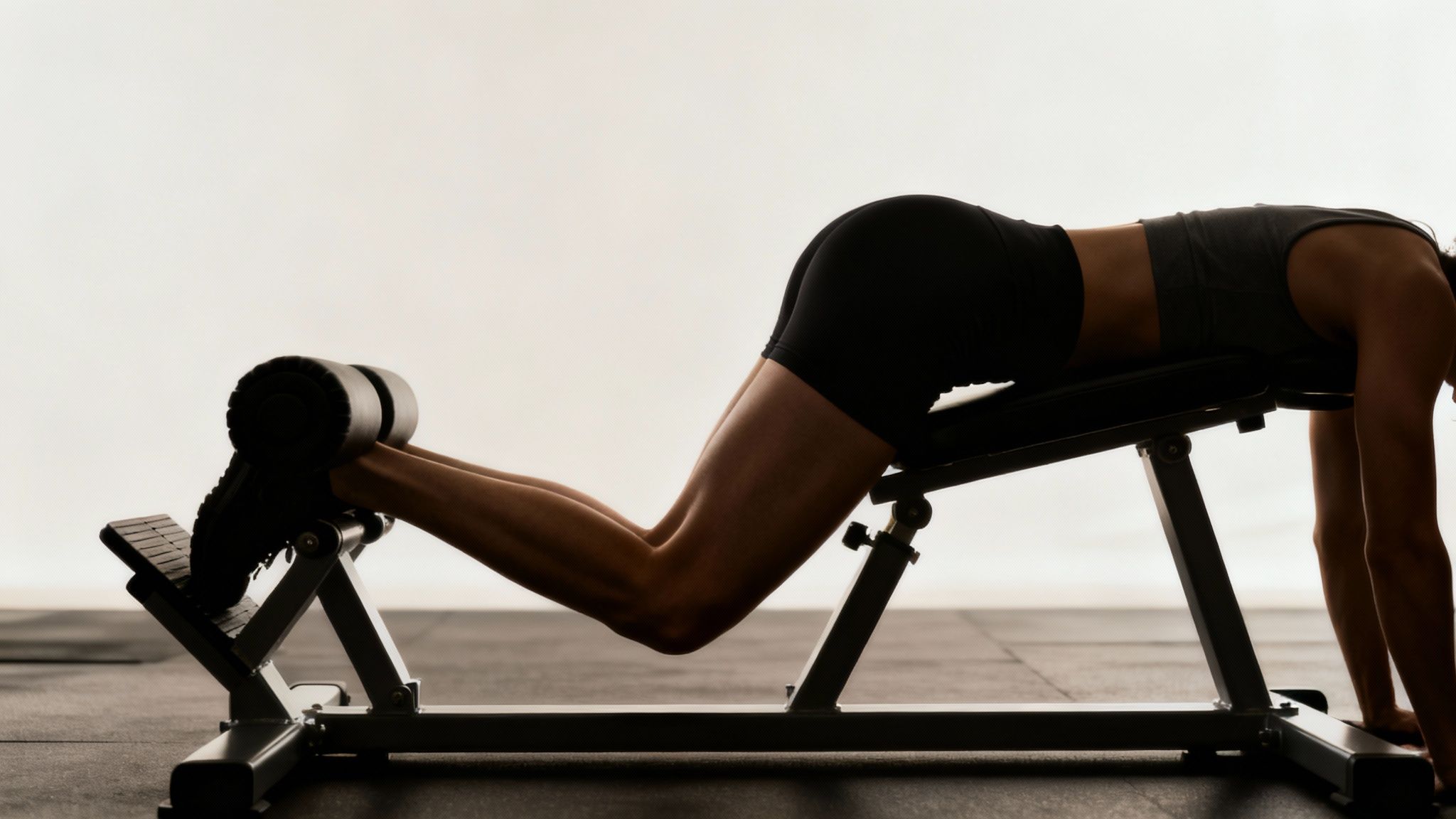
Its immense value is recognized in elite strength and conditioning settings, from professional sports facilities to CrossFit boxes and collegiate football programs. The GHR builds the kind of functional strength that directly translates to faster sprinting, higher jumping, and a reduced risk of hamstring strains. It uniquely isolates the hamstrings through their full range of motion under significant load without compressing the spine, making it a powerful alternative to heavily loaded barbell movements.
Why It Works So Well
The GHR is superior because it trains the hamstrings at both the knee and hip joints. As you lower your torso, your hamstrings work eccentrically to control the descent (knee flexion), and as you raise your torso, they work concentrically alongside the glutes to extend the hips and pull you back up. This complete contraction is difficult to replicate with other exercises.
Key Insight: Unlike leg curls which only isolate the knee flexion function, the GHR integrates the hamstrings' role as hip extensors. This functional integration is what builds true athletic power and helps prevent non-contact hamstring injuries.
How to Implement the Glute Ham Raise
The GHR is an advanced exercise that requires proper setup and progression. Do not rush into the full movement.
Starting Position: Secure your feet in the machine with your knees positioned just behind the pad. Your body should be in a straight line from your head to your knees, perpendicular to the floor. Squeeze your glutes and hamstrings to hold this position.
The Descent: Keeping your hips extended and back straight, slowly lower your upper body towards the floor by controlling the movement with your hamstrings. This eccentric phase should be slow and controlled, lasting 2-3 seconds.
The Ascent: Once you reach a horizontal position (or as low as you can control), forcefully contract your hamstrings to pull your body back up to the starting position. Use a slight push-off from the floor with your hands if needed.
Because this is a very challenging movement, many people will need assistance. Use a resistance band looped around your chest and the machine to help with the ascent. For a hamstring focused workout, aim for 3-4 sets of 5-10 repetitions, prioritizing perfect form and control.
6. Single Leg Deadlift (SLD)
The Single Leg Deadlift (SLD) is a challenging unilateral variation of the hip hinge that intensely targets the hamstrings and glutes while demanding significant balance and core stability. By performing the movement on one leg, you expose and correct muscular imbalances between your left and right sides, making it a powerful tool for injury prevention and athletic development. This exercise is highly functional, mimicking single leg movements common in sports and daily life.
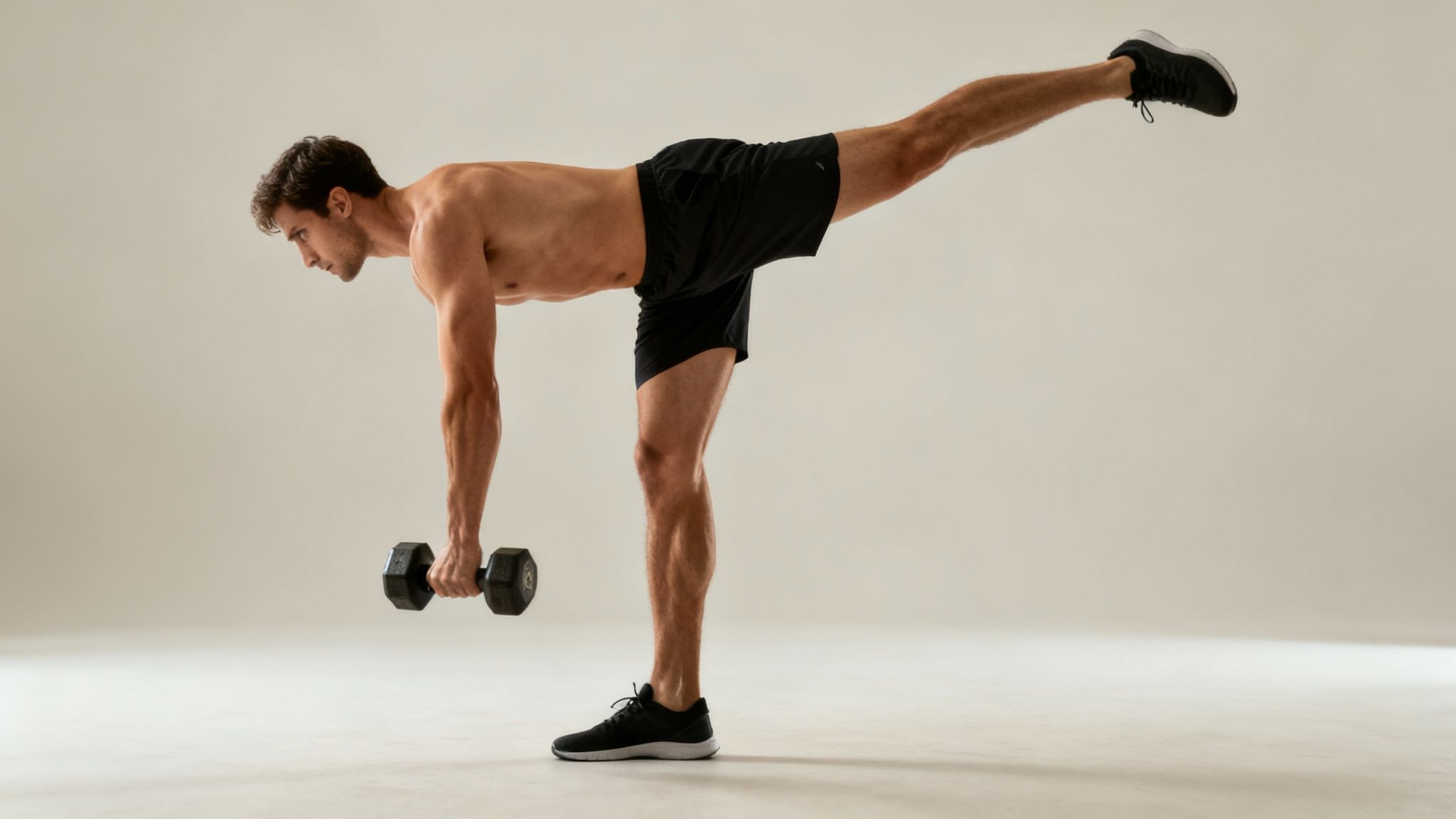
Its brilliance lies in its ability to combine strength training with stability and proprioceptive work. As you balance on one foot, the small stabilizer muscles in your ankle, knee, and hip must work overtime to maintain your position. This makes the SLD a staple in rehabilitation programs, functional fitness routines, and for any athlete looking to build a more resilient and balanced lower body. It's one of the best exercises for hamstrings because it builds real world, functional strength.
Why It Works So Well
The SLD forces each leg to work independently, preventing the stronger side from compensating for the weaker one. This unilateral load recruits deep core muscles to resist rotation and maintain a neutral spine, improving overall trunk stability. The coordination required to hinge at the hip while extending the opposite leg develops balance and body awareness critical for athletic performance.
Key Insight: The SLD isn't just a hamstring exercise; it's a full body stability challenge. The balance component forces your nervous system to engage more muscles, leading to greater functional strength and control.
How to Implement the Single Leg Deadlift
Mastering balance is the first step. Start with your bodyweight before adding dumbbells or kettlebells.
Starting Position: Stand on your right foot with a soft bend in the knee. Hold a dumbbell in your left hand to act as a counterbalance.
The Hinge: Hinge at your hips, pushing them backward while simultaneously extending your left leg straight behind you. Keep your back flat and your hips square to the floor.
Lowering Phase: Lower the weight towards the floor, keeping it close to your standing leg. Descend until you feel a strong stretch in your right hamstring or just before your balance wavers.
The Ascent: Drive your right foot into the floor and thrust your hips forward, squeezing your glutes to return to the starting position with control.
This movement heavily relies on your core to prevent your torso from twisting. To learn more about how a strong midsection supports dynamic movements, you can find information on essential core strengthening exercises for runners. Aim for 3-4 sets of 8-12 repetitions per leg, prioritizing perfect form over heavy weight.
7. Swiss Ball Hamstring Curl
The Swiss Ball Hamstring Curl is a dynamic stability exercise that challenges your hamstrings, glutes, and core simultaneously. Unlike machine based leg curls that isolate the hamstrings in a fixed position, this bodyweight movement forces your posterior chain to work in an unstable environment. This dual action of curling and stabilizing makes it one of the most functional exercises for hamstrings, bridging the gap between isolated strength and real world athletic movement.

Its effectiveness comes from the unique combination of knee flexion and hip extension under load. While your hamstrings pull your heels toward your glutes, your core and glutes must work overtime to keep your hips elevated and your spine neutral. This makes it an exceptional tool for building muscle endurance, improving neuromuscular control, and enhancing core stability, which is vital for injury prevention and performance in running and other sports.
Why It Works So Well
The magic of this exercise is the instability. The Swiss ball constantly challenges your balance, forcing smaller stabilizing muscles in your hips and core to fire continuously. This develops a more integrated and resilient posterior chain, teaching your muscles to work together as a unit, a skill essential for coordinating complex movements like sprinting or jumping.
Key Insight: The Swiss Ball Hamstring Curl trains the hamstrings to perform both of their primary functions at once: knee flexion (curling the leg) and hip extension (keeping the hips high). This dual function training is what makes it so transferable to athletic performance.
How to Implement the Swiss Ball Hamstring Curl
Proper form is crucial to engage the right muscles and protect your lower back from strain.
Starting Position: Lie on your back with your arms out to your sides for stability. Place your heels and lower calves on top of a properly inflated Swiss ball with your legs extended. Lift your hips off the floor until your body forms a straight line from your shoulders to your heels.
The Curl: Squeeze your hamstrings to pull the ball toward you, rolling it with your heels. Continue until your knees are bent at roughly a 90-degree angle. Keep your hips elevated throughout the movement.
The Extension: Slowly and with control, extend your legs back to the starting position, resisting the urge to let your hips sag toward the floor.
Maintaining Form: Brace your core as if you're about to be punched in the stomach to prevent your lower back from arching.
For developing muscular endurance and control, aim for 3-4 sets of 12-15 repetitions. As you get stronger, you can progress to the more challenging single leg variation.
8. Trap Bar Deadlift (Hex Bar Deadlift)
The Trap Bar Deadlift, also known as the Hex Bar Deadlift, is a powerful full-body movement that provides substantial hamstring and glute activation. Unlike conventional deadlifts, the hexagonal bar allows you to stand inside the frame, placing the weight in line with your center of gravity. This unique design reduces shear forces on the lower back and promotes a more upright torso, making it an accessible and effective option for developing the entire posterior chain.

Its value as one of the best exercises for hamstrings comes from its hybrid nature, blending elements of both a squat and a deadlift. This allows for significant load to be lifted safely, stimulating massive muscle growth and strength development in the hamstrings, glutes, and quads. It’s a staple in athletic training programs and rehabilitation settings for its ability to build foundational strength with a lower risk of technical error compared to its straight-bar counterpart.
Why It Works So Well
The Trap Bar Deadlift's effectiveness is rooted in its mechanics. The neutral grip handles and centered load distribution make it easier to maintain a flat back and engage the legs to drive the movement. This shifts the emphasis toward the leg musculature, including a significant contribution from the hamstrings, which work to extend the hips powerfully from the bottom position.
Key Insight: The Trap Bar Deadlift is an excellent bridge between squatting and hinging patterns. It allows you to overload your legs and hips with heavy weight, which is a key stimulus for hamstring hypertrophy, while being more forgiving on the spine.
How to Implement the Trap Bar Deadlift
Proper execution is key to maximizing hamstring engagement and ensuring safety.
Starting Position: Step inside the hex bar with your feet positioned hip width apart. Hinge at your hips and bend your knees to grip the handles, keeping your chest up and back straight.
The Lift: Drive through your feet as if pushing the floor away from you. Maintain a neutral spine as you extend your hips and knees simultaneously to stand up tall.
Top Position: Squeeze your glutes at the top of the movement without hyperextending your lower back. Your body should form a straight line.
Lowering Phase: Control the descent by reversing the motion, pushing your hips back first and then bending your knees to return the bar to the floor.
As one of the most effective compound exercises for beginners, mastering the Trap Bar Deadlift can build a strong foundation for your entire training program. Explore more about how to start with compound exercises on flourish-everyday.com to build a well rounded routine. For strength, aim for 3-5 sets of 3-5 repetitions, while for muscle growth, 3-4 sets of 5-8 repetitions is ideal.
8-Exercise Hamstring Comparison
Exercise | 🔄 Complexity | ⚡ Equipment & accessibility | 📊 Expected outcomes | ⭐ Key advantages | 💡 Ideal use cases |
|---|---|---|---|---|---|
Romanian Deadlift (RDL) | Intermediate — hip‑hinge technique required | Barbell/dumbbell/kettlebell; widely accessible | Strong posterior chain, hamstring isolation, improved hip mobility | Excellent hamstring isolation, heavy loading, transfers to deadlift/squat | Strength accessory, athletic training, rehab |
Nordic Hamstring Curl | Advanced — high eccentric control | Minimal equipment but needs foot/anchor or partner, padded surface | Large eccentric strength gains, reduced hamstring injury risk | Exceptional for injury prevention and eccentric overload | Sport injury prevention, elite conditioning, rehab |
Lying Leg Curl | Beginner → Intermediate — machine-guided | Leg curl machine required; gym-dependent | Targeted hamstring hypertrophy, consistent tension | Accessible, safe, easy progressive overload | Bodybuilding, rehab, beginner strength work |
Good Morning Exercise | Intermediate — strict spinal control essential | Barbell and rack; supervision recommended | Posterior chain strength, spinal stability, hip mobility | Strong posterior chain development, easily loaded | Strength programs, deadlift/squat accessory work |
Glute‑Ham Raise (GHR) | Advanced — steep learning curve | Glute‑ham developer required; low availability | Intense hamstring strength & hypertrophy, eccentric resilience | Exceptional hamstring builder with high eccentric load | Elite athletics, performance training, targeted rehab |
Single‑Leg Deadlift (SLD) | Intermediate → Advanced — balance & proprioception | Dumbbell/kettlebell; highly portable | Unilateral hamstring/glute strength, balance, asymmetry correction | Corrects imbalances, functional carryover, low back stress | Rehab, functional training, sport‑specific balance work |
Swiss Ball Hamstring Curl | Beginner → Intermediate — core stability needed | Stability/exercise ball; low cost & portable | Hamstring + core stability, muscular endurance | Combines isolation with core challenge, scalable | At‑home training, rehab, core‑focused programs |
Trap Bar Deadlift | Beginner → Intermediate — user‑friendly hinge | Trap/hex bar required; not in all gyms | Posterior chain strength, heavy loading with reduced spinal stress | Allows heavier loads, less lower‑back strain, accessible learning tool | Beginner strength, collegiate programs, conditioning |
Your Next Steps to a Stronger Posterior Chain
You now have a comprehensive toolkit of powerful exercises for hamstrings, ranging from the foundational strength builder of the Romanian Deadlift to the bodyweight mastery of the Nordic Hamstring Curl. We’ve explored the nuances of hip-dominant movements like the Good Morning and the unilateral stability challenge of the Single Leg Deadlift. The journey to a stronger, more resilient posterior chain doesn't end with reading this list; it begins with intentional action.
Remember, the hamstrings are a complex group of three muscles, and a well rounded routine should address both of their primary functions: knee flexion and hip extension. By integrating a mix of exercises that emphasize each of these roles, you ensure balanced development, which is crucial for preventing injuries and maximizing athletic performance.

Key Takeaways for Hamstring Mastery
To translate this knowledge into tangible results, focus on these core principles:
Prioritize Form Over Weight: Flawless technique is non-negotiable. Whether you are performing a complex movement like the Trap Bar Deadlift or a focused isolation exercise like the Lying Leg Curl, proper form ensures you’re targeting the hamstrings effectively and keeping your lower back safe.
Embrace Progressive Overload: Your muscles adapt and grow stronger only when they are challenged. Consistently increase the demand by adding weight, performing more reps, or reducing rest times. This is the fundamental engine of progress.
Listen to Your Body: Pay close attention to feedback. Differentiate between the satisfying ache of muscle fatigue and the sharp signal of pain. Incorporate mobility work and rest days to allow for proper recovery and tissue repair.
Balance is Essential: A strong posterior chain is more than just hamstrings. To further enhance your posterior chain development with a versatile exercise that targets both glutes and hamstrings, consider mastering the foundational Shoulder Bridge exercise. This movement complements the exercises in this guide by improving core stability and glute activation, creating a more integrated and powerful lower body.
Building Your Hamstring Focused Routine
Your next step is to create a plan. Start by selecting two or three exercises from this guide that align with your current fitness level and equipment access. For instance, a beginner might pair Swiss Ball Hamstring Curls with bodyweight Good Mornings, while an advanced lifter might focus on heavy RDLs and Nordic Hamstring Curls.
Integrate these movements into your lower-body training days, aiming for 1-2 sessions per week dedicated to your posterior chain. By consistently applying these principles and thoughtfully selecting your exercises for hamstrings, you are not just building muscle; you are constructing a foundation for greater speed, explosive power, and long-term joint health. The strength you build in the back of your legs will carry you forward in all your athletic pursuits.
Ready to support your stronger body with gear that performs as hard as you do? Discover premium athletic apparel and expertly curated wellness products at Flourish-Everyday. From supportive training shoes for your heaviest lifts to recovery tools that aid muscle repair, we provide the essentials you need to achieve your fitness goals. Visit Flourish-Everyday to gear up for your journey to a more powerful you.


