StairMaster Workout Plan: A Complete Guide for All Fitness Levels

Updated: Feb 16
We have all looked over at the StairMaster area of the gym and asked ourselves, "Should I try it?" We see gym-goers stepping away, sweat dripping from their efforts, and wonder if it's better than my cardio exercises. Let's take a closer look at StairMaster workout plans that will fit your needs.
A good StairMaster plan isn't complicated. It's about consistency, hitting it 2-3 times per week, and always pushing yourself just a little bit more by adding time, speed, or resistance. Plan for sessions lasting anywhere from 20-45 minutes, making sure you always bookend your main workout with a proper warm-up and cool down.
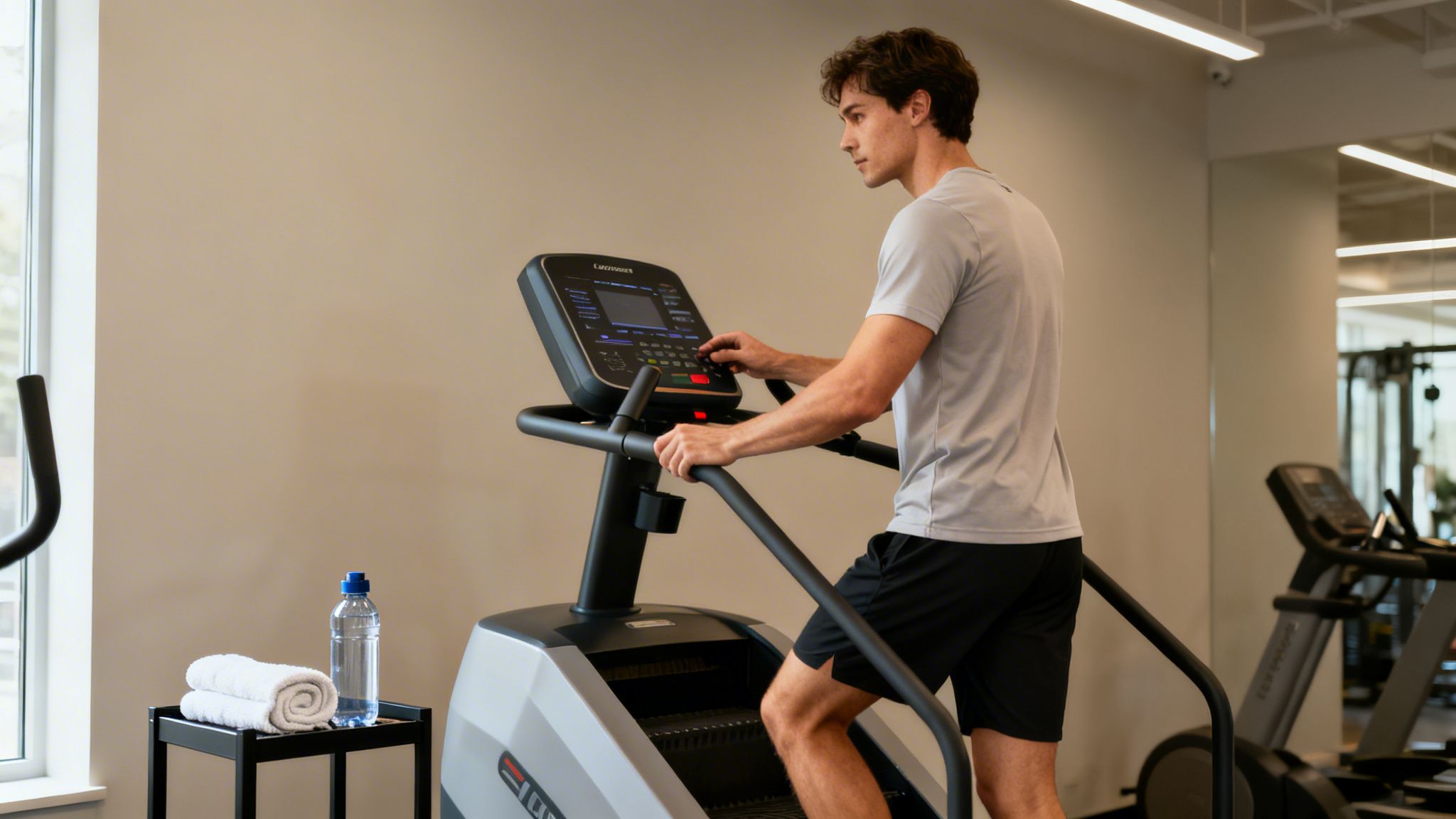
The StairMaster is so much more than just another cardio machine tucked in the corner of the gym. It's a powerful tool for building serious lower body strength and lung capacity at the same time. Unlike jogging on a treadmill, every single step you take is a fight against gravity. This constant resistance hammers your glutes, hamstrings, quads, and calves in a smooth, low impact motion that’s much kinder to your joints than pounding pavement.
This unique mix of resistance and cardio makes it incredibly efficient. StairMaster workouts are famous for how many calories they torch. Just a half hour session can burn anywhere from 180-260+ calories, depending on your body weight and how fast you're climbing. For example, a 180-pound person will burn more than a 125-pound person at the same pace.

Building Your Foundational Plan
To get real, lasting results, you need a plan. Let’s break it down into frequency, duration, and intensity. Getting on the machine consistently is what truly moves the needle.
Frequency: Aim for 2-3 sessions a week. Schedule them on non-consecutive days to give your muscles time to recover and strengthen.
Duration: If you're just starting out, 15-20 minutes is a perfect target. As you get fitter, work your way up to 30-45 minutes per session.
Intensity: A great way to measure this is the Rate of Perceived Exertion (RPE) scale, where 1 is sitting on the couch and 10 is an all-out sprint. Most of your workouts should be in the 5-7 RPE range, you're breathing hard, but you could still manage a short conversation.
I’ve put together a quick table that outlines the core elements you'll build your week around, whether you're a beginner or a pro.
Core Components of a Balanced StairMaster Week
A quick look at the fundamental elements of a StairMaster workout plan, adaptable for your current fitness level.
Component | Beginner Recommendation | Intermediate/Advanced Recommendation |
|---|---|---|
Steady State Cardio | 1-2 sessions, 20-30 mins at RPE 4-5 | 1 session, 30-45 mins at RPE 5-6 |
Interval Training | 1 session, 15-20 mins (e.g., 1 min hard, 2 mins easy) | 1-2 sessions, 20-30 mins (e.g., 1 min hard, 1 min easy) |
Active Recovery | Gentle walk, stretching on off days | Light climbing (Level 1-3), yoga, or foam rolling |
This framework gives you the flexibility to mix and match workouts, keeping things interesting while ensuring you're hitting all the right notes for steady progress.
The Core Components of Every Session
Every single time you step on that machine, your session should have three distinct parts. Skipping any of these is a fast track to injury or a frustrating plateau.
Dynamic Warm-Up (5 minutes): Get the blood flowing and prepare your body. Start with easy climbing on a low level (1-3), then hop off for some dynamic stretches like leg swings or walking lunges.
Main Workout (15-35 minutes): This is the heart of your session. It might be a steady climb at a challenging pace or an interval workout where you push hard for short bursts and then recover.
Cool-Down (5 minutes): Don't just jump off! Lower the speed to a slow walk (level 1-2) for the last few minutes. Follow it up with static stretches, holding each for 20-30 seconds. Focus on your quads, hamstrings, glutes, and calves.
A structured approach is everything. Just mindlessly climbing without a plan will only get you so far. By intentionally changing up your intensity and duration, you're using the principle of progressive overload, which is the secret sauce for continuous improvement.
Why The StairMaster Delivers Powerful Results
Ever wonder why just a few minutes on the StairMaster can feel more intense, and get you results faster, than other cardio machines? The secret isn't complicated. It's the unique combination of heart pumping cardio and constant resistance. Every single step is a mini battle against gravity. You’re not just moving; you're actively lifting your body weight, forcing your muscles to engage with every push.
This isn’t just your average cardio session. Think of it as a low impact strength workout in disguise. Unlike the pounding your joints take from running, the StairMaster offers a smooth, controlled motion that’s much kinder to your knees and ankles while still delivering a high intensity challenge. This blend is why it's a favorite for everyone, from physical therapists to elite athletes.

A Full Lower Body Workout
That continuous climbing motion is a masterclass in activating your lower body. It systematically targets all the major power producing muscles, creating a sculpting and strengthening effect that few other machines can replicate.
Here’s a quick look at the primary movers:
Glutes: When you drive through your heels on each step, you're directly firing up your gluteus maximus.
Quadriceps and Hamstrings: The front and back of your thighs work together to lift your entire body weight, step after step.
Calves: These muscles constantly work to provide stability and help propel you upward.
By hitting these large muscle groups all at once, you're not just building functional strength, you're also torching a significant number of calories.
The real power of a StairMaster workout plan is its dual action nature. You’re building the engine (your cardiovascular system) and strengthening the chassis (your lower body) at the same time, without the wear and tear of high impact alternatives.
Boosting Your Aerobic Engine
One of the biggest payoffs from sticking with a StairMaster plan is the incredible boost to your VO2 max. This is the maximum amount of oxygen your body can effectively use during intense exercise, and a higher number is a key marker of cardiovascular fitness. Better VO2 max translates directly to improved performance in just about everything, from running a 5k to crushing a demanding CrossFit WOD.
Remarkably, the fitness gains from climbing stairs can rival those from more traditional forms of cardio. A landmark trial found that people on a stair climbing program boosted their relative VO2 max by an impressive 20.1%. On top of that, both the stair climbers and a walk/run group lost an average of 2.7 kg of fat mass. This research highlights how effective a solid stairmaster workout plan can be for elevating your endurance.
Beyond just strengthening your heart, regular StairMaster sessions are fantastic for your overall vitality. They are one of the best ways to improve blood circulation naturally. The constant demand helps your body deliver oxygen rich blood more efficiently, which is a huge plus for muscle recovery and general health. This powerful trio, muscle engagement, low impact intensity, and profound cardiovascular benefits, is exactly why the StairMaster delivers such incredible results.
Progressive 4-Week StairMaster Workout Routines
If you want to see real, consistent results from your StairMaster sessions, you need a plan that grows with you. Just climbing at the same speed every time is a surefire way to hit a plateau. That's why I've mapped out these 4-week plans to gradually ramp up the intensity, ensuring you're always building strength and endurance.
The whole idea is to start by building a solid aerobic foundation and then start weaving in more intense interval work. This keeps your body adapting and getting stronger.
This visual gives you a quick look at how your intensity should build over four weeks, taking you from a steady walking pace all the way to peak performance.
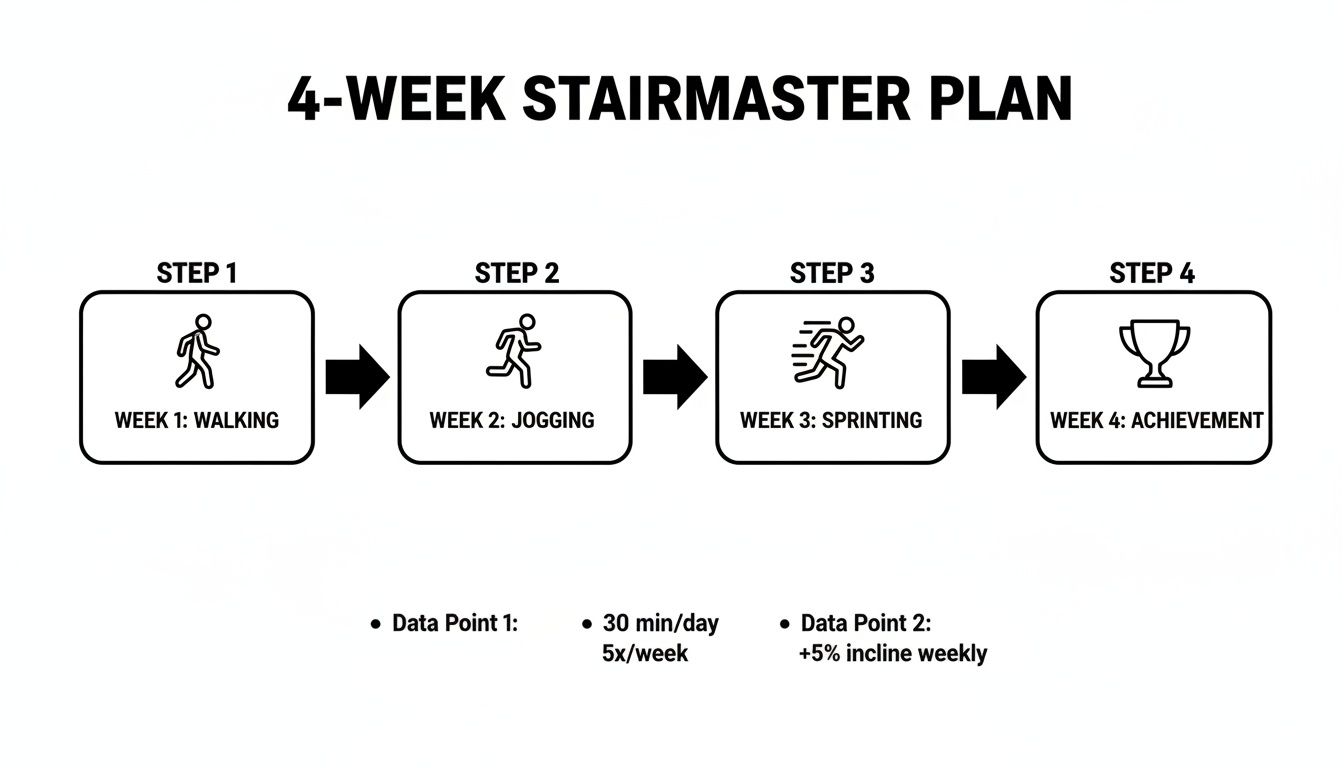
As you can see, each week is designed to be a stepping stone to the next, demanding just a little bit more from your muscles and cardiovascular system.
Beginner 4-Week StairMaster Plan
This plan is your perfect entry point if you're new to the StairMaster. The main goal here is to build foundational endurance and get your body comfortable with the climbing motion. A quick tip: focus on keeping your posture upright and only use the handrails for balance, not to hold yourself up.
Week 1: Kick things off with two 15-minute sessions. Stick to a comfortable pace (around Level 3-5) where you could still hold a conversation.
Week 2: Bump it up to two 20-minute sessions. Keep the level the same; the focus is on extending your time to build stamina.
Week 3: Time to add another day. Aim for three 20-minute sessions this week. Increasing your weekly frequency is a great way to accelerate conditioning.
Week 4: Push yourself to two 25-minute sessions. For an extra challenge, try bumping the level up by one for the last 5 minutes of each workout.
Intermediate 4-Week Plan
Once you can handle 25-30 minutes of steady climbing without feeling gassed, you're ready for intervals. By alternating between high intensity bursts and recovery periods, you'll boost your fitness in a big way. Plus, it makes the time fly by. If you're new to this style of training, our guide on 10 interval running workouts to supercharge your speed in 2026 is a great resource.
Here’s what a typical interval workout might look like:
Warm-up: 5 minutes at Level 4-5.
Workout: Go through 8 rounds of 1 minute at a tough pace (Level 7-8) followed by 2 minutes of recovery (Level 4-5).
Cool-down: 5 minutes at Level 3-4.
The real magic of interval training is its efficiency. You can achieve significant cardiovascular improvements in less time compared to longer, slower sessions. It teaches your body to recover more quickly under stress.
Advanced 4-Week Plan
For seasoned climbers, the game is all about pushing your limits with high intensity interval training (HIIT) and longer endurance climbs. These workouts are tough, so ensure you give your body enough time to recover between sessions.
Week 1: Schedule two HIIT sessions and one 30-minute endurance climb. For HIIT, try 10 rounds of 60 seconds at Level 9-11 and 60 seconds of recovery at Level 5. Your endurance day should be a steady climb at Level 7-8.
Week 2: Stick with two HIIT sessions, but extend your endurance climb to 35 minutes. To up the intensity, shorten your HIIT recovery time to 45 seconds.
Week 3: Mix it up with one HIIT session, one pyramid workout, and one 40-minute endurance climb. A pyramid workout involves increasing the level each minute for 10 minutes, then stepping it back down.
Week 4: Finish strong with two challenging HIIT workouts (like 30 seconds all-out, 30 seconds rest for 15 rounds) and one easy 30-minute recovery climb (Level 5-6).

To help you visualize how this all fits together, here’s a quick comparison of what a beginner's week might look like compared to an advanced user's.
Sample Weekly Schedules By Fitness Level
Day of Week | Beginner Focus (Example) | Advanced Focus (Example) |
|---|---|---|
Monday | Session 1: 20 min steady climb (Level 4) | HIIT Session 1: 25 min (10x 60s hard/60s easy) |
Tuesday | Rest or Active Recovery (Walk) | Active Recovery or Strength Training |
Wednesday | Session 2: 20 min steady climb (Level 4) | Endurance Climb: 40 min steady (Level 7) |
Thursday | Rest or Active Recovery (Walk) | Rest Day |
Friday | Session 3: 20 min steady climb (Level 4) | HIIT Session 2: 25 min (15x 30s max/30s rest) |
Saturday | Rest Day | Active Recovery (Light jog, stretching) |
Sunday | Rest Day | Rest Day |
This table just shows one possible way to structure your week. The key is to listen to your body and find a schedule that allows for both hard work and proper recovery.
The Viral 25-7-2 Workout
You might have seen the 25-7-2 StairMaster workout making the rounds online, and for good reason. The plan is simple: climb at level 7 for 25 minutes, twice a week. This routine hits that sweet spot of moderate intensity, aligning perfectly with the American Heart Association’s guidelines for weekly aerobic exercise. For someone weighing around 150 pounds, this type of workout can burn roughly 544 calories per hour, making it an incredibly efficient choice.
Mastering Form to Maximize Results and Prevent Injury
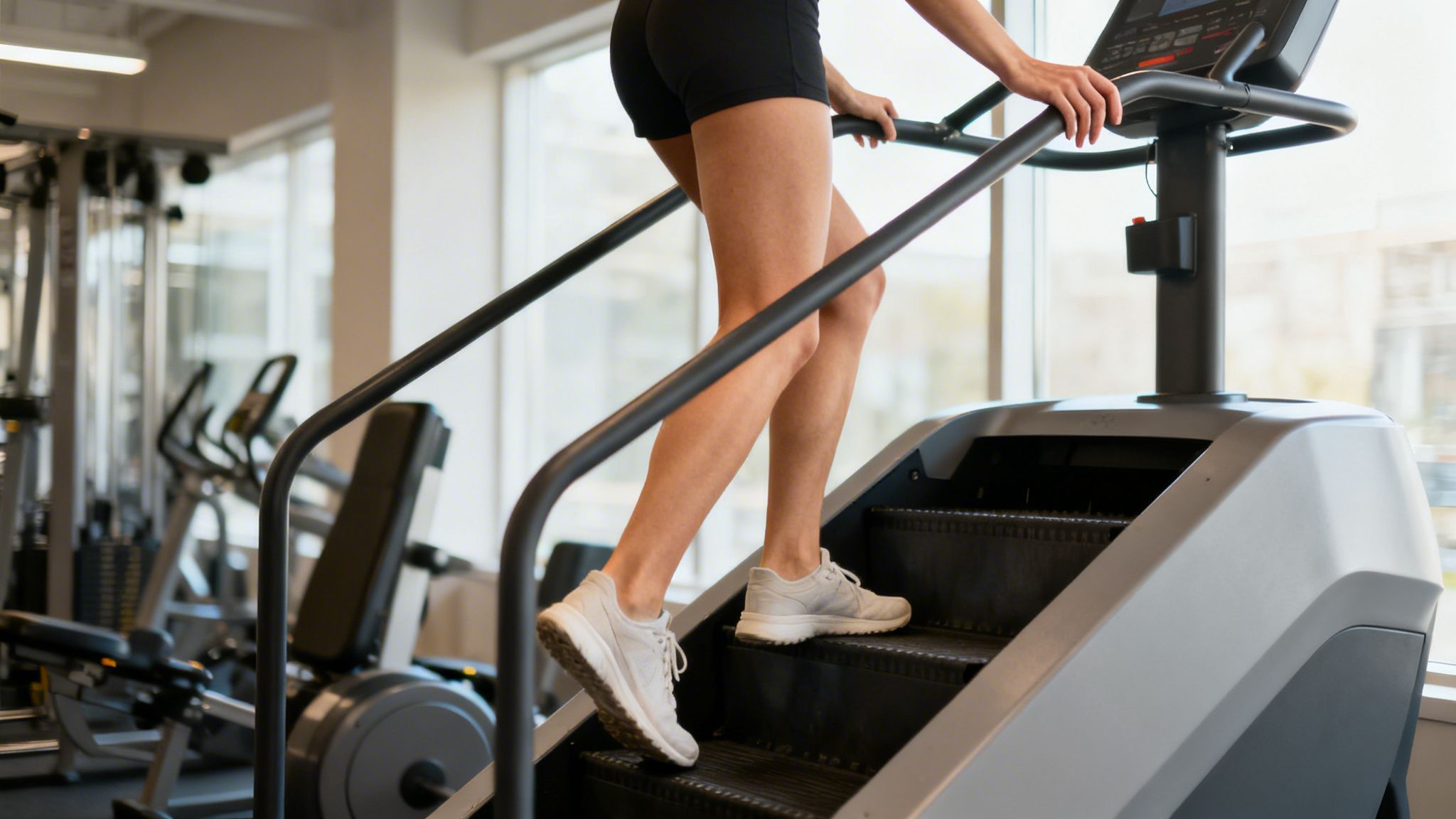
Any solid StairMaster workout plan is only as good as your form. Getting your movement right is the secret to firing up the right muscles, like your glutes and hamstrings, and protecting your joints. When you nail your technique, the StairMaster becomes a serious tool for sculpting your lower body. To make sure your routine is both effective and safe, mastering proper form is nonnegotiable to prevent sports injuries.
The Most Common Form Mistakes to Fix
It’s easy to fall into bad habits on the StairMaster, especially when you start to get tired. These common slip-ups will sabotage your results and can leave you with aches and pains.
Leaning on the Handrails: This is mistake number one. Gripping the rails and letting your body weight hang forward takes the load right off your legs. You're cheating yourself out of the workout's biggest benefits.
Slouching or Hunching: A rounded back and slumped shoulders don't just look sloppy; they can lead to lower back pain. This posture disengages your core, which is your foundation for stability.
Pushing Off Your Toes: When you only use the balls of your feet, you're putting all the work into your quads and calves, leaving your glutes and hamstrings out of the equation.
Your goal should be to use the handrails for light balance only. Think fingertips resting on them, not a white-knuckle death grip. This forces your core and lower body to do all the stabilizing and lifting.
Core Principles for Perfect StairMaster Form
Fixing those common mistakes really comes down to focusing on a few key cues. Drill these into your head during every session.
Maintain an Upright Posture: Stand tall. Pull your shoulders back and down, keeping them stacked over your hips. Lift your chest and keep your gaze straight ahead.
Engage Your Core: Consciously brace your abs throughout the entire workout. A tight core gives you the stability to stay upright and balanced without leaning.
Drive Through Your Full Foot: Make sure your entire foot connects with each step. Actively think about pushing through your heels to get that full glute and hamstring engagement.
Making these changes might mean you have to dial back the speed or level at first, and that's okay. Prioritizing perfect form over a high number on the display will always give you better, safer results. If you're looking for more ways to keep your body healthy, we have a guide on how to prevent running injuries with tips that apply to almost any workout.

Bookend Your Workout for Success
Never just jump straight into a high intensity climb or hop off the machine cold. A proper warm-up gets your body ready, and a cool down is crucial for recovery.
The Essential Warm-Up (5 minutes)
Light Cardio: Start with 2-3 minutes of easy climbing on a low level (1-3) to get the blood flowing.
Dynamic Stretches: Hop off for some leg swings (forward and side-to-side), walking lunges, and bodyweight squats to open your hips.
The Necessary Cool Down (5 minutes)
Gradual Slowdown: Spend the last 2-3 minutes of your workout climbing at a very slow pace (Level 1-2) to let your heart rate come down.
Static Stretching: Once you're off, hold stretches for your quads, hamstrings, glutes, and calves. Aim for 20-30 seconds on each side to improve flexibility.
Choosing the Right Shoes For Your Climb
It might sound odd, but the success of your StairMaster workout plan can come down to what's on your feet. It’s tempting to grab your running shoes, but the unique motion of climbing stairs calls for a different kind of support. The right footwear gives you the stability and control you need to climb safely and effectively. Unlike running, where you need plush cushioning to absorb heavy impact, StairMaster workouts are better with a flatter, more stable shoe. This solid base gives you better power transfer as you drive through your entire foot.
Key Features for StairMaster Shoes
When picking out shoes, you're looking for a specific blend of support, grip, and stability. Think less like a marathoner and more like a weightlifter who needs a solid connection.
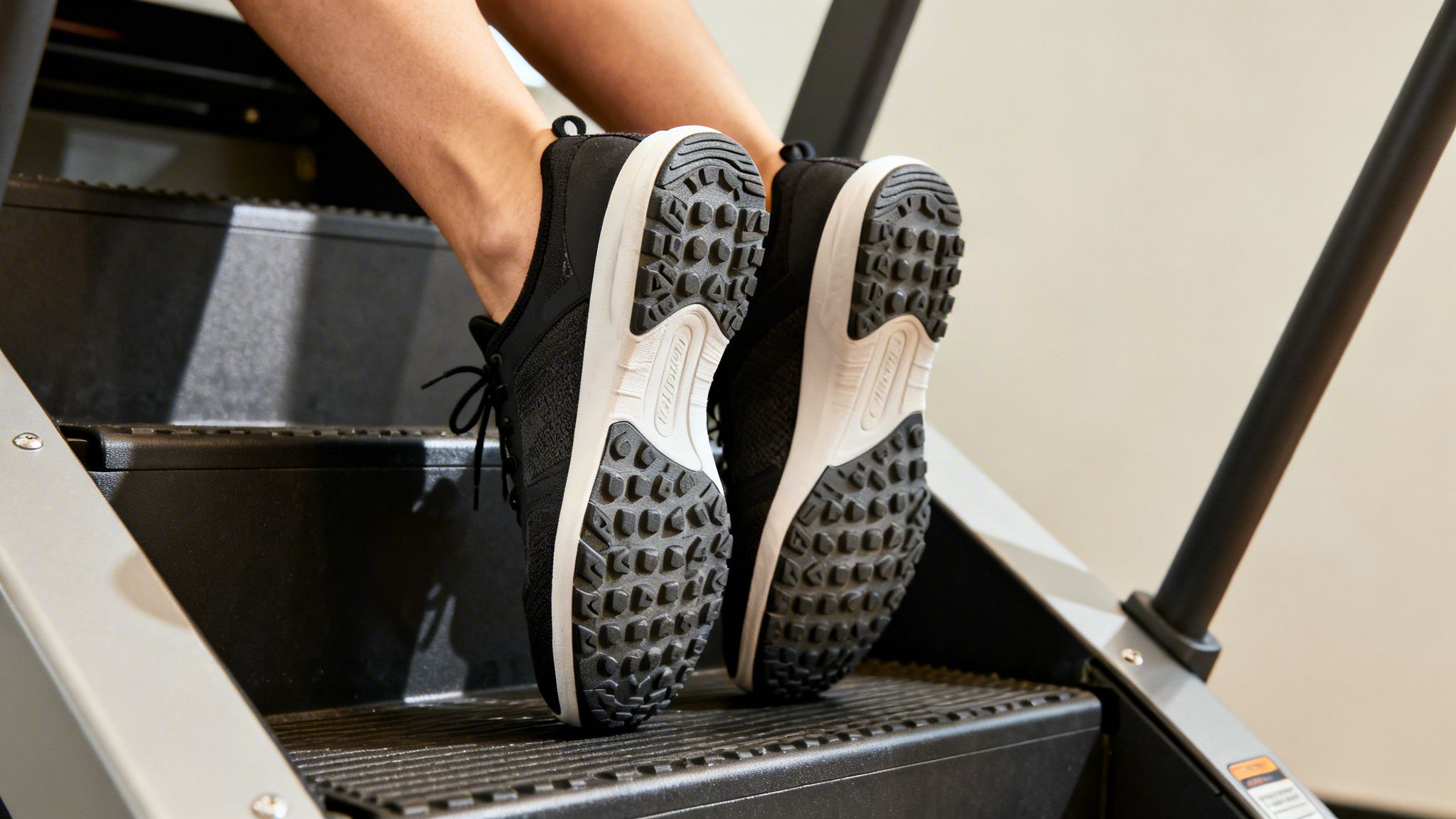
Firm Heel Support: A snug heel counter is critical. It keeps your foot from sliding, which helps you maintain balance and proper form.
Good Traction: Check the outsole for a reliable grip. Those steps can get slick, and good traction ensures your footing stays secure.
Stable, Flatter Sole: Stay away from overly soft, squishy soles. A flatter, more rigid sole provides a stable platform, giving you better control and helping to prevent ankle rolls.
Choosing the right shoe is foundational to your workout. A stable, less cushioned shoe helps you feel more connected to each step, which directly translates to better form and more effective muscle activation.
Why Your Running Shoes Might Not Be The Best Fit
Your favorite running shoes feel great because they're engineered with thick, soft cushioning to absorb the shock of your foot hitting the pavement. On the StairMaster, that same plushness can work against you. It creates an unstable surface that can feel wobbly underfoot, compromising your form and making your climb less efficient. For other cardio machines, you might find our article on the best shoes for treadmill running helpful, as it covers a different set of priorities.
At the end of the day, wearing breathable workout clothes and the right shoes is a crucial part of setting yourself up for a great session. When you prioritize firm support and solid traction, you’re equipping yourself for a safer, more powerful workout.

Frequently Asked Questions About StairMaster Workouts
Even with the best StairMaster workout plan, some questions are bound to come up. Getting those answers sorted is key to staying on track and feeling confident in what you’re doing.
How Often Should I Do a StairMaster Workout for Results?
This is a big one. For noticeable results, it’s all about consistency. I always tell people to aim for 2-3 StairMaster sessions per week. Make sure to schedule them on non-consecutive days. That rest day in between is when your muscles recover and get stronger. This schedule lines up perfectly with what the American Heart Association recommends for solid cardio work.
Is the StairMaster Better Than the Treadmill for Weight Loss?
Ah, the classic gym debate. While both are fantastic tools, the StairMaster often gets a slight edge for torching calories and building muscle simultaneously. Why? It all comes down to gravity. With every single step, you are lifting your entire body weight upward. This forces your glutes, quads, and hamstrings to fire up in a way that doesn't happen on a flat treadmill. It’s a powerful combination of cardio and resistance training.
To put some numbers on it, the American Council on Exercise estimates a 150-pound person can burn around 272 calories in just 30 minutes on a stair stepper. That’s a serious return on your time. Plus, it's lower impact than running.
Can I Build Glutes with a StairMaster Workout Plan?
Absolutely. The StairMaster is one of the best cardio machines out there for targeting your glutes. The climbing motion is basically a non-stop series of weighted step-ups, a foundational move for building a strong posterior chain. If you really want to focus on your glutes, dial in your form:
Drive through your heels on every step. Don't just tap with your toes.
Stand up straight. Avoid the temptation to hunch over and lean on the handrails. You can also add a slight hinge forward at the hips (keeping your back straight!) to increase glute engagement. For the best results, think of the StairMaster as a supplement to your strength training. Pair it with squats, deadlifts, and hip thrusts on your other gym days.
Think of the StairMaster as your cardio-based accessory work for glute development. It complements your strength training by adding volume and metabolic stress to the target muscles.
What Level Should I Use on the StairMaster?
There’s no magic number here. The "right" level depends on your fitness level and workout goal. Your best guide isn't the number on the screen, but how your body feels. This is where the Rate of Perceived Exertion (RPE) scale (a simple 1-10 scale of effort) comes in handy.
For steady state cardio: Aim for a level where you can still hold a conversation, but you’re breathing a bit heavy. That’s about a 6-7 RPE. For most people, this will be around Level 4-6.
For HIIT workouts: Your "on" intervals should feel like an 8-10 RPE, a pace you can only hold for a minute or so. Your recovery periods should be way down at a Level 2-4. That viral "25-7-2" workout uses Level 7 as its sweet spot, but don't feel locked into that. If your form is breaking down, lower the level. The goal is a quality workout, not just hitting a certain number.
At Flourish-Everyday, we believe that having the right information and gear is essential for your fitness journey. We are dedicated to helping you find the best athletic shoes and health insights to support your goals. Explore our expert reviews and wellness guides at https://www.flourish-everyday.com.


