Treadmill vs Outdoor Running: Which Is Better for You?

Updated: Dec 11, 2025
Deciding between hitting the treadmill or the pavement comes down to your goals and circumstances. Treadmills offer a controlled, convenient, and lower impact workout, while running outdoors delivers a more dynamic, engaging, and mentally stimulating challenge. The best choice hinges on whether you value consistency and joint protection over variability and real world race simulation.
Introduction: A Practical Comparison of Running Environments
The debate over the "best" way to run is a classic one. Smart training plans often use both. By understanding the unique perks of each, you can build a more balanced running routine. This guide breaks down the essential differences to help you decide which option, or combination, is right for you.

Index of Sections

This visual can help you see whether your primary goal aligns better with the control of a treadmill or the varied terrain of the outdoors.
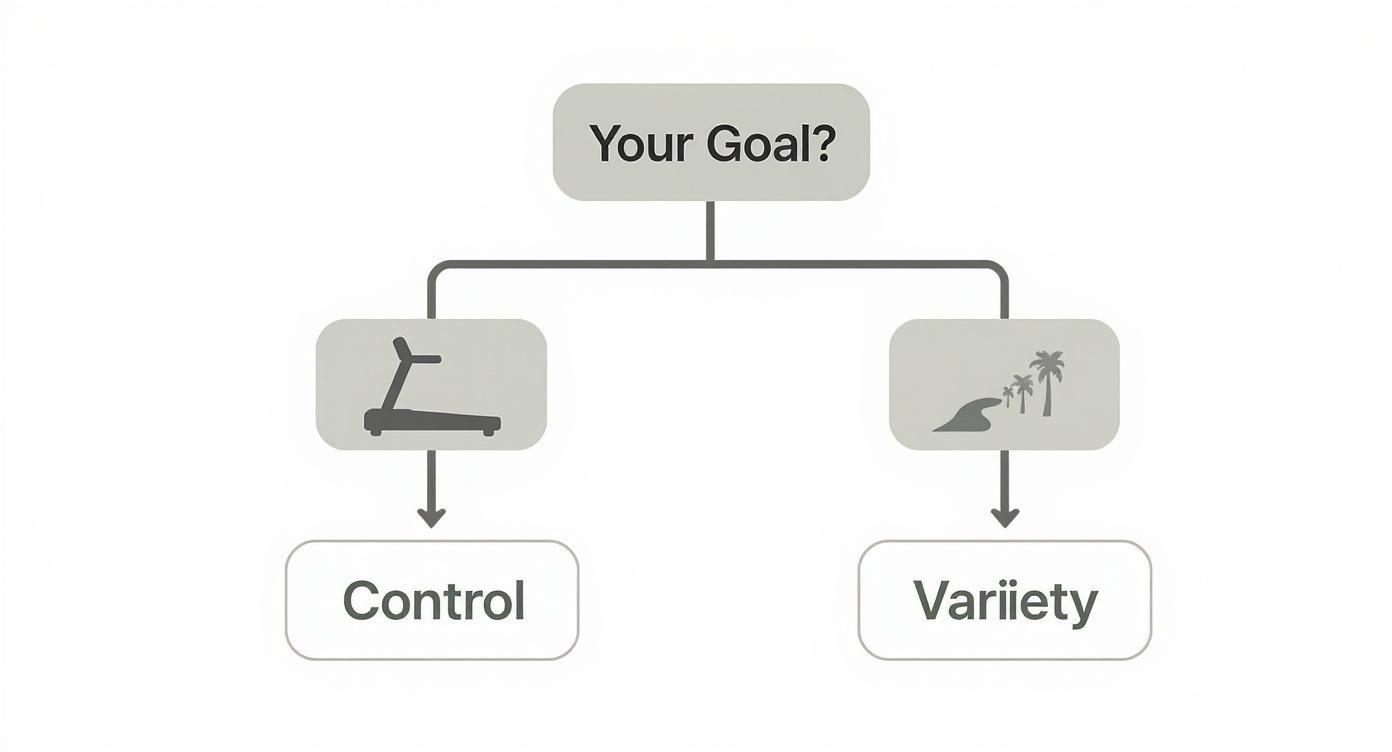
If precise control over pace and incline is your priority, the treadmill wins. If you crave variety and mental engagement, nothing beats running outside.
Treadmill vs Outdoor Running At a Glance
This head-to-head comparison highlights the key differences between these two running methods to guide your choice.
Factor | Treadmill Running | Outdoor Running |
|---|---|---|
Surface Impact | Lower impact due to a cushioned deck, reducing joint stress. | Higher impact on pavement; variable on trails. |
Environmental Control | Complete control over weather, temperature, and safety. | Exposure to weather, traffic, and light conditions. |
Pacing & Incline | Precise control for structured workouts. | Self-propelled pace with natural hills and declines. |
Muscle Engagement | Repetitive motion, less use of stabilizing muscles. | Engages more stabilizing muscles to adapt to uneven surfaces. |
Mental Stimulation | Can be monotonous, often requiring distractions. | Engaging with changing scenery and new routes. |
Convenience | Highly convenient and accessible anytime. | Requires planning around weather, daylight, and safety. |
For those leaning toward indoor training, it’s worth understanding how to select the optimal home treadmill and its top 5 health benefits.
The best running plan isn't about choosing one "superior" method, but about strategically using the right tool for the right job. A treadmill excels at controlled intervals, while outdoor runs build the resilience you need for race day.
How Each Environment Shapes Your Body
Choosing between a treadmill and the outdoors fundamentally changes how your body works and adapts. Each environment places different demands on your cardiovascular system and stride mechanics, sculpting your fitness in unique ways.
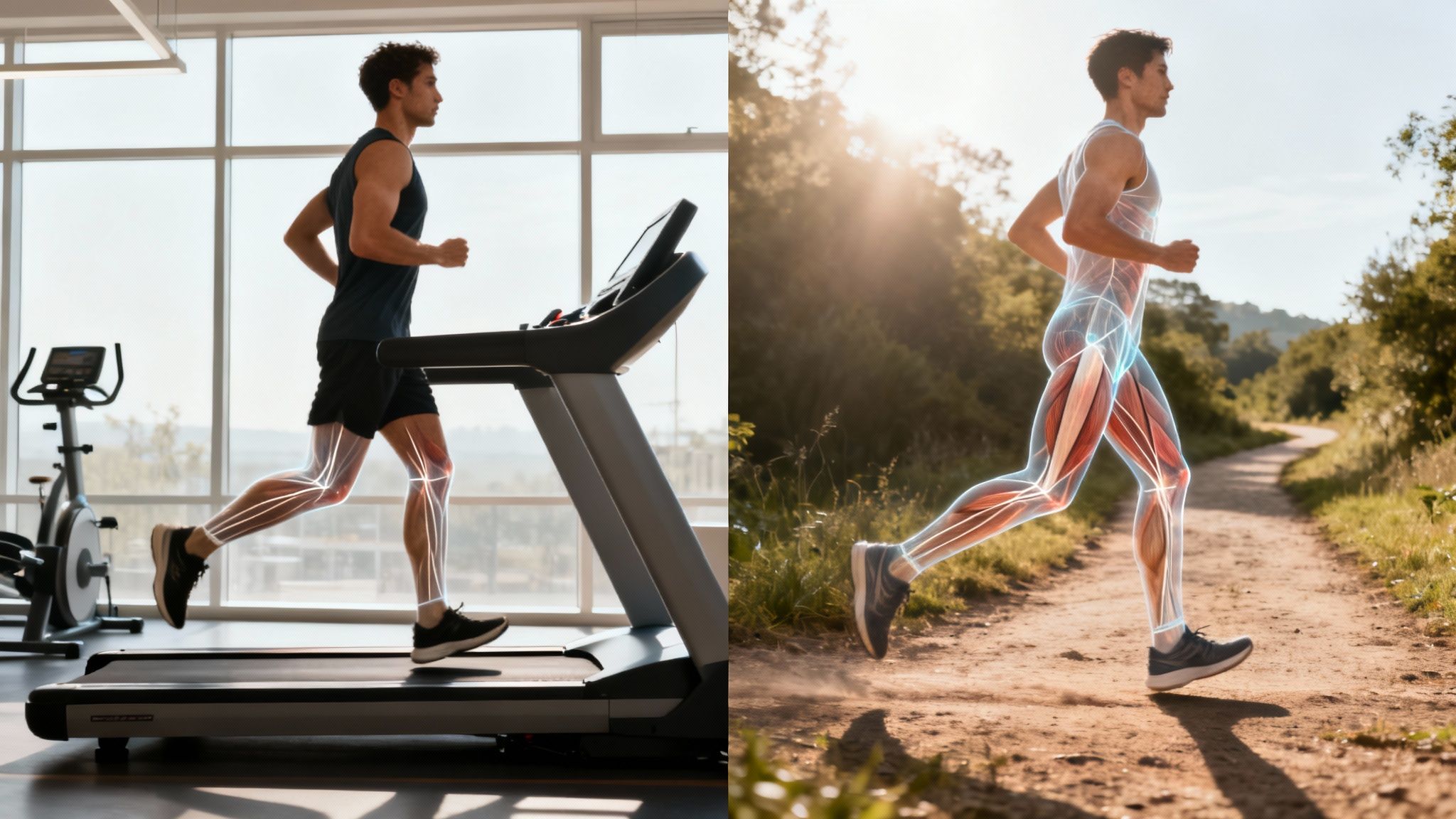
In terms of pure cardio effort, the two are surprisingly close. Research shows that runners can achieve nearly identical VO2 max (the maximum amount of oxygen your body can use during intense exercise) in both settings. However, to match the energy burned outside, you must compensate for the lack of wind resistance and the push from the treadmill's belt. Studies confirm that setting the treadmill to a 1% incline effectively mimics the effort of running on flat ground outdoors [1]. For more on the science, see insights from experts at RunnersConnect.
The Biomechanical Divide
While cardio demands can be equalized, the biomechanics are worlds apart. A treadmill provides a flat, cushioned, predictable surface. Running outdoors forces constant adaptation to varied surfaces like pavement, trails, and grass.
The core difference is simple: on a treadmill, you're mostly just lifting your legs to keep up. Outdoors, you're actively using your glutes and hamstrings to propel your entire body forward over the ground.
This distinction drives most physiological differences between the two environments.
Muscle Activation and Stride Mechanics
The treadmill's unvarying surface can lead to a more repetitive, sometimes shorter, stride, requiring less activation of small stabilizing muscles in your ankles, hips, and core.
Outdoor running acts as a full body stability drill. Your feet constantly adjust to uneven ground, engaging these crucial muscles to maintain balance. This builds greater strength in supportive muscle groups.
Let's break it down:
Treadmill Running: Encourages quicker leg turnover as less push off from the posterior chain (glutes and hamstrings) is needed. The cushioned deck reduces impact on joints.
Outdoor Running: Demands a powerful push off from glutes and hamstrings. It places a greater eccentric load on quads, especially downhill, and strengthens bones through higher impact forces.
Ultimately, the treadmill offers unmatched control for specific workout targets, while the outdoors builds the adaptable strength needed for real-world terrain.
Performance and the Psychology of Effort
How a run feels doesn't always align with physiological performance. While cardiovascular metrics may be similar, endurance and the mental game often differ between treadmill and outdoor running.
Many find treadmill running feels harder, even at a comfortable outdoor pace. This is due to the sterile environment, lack of a natural breeze, and the mental drag of watching the numbers, which can increase your rate of perceived exertion (RPE).
Key Insight: The psychological toll of the treadmill is very real. The monotony can make your RPE climb much faster than your heart rate, essentially tricking your brain into feeling tired before your body is.
This gap between perception and reality has been explored in numerous studies.

Running Economy and Endurance Realities
Running economy is your body's fuel efficiency, how well you use oxygen at a given speed. Evidence suggests an advantage for outdoor running.
A meta analysis of 34 studies found that runners consistently showed better endurance outside. One study found runners averaged 11.8 kilometers on a treadmill before exhaustion but covered 12.2 kilometers on an outdoor track, a 3.3% performance boost [2]. You can explore these endurance study findings from Runner's World.
This performance gap suggests that while a treadmill is excellent for controlled workouts, the unpredictable nature of outdoor running often pushes us to achieve more.
The Mental Side of Pacing and Motivation
Why the performance difference? The psychology of pacing and effort is a major factor.
Visual Monotony: Staring at a console can lead to boredom and a focus on discomfort. Changing scenery outdoors is a natural distraction.
Forced Pacing: The treadmill sets the speed, which is great for intervals but can feel mentally restrictive over long distances.
Lack of Airflow: Without a natural breeze, your core temperature can rise faster indoors, increasing physiological stress and perceived effort.
The table below summarizes key performance metric differences.
Performance Metrics: Treadmill vs. Outdoor
Metric | Treadmill Running | Outdoor Running | Key Finding |
|---|---|---|---|
Endurance | Runners often stop sooner in time-to-exhaustion tests. | Consistently higher endurance and distance covered. | Outdoor environments appear to foster better overall endurance. |
Running Economy | Can be slightly less efficient due to altered biomechanics. | Often more efficient due to natural stride and propulsion. | Better economy outdoors translates to less energy spent. |
Perceived Exertion | Tends to be higher at the same physiological intensity. | Generally lower, as external focus reduces self-monitoring. | The mental game is often easier when running outdoors. |
While the treadmill offers incredible control, running outside often leads to better raw performance and endurance.
Comparing Injury Risk and Safety Factors
Safety is a critical topic in the treadmill vs. outdoor debate, covering everything from long term joint health to personal security.
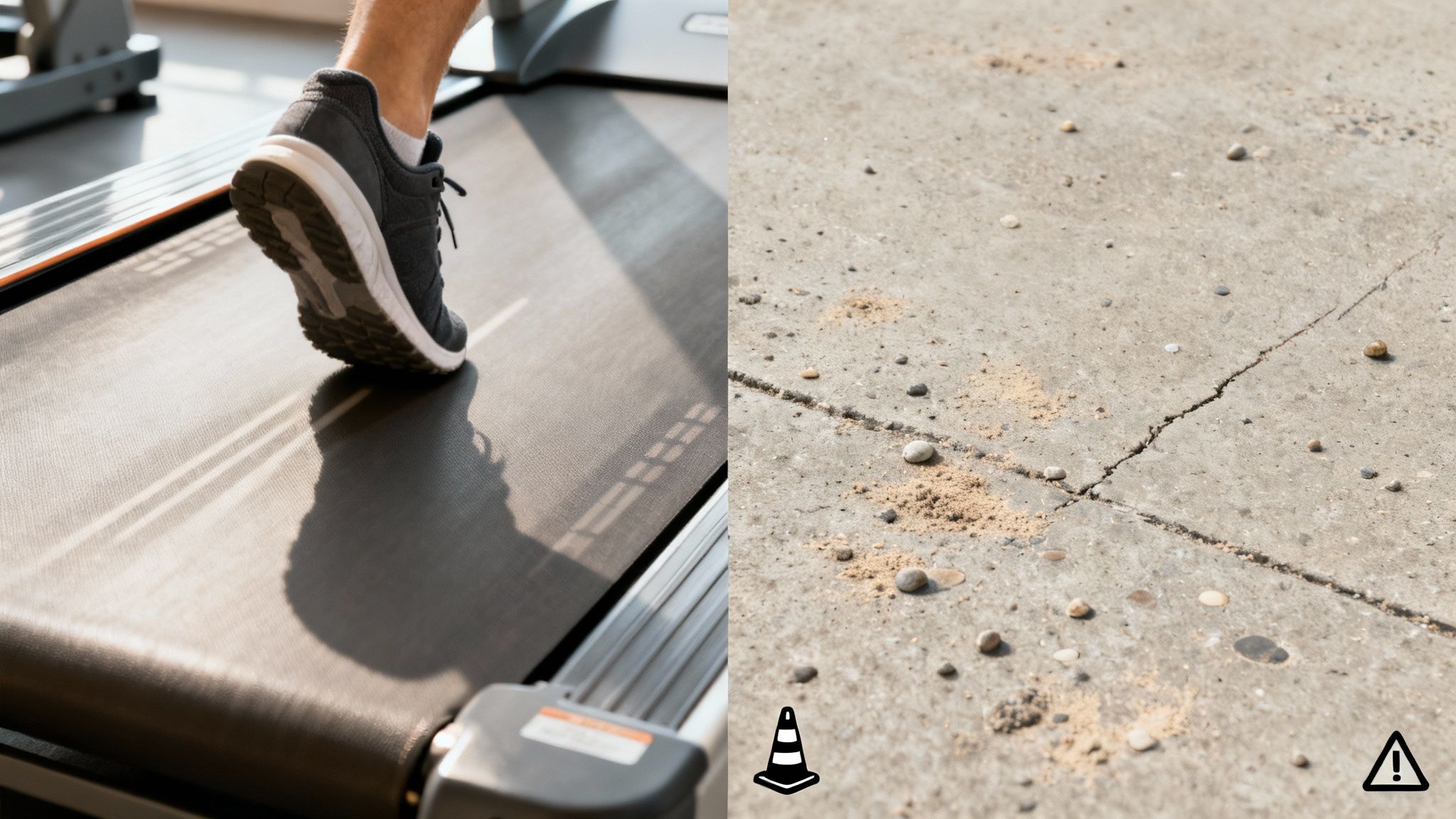
The primary physical difference is the running surface. A treadmill's cushioned deck is designed to absorb shock, reducing impact on joints. This is a significant benefit for those prone to injuries like shin splints. Outdoor surfaces like concrete are far less forgiving, increasing ground reaction forces.
Surface and Strain
While trails and grass offer a softer alternative to pavement, they introduce challenges like uneven terrain, roots, and potholes. This variability builds strength but increases the risk of acute injuries like sprains.
The treadmill minimizes the risk of sudden, accidental injuries by providing a perfectly controlled surface. However, its repetitive nature can lead to overuse injuries if you don't vary your workouts or maintain proper form.
The treadmill's controlled setting allows you to stop immediately if you feel pain, but the unchanging motion can aggravate existing biomechanical imbalances. Learn how to prevent running injuries with our top tips for safe running.
External Safety Considerations
Your choice of environment directly impacts personal safety. The treadmill offers a secure space free from external threats.
Outdoor running requires situational awareness.
Traffic: Stay alert for cars, cyclists, and pedestrians.
Weather Conditions: Extreme heat, ice, or rain can create hazardous situations.
Personal Security: Running alone, especially early or late, presents safety concerns.
The "safer" option depends on your definition. The treadmill protects against external dangers and offers lower impact. Outdoor running builds a more resilient body but requires careful planning and awareness.
Choosing the Right Running Shoes and Gear
The right gear is crucial for performance and injury prevention, and your needs differ between the treadmill and the outdoors.
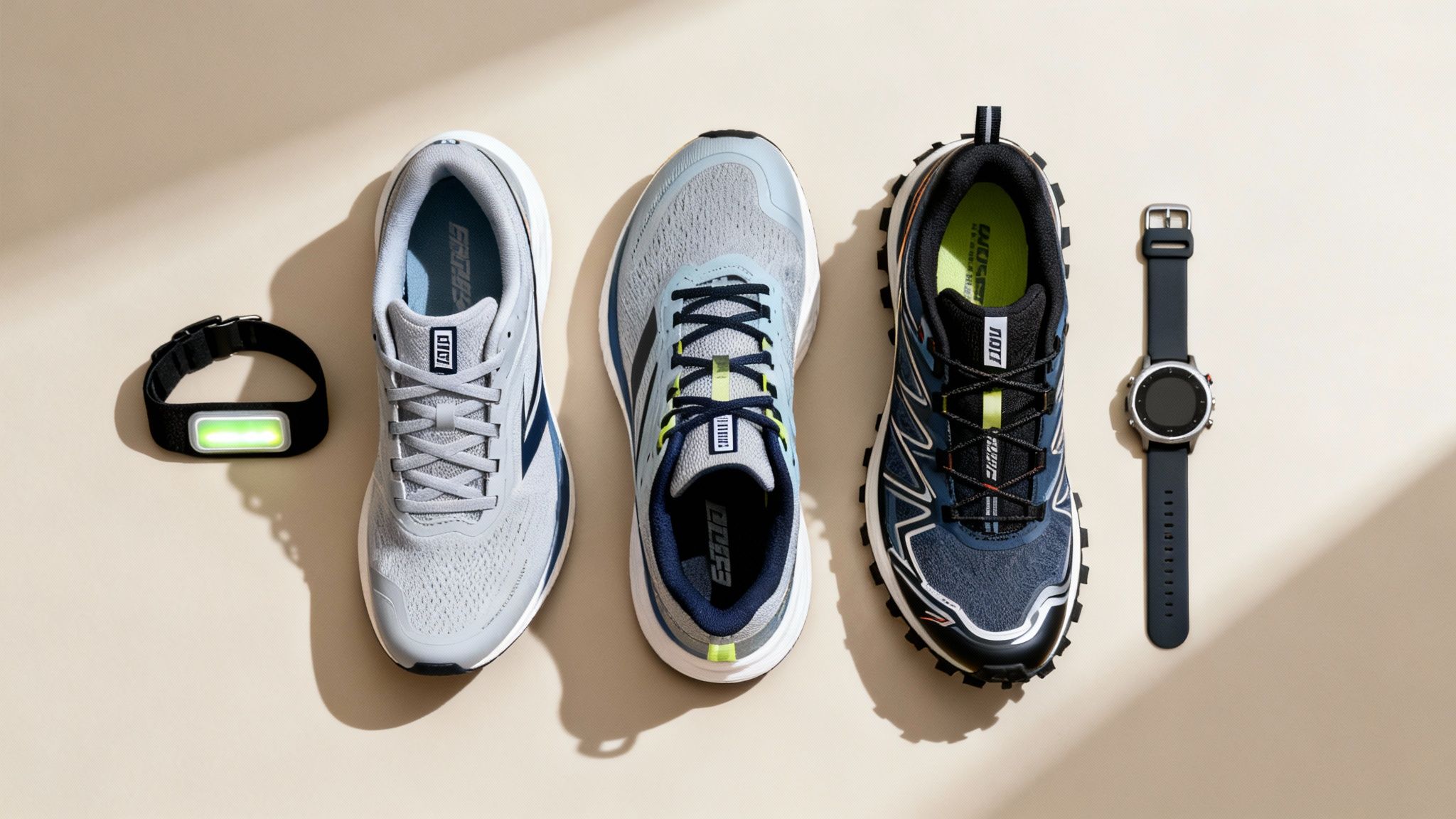
It starts with your shoes. A great treadmill shoe might be a disaster on a rocky trail.
Footwear for the Treadmill
Treadmill running is consistent. The surface is flat and cushioned, changing shoe requirements. The best treadmill shoes focus on:
Lightweight Construction: Reduces fatigue and encourages a natural stride.
Breathability: Mesh uppers keep feet cool in warm gym environments.
Flexibility: A flexible sole moves with your foot on the smooth deck.
The treadmill deck already provides a ton of shock absorption. Because of this, some runners find they can get away with a shoe that has less cushioning than they'd ever use for pounding the pavement outside.
Shoes for Outdoor Running
Outdoor shoes must protect your feet while providing support and traction.
Road Running Shoes: Designed for hard surfaces like asphalt, with substantial cushioning to absorb impact.
Trail Running Shoes: Built for rugged trails, with aggressive lugs for grip and protective features like rock plates.
Our guide on how to choose running shoes an expert guide can help you find the perfect pair.
Individual Brand Shoe Reviews
Hoka Clifton 9 (Road): Known for maximal cushioning and a smooth ride, making it a favorite for long road runs.
Brooks Ghost 15 (Road): A reliable daily trainer offering a balanced blend of softness and responsiveness. Suitable for both men and women.
Saucony Peregrine 13 (Trail): Offers excellent grip and a nimble feel, perfect for tackling technical trails.
Essential Gear Beyond the Shoes
Apparel and accessories are critical for comfort and safety, especially outdoors.
Moisture-Wicking Apparel: Essential for both environments to regulate body temperature and prevent chafing.
Hydration Systems: A must for longer outdoor runs.
Reflective Gear: Critical for safety when running in low-light conditions.
For male runners, choosing the right running underwear can significantly enhance comfort and performance by preventing chafing.
How to Integrate Both into Your Training
The smartest approach is a hybrid training plan that leverages the strengths of both environments. This creates a balanced routine that builds speed, endurance, and resilience.
Assign specific jobs to each run type. Use the treadmill as a controlled lab for precision workouts. Use outdoor runs to build real-world grit. If adding a machine to your home, proper treadmill delivery and setup makes a huge difference.
Designing Your Hybrid Running Plan
Start with your goals. Training for a 5K requires a different mix of sessions than building general fitness. If training for a hilly race, use the treadmill for controlled hill repeats and run long runs on actual hills.
Studies show running outside often leads to higher enjoyment, which is key for consistency. In contrast, many find their heart rate is higher at the same speed indoors, useful for high intensity training.
The goal is synergy. Use the treadmill to sharpen your speed and climbing ability in a controlled setting, then take that newfound strength outdoors to build endurance and prepare your body for the unpredictability of race day.
Sample Hybrid Training Schedules
Goal: General Fitness (3 Runs Per Week)
Run 1 (Treadmill): 30-minute interval session. Warm up, then alternate 2 minutes hard effort with 2 minutes easy recovery.
Run 2 (Outdoor): 45-minute easy, conversational pace run on varied terrain.
Run 3 (Treadmill or Outdoor): 3-mile tempo run. Run the middle mile at a comfortably hard pace.
Goal: 5K Race Prep (4 Runs Per Week)
Run 1 (Treadmill): Hill repeats. Warm up, then run 6-8 reps of 90 seconds at a steep incline with full recovery.
Run 2 (Outdoor): 30-minute easy recovery run on flat ground.
Run 3 (Treadmill): 400m speed intervals at your target race pace.
Run 4 (Outdoor): 4-5 mile long run on a route that mimics your race course.
Your Top Questions Answered
Here are answers to common questions about treadmill versus outdoor running.
Is The Treadmill Really Easier On My Knees?
Generally, yes. The cushioned deck absorbs much of the impact compared to surfaces like concrete. However, soft grass or a well-maintained dirt trail can be equally gentle.
Can I Actually Train For A Marathon Just On The Treadmill?
While you can build a strong cardiovascular base, training exclusively on a treadmill is not recommended. It doesn't replicate real-world challenges like wind resistance, weather, and subtle elevation changes.
The smartest approach is to blend both. Use the treadmill for structured, high-intensity work like hill repeats or interval sessions. Then, take your long runs outside to get your body and mind ready for the specific demands of the race environment.
How Accurate Are Those Calorie Counters Anyway?
Treadmill calorie counters are more motivational than scientific. They use generic formulas and miss key personal details like weight, age, and metabolism. For accurate tracking, use a fitness watch with a heart rate monitor.
Should I Bother Setting The Treadmill Incline To 1%?
Absolutely. Setting the incline to 1% is a research-backed way to mimic the effort of running outdoors on flat ground. This compensates for the lack of air resistance and the belt's assistance, ensuring your indoor training translates to outdoor performance.
References
[1] Jones, A. M., & Doust, J. H. (1996). A 1% treadmill grade most accurately reflects the energetic cost of outdoor running. Journal of sports sciences, 14(4), 321–327.
[2] Vancini, R. L., et al. (2019). Treadmill versus overground running: A meta-analysis of outcomes in endurance runners. Gazzetta Medica Italiana - Archivio per le Scienze Mediche, 178(1-2), 15-22.
At Flourish-Everyday, our goal is to give you the expert advice and top-notch shoe recommendations you need to hit your goals, whether you're logging miles on the belt or the backroads. Check out our reviews, product savings, and guides to find the perfect gear for your run. Visit us at https://www.flourish-everyday.com.