Running Cadence for Beginners: Guide to Form and Pace

For many runners, cadence is just another number on their watch they tend to ignore. But if you're new to the sport, it’s one of the most important things you can focus on to build good habits from the ground up.
Running cadence for beginners is simple: it’s the number of steps you take per minute, or SPM. Paying attention to this metric can help you run more efficiently, reduce impact on your joints, and sidestep common injuries that arise from overstriding.
Article Index
What Running Cadence Means for You
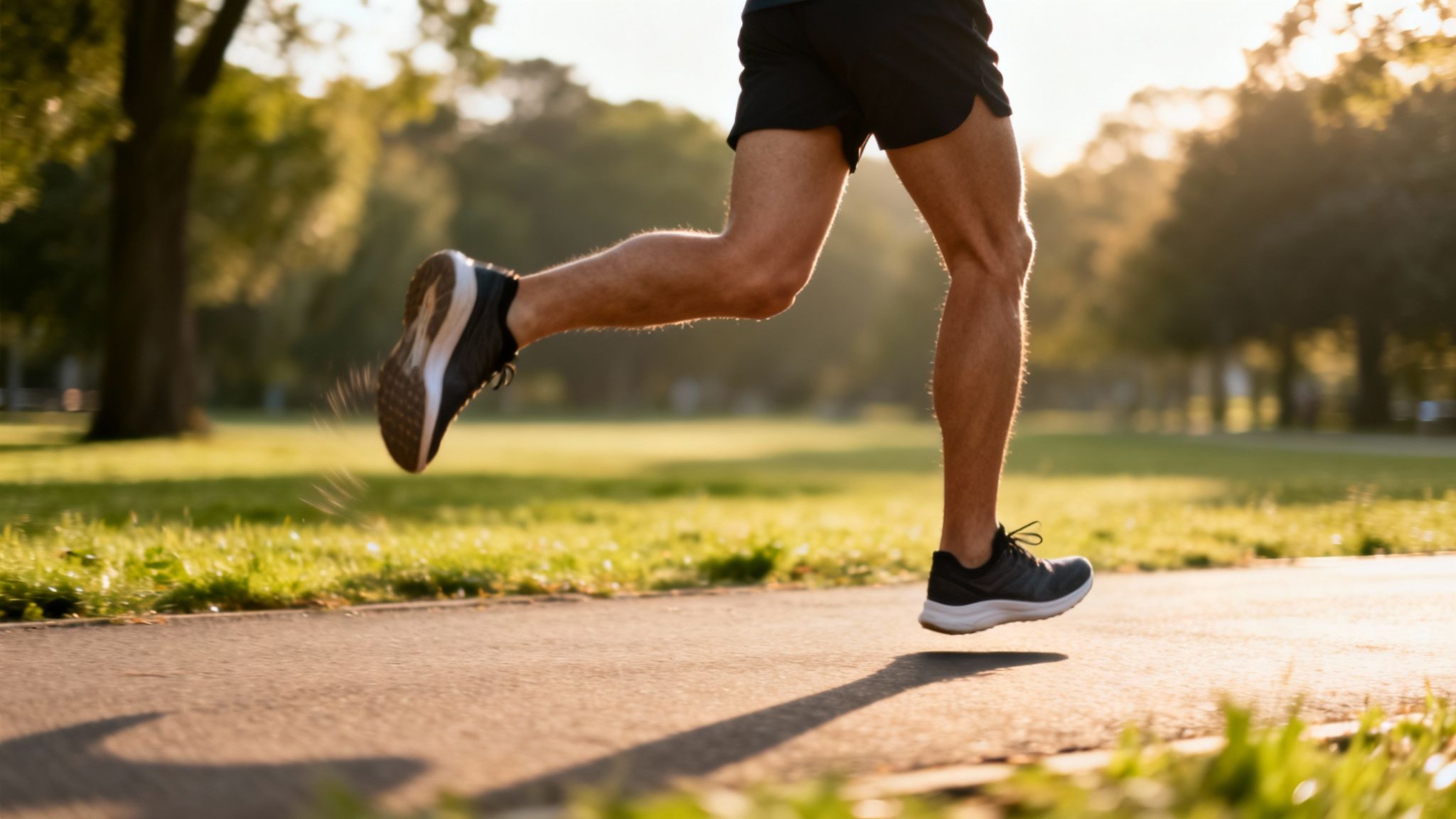
If you've heard runners discussing cadence, you might think it's an advanced metric for elite athletes. The truth is, it’s a practical tool any new runner can use to improve their form and make running feel easier.
A lower cadence often means you’re taking longer, heavier strides. This is called overstriding, and it happens when your foot lands far in front of your body. Each time this occurs, you’re essentially hitting the brakes, wasting energy and sending a jolt of force up through your legs, especially your knees and hips.
The Myth of the Perfect Number
For years, the magic number was 180 SPM. This number is based on observations of elite runners, but it isn't a universal target for everyone. Your optimal cadence is personal and varies based on:
Your height and leg length: Taller runners naturally have a slightly lower cadence.
Your running speed: As you run faster, your cadence will increase.
Your current fitness level: A beginner's cadence is typically lower than a seasoned marathoner's.
Most recreational runners average somewhere in the mid-150s to mid-160s SPM, while pros are often around 170–180+ SPM (Health HP, 2021). For beginners, it's helpful to understand these core concepts.
Beginner Cadence Quick Guide
Concept | What It Means for a Beginner |
|---|---|
Cadence (SPM) | The number of steps you take per minute. A simple way to check your running form. |
Overstriding | Landing with your foot far in front of your body. This is inefficient and can lead to injuries. |
Ideal Cadence | There's no "perfect" number for everyone. It depends on your body and pace. |
Beginner Goal | Instead of aiming for 180 SPM, focus on a small increase (5-10%) from your current number. |
The goal isn't to hit a magic number overnight, but to understand your running style and make small, beneficial adjustments.
Why Cadence Is Revolutionary
When you focus on your cadence, you naturally start taking quicker, lighter steps. This encourages your feet to land more directly underneath your body, and the benefits are significant.
By increasing your step rate, even slightly, you reduce the braking forces with each foot strike and lessen the overall impact on your joints. This is your first step toward running smarter, not just harder.
Understanding running cadence is about finding a rhythm that makes your runs feel smoother, more efficient, and more sustainable. It's a key to a more enjoyable, injury free running journey.

How to Find Your Personal Cadence Baseline
Before you start tweaking your running form, you need to know your starting point. Pinpointing your baseline cadence is the first step toward building a more efficient stride. There are two straightforward ways to figure out your current steps per minute (SPM).
The Low Tech 30-Second Count
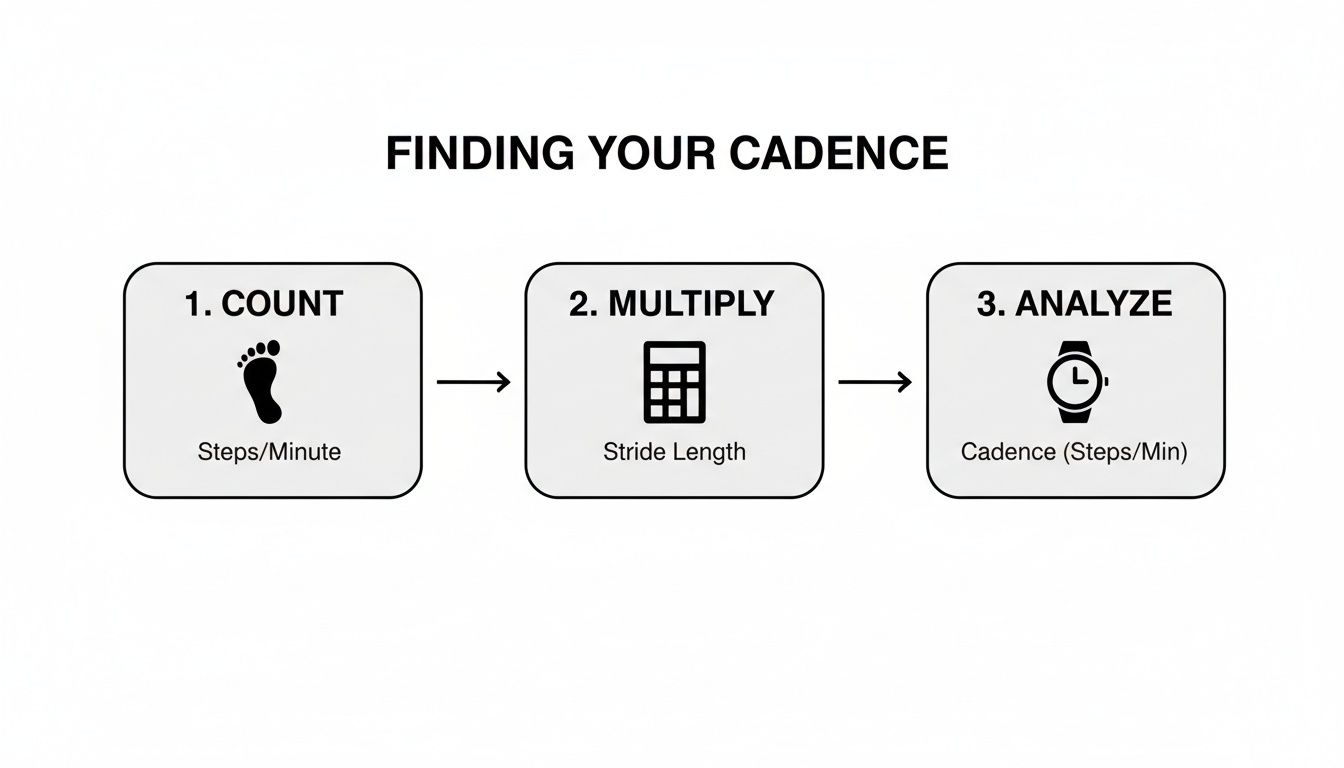
The simplest method is to count your steps. On your next easy run, once you're warmed up and settled into your usual pace, try this:
Start a timer for 30 seconds.
Count every time one foot hits the ground. Stick with either the left or right foot.
Multiply that number by four.
For example, if you counted your right foot striking the ground 40 times in 30 seconds, your math would be: 40 x 4 = 160 SPM. I'd recommend doing this a few times during your run to get a good average.
Your initial number is just that, a number. It's a neutral starting line, not a grade on your running ability. We're just trying to understand where you are today so you can make small, smart improvements tomorrow.
Using Tech to Track Cadence
If you run with a GPS watch or your phone, your cadence is likely already being tracked for you. This is generally the most accurate way to get your data over an entire run.
Running Watches: Most modern GPS watches from brands like Garmin, COROS, or an Apple Watch automatically track your cadence. Look for a "Running Dynamics" or "Metrics" section in their companion apps.
Running Apps: Popular apps like Strava and Runkeeper will also log this data if you carry your phone. After your run, check the detailed analysis to find your average SPM.
Using tech removes the guesswork and provides a complete picture of how your cadence shifts with pace, hills, or fatigue.
Practical Ways to Improve Your Cadence Safely
Once you know your baseline cadence, the next step is a small, controlled increase. The goal is a gentle adjustment that gives your body time to adapt.
The best approach is the ‘5-10% rule’. A small bump in this range is enough to retrain your body's neuromuscular system without excessive stress on your muscles and joints. It's a proven method for reducing heavy impact loads, which helps prevent common running injuries.
Actionable Drills to Weave into Your Runs
Sprinkle short drills into your regular runs rather than dedicating an entire workout to cadence. These are focused intervals where you pay close attention to your foot turnover.
Here are a few simple methods:
Use a Metronome: This is the most direct way to nail the rhythm. If your baseline is 155 SPM, set a metronome app to 162 SPM (~5% increase). Try running to that beat for one minute, then return to your natural cadence for three minutes. Repeat this cycle several times.
Mental Cues: Picture yourself running over hot coals or trying to be as quiet as a ninja. These cues naturally encourage quicker, lighter steps and prevent heavy heel striking.
Focus on Form: Instead of just thinking "faster feet," concentrate on shortening your stride. Your feet should feel like they're landing underneath your hips, not reaching out in front. Cadence is deeply connected to your overall running form. For more detail, see our guide on how to improve running form for better speed and endurance.
Listening to your body is crucial. Understanding general physiological responses during exercise and recovery can help you know when you're adapting well versus pushing too hard.
Sample 4-Week Cadence Improvement Plan
Patience is key. Your body needs time to adapt to new movement patterns. A slow, structured plan is the safest way to make lasting changes.
This isn't about chasing a magic number. It's about building a more efficient and sustainable way of running. Focus on being consistent, not on hitting your goal overnight.
Here’s a sample plan for a runner starting at 155 SPM with a target of 162 SPM.
Week | Focus | Action |
|---|---|---|
Week 1 | Awareness | During two runs, perform 4 x 1-minute intervals at 162 SPM using a metronome. Focus on the feel, not speed. |
Week 2 | Consistency | Increase to 6 x 1-minute intervals at 162 SPM during two runs. Continue to focus on light, quick steps. |
Week 3 | Duration | Lengthen the work periods. Try 3 x 2-minute intervals at your target cadence during two runs. |
Week 4 | Integration | Attempt to hold 162 SPM for the first 5 minutes of a run. Add 2 x 3-minute intervals at your target cadence during the middle of the run. |
This gradual progression helps your body adapt without causing new aches or pains. Adjust the plan based on how your body feels.
Why Better Cadence Means Easier Runs
Ever finish a run feeling completely wiped out? The culprit might be your running cadence. Improving your cadence is one of the quickest ways to enhance your running economy, how efficiently your body uses oxygen and energy. Better economy makes runs feel less like a slog and more like a smooth, sustainable effort.
The magic lies in taking more, shorter steps. A low cadence usually involves long, bounding strides, causing you to bounce up and down (vertical oscillation). This wastes energy that should be propelling you forward. By increasing your cadence, you naturally shorten your stride and reduce this inefficient bounce, redirecting energy into forward motion.
Turning Effort Into Forward Motion
This simple mechanical tweak impacts how much fuel your body burns. Quicker, lighter steps mean less ground contact time, which cuts down on the braking forces with each footstrike.
This isn't just theory. Research shows that even a small, deliberate increase in cadence can improve running economy (Lussiana et al., 2019). You can explore more of the data on how cadence impacts running economy for a full breakdown.
The Real World Benefit
What does this mean for your daily miles? You can run farther or faster using the same amount of effort.
A better cadence helps you work with your body, not against it. By minimizing wasted energy, you're tapping into a more efficient way of moving that makes running feel less taxing and more enjoyable.
Ultimately, focusing on your running cadence for beginners is about finding a rhythm that makes running feel easier and more natural. This efficiency is also supported by functional strength. For more, see our guide on strength training for distance runners to boost your pace.

Common Cadence Mistakes and How to Avoid Them
As you start fine tuning your cadence, it's common to hit a few bumps. The biggest mistake is trying to change too much, too fast, which often leads to aches or injuries. Another error is forcing a higher step rate by "shuffling" without adjusting stride length. Real improvement comes from a balanced change in both stride length and turnover.
Rushing the Process
The desire to leap from 160 SPM to 175 SPM overnight is understandable, but your body isn't built for that sudden shift. Your muscles, tendons, and cardiovascular system need time to adapt. A huge jump can shock your system, inviting issues like shin splints or calf strains. Always follow the 5-10% rule; a slow, steady increase is the only way to build a better cadence that sticks.
Spiking Your Heart Rate and Forgetting Form
If your heart rate shoots up when you try to increase your cadence, it likely means you're increasing your overall pace, not just your foot turnover. The fix is to consciously shorten your stride.
The goal is to take quicker, lighter steps, not necessarily faster ones. Picture swapping out long strides for shorter, peppier ones while keeping your effort level the same.
This adjustment will help keep your heart rate in a manageable zone, allowing you to practice your new cadence for longer without getting winded.
Ignoring Your Body’s Feedback
Listening to your body is the most critical lesson. Changing your running mechanics places new demands on different muscles. It's normal to feel new sensations, but you must learn the difference between minor muscle fatigue and the first signs of pain.
Watch for these signals:
Sore Calves and Achilles: A higher cadence works your calves more. Some initial soreness is expected, but sharp or nagging pain is a sign to ease up.
Aches in Your Feet: More steps mean your feet work harder. Pay attention to new aches in your arches or the balls of your feet.
If you feel pain, don't push through it. Cut back on cadence drills or take an extra rest day. It can take up to two months for your body to fully adapt to a faster cadence, so patience is everything (Wahoo Fitness, n.d.).
Does Your Gear Affect Your Running Cadence?
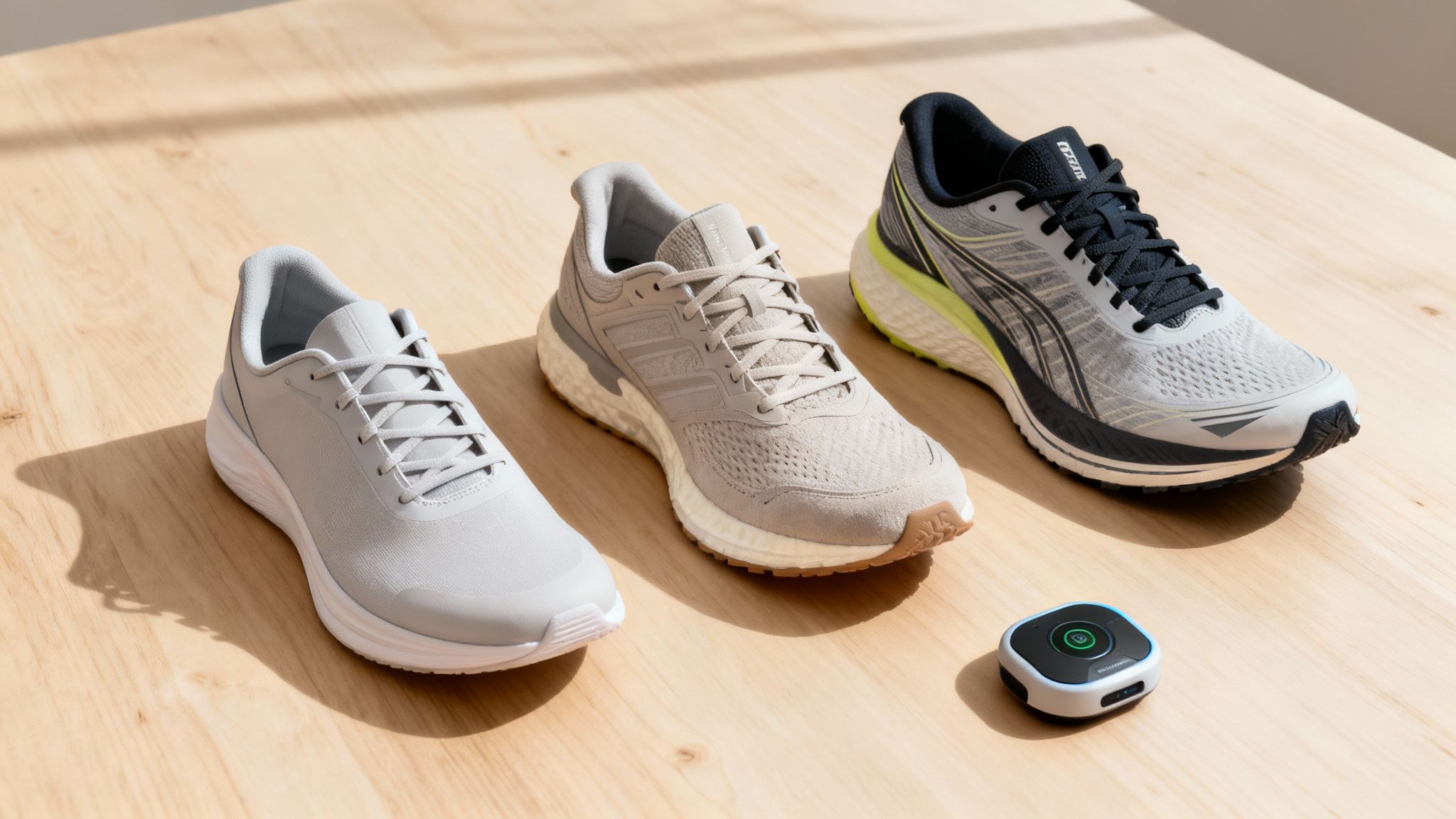
No gear is a magic bullet for fixing your cadence. However, the wrong gear can work against you, while the right stuff can make it easier to build a quicker, lighter stride. Heavy, clunky shoes can encourage a slower, plodding turnover. Conversely, lighter shoes can make your legs feel freer, encouraging a faster leg cycle.
How Shoe Design Influences Your Stride
Your running shoe design plays a part in how your foot meets the ground. Two factors are worth paying attention to: heel-to-toe drop and cushioning.
Heel-to-Toe Drop: This is the height difference between the heel and the forefoot. A lower drop (0-6mm) tends to promote a midfoot strike, which often aligns with a higher cadence.
Cushioning: Super soft, max cushion shoes are comfortable but can numb the feeling of the ground. When you can't feel your foot strike, it’s harder to make adjustments. A moderately cushioned shoe might provide better feedback.
Your gear should work with you, not against you. The goal is to find equipment that encourages a more efficient movement pattern, making it easier to maintain your target cadence.
For a complete breakdown, check out your ultimate guide to running shoes for beginners.
Tech That Can Help Your Cadence
Modern tech offers fantastic tools to track and improve cadence with precision.
Foot Pods: These small sensors clip onto your shoe and feed hyper-accurate, real-time cadence data to your watch. They are perfect for drills due to the instant feedback.
GPS Watches: Most running watches are great for tracking cadence over an entire run. The data is invaluable for analyzing your averages and trends.
Understanding how different tools track your movement is a big step. Exploring modern GPS tracking in sport can give you a deeper appreciation for the available data.
Your Top Cadence Questions, Answered
As you start focusing on running cadence, many questions arise. Here are some of the most common ones.
What’s a Good Running Cadence for a Beginner?
There is no single magic number. While elites may hit 180+ steps per minute (SPM), most recreational runners are in the 155-165 SPM range. Instead of chasing an elite number, determine your baseline and aim for a small, manageable increase of 5-10%. The goal is to improve your form, not copy someone else's.
Will a Higher Cadence Automatically Make Me Faster?
Not immediately. The initial goal of increasing cadence is efficiency, not speed. By taking more, shorter steps, you reduce braking forces and impact on your body. Over time, as your body adapts to this more economical running style, you will likely be able to run faster with the same effort. Think of speed as a happy byproduct of better form.
Why Do My Calves Hurt When I Increase My Cadence?
This is completely normal. A higher cadence requires your calf muscles and Achilles tendons to work harder and more frequently. Some initial soreness reflects your body adapting to this new demand. However, if you feel sharp or persistent pain, it's a signal to back off. It means you've likely done too much, too soon. Ease up, allow for more recovery, and reintroduce the changes more gradually.
References
Health HP. (2021). Cadence: The Facts. https://www.healthhp.com.au/post/cadence-the-facts
Lussiana, T., Gindre, C., Mourot, L., & Heugas, A. M. (2019). The 'Art' of Running: What Is the Influence of Shod and Barefoot Running on the Biomechanics and Energetics of the Run? International Journal of Environmental Research and Public Health, 16(10), 1686. https://doi.org/10.3390/ijerph16101686
Wahoo Fitness. (n.d.). Running Cadence: Why it Matters and How to Improve Yours. https://www.wahoofitness.com/blog/running-cadence-why-it-matters-and-how-to-improve-yours/

