Best Cross-Trainer for Running: Best 8 Shoe Picks

Updated: 3 minutes ago
Hi everyone, the common advice these days is to purchase a versatile gym shoe that you can wear for all activities. This is usually wrong for runners. A shoe that's stable enough for heavy deadlifts won't bend well for agility work, and a flexible shoe that feels great for bodyweight circuits won't give you a solid base under a barbell. The best cross-training shoe for running depends on the job you're asking the shoe to do that day.
Cross-training complements running by strengthening weak areas, improving efficiency, and reducing repetitive strain without increasing mileage. These eight shoe options are perfect for varied gym workouts, brief intervals, and recovery days, not long distance runs. Save specialized running shoes for long runs and key pace sessions.

Index Guide

The Right Strategy
Manage total load, don't just add sessions on top of mileage. Introduce flatter or more flexible shoes gradually so your feet and calves can adapt, and stop if you notice sharp pain, swelling, or a change in your stride. See a qualified healthcare professional if discomfort persists or you're returning from injury. This comprehensive guide evaluates footwear, it doesn't prescribe exercise intensity. Prices and current model availability change, so click on a shoe link below to see current savings and color variations.
1. Nike Metcon 9 (Men's and Women's) Stable Strength Trainer for Runners Who Lift
Here's a quick look at the core features and best uses for this shoe.
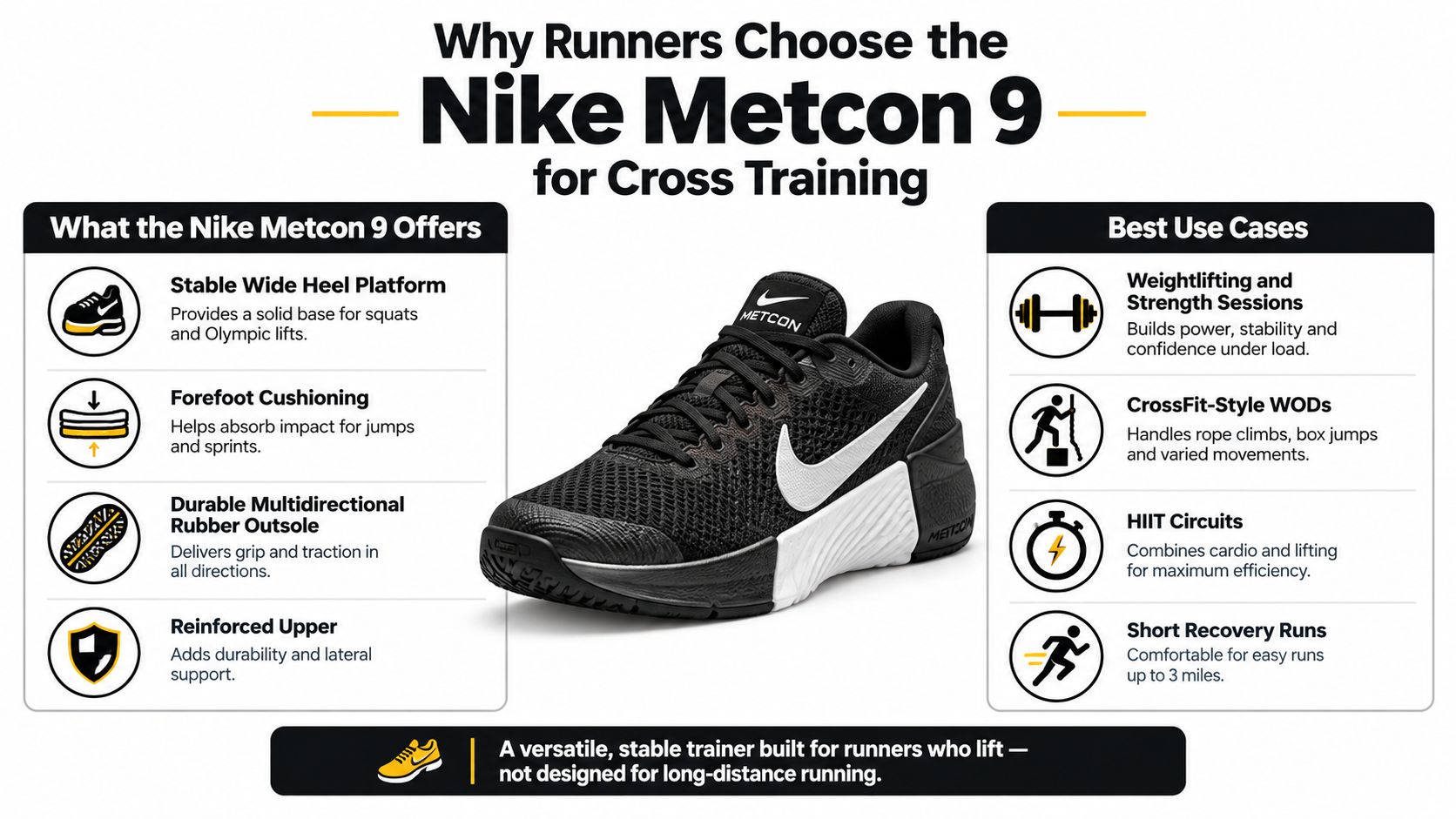
If your cross-training day centers on a barbell, start here. The Nike Metcon 9 gives you a firm, stable base for heavy lifts while keeping enough forefoot flex for box jumps, burpees, and short sprints. Men's and women's versions share that same purpose, a grounded platform first, dynamic movement second. It handles rope work, rowing, and wall balls in a CrossFit style class without feeling wobbly under load.
That stability is the trade off. The platform that helps you deadlift is too firm and flat for comfortable distance running. Use it for a short run into a strength circuit if you need to, then switch back to your running shoes for mileage. For a fuller view of how to structure that work, see cross-training for runners to boost performance and prevent injuries.
Why It Earns a Strength Day Slot
Strength work isn't filler for runners. In a 2022 randomized controlled trial of 30 moderately trained distance runners, 10 weeks of concurrent strength and endurance training improved 2-kilometer time by an average of 11.3 seconds versus controls, and increased time to exhaustion by 59.1 seconds. That's a small trial, not a guarantee, but it supports building your week around real lifting, and the Metcon 9 is built for exactly that session.
This short video shows how the shoe moves through lifting and dynamic work.
Try your normal running size and a half size up, since feet swell during workouts. Check the forefoot flex in store if you do a lot of box jumps.
Best use: Heavy squats, deadlifts, and mixed lifting circuits
Skip it for: Long runs, tempo miles, and high mileage weeks
2. Reebok Nano X3 (Men's and Women's) Lightweight Versatile Trainer
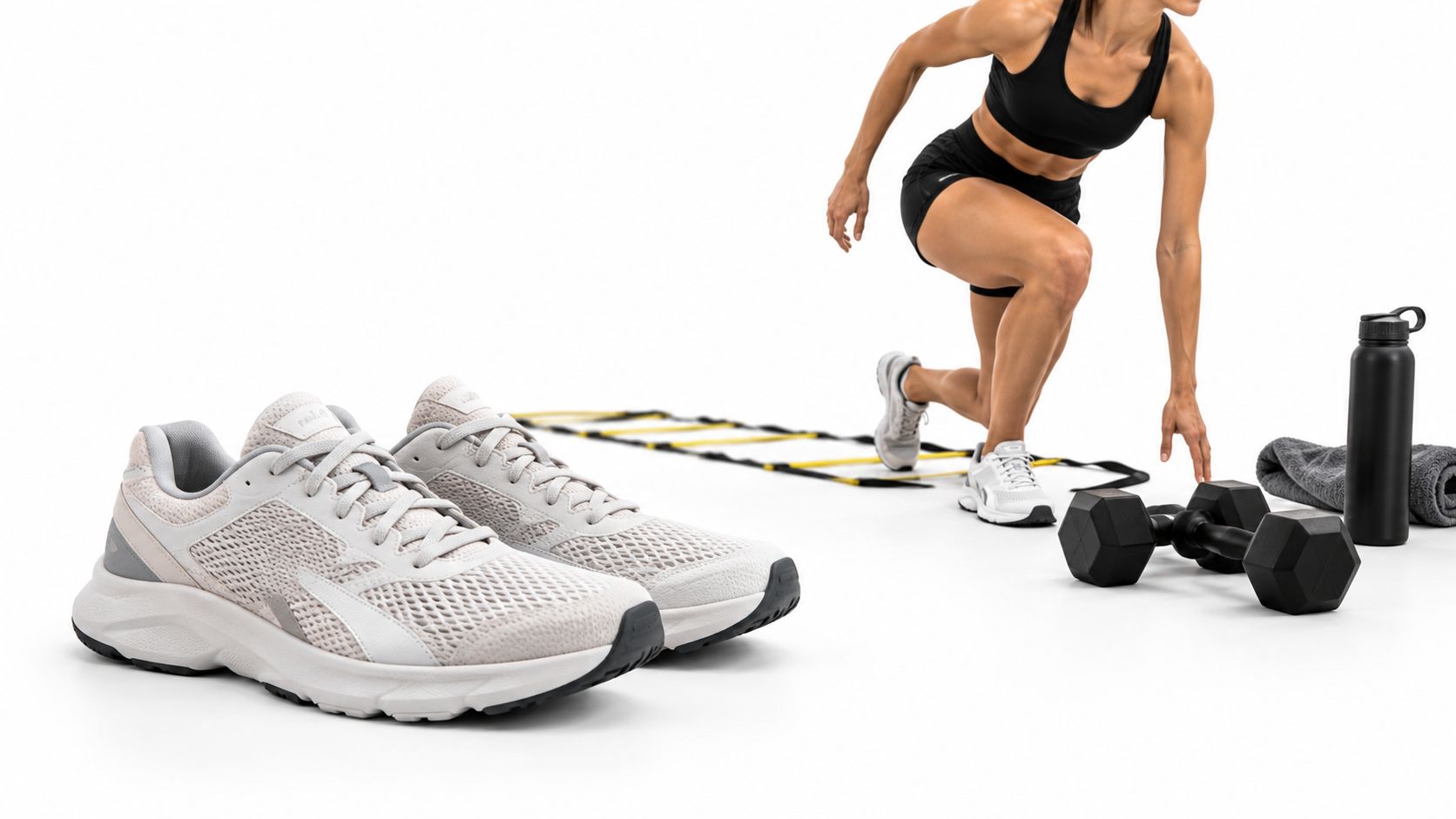
One shoe for intervals, circuits, and moderate lifting usually means compromise. The Reebok Nano X3 makes that compromise on purpose. It is lighter and more flexible than a pure lifting shoe, with enough cushion for running intervals and agility drills, yet still stable enough for moderate weight training. Men's and women's versions aim at that same middle ground.
Put it on Tuesday for 400-meter repeats, then keep it on for kettlebell work, sled pushes, and a full body circuit. It handles agility ladders and short tempo efforts where a bulky lifting shoe would slow you down. The trade off is clear: you give up some maximal stability compared with the Metcon 9, and heavier barbell sessions belong in a flatter shoe.
Where Versatility Helps and Where It Doesn't
A versatile trainer preserves fitness between running days, but it does not create race specific sharpness. Cross-training can maintain aerobic stimulus when impact needs managing, while faster running still depends on running. Treat the Nano X3 as the bridge: useful when the session mixes modalities, wrong when the day is about pace or about maximum load.
Fit check matters here. Test lateral support with lateral lunges, and if your feet are wide check the brand's width guidance or try a different last. A snug midfoot that feels secure for lifting can feel restrictive once intervals start.
Rotate the Nano X3 for mixed training and keep a dedicated running shoe for long runs. Versatility is a strength only when you don't ask it to do the longest job in your week.
3. Adidas Dropset Trainer (Men's and Women's) Flat Grounded Lifting Platform
Flat, low, and close to the floor. That's the whole point of the Adidas Dropset Trainer . Its low profile platform keeps your foot grounded for squats and deadlifts, which many lifters prefer because there's less cushion to compress under load. Men's and women's versions suit runners who are getting serious about strength work twice a week while running on separate days.
A runner building strength with back squats twice weekly and running three days a week is the target user. A beginner lifter also fits here, using the shoe for bodyweight and barbell work while easing into loaded training. Don't expect it to double as a running shoe. There's little here to absorb repetitive road impact, and that's by design.

The Case for Structured Strength Work
A systematic review and meta-analysis in highly trained middle and long distance runners found strength training produced a large improvement in running economy, standardized mean difference of -1.42. The most actionable protocol combined resistance work with plyometrics 2 to 3 times weekly for 8 to 12 weeks. Running economy is the oxygen cost of holding a pace, so improving it means the same pace costs you less. A flat shoe that lets you lift with good form supports that work directly.
Introduce the flat platform gradually to avoid calf or Achilles strain, especially if your running shoes have a higher heel. Pair it with varied strength exercises to build foot and ankle stability, and keep your running shoes for outdoor road or trail runs.
Best use: Back squats, deadlift variations, split squats, calf work
Transition tip: Shorten your first few sessions and monitor calf soreness
4. Under Armour Project Rock (Men's and Women's) Training Shoe Built for Hybrid Athletes
Some runners don't separate lifting and conditioning. They do hill sprints and sled work in the same session, or finish a strength day with a short easy run. The Under Armour Project Rock, developed in collaboration with Dwayne Johnson (The Rock), is built for that hybrid athlete. It offers a stable, supportive ride with more cushioning than a flat lifting shoe, so intervals and plyometrics feel less harsh.
Men's and women's versions handle a wide range of workouts, which is both the appeal and the limit. You get lateral support and some underfoot softness for conditioning, but you don't get the locked down, ground level feel of the Dropset for maximal lifts. If you're unsure how these categories differ, this essential guide to what cross-training shoes are breaks down the design choices.
Matching the Shoe to the Training Goal
A 2024 systematic review and meta-analysis on strength methods and running economy reported small effects for high-load training (ES = -0.266) and moderate effects for combined methods (ES = -0.426) at speeds of about 8.64 to 17.85 km/h. Combined methods carried lower evidence certainty, so you shouldn't stack every modality at once. The Project Rock fits a combined session well, provided you monitor fatigue and tendon soreness and protect your quality run days.
Check the heel-to-toe transition if you're used to a lower-profile shoe. Use it for strength and conditioning days rather than marathon style runs, and rotate with a dedicated running shoe to reduce repetitive stress.
5. NOBULL Trainer+ (Men's and Women's) Minimal Feel Trainer for Functional Fitness
Ground contact first, cushioning second. The NOBULL Trainer+ emphasizes a low, minimal feel platform and a lightweight build that CrossFit style athletes and natural movement fans tend to like. Men's and women's versions suit bodyweight circuits, kettlebell swings, and short easy runs where you want to feel the floor rather than float above it.
That feel comes with a real adaptation cost. If you're coming from a cushioned running shoe, your feet and calves will work harder from the first session. Build up gradually, start with shorter workouts, and don't take it out for extended long runs until you're fully adapted. Runners who rotate between barbell work and short sprint intervals often accept that trade off because the shoe never feels bulky.
Short Structured Work Can Do a Lot
You don't need an extra hour of cardio to get value from cross-training. A 2025 randomized controlled trial of 264 recreational runners followed for nine months used 11 exercises for 15 to 30 minutes, two to four times weekly, and overall running related injuries fell from 8.71 to 4.62 per 1,000 running hours. Overuse injuries fell from 7.61 to 4.04 per 1,000 hours, while acute injury rates didn't differ significantly. That supports targeted, repeatable work in a shoe like this, not random extra volume.
Strengthen your feet and calves alongside the transition. Single leg raises and short foot drills pair well with the low platform.
Best use: Kettlebell work, bodyweight circuits, short runs
Watch for: Calf fatigue and foot soreness in the first weeks
Progression rule: Increase time in the shoe only when soreness settles between sessions

6. Inov-8 F-Lite 260 V2 (Men's and Women's) Lightweight Flexible Trainer
Runners who build sessions around speed and agility should start here. The Inov-8 F-Lite 260 V2, from the UK-based brand, prioritizes grip, flexibility, and low weight over cushioning. It moves naturally through agility ladder drills, 800-meter repeats, and mobility circuits, and the men's and women's versions share that light, responsive character.
Flexibility is the trade off you choose on purpose. Heavy barbell lifts don't belong in this shoe, because a softer, more flexible base can feel unstable under load. It earns its place on days built around foot speed, direction changes, and light running. If your week already includes a stable lifting shoe, the F-Lite fills the opposite slot cleanly.
Low Impact Work Still Needs Running Specificity
As noted earlier, short cross-training blocks can improve 5-kilometer performance in ways similar to run only blocks. Running remains the most specific stimulus for race times. Use the F-Lite to make your non-running days sharper, not to replace the runs that build race fitness.
Slot it into speed and agility days first, then extend its role as your feet adjust. Keep long runs in something more cushioned, and keep heavy lifting for a flatter, more stable shoe.
Practical rule: If the workout is measured in seconds and direction changes, pick flexibility. If it's measured in kilos on the bar, pick stability.
7. Nike Free Metcon (Men's and Women's) Flexible Trainer for Natural Movement
The Nike Free Metcon blends the flexible, natural movement idea of the Nike Free line with enough structure for training. It bends with your foot during lunges, bodyweight work, and short strides, which makes it a useful bridge between minimalist running shoes and structured cross-trainers. Men's and women's versions suit runners who want freedom of movement without going fully minimal.
Use it for yoga based mobility sessions, light cardio, and bodyweight circuits. Don't use it for maximal lifts. The same flexibility that feels great in a deep lunge lets the foot move too much under a heavy barbell load. If you're weighing that distinction, this running versus cross-training shoes comparison guide lays out where each category belongs in your week.
How Flexible Work Fits the Bigger Picture
The WHO physical activity information sheet for adults aged 18 to 64 classifies running, swimming, and bicycling as aerobic activities where large muscle groups move rhythmically for a sustained period. It pairs that endurance work with strength training on at least two days weekly. The Free Metcon supports the mobility and light strength side of that pairing, the work that keeps you moving well between harder running and lifting days.
Gradually add flexibility focused workouts to build foot strength rather than jumping straight into daily use. Keep dedicated running shoes for distance runs, and treat this as your movement quality shoe, not your mileage shoe.
Best use: Bodyweight training, mobility work, light cardio
Skip it for: Maximal squats, deadlifts, and long runs
8. Hoka Transport (Men's and Women's) Rocker Soled Cross-Training Hybrid
Recovery days deserve their own shoe. The Hoka Transport brings Hoka's maximal cushioning and rocker geometry, which helps your foot roll forward smoothly, into a versatile build for walking, light jogging, and easy cross-training. Men's and women's versions suit runners who spend long hours on their feet or want a softer ride between workouts.
Use it for recovery walks, light jogging, and cardio days where comfort matters more than ground feel. Don't lift heavy in it. A tall, cushioned, rockered sole is the opposite of a stable lifting platform, and balance during single leg work can feel uncertain. Test that balance before you use it for any strength training, and reach for a flatter shoe for squats and deadlifts.

Low Impact Does Not Automatically Mean Lower Risk
Cross-training is often sold as injury prevention, but the evidence is more nuanced. A 2025 retrospective study on injury occurrence in triathletes and marathon runners covered 384 athletes and found greater cycling time and total cross-training were positively associated with reported injuries, while greater swimming time was associated with fewer injuries. That study can't establish causation, since injured athletes may add cross-training during rehab. The takeaway for your week is simple. Track total stress, don't assume a soft shoe or a low impact day erases load.
The Hoka Transport earns its place by making easy days easy. That protects your hard running and lifting days, which is where adaptation happens.
Best Cross-Trainer for Running: 8-Way Comparison
Shoe | 💲 Approx. Price (USD) | 🔄 Adaptation / Fit Considerations | ⭐ Training Profile | 📊 Ideal Use Cases | 💡 Key Advantage / Trade-Off |
|---|---|---|---|---|---|
$130 | Check fit; try usual size and half size up | Very stable, firm, durable; relatively heavy | Heavy lifting, HIIT, CrossFit-style workouts, short runs | Excellent lifting stability; firm feel is less suited to distance running | |
$140 | Check lateral support; may feel narrow for some | Balanced cushioning and stability; flexible | Mixed training, agility drills, intervals, gym circuits | Versatile and lighter than many lifting-focused trainers; less stable for heavy squats | |
$110 | Gradually adapt to the flat platform | Firm, low-profile, grounded | Squats, deadlifts, strength training | Strong ground feel at a relatively affordable price; limited cushioning for running | |
$130 | Check heel-to-toe transition; may feel bulky | Supportive, cushioned, durable | Lifting, sprints, plyometrics, conditioning | Good lateral support and impact cushioning; heavier than running shoes | |
$130 | Allow time to adapt from cushioned shoes | Minimal-feel, flexible, low-profile | Functional fitness, lifting, agility, short runs | Lightweight with strong ground feel; less forgiving on long or high-impact sessions | |
$130 | Build up wear time gradually | Very lightweight and flexible, low drop | Speed work, agility drills, mobility circuits | Grip and flexibility support quick movement; limited cushioning and heavy-lift stability | |
$120* | Gradually adapt to its flexible feel | Flexible, lightweight, stable at the heel | Bodyweight training, mobility, light cardio | Natural foot movement; limited support for maximal lifts and long runs | |
$120* | Test balance with single-leg moves; rocker may feel unusual | Cushioned, supportive, rocker-soled | Walking, recovery, light running, everyday wear | Comfortable on hard surfaces; elevated cushioning is less stable for heavy lifting | |
*Approximate price; verify current model. |
Build a Smarter Hybrid Training Week
There's no universal winner here, and picking one would miss the point. Across stability, cushioning, flexibility, durability, weight, and intended workout type, these eight shoes split into clear roles. The Metcon 9 and Dropset Trainer anchor the stable end, the Nano X3 and Project Rock cover mixed work with different levels of cushioning, and the NOBULL Trainer+, F-Lite 260 V2, and Free Metcon trade cushioning for flexibility and ground feel. The Hoka Transport stands apart as the recovery option, soft and rockered where the others are flat and firm.
Buy for your primary need first. Choose the Metcon 9 for heavy compound lifting, the Nano X3 for frequent mixed sessions, the Dropset Trainer for flat-ground strength work, and the Project Rock for cushioning and lateral support. Pick the NOBULL Trainer+ for minimal feel training, the F-Lite 260 V2 for speed and agility, the Free Metcon for mobility and bodyweight work, and the Hoka Transport for recovery and light running. Most runners need two of these at most, one for lifting days and one for everything else, alongside their running shoes.

Workout Schedule
A sample week keeps those roles separate. Run intervals Tuesday in your running shoes, lift Wednesday in your stable trainer, take Thursday easy or off, run Friday, and do a mixed or mobility session Saturday in your flexible shoe. Put your long run Sunday in dedicated running shoes, and use the Transport for recovery walks on Monday. Don't stack hard running and high-impact conditioning on consecutive days, and leave at least one genuine recovery space in the week.
That structure also matches general health guidance. The WHO physical activity fact sheet for adults recommends 150 to 300 minutes of moderate intensity aerobic activity weekly, or 75 to 150 minutes of vigorous activity, plus muscle strengthening work on at least two days. Your running and low impact cardio cover the aerobic side, your lifting days cover the strengthening side, and neither replaces the other. A 2023 study protocol planning to recruit 40 competitive distance runners was designed to compare elliptical, cycling, and swimming substitutions against unchanged run training over 12 weeks, which shows how seriously researchers treat mode-by-mode comparison rather than assuming all cross-training is equal.
Adaption
Adapt gradually to flatter or more flexible shoes, stopping if pain, swelling, altered gait, or discomfort occurs. These signals indicate the need to adjust the load or transition, not push harder. For demanding hybrid events, structured plans like elite Murph preparation, highlight the importance of sequencing and recovery when combining running and strength training.
Identify your primary training need, check model availability and price, and test fit before purchasing. For more options, Flourish-Everyday offers guidance on cross-training, CrossFit, running shoes, and wellness. Refer to the numbered sources cited inline for detailed study information. Thanks.
Visit Flourish-Everyday for side-by-side cross-training and running shoe reviews, hybrid training guides, and practical wellness advice built for runners at every level. Browse the latest men's and women's picks, compare stability, cushioning, and flexibility for your training week, and pick the shoe that fits your next session.

