What Causes Shin Splints in Runners: A Clear Guide

Updated: 6 hours ago
Hey runners, so you added a longer loop in week three. Two weeks later a dull ache shows up along the inner shin in the first kilometers, then quiets once you stop. Many runners are currently in that week. This shin ache typically involves a recovery issue rather than a single bad stride.
What the heck are shin splints anyway? Shin splints are the overuse or alignment strain caused by shoes that fail to control excessive rolling of the ankle (overpronation) or lack proper stability. What does this mean? This comprehensive article will help you evaluate if you have them and what to do.

Guide index
"This post contains affiliate links.”
Shin Splints Explained and What This Guide Covers
What causes shin splints in runners, that ache has a plain description before it has a clinical name. It is exercise related pain along the inner, lower shin, the posteromedial distal two thirds of the tibia. Clinicians call it medial tibial stress syndrome (MTSS), the condition commonly meant by shin splints.
Picture the tibia as a bucket. Each footstrike pours in a little impact. Bone remodeling and the tissues around the bone drain that bucket, but they drain slowly. What causes shin splints in runners is this mismatch. Repeated loads arrive faster than the bone and the tissues around it can adapt and recover. One isolated stride almost never fills the bucket. The running weeks do.
A systematic review on PMC found MTSS incidence of approximately 13.6% to 20% among runners in prospective studies. A separate review in that summary put the span at roughly 5% to 35% of runners, depending on the population and the study design. This is a common training injury, not a rare one.
A fast mileage jump, thin rest, stacked hard sessions, or a quick move from cycling or the gym onto the road widens the gap between stress and repair.

The Main Causes of Shin Splints at a Glance
Most runners can find their week in one or two rows of this scan, rather than hunting for a single villain.
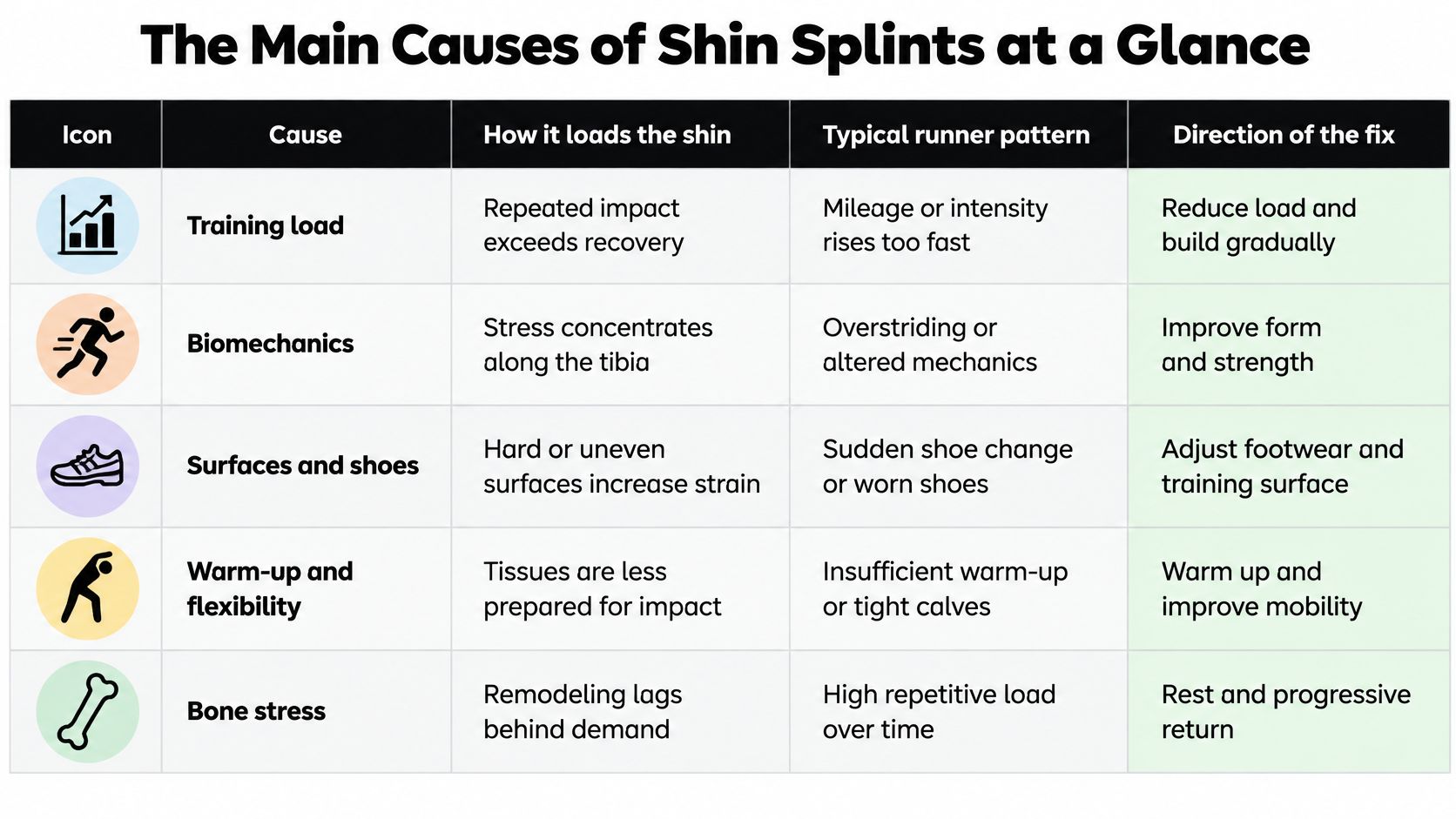
Full Comprehensive Chart
Cause | How it loads the shin | Typical runner pattern | Fix direction |
|---|---|---|---|
Training load spike | Bone micro damage outpaces repair | Mileage up more than 30% in a week | Build mileage gradually |
Running frequency and volume | Cumulative impacts stack up | More than four runs a week or about 2,600 km of exposure | Add rest days and cap weekly volume |
Daily running duration | Longer daily time adds impacts | Long continuous runs every day | Split sessions or shorten them |
Hard or uneven surfaces | Higher impact force per stride | Repeated road or concrete sessions | Alternate with softer surfaces |
Footwear change | Alters cushioning and load distribution | New or worn out shoes introduced suddenly | Introduce new shoes gradually |
Insufficient warm-up | Tissues start cold under load | Hard intervals straight from rest | Warm up before quality work |
Foot posture and navicular drop | Changes arch control and rotation | Greater navicular drop or pronated foot | Individual gait and strength assessment |
Hip and ankle mobility | Changes lower-limb alignment | Greater hip external rotation or ankle plantar-flexion range | Mobility and hip strength work |
Body mass index | Higher load per stride | BMI about 0.79 units higher in people with MTSS | Gradual progression and strength work |
Prior shin splints | Movement patterns may persist after pain fades | Previous MTSS episode | Plan a staged return to running |
Experience and sex | Higher relative risk in less experienced and female runners | Newer runners; female runners relative risk 1.71 | Extra caution in the first training blocks |
Remember that causes stack up. Most irritable shin splints show up after a training change or equipment factor, not after a shoe fails in isolation. The training load rows above are the ones you can change this week, which is where the mechanism starts.
How Training Load Overwhelms the Tibia
Each stride adds a tiny bit of micro damage to the tibia. The body repair process is progressing slowly, so if you keep causing damage to the area, the body won't be able to keep up.
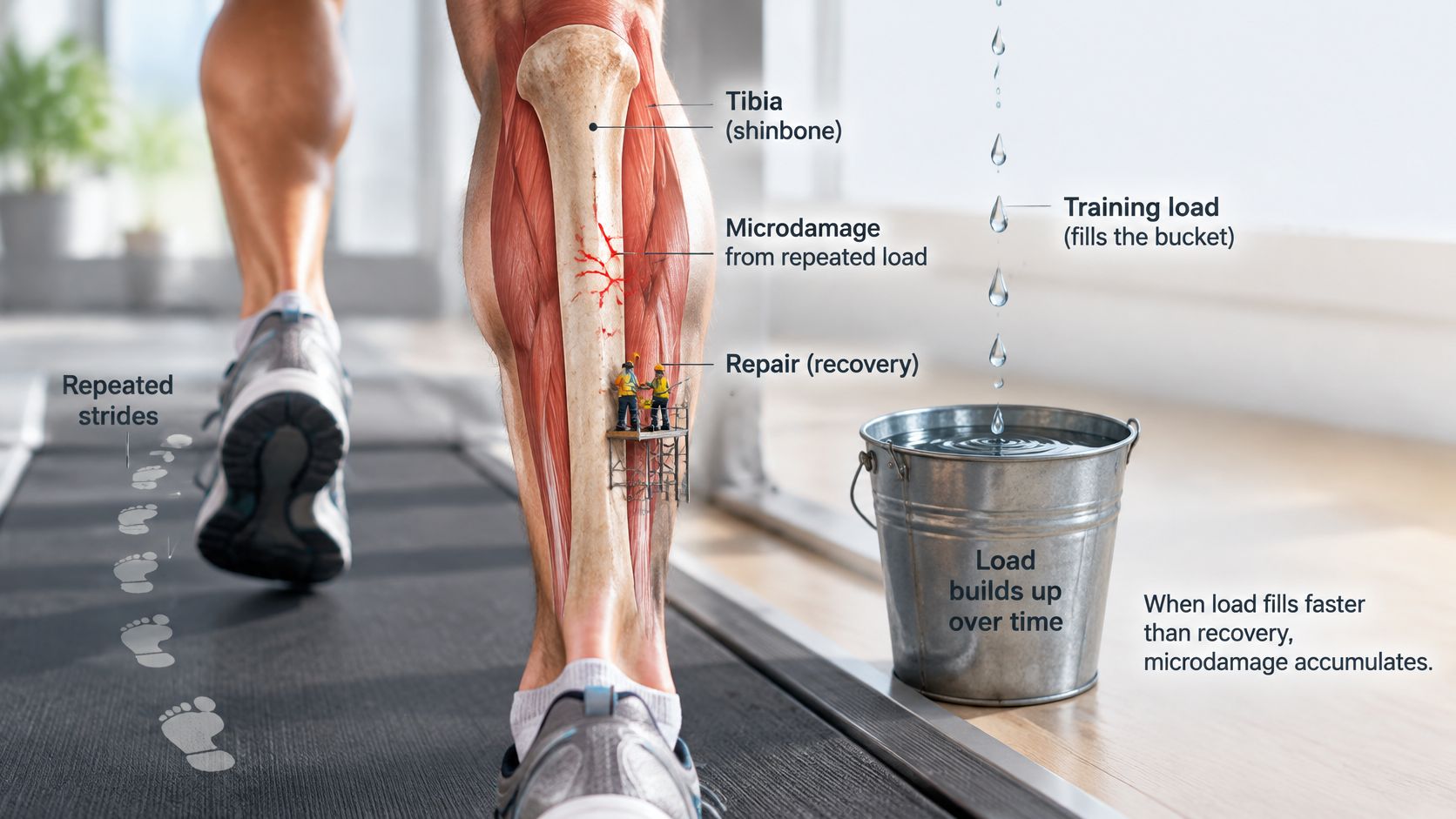
What the bone is actually doing
An NCBI Books review of MTSS describes the process as repetitive axial loading. Impact and bending can overload the distal or posteromedial cortex. Traction from attached muscles and tendons may irritate the periosteum, the lining on the bone. That is a cumulative bone and periosteal stress response. It is not ordinary muscle soreness that should vanish after a shakeout.
In a prospective cohort of 873 runners, increasing weekly running distance by more than 30% was associated with a higher prevalence of MTSS. Association is not a personal guarantee. It is a loud hint that big week to week jumps outrun repair.
Change one variable at a time. Track pain during the run and the next morning. If tenderness becomes localized, or it is still there between sessions, cut impact load. Pain that is focal, worse with hopping, or present at rest needs a clinician, because a tibial stress fracture can overlap with MTSS or follow it. If you are also dragging fatigue from the gym, the guide to recovering from overtraining is a useful companion for separating tired legs from a bone that needs fewer impacts.
Foot Mechanics and Body Factors That Raise Tibial Load
Two runners can cover the same distance and place different demands on their shins. Foot posture, joint movement, body mass, and past injury may all be associated with MTSS, but none alone explains every case.
Measured technical differences, not a single foot type
A systematic review and meta analysis in NCBI Books found that physically active people who developed MTSS had, on average, a body mass index 0.79 units higher than controls, 1.19 millimeters more navicular drop, 5.94 degrees greater ankle plantar flexion range, and 3.95 degrees greater hip external rotation range. These are average group differences, not a way to predict whether an individual runner will get shin splints.
A 2024 systematic review and meta analysis on PubMed found associations between MTSS and foot posture, with a standardized mean difference of 1.23, and between MTSS and dynamic arch height change during walking, with a standardized mean difference of 1.05. These group differences do not prove that foot posture alone causes shin splints.
Practical rule: Once pain has settled, review training history, single leg control, hip and calf strength, and running form when tired. Choose footwear for your own comfort and needs rather than assuming one shoe type suits every arch.
Toe alignment can affect how the forefoot bears load. Dream Body Clinic explains inward pointing toes as an alignment issue to consider alongside other factors. Foot mechanics may influence tibial loading, but shin pain still depends on whether repeated running demands exceed the bone's recovery rate.

Surfaces, Shoes and Warm-Up as External Triggers
The popular blame is one harsh road or one "bad" shoe. Clinical descriptions list several outside factors at once, and a single swap rarely explains the ache.
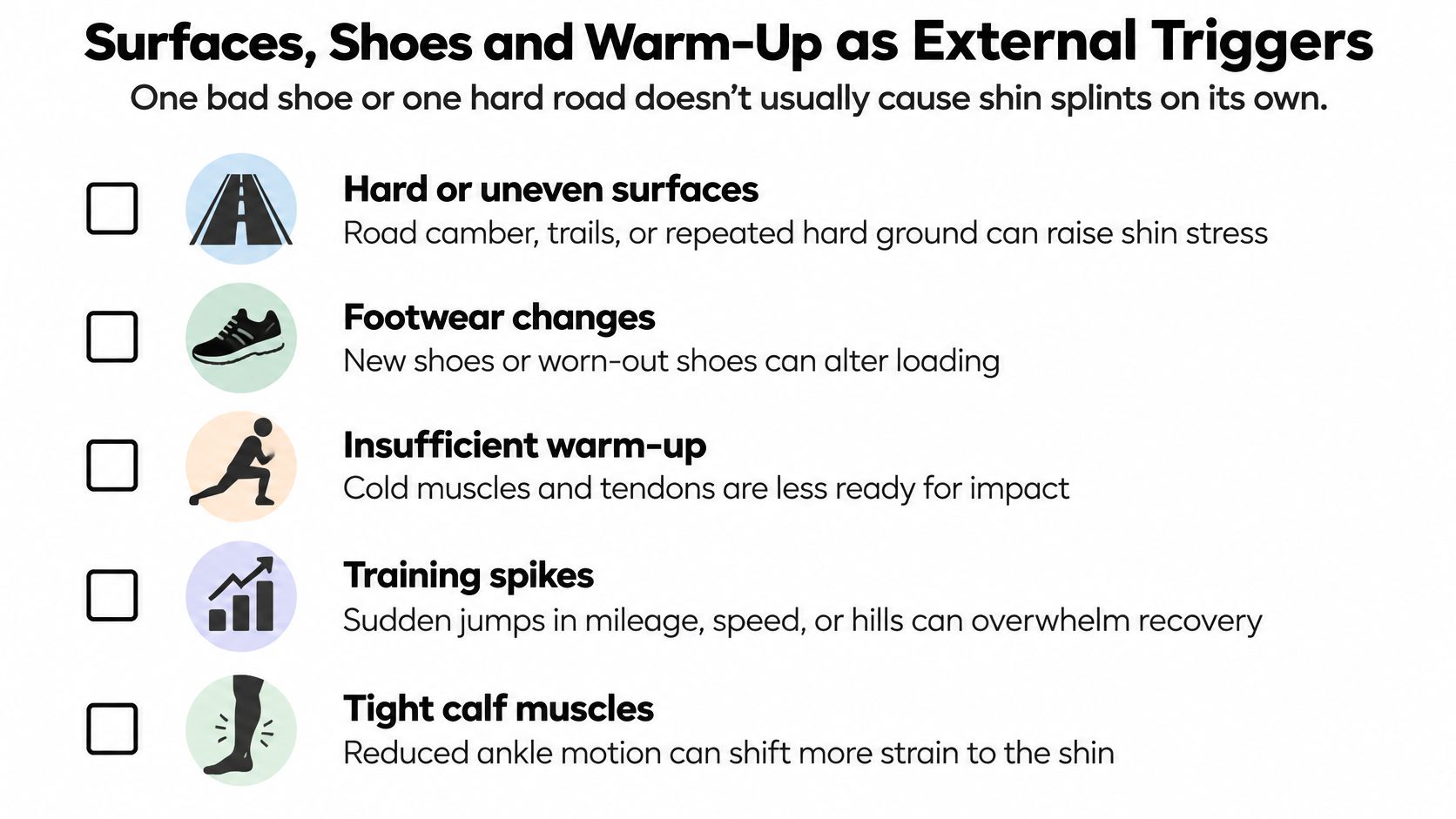
A 2024 review on PMC identifies hard or uneven surfaces, footwear changes, insufficient warm-up, hyper pronation, and recently increased or modified training as predisposing factors. Duration, surface, and equipment can all change faster than bone adapts.
Test one trigger, then wait
Surface. Swap one hard session for a softer route, such as a track or even path instead of concrete. Note the inner shin over the next 48 hours, not during the first kilometre only.
Shoes. Compare the new pair with the old one for feel, heel-to-toe drop, and fit. Wear the new pair for short easy runs across several weeks. A sudden full week switch is itself a load change. The running shoe selection guide on Flourish-Everyday.com walks through fit and support as one option among a fitter's advice and a gait check, not as a cure.
Warm-up. Give quality work about 10 minutes of easy jogging plus leg swings and calf raises before intervals or hills. Track next morning tenderness, not just how loose you felt at the start line.
Shoes for different feet, without a miracle pair
Fit differs by foot, not by a gender trophy. Many women need a narrower heel and a secure midfoot. Many men need a roomier toe box. A neutral daily trainer such as the Brooks Ghost or Nike Pegasus suits a lot of easy mileage. A stability shoe such as the ASICS Gel-Kayano is aimed at pronation control. A max-cushion shoe such as the Hoka Clifton changes the feel under the heel. None of those models removes a 30% mileage jump. Introduce any of them slowly.
Cold calves and a brand new shoe on concrete is three variables on the same morning. You will not know which one filled the bucket.
After the run, some people like a sports roll-on for active adults on the calf, not on a focal bone spot, as a comfort step while they sort the trigger. Surface, footwear, and warm-up change force per stride. Duration and the recent training change decide whether the tibia can recover from that force.
Telling Shin Splints Apart From Serious Injuries
Pain along the inner lower shin during or after running can fit the typical pattern of medial tibial stress syndrome (MTSS), often called shin splints. It tends to ease with rest. Burning, cramping, numbness, or tingling suggests a different problem.
A review in the Orthopaedic Journal of Sports Medicine identifies focal tenderness, pain at rest, swelling, limping, and pain that worsens despite reduced training as signs to get checked. A tibial stress fracture can resemble shin splints. Diagnosis depends on your history and an examination, and imaging may be needed.
Sort the pattern before you sort the shoe
Symptom | What it suggests | Action |
|---|---|---|
Dull ache along the inner lower shin during or after running that eases with rest | Typical MTSS pattern | Reduce load and track progress |
Focal tenderness at one point on the tibia | Possible tibial stress fracture | Get evaluated before running on it |
Pain at rest, at night, or worse with hopping | Warning sign beyond shin splints | Seek clinical assessment |
Burning, cramping, numbness or tingling | Possible chronic exertional compartment syndrome or nerve involvement | Seek medical assessment |
Swelling, limping, or pain that worsens despite less training | Needs examination and possibly imaging | Stop running until assessed |
A scoping review links running more than four times a week, cumulative exposure beyond about 2,600 km, and ultramarathon participation with greater MTSS risk (scoping review of MTSS risk factors). These exposure patterns provide context, but they cannot tell you what is causing your pain now. Focal pain at night, for example, still deserves assessment, whatever your running history.
Pain location, timing, nerve symptoms, and whether the pain is worsening help distinguish shin splints from injuries that may need examination or imaging. Use the pattern as a guide, not as a diagnosis.

Decide Whether to Keep Running or Get Checked
Use the symptom table above in order.
Match the typical pattern, then cut the newest stress. If your pain is the diffuse inner shin ache that eases with rest, only run within a pain free level. Remove the change that most recently raised load, whether that was mileage, frequency, daily duration, or surface.
Rebuild with one variable, plus strength. Add back a single piece at a time. A review of running mechanics on PMC notes that a modest cadence increase of about 5% to 10% has been reported to reduce vertical ground reaction forces, loading rates, and stride length, which may lower tibial stress. Raise it gradually and keep it comfortable. Pair that with hip and calf strength, and recheck single leg control and form when you are tired. See Strength and load management go with assessment of bone pain. They do not replace it. The same habits sit inside a wider injury prevention routine for runners.
Any red flag row means stop. Focal tenderness, pain at rest, numbness, or swelling is a reason to stop running and get assessed, not a reason to jog it out.
I realize this article is pretty technical, but it is important to nail down your cause and reverse it. You know your body well, and only you can fix it. Pronation findings are mixed across studies. There are risk associations with pronation but no proof that pronation alone causes the injury. There is no universal shoe that fixes every shin. I hope this post helps. Be well.
Sources and References
A PMC systematic review of prospective runner studies supports an incidence range of 13.6% to 20%, with a wider range of 5% to 35% across study designs.
An NCBI Books biomechanics review covers navicular drop, ankle plantar-flexion, and hip external-rotation differences, along with sex, running experience, and orthotic use as risk markers.
An NCBI Books chapter on medial tibial stress syndrome describes a cohort of 873 runners and reports an association with weekly distance increases of more than 30%.
A 2024 PMC review reports higher MTSS prevalence among runners with longer continuous daily running (p = 0.000 as reported).
A scoping review of running exposure reports links between more than four runs per week, about 2,600 km, ultramarathons, and MTSS risk. Read the running-exposure review.
A PMC article on running cadence and load supports the reported 5% to 10% cadence change and lower loading rates.
The SAGE review (DOI 10.1177/23259671241311849) discusses red-flag symptoms and the limits of self-diagnosis. A 2024 PubMed meta-analysis (39577407) reports standardized mean differences for foot posture and arch height.