Your Ultimate Guide to Marathon Running Shoes

Updated: Jan 3
Finishing a 26.2-mile marathon is a massive accomplishment, and that entire journey starts from the ground up, with your shoes. The right pair of marathon running shoes isn't a luxury; it's the most critical piece of gear you'll own. They're specifically built with the cushioning, support, and sheer durability needed to get you through hundreds of training miles and the big day itself. Think of this guide as your trusted partner for every step of the way.

Index: Your Guide to Marathon Shoe Selection
Why Specialized Marathon Shoes Matter
Picking the perfect marathon running shoes is a critical decision in your training. Unlike everyday trainers, these shoes are engineered for the relentless pounding of long distance running. Their job is to prevent injuries and boost performance over thousands of steps, absorbing shock and providing energy return when you need it most.
The "best" shoe is a deeply personal choice, dependent on your foot shape, running style, and race day goals. A shoe that feels great on a 5k might fail in the final miles of a marathon. This is why understanding the specifics of marathon footwear is crucial. Choosing the best running shoes for marathon training is priority one.

Difference Between Marathon Training Shoes and Race Day Shoes
Marathon training shoes are durable, cushioned workhorses for high mileage, focusing on impact absorption and stability over many miles, while marathon (race) shoes are super light, fast, often carbon plated performance shoes designed for speed and energy return on race day, sacrificing some durability and cushion for minimal weight and maximum propulsion, meant to be saved for race day itself. Training shoes handle the bulk of your mileage, while race shoes give you that extra edge when you're warmed up and ready to fly.
The right pair of marathon shoes does more than just protect your feet, it boosts your confidence. Knowing your footwear is built for the distance allows you to focus on your performance, breathing, and the joy of the run.
Decoding the Anatomy of a Marathon Shoe
To understand a marathon shoe, think of it like a high performance vehicle. Every component is engineered for a specific job, working together to get you through 26.2 grueling miles with comfort and efficiency.
The Engine Room: Midsoles and Superfoams
The midsole is the heart of the shoe, your engine and suspension system. It provides crucial cushioning and energy return. While EVA (ethylene vinyl acetate) foam was once standard, top tier racing shoes now use advanced "superfoams." These proprietary materials are lighter and bouncier, absorbing impact while returning more energy to combat fatigue.
The revolution in midsole tech has transformed marathon running. When designers embedded carbon fiber plates within these superfoams, they created a powerful springboard effect, propelling you forward with less effort. This technology has had a measurable impact: since 2019, super shoes have helped shave an average of 90 seconds off marathon world records, with 85% of top finishers in major marathons now wearing them. (Source: the impact of these shoe technologies on HTF Market Insights).
The Foundation: Uppers and Outsoles
The outsole is the rubber on the bottom that hits the pavement. Its job is to provide traction and durability. A good marathon shoe's outsole often features:
Durable Carbon Rubber: Positioned in areas of high wear, such as the heel, to ensure durability.
Blown Rubber: A softer, lighter rubber in the forefoot for added cushioning and grip.
Strategic Tread Patterns: Designed for reliable grip on wet or dry roads.
The upper is the soft fabric part wrapping your foot. Modern uppers use engineered mesh or knit fabrics that are lightweight, breathable, and flexible, aiming to feel like a second sock that secures your foot without causing irritation.
Guiding Your Stride: Drop and Support Structures
The heel-to-toe drop is the height difference between your heel and forefoot. A higher drop (10-12mm) suits heel strikers, while a lower drop (0-6mm) encourages a midfoot or forefoot landing. The heel counter, a firm piece inside the back of the shoe, locks your foot in place to prevent slipping and blisters.
Matching Shoes to Your Unique Runner Profile
The perfect marathon shoe isn't about trends; it's about your body, running style, and goals. Before considering a brand, you must understand your unique runner profile. This starts with pronation, the natural inward roll of your foot to absorb shock.

Understanding Your Gait and Pronation
Your gait is unique. We can group gaits into three main pronation types:
Neutral Pronation: The ideal. Your foot rolls inward about 15%, distributing impact evenly.
Overpronation: Your foot rolls inward more than 15%, which can stress ankles, shins, and knees.
Supination (Underpronation): Your foot doesn't roll inward enough, placing pressure on the outer edge.
Not sure where you fall? Try the "wet test": wet the bottom of your foot and step on cardboard. A full footprint suggests low arches and overpronation. A print showing only your heel and ball of your foot indicates high arches and supination. For more guidance, see our guide on the best running shoes for high arches.
Choosing Your Support Level
Once you know your pronation, you can match it to the right shoe category:
Neutral Shoes: For neutral runners and supinators, focusing on cushioning and flexibility.
Stability Shoes: For mild to moderate overpronators, using features like guide rails to steer the foot.
Motion Control Shoes: For severe overpronators, offering maximum support to limit excess movement.
Heavier runners exert more force and often benefit from more substantial cushioning. Likewise, a first time marathoner might prefer a more supportive shoe, while an experienced veteran may opt for a lighter, faster model.
How to Achieve the Perfect Fit and Sizing
A poor fit can sabotage your marathon with blisters and pain. Nailing the size and fit is everything. Over a long run, your feet swell, so you need to be smart about trying on shoes.
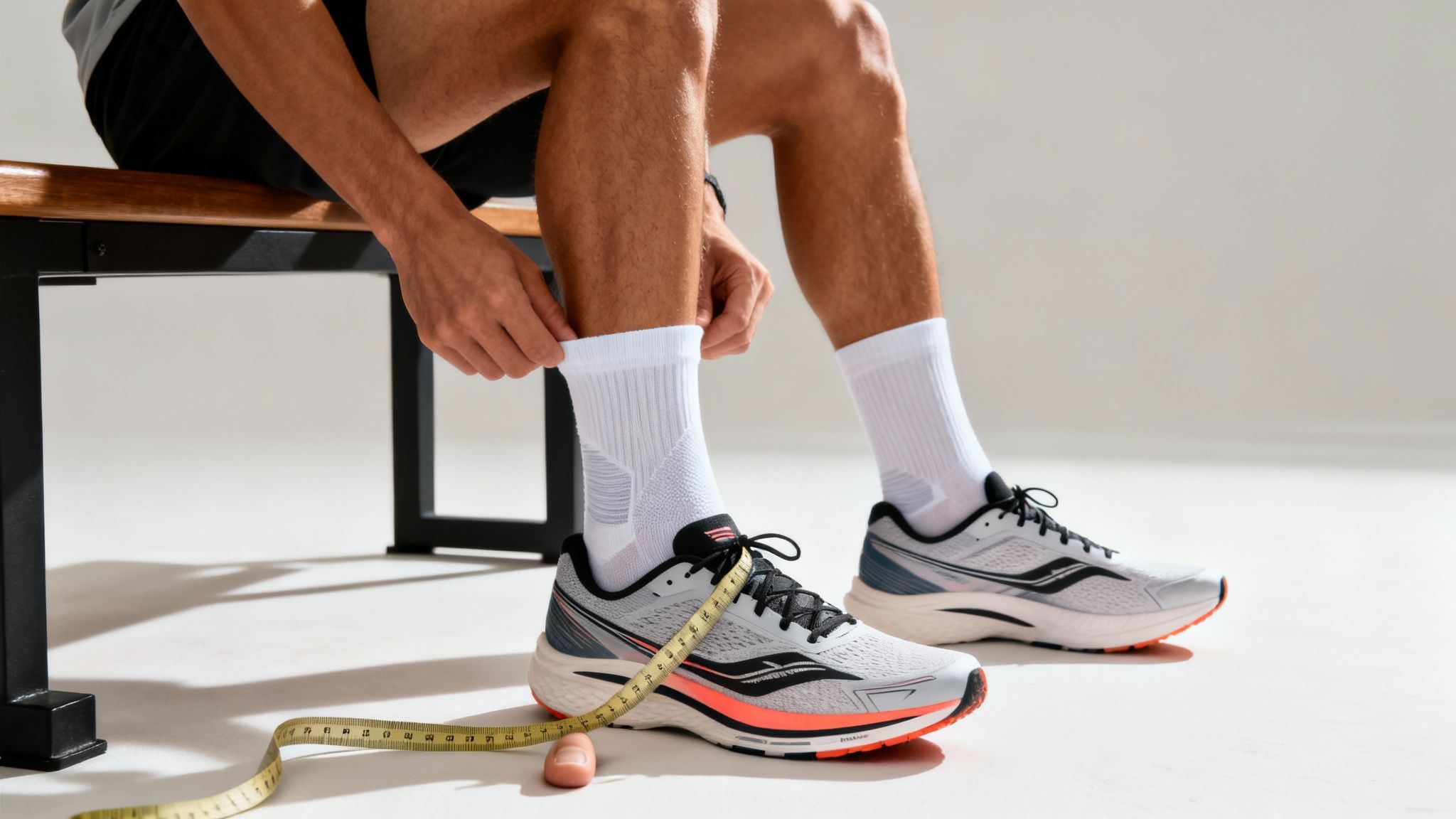
When to Shop for Shoes and Sizing Up
Shop for shoes in the afternoon or evening when your feet are at their largest. It's standard practice for runners to go up a half or full size from their street shoes. This extra room prevents toes from hitting the front of the shoe. Sizing can vary, as shown in our guide on how ASICS fit compared to other shoes.
The "rule of thumb" is your best friend here. You should have about a thumb's width of space between the tip of your longest toe and the very end of the shoe.
The Perfect Fit Checklist
The shoe should feel snug through the midfoot and heel but never tight. Your toes need room to spread.
Bring Your Running Socks: Try on shoes with the socks you'll wear on race day.
Check the Width: Ensure the shoe hugs your foot without squeezing it.
Walk (or Jog) Around: Test for heel slippage or rubbing.
Test Both Feet: Fit the shoe to your larger foot.
Knowing When to Retire Your Running Shoes
Your marathon shoes are critical gear, but they don’t last forever. Knowing when to retire them is a key injury prevention strategy.
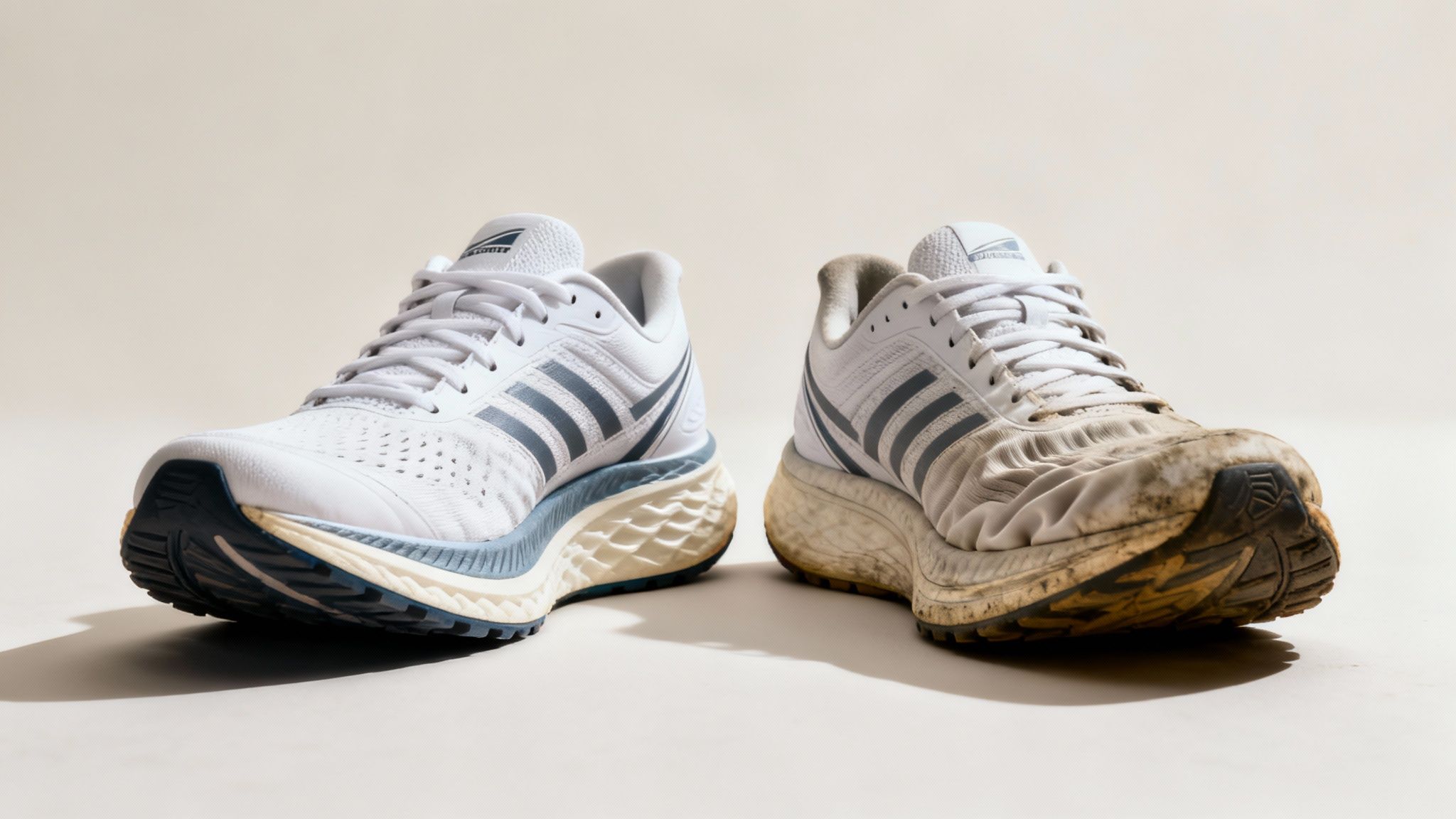
The 300 to 500 Mile Rule
A general guideline is to replace shoes every 300 to 500 miles. However, your weight, form, and running surfaces affect breakdown speed. Track your mileage with an app or log. As you approach 300 miles, start looking for warning signs. For more details, consult our guide on how often to replace running shoes.
Visual Signs of Wear and Tear:
Outsole Wear: Check if the treads are worn smooth in key spots.
Midsole Wrinkles: Look for deep, compressed wrinkles in the foam that don't bounce back.
Heel Counter Instability: Squeeze the heel; if it feels mushy, it's lost its stability.
Listening to Your Body
Your body provides the most important feedback. New, nagging aches in your feet, shins, or knees can be a sign of worn out shoes. If the shoe feels "flat" or "dead," its cushioning is gone. Retiring shoes on time ensures you get the protection you need to run strong and injury free.
Top Marathon Shoe Reviews: Brands, Men's & Women's Picks
This section offers a concise review of top rated marathon running shoes, tailored for both men and women, focusing on key brands known for performance and innovation.
Leading Brands in Marathon Footwear
Hoka: Known for maximalist cushioning that provides exceptional shock absorption without excessive weight. Models like the Clifton and Bondi are favorites for long distance comfort.
Brooks: A popular runners brand, focusing on biomechanics. The Ghost (neutral) and Adrenaline GTS (stability) are consistently praised for their reliable performance.
ASICS: Renowned for its GEL cushioning technology. The GEL-Kayano is a stability icon, while the GEL-Nimbus offers plush comfort for neutral runners.
Saucony: Delivers a balance of cushioning and responsiveness. The Kinvara is a lightweight trainer, and the Endorphin series features cutting edge carbon plate technology for race day.
Top Athletic Shoe Reviews for Men
Best for Neutral Runners: Saucony Endorphin Speed 4. Offers a versatile combination of speed and cushioning, making it suitable for both training and race day. Its nylon plate provides a propulsive feel without the harshness of carbon fiber.
Best for Stability: Brooks Adrenaline GTS 23. Features GuideRails technology to support overpronators by keeping excess movement in check. It's a workhorse shoe trusted for its comfort over high mileage.
Best for Race Day Speed: Nike Alphafly 3. The pinnacle of super shoe technology, combining ZoomX foam and dual Air Zoom units with a carbon fiber plate for maximum energy return.
Top Athletic Shoe Reviews for Women
Best for Neutral Runners: Hoka Clifton 9. Praised for its lightweight yet highly cushioned ride. It provides a soft landing that reduces impact, making it ideal for long training runs.
Best for Stability: ASICS GEL-Kayano 30. This latest iteration offers adaptive stability that feels less intrusive than traditional posts. It’s a plush, supportive option for women who overpronate.
Best for Race Day Speed: Saucony Endorphin Pro 4. A top tier carbon plated racer that feels fast and efficient. It's celebrated for its aggressive rocker geometry that promotes a quick turnover.
Health Information: Running, Well-Being & Injury Prevention
Proper footwear is a cornerstone of running health, directly impacting your well being and injury risk. This section provides informative health insights related to marathon training.
Comparison of Well-Being Trends and Methods
Minimalism vs. Maximalism: The "barefoot running" trend emphasized minimal shoes to strengthen feet. In contrast, the current maximalist trend, led by brands like Hoka, focuses on extensive cushioning to reduce impact forces on joints. Research suggests that for high mileage marathon training, maximalist shoes are generally more effective at preventing stress related injuries like stress fractures. A 2018 study in the American Journal of Sports Medicine found that highly cushioned shoes were associated with lower injury rates in novice runners.
Carbon Plates and Biomechanics: Modern "super shoes" with carbon fiber plates alter running biomechanics by improving running economy. They create a stiff lever that reduces the workload on the ankle joint, allowing runners to maintain pace with less energy expenditure. However, this shift can place different stresses on the body, potentially affecting the hamstrings and hips. It's crucial for runners to gradually adapt to these shoes to avoid injury.

Informative Health Information for Marathoners
Listen to Your Body: Pay attention to pain. Aches are normal, but sharp, persistent, or worsening pain is a red flag. Worn out shoes are a primary suspect for new pains in the shins, knees, or hips.
Strength Training is Non-Negotiable: Strong glutes, hips, and core muscles provide stability and reduce the load on your joints. Incorporate exercises like squats, lunges, and planks 2-3 times a week.
Rotation Reduces Risk: Alternating between two different pairs of running shoes can decrease injury risk by over 30%, according to a study in the Scandinavian Journal of Medicine & Science in Sports. This varies the load and stress on your body.
Prioritize Recovery: Sleep, nutrition, and hydration are as important as your runs. Proper recovery allows your body to adapt and get stronger, preventing burnout and injury.
Common Mistakes When Buying Marathon Shoes
Navigating the world of marathon running shoes can be tricky. Sidestepping these common traps will save you from discomfort, wasted money, and potential injury.
Choosing Form Over Function
One of the biggest blunders is buying shoes based on looks or brand loyalty. A flashy colorway means nothing if the shoe is a mismatch for your foot and running style. Focus on the shoe’s engineering: its stability features, cushioning level, and overall fit. Similarly, don't just buy what an elite runner wears; their needs are likely different from yours.
Another pitfall is using an ultra lightweight racing shoe for all your daily training miles. Race day shoes often lack the durability needed for high volume training, leading to premature breakdown and increased stress on your joints.
The right pair of marathon running shoes is a tool, not a fashion accessory. Its primary job is to support your body and enhance your performance.
Misunderstanding Fit and Break-In Periods
Buying shoes online without trying them on is a common mistake. Sizing varies wildly between brands and even models. An in person fitting is invaluable. Also, don't believe the myth that modern shoes need no break-in period. Ease new shoes into your rotation over a few shorter runs to identify potential hot spots before a long run. Making smarter choices is crucial, as proper shoes can slash injury risks. (Source: the impact of cushioning and support on dataintelo.com).
Marathon Shoe FAQs: Your Questions Answered
Here are quick answers to the most common questions runners ask when preparing for 26.2 miles.
Do I Really Need a Separate Pair of Shoes for Training and Racing?
It's a highly recommended strategy. Use a durable, cushioned "workhorse" shoe for daily training to protect your legs. Save your lighter, faster "racehorse" shoe for key workouts and the race itself. This keeps your race shoes fresh and can even extend the life of both pairs by allowing the midsole foam to recover between runs.
How Far Out from the Marathon Should I Buy My Race Shoes?
Buy your race day shoes at least 3-4 weeks before the marathon. This gives you time for a few shorter runs and at least one longer effort (10-12 miles) to ensure they work for you. This window allows your feet to adapt and helps you identify any issues before they can ruin your race.
Can I Just Wear My Trail Running Shoes for a Road Marathon?
It's not recommended. Trail shoes have deep lugs designed for grip on soft, uneven surfaces. On pavement, these lugs feel awkward, wear down quickly, and can create pressure points. Road shoes have flatter outsoles designed for the smooth, hard surfaces of a road marathon. Stick with the right tool for the job.
What's the Best Way to Clean My Running Shoes?
Avoid the washing machine. The heat and tumbling can destroy the foam and warp the shoe.
Brush off loose dirt with a soft brush.
Scrub gently with a cloth and a mild soap/water solution.
Rinse with a clean, damp cloth.
Air dry away from direct heat. Stuffing them with newspaper helps absorb moisture.
Here at Flourish-Everyday, we believe the right gear is the foundation of a great run. We are your go-to destination for expert reviews and information on the best running shoes, helping you find the perfect pair to support your wellness journey. Explore our guides and recommendations to empower every step you take. Find everything you need at https://www.flourish-everyday.com.

