Flourish-Everyday
Search Results
Search this site
346 results found with an empty search
- Dynamic Stretching vs Static Stretching: Which Is Best?
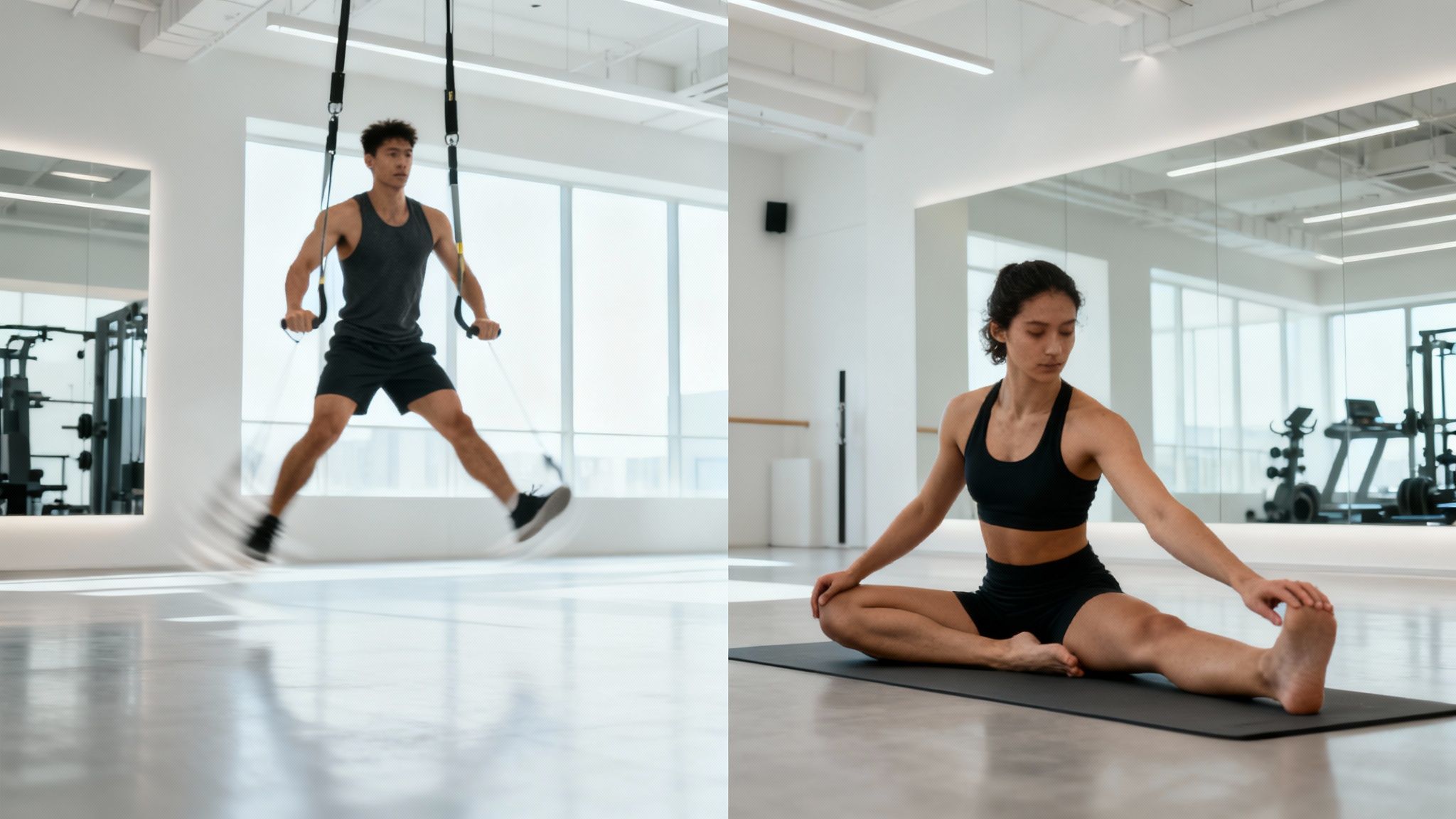
There has been a lot of controversy about when to stretch, how to stretch, and what kind of stretches to do for fitness health. When it comes to the dynamic stretching vs static stretching debate, the science is clear: dynamic stretching belongs before your workout, and static stretching is best saved for after . Getting this timing right is one of the simplest yet most effective things you can do to boost your performance and keep injuries at bay.Think of it as preparing your body for action versus helping it wind down and recover. Your Guide to Smarter Stretching This guide breaks down the science behind each stretching method, helping you use them to get fitter, prevent injuries, and speed up recovery. Index of Sections The Science of Dynamic Stretching for Performance Understanding Static Stretching for Recovery and Flexibility A Head-to-Head Comparison of Stretching Methods Putting Theory into Practice with Sample Routines Common Questions About Stretching References Dynamic vs Static: A Quick Overview Dynamic stretching is your body's "go" signal . It involves moving your joints and muscles through a full, controlled range of motion, like leg swings or arm circles. This gets the blood flowing, raises your muscle temperature, and wakes up your nervous system, priming it for action. You can find more detail in our guide on how to warm up before exercise for peak performance . Static stretching, on the other hand, is the classic "stretch and hold." This is your body's "relax" signal. By holding a stretch for 15-30 seconds, you encourage your muscles to lengthen and release tension. This is fantastic for improving long term flexibility and calming your nervous system after a tough session, making it a perfect fit for your cool down. The real takeaway is this: Dynamic stretching is all about preparation and activation . Static stretching is about relaxation and restoration . Using the right one at the right time is the secret. Quick Guide to Stretching Timing and Purpose This table gives you a quick look at when to use each method and what you'll get out of it. Stretching Type Primary Purpose Best Time to Perform Dynamic Stretching Prepares muscles for intense activity by increasing blood flow and activating the nervous system. Before Exercise (Warm-Up) Static Stretching Increases long-term flexibility and helps muscles recover by releasing post-workout tension. After Exercise (Cool-Down) By integrating this simple timing strategy, you start stretching with intent, strategically preparing your body for peak performance and setting it up for a faster, more effective recovery. Gangster Allergy Free Mixes The Science of Dynamic Stretching for Performance Dynamic stretching is a strategic way to prep your body for exercise. Unlike holding a stretch, it involves active, controlled movements through your full range of motion. This is about triggering specific physiological responses that prime you for performance. This process raises your core body temperature and ramps up blood flow to the muscles you're about to use. That increased circulation delivers oxygen and nutrients, making the muscle tissue more pliable and ready to work. Building effective dynamic warm-up routines is essential for hitting peak performance. Boosting Neuromuscular Activation The biggest advantage of dynamic stretching is its effect on your nervous system. Movements like leg swings or torso twists mimic your workout, a process called neuromuscular activation. By performing these movements, you send direct signals from your brain to your muscles, improving their ability to contract with force and speed. Dynamic stretching trains the neuromuscular system to fire more effectively. This improves coordination, reaction time, and power output, which are critical for most athletic endeavors. This pre-activation leads to measurable performance gains. For example, research has shown that dynamic stretching can improve maximal strength, sprint performance, and vertical jump height in athletes. How Dynamic Movements Improve Performance The performance boost from a dynamic warm-up comes from several key mechanisms working together. Here’s a quick look at what’s happening: Increased Muscle Temperature: Warm muscles are more elastic and less likely to tear. Dynamic movements generate heat, preparing muscle fibers for intense contraction. Synovial Fluid Production: Movement tells your joints to produce synovial fluid, their natural lubricant. This allows for smoother movement with less friction, improving mobility. Enhanced Proprioception: Proprioception is your body's awareness of its position in space. Dynamic stretches sharpen this sense, leading to better balance and coordination. By focusing on active preparation, dynamic stretching gets your entire system ready for powerful, coordinated action. This is why it's favored over static stretching before a workout. Understanding Static Stretching For Recovery And Flexibility While dynamic stretching primes you for action, static stretching is for your cool-down. It’s the classic "stretch and hold" method, where you lengthen a muscle for 15-30 seconds . The goal isn't to fire up your muscles, but to help them relax, release tension, and build flexibility over time. When you hold a stretch, sensory receptors in your muscle tendons called Golgi tendon organs (GTOs) are activated. They send a signal to your brain to tell the muscle to relax. This reflex, called autogenic inhibition, allows muscle fibers to lengthen safely. The Right Time And Place For Static Holds For decades, we were taught to do static stretches before a workout. We now know better. Science shows that holding a stretch can temporarily reduce a muscle's ability to generate power. That's why it’s a post workout tool, not a warm-up. Extensive research confirms this. A major review of over 100 studies found that pre-activity static stretching reduced maximal strength and power. Other studies showed slower sprint times and lower vertical jump height. These numbers make a strong case for saving static holds for after your session. It's all about calming your system, helping your muscles repair, and improving your long term range of motion. Maximizing Your Post Workout Recovery Done correctly after exercise, static stretching is a powerful recovery tool. It helps your body shift from the high stress state of a workout to a mode of rest and repair, which can ease delayed onset muscle soreness (DOMS). Think of static stretching as your body’s reset button. It signals that the hard work is over and recovery can begin, helping to reduce soreness and build lasting flexibility. For an even bigger recovery boost, you can pair static stretching with other methods. For example, using a sauna for sore muscles can enhance blood flow and deepen relaxation. Runners can find a dedicated routine in our guide on building a smarter post run stretching routine . A Head-to-Head Comparison of Stretching Methods Deciding between dynamic and static stretching isn’t about choosing a winner. It’s about knowing which tool to use and when. To settle the dynamic stretching vs static stretching debate, we must look at how each affects performance, flexibility, and injury risk. The biggest difference is their purpose. Dynamic stretching prepares the body for what’s to come. Static stretching helps restore the body after the work is done. Impact on Power and Speed For a before workout warm-up, dynamic stretching is the undisputed champion. Its active movements get blood flowing, raise muscle temperature, and fire up your neuromuscular system. The result is measurable improvements in strength, speed, and jump height. Static stretching, if done right before a workout, does the opposite. Holding a deep stretch triggers a relaxation reflex that temporarily dials down muscle stiffness and its ability to produce force. That’s why studies show a drop in power when athletes perform static stretches in their warm-up. Effects on Flexibility Static stretching is fantastic for improving passive flexibility, your ability to hold a stretched position. This is key for developing your overall long term range of motion. Dynamic stretching builds active flexibility, which is the range of motion you can use during an activity. It's functional and sport specific. Interestingly, research shows dynamic stretching is surprisingly effective at improving both types of flexibility. For example, you can explore the research on hamstring flexibility here . Nervous System Influence A critical difference is how each type of stretching "talks" to your nervous system. Dynamic stretching excites the nervous system. It increases alertness and sharpens the connection between your brain and muscles, leading to better coordination and quicker reactions. Static stretching calms the nervous system. It shifts you into a parasympathetic (rest and digest) state, making it perfect for your cool-down. The choice isn't about which stretch is "better," but which neurological signal you want to send. Dynamic stretching says "get ready to move," while static stretching says "it's time to relax and repair." Dynamic vs Static Stretching Key Differences and Applications This table breaks down the key distinctions and shows you where each method fits into your routine. Criterion Dynamic Stretching Static Stretching Primary Purpose Warm-up and performance preparation. Cool-down, recovery, and increasing passive flexibility. Timing Before exercise. After exercise. Movement Type Active, controlled, continuous movement. Passive, holding a single position for 15-30 seconds . Performance Impact Increases power, speed, and agility. Decreases power if performed before activity. Physiological Effect Increases heart rate, blood flow, and core temperature. Decreases muscle tension and promotes relaxation. Nervous System Excitatory – wakes up the central nervous system. Inhibitory – calms the central nervous system. Ideal Use Cases Pre-game for runners, weightlifters, team sports. Post workout cool-downs, yoga, improving general flexibility. An effective fitness plan makes room for both. Using dynamic stretching to prepare and static stretching to recover gives you the best of both worlds. Putting Theory into Practice with Sample Routines Knowing the theory is one thing, but applying it is what counts. Here are simple, effective routines you can start using today. The goal is always controlled movement and solid form. Five focused minutes can make a real difference. https://www.youtube.com/embed/ZJBprx7oWAM Your Go To 5-Minute Dynamic Warm-Up This sequence is a great all-rounder for running, lifting, or cross-training. Perform each movement for about 30-45 seconds , flowing smoothly from one to the next. Walking High Knees: Walk forward, driving one knee up toward your chest, then the other. Walking Lunges with a Twist: Step into a lunge and gently twist your torso over your front leg. Leg Swings (Forward and Sideways): Holding a support, swing one leg forward/back 10-15 times, then side-to-side. Arm Circles (Forward and Backward): Start with small circles and gradually increase their size. Torso Twists: Stand with feet shoulder-width apart and gently rotate your upper body side to side. A quick reminder: the point of a dynamic warm-up isn't to force a deep stretch. It’s about actively preparing your muscles. Keep the movements fluid and controlled. The Essential 5-Minute Static Cool-Down After you’ve worked out, it’s time to relax. This routine targets major muscle groups. Hold each stretch for 20-30 seconds , breathing deeply. Standing Hamstring Stretch: Prop your heel on a low bench. Keeping your leg straight, hinge at your hips and lean forward. Quad Stretch: Stand tall, holding a wall for balance. Grab your ankle and gently pull your heel toward your glute. Pigeon Pose: From a plank position, bring one knee forward toward the same-side wrist and sink down, extending the other leg behind you. Chest Stretch in Doorway: In a doorway, place your forearms on the frame. Step forward until you feel a stretch across your chest. These static holds are fantastic for calming your nervous system and can improve your range of motion over time. For more on functional movement, check out our guide on what mobility training is and how it can boost your performance . Exercise Mat Common Questions About Stretching Let's clear up a few finer points about stretching so you can apply these concepts safely and effectively. How Long Should I Hold A Static Stretch? For improving flexibility and aiding recovery, the sweet spot for a static stretch is 15-30 seconds . This is enough time to trigger the muscle's relaxation response. Holding a stretch past 60 seconds offers little extra benefit and may risk overstretching. Consistency is key; a daily 30-second hold post-workout is more effective than one long session per week. Can Dynamic Stretching Replace My Entire Warm-Up? No. Dynamic stretching is a crucial part of your warm-up, but not the whole thing. An effective warm-up starts with 5-10 minutes of light cardio (jogging, jumping jacks) to raise your core body temperature. Only then should you move into dynamic stretches to prime the specific joints and muscles for your workout. Is It Ever Okay to Do Static Stretching Before A Workout? While generally not recommended before activities requiring power or speed, there are exceptions. For disciplines like gymnastics or dance, brief static holds may be integrated into a warm-up. For the vast majority of gym-goers and athletes, dynamic stretching is the smarter choice. A very brief hold (under 15 seconds) on a tight muscle won't hurt, but it shouldn't be the focus of your pre-workout routine. References Herman, S. L., & Smith, D. T. (2008). Four-Week Dynamic Stretching Warm-up Intervention Elicits Longer-Term Performance Benefits. Journal of Strength and Conditioning Research , 22(4), 1286-1297. Behm, D. G., & Chaouachi, A. (2011). A review of the acute effects of static and dynamic stretching on performance. European Journal of Applied Physiology , 111(11), 2633–2651. Samson, M., Button, D. C., Chaouachi, A., & Behm, D. G. (2012). The acute effects of either static or dynamic stretching on athletic performance. Journal of Bodywork and Movement Therapies , 16(2), 223–234. O'Sullivan, K., McAuliffe, S., & DeBurca, N. (2012). The effects of eccentric training on lower limb flexibility: a systematic review. British Journal of Sports Medicine , 46(12), 838-845. Opplert, J., & Babault, N. (2018). Acute effects of dynamic and static stretching on hamstring flexibility in healthy, young adults. Journal of Sports Science & Medicine , 17(1), 87-92. At Flourish-Everyday , we believe that understanding the 'why' behind your training is just as important as the training itself. We provide the insights and gear recommendations you need to build a smarter, more effective fitness lifestyle. Find expert shoe reviews and health guidance to support every step of your journey at https://www.flourish-everyday.com .
- How to Run Better: Your Ultimate Guide to Smarter Running
Running better isn't just about logging more miles, it’s about running smarter. It boils down to a simple formula: refining your running form, sticking to a structured training plan, and committing to the strength and recovery work that builds a resilient and efficient body. This guide will walk you through exactly how to do that, backed by health information and expert insights. Index of Sections Your Blueprint for Smarter Running Master Your Form for Effortless Speed Build a Training Plan That Actually Works Your Essential Running Gear and Tech Unlock Performance with Smart Recovery Common Questions About Improving Your Running References Your Blueprint for Smarter Running Becoming a faster, stronger, and more resilient runner is an achievable goal for everyone, not just elite athletes. The secret isn't a magic workout or expensive gadget, it's the consistent application of a few core principles. If you are new to running, this article will help you get started and on your way to a healthy lifestyle. Think of this guide as your personal coaching session, designed to provide a clear, actionable roadmap. Whether you're aiming to finish your first 5K or shave minutes off your personal best, mastering the fundamentals is where it all begins. We'll break down the complex puzzle of how to run better into manageable pillars, packed with practical advice you can use on your next run. Quick Guide to Running Better This table provides a quick overview of the key areas that will make the biggest impact on your performance. Section Focus Key Takeaway Mastering Your Form Learn the biomechanics to run faster with less effort and lower your injury risk. Smarter Training Plans Structure your weekly runs to build speed and endurance without burning out. The Runner's Toolkit Choose the right shoes, gear, and tech to support your specific goals. Recovery & Injury Prevention Discover how rest and strength work are key to becoming a more resilient runner. By focusing on these key areas, you'll develop a well rounded approach that addresses every aspect of your performance. From foot strike to sleep quality, every detail plays a role. Master Your Form for Effortless Speed Great runners make it look easy because every movement is efficient. They eliminate wasted energy, and a huge part of that is proper form. Small tweaks to posture and muscle engagement can channel your effort directly into forward momentum. It starts with your core and hips. Aligning your hips and leaning slightly forward from the ankles, not your waist, uses gravity to your advantage, saving energy. A common energy waster is over striding, where your foot lands far in front of your body, acting like a brake. To fix over striding : Focus on lifting your knees, not reaching your feet forward. Ensure your feet land directly underneath your hips. Imagine pushing the ground away behind you. Posture and Core Alignment Good running posture is built on a strong, stable core. Gently tightening your abs and glutes supports your spine and keeps you upright. A helpful mental cue is to imagine a string gently pulling the top of your head upward. Maintaining a neutral pelvis prevents lower back arching or tucking, which can cause an inefficient, bouncy stride. Simply engaging your core properly can reduce unnecessary lateral motion, saving significant energy on a long run. Arm Swing and Cadence Your arms are critical for balance and driving your cadence (step rate). A powerful arm swing counterbalances the rotation from your legs. Keep your elbows bent at roughly a 90-degree angle and swing them straight forward and back, avoiding crossing your body's midline. A quicker arm swing leads to a quicker cadence, with most experienced runners aiming for 170-180 steps per minute. Key Running Form Adjustments and Their Benefits Focus on one cue at a time to build muscle memory without feeling overwhelmed. Common Form Flaw Corrective Action/Cue Performance Benefit Overstriding Land with your foot under your hip; think "drive the knee forward." Reduces braking force and significantly lowers injury risk. Excess Vertical Bounce Engage your core; maintain a slight forward lean from the ankles. Conserves energy by creating a smoother, more direct stride. Arm Crossover Keep elbows tucked in; swing arms from "hip to lip." Improves balance, reduces torso rotation, and supports a higher cadence. Weak Hip Drive Squeeze your glutes as you push off the ground. Generates more propulsive power with every single step. These principles contribute to improving performance. According to a 2024 analysis, marathon participation has returned to pre-pandemic levels, with average finish times improving by 1.9% , suggesting a greater focus on training efficiency is paying off [1]. For more detailed drills, see our guide on improving running form for speed and endurance . Build a Training Plan That Actually Works Simply running more isn't a strategy; it's a path to burnout. A structured plan, where every run has a purpose, is essential for improvement. Smart plans are built on progressive overload , gradually increasing demands on your body to foster adaptation without causing injury. The Key Ingredients of a Smart Plan An effective training plan includes a variety of run types to build comprehensive fitness. Easy Runs: The bulk of your weekly mileage, run at a conversational pace. They build your aerobic base, strengthen tissues, and aid recovery. Tempo Runs: "Comfortably hard" runs that improve your lactate threshold, allowing you to sustain a faster pace for longer. Interval Training: Short, intense bursts of running followed by recovery. Intervals boost top speed and improve running economy (oxygen efficiency). Listening to Your Body Is Nonnegotiable No plan should be rigid. The most critical skill for a runner is learning to listen to your body. Some days you can push harder; other days, a planned workout might need to become a recovery jog. A training plan is a guide, not a dictator. Your "why" also shapes your approach. Knowing your motivation, whether it's enjoyment or race training, helps you stay committed. A well structured plan is the foundation for improving speed and stamina. For more strategies, there are excellent resources on building endurance for running . Putting It All Together: A Sample Week A balanced schedule avoids stacking hard workouts, allowing for crucial recovery. Here is a flexible framework for an intermediate runner: Monday: Rest or Active Recovery (e.g., walking, stretching) Tuesday: Interval Training (e.g., 6 x 400m fast with recovery jogs) Wednesday: Easy Run (3-5 miles at a relaxed pace) Thursday: Tempo Run (e.g., 2-3 miles comfortably hard, with warm-up/cool-down) Friday: Easy Run or Cross-Training (e.g., swimming, cycling) Saturday: Long Run (at an easy pace to build endurance) Sunday: Rest or Active Recovery For race specific goals, a dedicated plan is ideal. Our intermediate 10K training plan to crush your personal record offers a structured approach to building speed and endurance simultaneously. Your Essential Running Gear and Tech While no gear does the work for you, the right tools can make every run more comfortable and effective. Think of your gear as a support system that enhances your training. Choosing Your Most Important Teammates: Your Shoes Your shoes are your most critical piece of equipment. The right pair supports your natural stride and cushions impact, while the wrong pair can lead to discomfort or injury. A gait analysis at a specialty running store can determine your foot mechanics (neutral, overpronation, or supination), which is crucial for selecting a shoe with the appropriate stability. Also, consider your primary running surface; road shoes are cushioned for pavement, while trail shoes offer grip and protection for off road terrain. Top Athletic Shoe Reviews Choosing the right shoe can be overwhelming. This comparison highlights top models for both men and women, categorized by their best use cases. Shoe Reviews for Men Shoe Model Best For Key Feature Category Hoka Clifton 9 Daily training, long runs Maximum cushioning, smooth ride Neutral Brooks Adrenaline GTS 23 Overpronators needing support GuideRails® stability technology Stability Saucony Endorphin Speed 3 Tempo runs, speed work Nylon plate for a propulsive feel Neutral/Performance New Balance Fresh Foam X 880v13 A reliable "workhorse" for any run Balanced cushioning, durable Neutral Shoe Reviews for Women Shoe Model Best For Key Feature Category On Cloudsurfer Daily training, recovery runs CloudTec Phase™ for soft landings Neutral ASICS GEL-Kayano 30 Overpronators, maximum stability 4D GUIDANCE SYSTEM™ Stability Nike Pegasus 41 Versatile daily trainer Responsive React foam, comfortable fit Neutral Altra Rivera 3 Natural foot-shape enthusiasts Balanced Cushioning™, FootShape™ fit Neutral/Zero-Drop Leveraging Tech to Train Smarter GPS watches and smartphone apps provide valuable data to track progress and train effectively. The goal isn't to obsess over numbers but to use key metrics like pace, heart rate, and cadence, to ensure your easy days are truly easy and your hard days are effectively hard. Modern wearables can track everything from sleep quality to training load, offering a holistic view of your fitness and recovery. Unlock Performance with Smart Recovery The key to improvement happens after the run, during recovery. Your body rebuilds and adapts during rest. Ignoring recovery leads to plateaus and injuries. Smart recovery is a proactive strategy to repair muscles, reduce inflammation, and prepare your body for the next workout. Pillars of Effective Post Run Recovery A consistent recovery routine is essential. Focus on these key areas for the best results. Nutrition and Hydration: Refuel with a mix of carbs and protein (a 3:1 or 4:1 ratio is ideal) within 30-60 minutes post run to restock energy and repair muscles. Rehydrate with water and electrolytes. Sleep: This is prime time for repair. During deep sleep, your body releases growth hormone, vital for healing tissue. Aim for 7-9 hours of quality sleep per night. Active Recovery: Gentle movement like walking or swimming on rest days increases blood flow to muscles, flushing out metabolic waste and speeding up the recovery process. Strength Training for a Resilient Body Strength training is one of the most effective injury prevention tools. It corrects muscular imbalances that lead to common running pains. Focus on the core, hips, and glutes. A strong core stabilizes your body, while strong hips and glutes power an efficient stride. Just two 20-30 minute strength sessions a week focusing on single leg exercises, core stability, and glute activation can dramatically reduce injury risk. Informative Health & Well being Information Overall health is crucial for performance. Foam rolling can ease muscle tightness, while managing nutrition is key. For example, addressing iron deficiency in runners is important, as low iron can cause fatigue and hinder performance [2]. Comparing well being trends, practices like mindfulness and meditation are gaining traction among athletes to improve focus and reduce stress, complementing physical recovery methods like cryotherapy or compression therapy. For a deeper dive into recovery techniques, explore our guide on top running recovery tips for peak performance . Common Questions About Improving Your Running Navigating running advice can be confusing. Here are answers to common questions from runners looking to improve. How Long Does It Take to See Running Improvement? Consistency is key. You'll likely feel a difference in endurance within two to three weeks of sticking to a plan. However, noticeable gains in speed and efficiency typically take 4 to 6 weeks of consistent, structured training as your aerobic capacity and muscular strength adapt. Sustainable progress comes from consistency, not intensity. Should I Focus on Speed or Distance First? For most runners, the answer is distance first . Build your aerobic base with easy paced runs before introducing high intensity. Jumping into speed work too early puts excessive stress on your body, increasing injury risk. Prioritizing easy miles strengthens your heart, lungs, and connective tissues. Once you can comfortably run for 30-45 minutes , you can gradually add speed work. What Is the Single Best Way to Prevent Common Running Injuries? While proper shoes are crucial, the most effective injury prevention strategy is incorporating strength training into your routine at least twice a week. Many common running pains, like runner's knee, stem from weak links in the kinetic chain, particularly the hips, glutes, and core. A stronger, more resilient body is better equipped to handle the repetitive impact of running. References [1] RunRepeat. (2024). The State of U.S. Marathons 2024 . RunRepeat . [2] Lola Health. (n.d.). Iron Deficiency In Runners . addressing iron deficiency in runners . At Flourish-Everyday , we know that finding the right gear is a foundational step in your running journey. We're here to help you navigate your options and find the perfect shoes to support your goals. Explore our expert reviews and recommendations at https://www.flourish-everyday.com .
- Ab Workout for Runners to Boost Speed and Prevent Injuries
A strong core isn't just about looking good; for a runner, it's the stable foundation that turns raw leg power into efficient, forward motion. It keeps your form intact when fatigue hits and helps you dodge injuries stride after stride. Ab Workout for Runners to Boost Speed and Prevent Injuries will help you think of your core as the chassis of your body, because when it’s solid, everything else works better. I have packed a lot of information in this brief article so please refer to it as you progress. Index: Why Core Strength Powers Every Stride Functional Ab Exercises for Runners Core Workout Routines for All Levels Integrate Core Training into Your Running Schedule Sprint Training for Core Development Shoe Reviews for Runners 6.1 Men’s Top Athletic Shoes 6.2 Women’s Top Athletic Shoes Well-Being Trends Comparison Got Questions About Core Workouts? References Why Core Strength Powers Every Stride Runners often think logging mileage is enough to get faster, but skipping core work is like dropping a powerful engine into a flimsy frame. A stable core keeps your pelvis and spine steady, letting arms and legs move with maximum efficiency. Weak core muscles lead to hip drop, excessive rotation, wasted energy, and a higher risk of injury. Just 2–3 core sessions per week, with 2–3 sets per exercise, plugs those energy leaks and builds resilience. At-a-Glance Benefits of Core Training for Runners Benefit Impact on Running Performance Improved Form Less torso rotation and hip drop, more efficient stride. Increased Power Better force transfer from legs through the torso. Enhanced Endurance Delays fatigue by minimizing stabilizing energy leaks. Greater Stability Improves balance on uneven terrain or during sprints. Reduced Injury Risk Decreases strain on lower back, hips, knees, and hamstrings. For more on injury prevention, check out how to prevent running injuries . Functional Ab Exercises for Runners Runners need a core that resists twists, prevents lower back arch, and stops side-to-side bending. Here are five exercises that mimic running mechanics: Plank With Leg Lift Setup : Forearm plank, elbows under shoulders, body in one line. Movement : Lift one leg ~6 inches, hold 2 seconds , switch. Tip : Squeeze the raised glute, no pelvis tilt. Bird-Dog Reach Start : On all fours. Action : Extend right arm + left leg, pause, switch. Tip : Keep ribs to hips, no arching. Russian Twist Position : Sit, knees bent, feet off ground, torso at 45°. Movement : Rotate from rib cage, tap floor each side. Tip : Engage obliques; add light weight to progress. Dead Bug Setup : Lying on back, arms up, knees bent at 90°. Execution : Lower opposite arm and leg near the floor, return. Cue : Exhale on descent. For more core variety, see Pilates exercises for core strength . Side Plank Form : Side lying, elbow under shoulder, feet stacked. Hold : Hips high, shoulders aligned. Progression : After 45–60s , add hip dips. Core Workout Routines for All Levels Consistency beats intensity. Better to do 10 solid minutes three times a week than one crushing 30 -minute session that leaves you sore. Beginner Flow: 10 Minutes Warm-Up : Cat-Cow (5–8 reps), pelvic tilts. Bird-Dog Reach: 10 reps/side Dead Bug: 10 reps/side Forearm Plank: 30s Glute Bridges: 15 repsRest 60s, repeat once. Intermediate Circuit: 15 Minutes Warm-Up : Spiderman lunges, leg swings. Plank with Leg Lift: 8 reps/side Russian Twist: 12 reps/side Side Plank: 30s/side Mountain Climbers: 30sRest 45s between, 2 rounds. Advanced Sequence: 20 Minutes Warm-Up : Inchworms, high knees. Plank Pull-Throughs: 8 reps/side Hanging Knee Raises: 12 reps (or reverse crunches) Side Plank with Hip Dip: 12 reps/side V-Ups: 15 repsRest 30–45s, 3 rounds. After 8 weeks, college runners saw improved economy and lower oxygen consumption at high intensity[^1]. Sample Core Workout Progression Level Duration Focus Example Exercises Beginner 10 min Foundational Stability Dead Bug, Forearm Plank Intermediate 15 min Dynamic Control & Endurance Russian Twist, Side Plank Advanced 20 min Strength & Power Transfer Plank Pull-Throughs, V-Ups Integrate Core Training into Your Running Schedule Core sessions work best after easy runs or on cross-training days. Avoid heavy core work before key speed or long runs. Scheduling Options: Post-Run Core (10–20m): 2–3×/week after easy runs. Dedicated Day : Longer session on non-running day. Example Week (3-Day Runner): Mon: Easy Run + 15m CoreTue: Cross-TrainingWed: TempoThu: RestFri: Easy Run + 15m CoreSat: Long RunSun: Active Recovery Sprint Training for Core Development Sprints fire up your core like nothing else. Each stride becomes a ballistic brace, engaging upper and lower abs. A simple sprint session once a week delivers hundreds of contractions. Simple Sprint Workout: Reps: 4–6 Distance: 20–40 m Intensity: 90–95% max Recovery: Walk back, full rest For supplement insights, see Creatine for Endurance Athletes to Unlock Faster Runs . Shoe Reviews for Runners Choosing the right shoe supports your core and reduces injury risk. Here are top picks for men and women. Men’s Top Athletic Shoes Nike Air Zoom Pegasus - Responsive cushioning, moderate stability, durable outsole. Ideal for daily runs and tempo workouts. Brooks Ghost - Soft midsole, balanced support, smooth transitions. Great for long distances and easy runs. ASICS Gel-Cumulus - Gel tech for shock absorption, breathable mesh upper. Best for versatile training and recovery days. Women’s Top Athletic Shoes New Balance Fresh Foam 880 - Plush Fresh Foam midsole, secure fit, rubber outsole. Perfect for marathons and long training runs. Saucony Ride - PWRRUN cushioning, flexible sole, snug heel. Excellent for speed work and tempo sessions. Hoka Clifton - Maximal cushioning, lightweight design, early stage meta rocker. Ideal for high mileage and recovery runs. Well Being Trends Comparison Here's how popular methods stack up for runners’ health and recovery. Trend Focus Benefits Considerations Core Strength Routines Functional stability Improves economy, reduces injury risk Requires consistency Pilates & Yoga Flexibility & control Enhances posture, mobility, mind-body May lack direct running specificity Foam Rolling & Massage Recovery Reduces muscle soreness, improves flow Temporary relief without strength work Questions About Core Workouts. How Often Should I Do This? Aim for 2–3 core sessions per week, 15–20 minutes each, preferably after easy runs. Does This Replace Strength Training? No. Core work builds the stabilizing chassis; full strength training targets glutes, quads, and hamstrings. What If I Feel It in My Lower Back? Back strain means deep core muscles are off. Regress the exercise—e.g., knee plank or smaller Dead Bug movements. How Do I Track Progress? Hold Time : Log plank/side plank durations. Reps/Sets : Add reps or sets once form is perfect. Exercise Progression : Use bands or weights for bird-dogs and twists. At Flourish-Everyday , we believe that a strong, informed approach to fitness is the key to unlocking your potential. Find more shoe reviews and health information at https://www.flourish-everyday.com . References [^1]: Research on college runners: https://pmc.ncbi.nlm.nih.gov/articles/PMC6407754/ [^2]: Pilates exercises for core strength: https://wundacore.com/blogs/news/pilates-exercises-for-core-strength [^3]: How to prevent running injuries: https://www.flourish-everyday.com/post/how-to-prevent-running-injuries-top-tips-for-safe-running [^4]: Strength training for distance runners: https://www.flourish-everyday.com/post/strength-training-for-distance-runners-boost-your-pace [^5]: Creatine for endurance athletes: https://www.crazymuscle.com/blogs/fitness/creatine-for-endurance-athletes
- How to Breathe While Running for Better Endurance
Learning how to breathe while running properly is foundational to improving your performance. I have talked to many runners who experiment with what state of mind they should be in while running. Some distance runners have tried to put their mind into a "sleep state" while running, while others put themselves into a trance and let their bodies work autonomously. The most crucial technique while running is diaphragmatic breathing , also known as belly breathing. I personally disagree with this descriptor because it conjures visions of your stomach filling up with air, expanding, and then being released in the exhale. A better way to think of it is the controlled expansion of the lungs regulated by the diaphragm. Diaphragmatic breathing uses your diaphragm muscle to pull air deep into your lungs, maximizing oxygen intake. It is far more efficient than shallow chest breathing, fueling your muscles more effectively, boosting endurance, and helping to prevent common issues like side stitches. Index of Sections The Foundation of Effortless Running Breathwork Finding Your Cadence by Syncing Breath to Stride Nose vs Mouth Breathing for Runners Troubleshooting Common Breathing Problems Mid Run Common Questions About Breathing and Running References The Foundation of Effortless Running Breathwork Your running potential isn't just in your legs, a huge part of it is in your lungs. Many runners inadvertently rely on shallow, inefficient chest breathing. This common mistake restricts oxygen and leads to premature fatigue. The key to unlocking better endurance is mastering a more powerful breathing technique. This is a fundamental shift from breathing with your chest to breathing from your belly. Chest breathing only fills the top portion of your lungs. Diaphragmatic breathing, however, utilizes the full capacity of your lungs. This sends more oxygen rich blood to your working muscles, making running feel easier and setting the stage for more advanced breathing strategies. You can find more tips on this in our guide to breathing during exercise for better performance . Understanding the Mechanics Your diaphragm is a large, dome shaped muscle at the base of your lungs. When you inhale correctly, it contracts and flattens, creating a vacuum that pulls air deep into your lungs, causing your belly to expand. As you exhale, the diaphragm relaxes, pushing air out. This is the most efficient way to breathe and is the standard for high performing athletes. One study found that 55.07% of athletes use diaphragmatic breathing and have significantly better lung function than chest breathers, linking diaphragmatic breathing directly to superior respiratory efficiency. Here's a quick look at why this matters for runners. Breathing Styles Compared Thoracic vs Diaphragmatic Feature Thoracic (Chest) Breathing Diaphragmatic (Belly) Breathing Primary Muscles Used Neck, shoulders, upper chest Diaphragm, abdominal muscles Oxygen Intake Low to moderate High (Maximal) Energy Efficiency Inefficient; wastes energy Highly efficient Effect on Body Increases tension, promotes fatigue Promotes relaxation, improves endurance Best For Resting or very light activity Running and all strenuous exercise The table makes it obvious: for running, diaphragmatic breathing is the superior choice. Key Takeaway: The single most important step to better running breath work is transitioning from shallow chest breathing to deep belly breathing. It's the difference between merely surviving your run and controlling it. How to Practice Diaphragmatic Breathing You can build this new habit at home with a simple exercise to develop muscle memory. Lie flat on your back with your knees bent and feet on the floor. Place one hand on your upper chest and the other on your belly, just below your rib cage. Breathe in slowly through your nose for two counts. Focus on feeling your belly rise while the hand on your chest remains relatively still. Exhale slowly through your mouth for two or three seconds, tightening your abs as your belly falls. Practicing this for five to ten minutes daily will help make diaphragmatic breathing your new default. Finding Your Cadence by Syncing Breath to Stride A great run often feels rhythmic, and your breath is the metronome that sets that pace. After mastering diaphragmatic breathing , the next step is to sync your breath with your footfalls. This creates a stable, efficient cadence that feels smooth and controlled. This synchronization creates a predictable, powerful pattern that enhances performance and helps prevent injuries. Erratic breathing leads to tension and inefficiency, while a synced breath to stride pattern brings calm and control, even during tough efforts. The Power of Rhythmic Breathing Patterns Rhythmic breathing, which uses specific stride to breath patterns (e.g., inhaling for three steps, exhaling for two), is an excellent way to achieve this synchronization. A key benefit is that it helps spread impact forces evenly across both sides of your body. By alternating which foot lands on an exhale, you can reduce injury risk and prevent side stitches. The infographic below illustrates the diaphragmatic technique that powers these rhythms. This simple flow, inhaling to expand the belly and exhaling as it falls, is the foundation for practicing rhythmic patterns effectively. Finding Your Ideal Running Rhythm The pattern you choose depends on your effort level. The goal is to find a rhythm that feels sustainable for your pace. Here are two common patterns: The 3:2 Pattern (Easy Pace): Inhale for three steps (right-left-right) and exhale for two steps (left-right). This five step cycle is ideal for warm-ups, cool-downs, and easy runs, ensuring you land on a different foot at the start of each exhale to balance impact. The 2:1 Pattern (Hard Pace): Inhale for two steps (right-left) and exhale for one step (right). This quicker, three-step cycle is for tempo runs, intervals, or races when your body demands more oxygen. Pro Tip: Initially, focus on the count ("In-2-3, Out-2") rather than specific footfalls. With practice, the rhythm will become automatic. Consciously counting your steps and breaths may feel mechanical at first, but with persistence, it will become second nature. This synchronization works in tandem with your running mechanics. For more on that connection, see our guide on how to improve running form for better speed and endurance . A strong core is also vital, providing a stable platform for your diaphragm. Find exercises in our guide to 5 essential core strengthening exercises for runners . Nose vs Mouth Breathing for Runners The nose versus mouth breathing debate isn't an either/or situation. The skill is learning when to use each to match your effort. Think of your nose as the low gear for easy cruising and your mouth as the high performance gear for speed. The Case for Nasal Breathing For easy runs, warm-ups, and cool-downs, breathing through your nose is ideal. Your nasal passages act as a natural filtration system. Here’s why it’s effective: It warms and humidifies air: This makes it easier for your respiratory system to handle cold, dry air. It filters out pollutants: Your nose traps dust and pollen before they reach your lungs. It promotes a calmer state: Nasal breathing activates the parasympathetic nervous system, helping to keep your heart rate lower and your body relaxed. This method encourages deep diaphragmatic breathing, perfect for building your aerobic base. By practicing nasal breathing on easy runs, you’re actually training your body to use oxygen more efficiently. That pays huge dividends when you need to push hard later on. When Mouth Breathing Becomes Essential When you increase your pace during a tempo run or race, your muscles will demand more oxygen than your nose can supply. This is the time to open your mouth. Breathing through your mouth is about volume, it’s the fastest way to get a large amount of air into your lungs. Elite runners don't finish races with their mouths closed. At high intensity, your body's priority is maximizing oxygen intake and carbon dioxide expulsion. Forcing nasal breathing at this point will only create an oxygen debt. A Practical Blended Approach The smartest strategy is a blended one that adapts to your intensity. Here’s a simple breakdown: Easy Pace: Inhale and exhale through your nose. Moderate Pace: Inhale through the nose, exhale through the mouth. Hard Pace: Inhale and exhale through both your nose and mouth. Listen to your body. The need for more air is the clearest signal to open your mouth. Troubleshooting Common Breathing Problems Mid Run Even with proper technique, issues like side stitches or breathlessness can occur. These are common running experiences, and knowing how to manage them in the moment is key. Taming the Infamous Side Stitch A side stitch is a sharp, stabbing pain under the rib cage, often linked to a spasming diaphragm from shallow breathing. When you feel one coming on, take action: Breathe Against Your Stride: Exhale forcefully through pursed lips each time the foot on the opposite side of the pain hits the ground. This helps relax the diaphragm. Go Back to Your Diaphragm: Slow down slightly and refocus on deep belly breathing. Apply Some Pressure: Gently press into the sore area, bend forward slightly, and try to breathe deeply into your hand. These actions can often relieve the spasm in under a minute. Don't let a side stitch end your run. It's usually just your body’s signal to slow down and refocus on deep, controlled diaphragmatic breathing. Adjust, don't quit. Managing Sudden Breathlessness Feeling suddenly out of air can happen when your breathing rate becomes chaotic and out of sync with your body's needs. This is a loss of rhythm, not a lack of oxygen. Immediate Recovery Actions When breathlessness hits, reset. Slow to a walk or stop. Hands on Knees: Bend forward and place your hands on your knees with your elbows straight. Round Your Back: Let your upper spine curve, giving your diaphragm more room. Reset Your Breath: Take a long, slow inhale through your nose, followed by a complete exhale through your mouth. Continue until your breathing calms, then ease back into a slow jog, focusing on a steady breath pattern. Common Questions About Breathing and Running Let's address some frequent questions runners have about breathing. Is It Better to Breathe Through My Nose or Mouth? The short answer is both. Use what works for your effort level. For easy runs, nose breathing is great. For faster paces, you'll need to use your mouth to get enough air. A common technique for moderate efforts is inhaling through the nose and exhaling through the mouth. How Can I Stop Getting Side Stitches So Often? Side stitches are often caused by a spasming diaphragm. When you feel one, try exhaling hard as the foot on the opposite side of the stitch hits the ground. You can also apply gentle pressure to the area and slow down to focus on deep belly breaths. Why Do I Feel So Out of Breath at the Start of My Run? Feeling winded in the first few minutes is common. Your body needs time to adjust from a resting state to the demands of running. A proper warm-up, including brisk walking or dynamic stretches, can help make this transition smoother. What Is the Best Breathing Cadence for a Race? This depends on the race distance and your intensity. Longer Races (Half & Full Marathon): A sustainable 3:2 (inhale for three steps, exhale for two) or 2:2 rhythm is effective. Shorter, Faster Races (5K & 10K): A faster 2:1 pattern (inhale for two steps, exhale for one) helps meet higher oxygen demands. Can My Running Posture Affect My Breathing? Absolutely. Slouching constricts your chest cavity and restricts your diaphragm. Run tall, with your shoulders relaxed and back, and your gaze forward. This opens up your chest, allowing your lungs to expand fully, which is a critical component of learning how to breathe while running. At Flourish-Everyday , we provide the insights and gear recommendations you need to run stronger and feel your best. Explore our expert reviews and health guides to support every step of your fitness journey. Find everything you need at https://www.flourish-everyday.com . References Dimitriadis, Z., Kapreli, E., Strimpakos, N., & Oldham, J. (2024). Respiratory pattern and chest wall mobility in athletes and non-athletes. Scientific Reports , 14, 1373. https://doi.org/10.1038/s41598-024-51758-5 Flourish-Everyday. (n.d.-a). 5 essential core strengthening exercises for runners . Retrieved from https://www.flourish-everyday.com/post/5-essential-core-strengthening-exercises-for-runners Flourish-Everyday. (n.d.-b). How to breathe during exercise for better performance . Retrieved from https://www.flourish-everyday.com/post/how-to-breathe-during-exercise-for-better-performance Flourish-Everyday. (n.d.-c). How to improve running form for better speed and endurance . Retrieved from https://www.flourish-everyday.com/post/how-to-improve-running-form-for-better-speed-endurance Kovacs, T., Pinter, M., & Toth, L. (2022). Do Rhythmic Breathing and Abdominal-Wall Muscle Co-Contraction Reduce Impact Forces and Muscular Strain During Running? Biology , 11(4), 580. https://doi.org/10.3390/biology11040580
- The Best Shoes with Ankle Support
When you hear "shoes with ankle support," you might picture bulky, high top boots. But there's a lot more to it. True support comes from specific design features, like a solid heel counter , a stable midsole, and a snug upper, that work together to prevent excessive side to side movement of your ankle. The best shoes with ankle support aren't just for elite athletes. They're a very important for anyone recovering from an injury or just looking for better stability and comfort in their daily life. Think of the right pair as the foundation for your entire body, helping to reduce strain and keep everything properly aligned. This guide is here to walk you through it all, explaining what really makes a shoe supportive and moving past the old myth that only high tops do the job. Table of Contents The Science Behind Supportive Footwear Who Needs Ankle Support and Why It Matters Top Athletic Shoes with Ankle Support How to Find Your Perfect Supportive Shoe Caring for Your Supportive Footwear Frequently Asked Questions References Ankle Braces Your Foundation for Stability and Comfort Finding the perfect pair of supportive shoes can feel overwhelming, but it's one of the best investments you can make for your health and mobility. Proper footwear is the bedrock of any physical activity and even just getting through your day. It’s your first line of defense against common injuries like sprains and strains, especially if you have an active lifestyle or your joints are already a bit unstable. A well crafted shoe not only cushions your feet, but also absorbs impact and supports proper alignment, thereby preventing a cascade of pain that can extend to your knees, hips, and back. Choosing the right shoe isn't just about comfort; it's a proactive decision to protect your joints, enhance performance, and support your overall well being. Think of it as building a stable foundation from the ground up. The Science Behind Supportive Footwear To find the right shoes with ankle support, you have to look past the marketing hype and get down to how a shoe is actually built. The secret isn't one flashy feature, but a whole system of parts working in harmony to manage motion, absorb impact, and lock your foot in place. Think of it as a team effort, starting from the ground up. The Foundation of Support Ankle stability starts right at the bottom of the shoe. The outsole is that tough rubber layer hitting the pavement, giving you traction. But the real workhorse for support is the midsole , which is the foam or gel layer sitting between the outsole and your foot. A good midsole does two critical things: it cushions you from impact and stops the shoe from twisting too much. The Key Structural Elements Beyond that foundation, a few key design features are specifically engineered to hold your foot and prevent lateral rolling that leads to ankle sprains. The Heel Counter: This is the firm, cup like piece built into the back of the shoe that cradles your heel. A stiff heel counter is nonnegotiable for real ankle support because it stops your heel from sliding around. Collar Height and Padding: While a high top offers a sense of security, it’s the combination of height and smart padding that makes the difference. Padded collars help lock your ankle in and reduce friction. Lacing Systems: A solid lacing system is like a harness. It spreads pressure evenly across the top of your foot, holding it snugly against the shoe's supportive base. A shoe's ability to support your ankle is a direct result of its structural integrity. Features like a firm heel counter, a stable midsole, and a secure upper are far more important than just collar height. This growing understanding of how our feet work has led to some major advancements in footwear. The orthopedic footwear market, which is all about shoes with ankle support , was valued at around USD 3.48 billion and is expected to blow past USD 9.13 billion by 2035 (1). This boom is happening because more people realize how proper footwear can help manage issues like plantar fasciitis and arthritis. You can explore more details on the orthopedic shoe market's growth and trends . Who Needs Ankle Support and Why It Matters While it’s good to know the nuts and bolts of shoe design, what really matters is figuring out who actually benefits from all this technology. Your need for ankle support comes down to your activities, your body's unique mechanics, and your overall health. Certain activities and conditions put unexpected stress on your ankles, and that’s when a supportive shoe becomes absolutely nessecary. Athletes in High Impact Sports Athletes are the most obvious group. Any sport that involves quick stops, sharp turns, jumping, or navigating tricky surfaces puts a massive strain on the ankle joint. Basketball and Court Sports: These athletes are constantly cutting, pivoting, and landing from high jumps. A shoe with a rock solid heel counter and a secure lacing system is crucial. Trail Running and Hiking: On a trail, you’re dealing with rocks, roots, and uneven slopes. Good ankle support here acts as a stabilizer, preventing a nasty twist or sprain. Cross-Training and HIIT: These workouts blend weightlifting, explosive jumps, and cardio. You need a shoe that provides a stable foundation for lifting but also locks your foot in place for dynamic movements. Individuals with Health and Medical Needs Ankle support isn't just for the gym. For many people, it’s a daily tool for managing chronic conditions or recovering from an injury. Here, the focus shifts from performance to pain reduction and preventing further damage. The shoe provides the external stability that the body might be lacking internally. For example, anyone dealing with tendonitis knows that limiting excessive joint movement is key. The right footwear can be a essential for long term relief. If that sounds like you, check out our guide on the best shoes for tendonitis for lasting pain relief . Support isn't just for preventing an initial injury; it's a crucial component of rehabilitation and managing long term joint health, allowing for confident, pain free movement. Support During Recovery and Rehabilitation If you're coming back from an injury or surgery, your ankle is in a vulnerable state. A supportive shoe acts like a temporary brace, preventing dangerous movements while allowing the controlled motion needed for proper healing. This need has created a huge market for specialized footwear. In 2021, the worldwide post operative shoe market was valued at USD 634.5 million , and it is projected to rise to USD 1.1 billion by 2031 (2). This growth reflects a genuine demand for effective and comfortable recovery footwear, not just a passing trend. Ankle Support Needs by Activity and Condition Activity/Condition Required Support Level Key Shoe Features to Look For Trail Running/Hiking High High cut collar, aggressive outsole for grip, rigid heel counter, rock plate. Basketball/Tennis High Mid to high collar, strong lateral support, secure lacing systems, flat outsole. CrossFit/HIIT Moderate to High Stable, flat heel for lifting; flexible forefoot for dynamic moves; durable upper. Road Running Low to Moderate Focus on midsole stability (pronation control); secure heel fit; breathable upper. Weightlifting High (Stability) Hard, non-compressible sole; minimal cushioning; midfoot strap for lockdown. Chronic Ankle Instability High Firm heel counter, supportive midsole, structured upper, often a higher collar. Post-Injury Rehab Very High Often a prescribed medical boot or shoe with maximum motion control features. General Walking/Daily Wear Low to Moderate Good arch support, cushioned midsole, comfortable heel counter. Ultimately, picking the right shoe is about finding your personal balance between stability and flexibility for your specific activity. Top Athletic Shoes with Ankle Support Let's turn technical talk into a real world shopping list. Knowing which brands deliver on stability promises is half the battle. Some models have built a solid reputation for providing serious ankle support. We'll look at top picks for both men and women, connecting their designs to the core ideas of stability. Top Picks for Men Finding the perfect men’s shoe with ankle support is about matching its build to your main activity. For Hiking and Trail Running - Salomon X Ultra 4 GTX : This shoe is a workhorse on tricky ground. Its Advanced Chassis™ technology provides incredible lateral stability to prevent ankle rolls. The high cut version adds another layer of mechanical support around the ankle joint. For Basketball - Adidas Dame 8 : Built for explosive, lateral movements, the Dame 8 has a beefy internal heel counter and a unique lacing system that locks your foot down. Its Bounce Pro midsole is cushioned but responsive, creating a solid platform for quick cuts. For Cross-Training - Brooks Adrenaline GTS 23 : While famous as a running shoe, the Adrenaline GTS 23 is a fantastic cross-training option because of its GuideRails® support system . This tech helps keep your foot, knee, and hip in proper alignment during varied movements. You can see more in our full Brooks Adrenaline GTS 23 CrossFit training shoe review . The best athletic shoe is one where every component works together. A supportive midsole is only effective if the lacing system and heel counter lock your foot onto that stable base. Top Picks for Women Women's athletic shoes are engineered differently to account for biomechanical variations. The best supportive options provide stability without sacrificing a comfortable fit. For Hiking and Trail Running - Merrell Moab 3 Mid Waterproof : A fan favorite, the Moab offers great comfort and support. Its molded nylon arch shank adds midfoot rigidity, while the deep heel cup and supportive footbed prevent sliding. The mid height collar offers gentle reinforcement. For Court Sports - ASICS Gel-Resolution 9 : A powerhouse for tennis and pickleball, this shoe is all about lateral stability. The DYNAWALL™ technology in the midsole extends to the heel, enhancing support during lateral shuffles for a locked in feel. For Road Running - Hoka Arahi 7 : For runners needing more stability, the Arahi 7 uses Hoka's J-Frame™ technology . This feature uses firmer foam on the inside edge to gently guide your foot, correcting pronation without stiff posts, resulting in a supportive yet lightweight ride. How to Find Your Perfect Supportive Shoe Knowing a shoe's specs is one thing, but testing its quality yourself is key. With a few simple checks, you can tell a lot about a shoe’s structural integrity in the store. A proper fit is just as important as the shoe's built in features, even the best tech is useless if your foot is sliding around inside. Put the Shoe to the Test Before you even slip a shoe on, give it these two quick physical tests. The Heel Counter Squeeze: Pinch the very back of the shoe at the heel. A shoe with solid ankle support will have a firm, rigid heel counter that barely gives. If it collapses easily, it won't provide the needed stability. The Flexion and Torsion Test: Grab the shoe by the heel and toe and try to bend it. A good shoe should only bend at the ball of the foot. Next, try to twist it like you're wringing out a towel. It should resist this motion; if it twists too easily, the midsole lacks stability. Achieving the Perfect Fit Once a shoe passes those structural tests, it’s time to dial in the fit. A poor fit can lead to blisters and instability. For a deeper dive, check out our expert guide on how to choose running shoes . Follow these steps to lock in that perfect fit: Mind the Gap: Ensure there’s about a thumb's width of space ( approximately half an inch ) between your longest toe and the end of the shoe. Check for Heel Slippage: Lace up the shoes snugly and walk around. Your heel should feel securely locked in with minimal slipping. Wiggle Your Toes: The toe box needs to be wide enough for you to wiggle your toes freely. A shoe's support system is only as effective as its fit. A perfectly engineered shoe is compromised if your foot isn't properly secured, turning supportive features into points of friction and discomfort. Sometimes, even the best shoes aren't quite enough. The global market for foot and ankle braces was valued at USD 4.65 billion and is expected to hit USD 8.32 billion by 2030 (3), which shows just how many people rely on extra stability. These braces often work alongside supportive shoes to manage chronic conditions. Caring for Your Supportive Footwear Investing in supportive shoes is a great start, but keeping them in top shape ensures they keep protecting you. Regular maintenance helps supportive materials last as long as possible. A few simple habits can go a long way. After use, pull the insoles out and let everything air out. When cleaning, avoid harsh chemicals and washing machines. A soft brush with mild soap and water is all you need. Let them air dry naturally, away from direct heat. Allergy Free Mixes Knowing When It's Time for a New Pair Even the best cared for shoes don't last forever. The foam and other materials that give you stability and cushioning wear out over time. Pushing a worn out pair too far can do more harm than good. Keep an eye out for these signs that your shoes are ready for retirement: Midsole Wrinkles: Deep creases on the sides of the foam midsole are a classic sign it's lost its support. Uneven Tread Wear: Bald spots on the bottom, especially in an uneven pattern, mean wear is affecting your stability. Loss of Torsion Control: If the shoe twists much more easily than when new, the internal support has broken down. As a general rule, replace athletic shoes every 300-500 miles . However, a quick visual inspection is your best bet. A shoe that has lost its structure isn't an asset anymore, it's a liability. Frequently Asked Questions When you start digging into supportive footwear, a few common questions always seem to pop up. Let's tackle some of the biggest ones. Will Supportive Shoes Make My Ankles Weaker? This is a common concern. The fear is that relying on a shoe for support will cause muscles to weaken. However, a supportive shoe acts more like a seatbelt than a crutch. It’s there to prevent a catastrophic movement, like an ankle roll, not to replace muscle function. The goal is to prevent an injury that could take you out of the game entirely. The key is balance. Use supportive shoes for high impact activities, but also actively strengthen your ankles with exercises like calf raises, ankle circles, and single leg balancing. Do High Tops Automatically Mean More Support? It’s a common myth that a shoe climbing up your ankle must be more supportive. While a high top can provide a sense of security, collar height is only one part of the equation. A shoe's real support comes from its underlying structure, not how high the collar is. A well built low top with a rock solid heel counter and a stable midsole will absolutely outperform a flimsy, floppy high top every single time. Focus on the features that do the heavy lifting: a firm heel counter, a stable midsole, and a secure lacing system. How Often Should I Replace My Shoes? Even the toughest shoes don't last forever. The foam and structural materials break down with every step. A good rule of thumb for athletic shoes is to replace them every 300-500 miles , but your eyes are often the best judge. Look for creased midsoles, bald outsoles, and a floppy overall structure. Pushing shoes past their expiration date is an easy way to get an injury. References Precedence Research. (n.d.). Orthopedic Shoes Market (By Product: Flatfoot Shoes, Cavus Shoes, Others; By Indication: Diabetes, Arthritis, Plantar Fasciitis, Bunions, Others; By Distribution Channel: Specialty Stores, Departmental Stores, Online Stores; By End-user: Adults, Pediatrics) - Global Industry Analysis, Size, Share, Growth, Trends, Regional Outlook, and Forecast 2024-2035 . Retrieved from https://www.precedenceresearch.com/orthopedic-shoes-market Allied Market Research. (2022). Post-Op Shoe Market by Product Type (Adjustable, Fixed), by End User (Hospitals, Specialty Clinics, Others): Global Opportunity Analysis and Industry Forecast, 2021-2031 . Retrieved from https://www.alliedmarketresearch.com/post-op-shoe-market-A16921 Transparency Market Research. (2023). Foot and Ankle Braces Market (Product: Hinged Braces, Rigid Braces, Soft Braces; Application: Plantar Fasciitis, Gout, Bunion, Others; Distribution Channel: Hospital Pharmacies, Retail Pharmacies, Online Stores) - Global Industry Analysis, Size, Share, Growth, Trends, and Forecast, 2022-2030 . Retrieved from https://www.transparencymarketresearch.com/foot-ankle-braces-market.html At Flourish-Everyday , we believe the right footwear is the foundation of a healthy, active lifestyle. Explore our expert reviews and wellness guides to find the perfect pair of supportive shoes for your fitness journey. Visit us at https://www.flourish-everyday.com to take advantage of the item savings.
- How to Improve Hip Flexibility and Unlock Movement
If you want to improve your hip flexibility, you'll need more than just a few random stretches. The key is a smart mix of static stretches, dynamic mobility work, and a few lifestyle tweaks to undo the damage of sitting too much. This approach is all about releasing that deep seated tension, getting your joints moving like they're supposed to, and building a solid foundation for every move you make. In This Guide: Why Hip Flexibility Is Your Secret Weapon Essential Stretches to Unlock Your Hips Building Your Daily Hip Flexibility Routine Go Beyond Stretching with Dynamic Mobility Common Hip Stretching Mistakes to Avoid Frequently Asked Questions About Hip Flexibility References Why Hip Flexibility Is Your Secret Weapon Let's be honest, most people write off stiff hips as just a minor inconvenience. Something only yoga gurus or serious athletes need to worry about, right? But that tightness is a sneaky barrier holding you back, affecting everything from how you feel at your desk to whether you can climb a flight of stairs without a groan. It’s a quiet saboteur that undermines your body’s entire foundation. When your hips are locked up, your body finds a way to compensate, and that's where the real trouble starts. This can kick off a whole chain of problems you might not even realize are connected to your hips. Nagging Lower Back Pain: When your hip flexors are tight, they tug your pelvis forward. This creates an unnatural curve in your lower back that often leads to a constant, dull ache. Poor Posture: It’s tough to stand up straight when tight hip muscles are constantly pulling you into a slouch. Your body is fighting a losing battle just to stay upright. Less Power and Stability: Your hips are the engine for powerful movements like walking, running, and jumping. If they can’t move freely, your performance tanks and you become less stable on your feet. The Connection to Longevity and Health Beyond the daily aches, your overall flexibility plays a bigger role in your long-term health than you might think. One fascinating study that followed people for nearly three decades found that those with better flexibility, hips included, had a much higher survival rate from natural causes over a 13-year follow up. This suggests that working on your hip mobility isn't just for today, it's an investment in healthier aging. You can read more about the study's findings on flexibility and longevity yourself. What this really drives home is that hip flexibility isn’t a luxury. It’s a fundamental piece of having a healthy, functional body that can carry you through life for years to come. Your Path to Better Movement Just understanding the "why" is a huge first step. For runners, especially, poor hip mobility is a fast track to inefficient form and injury. If you're looking to keep your joints happy on the road, be sure to check out our guide on how to prevent running injuries with top tips for safe running . This isn't just a list of exercises; it's a game plan to help you get back in control, move with more freedom, and build a stronger, more resilient body for whatever life throws at you. Essential Stretches to Unlock Your Hips Alright, let's move from theory to action. Knowing why your hips are tight is one thing, but knowing how to improve your hip flexibility comes down to getting on the floor and doing the work. This isn’t about forcing yourself into a pretzel, it's about mindfully releasing the key muscles that are holding your hips captive. We're going to focus on a few cornerstone stretches that I've seen deliver real results for myself and my clients. With each one, you're looking for a gentle, productive tension, never a sharp or shooting pain. Remember, consistency is king. A little bit every day goes a lot further than one intense session a week. The infographic below really drives home the point that what starts in the hips doesn't stay in the hips. Stiff hips can set off a chain reaction that often leads to back pain and even a noticeable drop in your athletic power. It’s a great visual reminder of how interconnected our bodies are. When you start taking care of your hips, you'll feel the positive effects ripple through your entire system. The Foundational Kneeling Hip Flexor Stretch If you do just one stretch from this list, make it this one. For anyone who spends a good chunk of their day sitting, this stretch is nonnegotiable. It goes right after the psoas and iliacus muscles, your primary hip flexors, which get notoriously short and tight from being in a seated position for hours on end. Here’s how to nail the form: Get down on one knee. A cushion or folded towel underneath can make a world of difference for comfort. Plant your other foot on the floor in front of you, making a nice 90-degree angle with that knee. Now, keep your back straight, brace your core, and gently press your hips forward. You should feel the stretch right down the front of the hip on your kneeling leg. Breathe into it and hold for 30-60 seconds . This simple move is surprisingly powerful. In fact, a study that looked at a similar lunge and reach stretch found that daily practice paid off big time. Participants improved their hip flexor length by an average of 5.92 degrees and even boosted their single leg broad jump, a test of glute power, by an average of 12.39 cm . It just goes to show that consistent, simple stretching builds both mobility and functional strength. You can explore the full study on hip mobility and power here . Unlocking External Rotation with Pigeon Pose Pigeon Pose is a yoga classic for a reason. It's fantastic for getting into the deep outer hip muscles and glutes, especially the piriformis. When the piriformis gets tight, it not only messes with your hip rotation but can also cause sciatic like pain down your leg. No thank you. To get into it, start on your hands and knees. Slide your right knee forward so it's near your right wrist, then angle your shin across your body so your right foot is near your left hip. Extend your left leg straight back, making sure to keep your hips level and pointing forward. If you feel like you're straining or your hip is hovering way off the ground, slide a yoga block or a firm cushion underneath your right hip. This support is essential, allowing you to actually relax and let the muscle release. Pro Tip: Don't get hung up on trying to make your front shin parallel to the front of your mat. That's a myth. The right angle for you depends on your unique anatomy. The goal is to feel a deep stretch in your outer hip, not to mimic a perfect shape. Improving Adductor Flexibility with the Butterfly Stretch Next up is the Butterfly Stretch, or Baddha Konasana, which is perfect for opening up those often neglected inner thighs (adductors) and groin. These muscles can get tight from side to side movements in sports or, ironically, from not being used enough. Just sit down on the floor, bring the soles of your feet to touch, and let your knees drop out to the sides. Grab onto your ankles or feet and focus on sitting up tall to lengthen your spine. If you want to deepen the stretch, you can gently press your knees toward the floor or hinge forward from your hips , not by rounding your back. Key Stretches for Unlocking Your Hips To help you keep things straight, here’s a quick reference table that breaks down these essential movements. Think of this as your go to guide for targeting the right muscles effectively. Stretch Name Primary Muscle Group Recommended Hold Time Best For Kneeling Hip Flexor Stretch Hip Flexors (Psoas, Iliacus) 30-60 seconds per side Counteracting the effects of prolonged sitting Pigeon Pose Glutes, Piriformis, Rotators 60-90 seconds per side Releasing outer hip tension and improving rotation Butterfly Stretch Adductors (Inner Thighs) 45-60 seconds Increasing inner hip and groin flexibility Each of these stretches targets a different part of the hip complex. By working them into your regular routine, you create a balanced approach to improving your overall hip health. This is your essential toolkit for releasing that deep seated tension and reclaiming the mobility you were meant to have. Just remember to listen to your body, use props whenever you need them, and focus on slow, steady progress. Building Your Daily Hip Flexibility Routine Knowing the right stretches is one thing, but seeing real, lasting progress in your hip flexibility comes down to something far less glamorous: consistency . True transformation is achieved through consistent, manageable actions that seamlessly integrate into your daily routine, rather than from sporadic, intense efforts you undertake once a month. The whole point is to weave these movements into your daily fabric until they feel as automatic as brushing your teeth. It’s not about carving out an extra hour you don’t have. It’s about being smart with the minutes you do have. Think of them as "mobility snacks" sprinkled throughout your day. Crafting Your Ideal Routine Let's be honest, the best routine is the one you’ll actually do. So, instead of a rigid, one size fits all plan, here are three practical templates you can borrow from and adapt to your own schedule. They're designed to be short, effective, and dead simple to remember. These poses are easily found online along with instructional videos. The 10-Minute Morning Wake-Up: The goal here is just to gently wake up your hips, not force them into deep, intense holds. Start with some fluid movements like Cat-Cow, then ease into a gentle Kneeling Hip Flexor Stretch on each side (hold for 30 seconds ). Finish up with about a minute in a relaxed Butterfly Stretch. It's a simple sequence that tells your body, "Okay, it's time to move." The 5-Minute Desk Reset: If you work at a desk, this one is nonnegotiable. Every hour or two, just get up. Do 10-15 leg swings on each leg, forward and back, then side to side. Follow it up with a Standing Figure Four stretch, using your desk for balance. This quick break is all it takes to fight back against that sedentary stiffness. The Post-Workout Cooldown: This is your opportunity for deeper, longer holds. Your muscles are warm and much more pliable after a run or a gym session. This is the perfect time for a Pigeon Pose, holding for 60-90 seconds per side. Follow that with a simple lying down hamstring stretch, using a strap or towel to gently deepen the stretch. The power of these mini routines is in their cumulative effect. A five minute stretch break done twice a day adds up to over an hour of mobility work a week. That's far more than what most people get from a single, longer session. Finding the Sweet Spot for Stretch Duration So how long do you really need to hold a stretch? It's a question I get all the time, and thankfully, the science is pretty clear. You don't need to hold a position for minutes on end to see real benefits. In fact, research consistently shows that moderate, shorter duration stretching is often the safest and most effective path. For instance, a 2020 meta analysis revealed that while extremely long stretches (over 4 minutes ) could actually hamper performance, shorter holds of 30 to 90 seconds were the sweet spot for improving flexibility without any downsides. That's fantastic news for anyone with a busy schedule. It confirms that consistent, shorter holds are scientifically sound. You don't have to overthink it, just aim for that 30-90 second window for most of your static stretches, and you'll be on the right track to unlocking better hip flexibility. Yoga Mat A Sample Weekly Hip Flexibility Schedule To pull this all together, here’s what a practical week could look like. This structure mixes different types of mobility work to keep things from getting stale while ensuring you hit all the bases. Day Focus Key Activities Monday Morning Wake-Up & Post-Workout 10-min morning routine. Pigeon Pose after your workout. Tuesday Active Recovery 5-min Desk Resets throughout the day. A longer foam rolling session. Wednesday Morning Wake-Up & Post-Workout 10-min morning routine. Kneeling Hip Flexor Stretch post workout. Thursday Dynamic Mobility Focus on leg swings and hip circles before activity. Friday Deep Static Holds A dedicated 15-minute session with longer holds (e.g., Pigeon, Butterfly). Weekend Listen to Your Body Repeat your favorite routine or take a walk to keep hips active. This framework gives you a solid structure but leaves plenty of room for real life. If you're a runner, for example, dialing in your post-run recovery is huge. For more specific ideas, check out our guide on building a smarter post-run stretching routine to add to your hip work. At the end of the day, making these small habits stick is what will create sustainable improvements in how you move and feel. Go Beyond Stretching with Dynamic Mobility While holding a deep stretch feels great for lengthening tight muscles, it’s really only half the battle for improving hip flexibility. If you want to build hips that are not just flexible but also functional and resilient, you have to bring dynamic mobility into the mix. This means using active movements to take your joints through their full range of motion. Think of it as lubricating the hip joint and getting it ready for whatever you throw at it. Unlike static holds where you're passively pushing a muscle to its limit, dynamic exercises actively warm up the muscles and boost circulation around the hip capsule. This is crucial for prepping your body for demanding activities like running, squatting, or even just climbing a flight of stairs, which significantly cuts down your injury risk. It’s all about control and fluidity. Key Dynamic Movements for Your Hips You don't need a lot of time to make a huge difference. Weaving just a few key dynamic exercises into your warm-up or daily routine can offer a massive return on investment for your joint health. Here are three of my go to dynamic movements that I recommend to almost everyone: Leg Swings (Forward and Backward): Find a wall and stand sideways to it for a bit of support. Keep your torso upright and core tight, then start swinging one leg forward and backward like a pendulum. The key is a smooth, controlled motion. Don't force it, let the swing get gradually higher as you warm up. Aim for 15-20 swings per leg. Leg Swings (Side to Side): Now, turn to face the wall, placing both hands on it for balance. Swing one leg out to the side, then let it cross in front of your body. This one is fantastic for targeting your adductors and abductors (the inner and outer thigh muscles), which are so important for hip stability. Do 15-20 swings on each side. Hip Circles: Stand with your feet about shoulder width apart and place your hands on your hips. Slowly start making big, controlled circles with your hips, almost like you're trying to draw a circle with your pelvis. Make sure you feel the movement through the entire joint. I suggest 10 circles in each direction. These exercises are perfect for a pre-workout warm-up or even as a quick break during a long day of sitting at a desk. They're like a wake-up call for your hips. If you want to see how these fit into a bigger picture, our guide on what mobility training is can help boost your flexibility and performance . Combatting the Effects of a Sedentary Lifestyle Let's be honest about the number one enemy of modern hip health: sitting. When you sit for hours on end, your hip flexors are stuck in a shortened position. Over time, this leads to chronic tightness and can really mess with your posture. One of the best things you can do to improve hip flexibility is simply to move more often. Your hips need movement in the same way a car needs to be driven; leave it sitting still for too long, and things stop working correctly. It’s not just about stretching, but about preventing the stiffness from setting in. Try to create a more movement friendly day for yourself. A standing desk can be a game changer, but you don't need one to make a difference. Just setting a timer on your phone to get up and walk around for two minutes every hour can work wonders. These tiny breaks keep your muscles from "settling in" to that tight, shortened state. Also, be mindful of how you sit. Try to sit up straight with your feet flat on the floor, and keep your knees bent at roughly a 90-degree angle . This neutral position is much less stressful on your hip flexors than slouching. By making these small, consistent changes, you’re actively preventing the very tightness you're working so hard to stretch out later. Common Hip Stretching Mistakes to Avoid It’s fantastic to be eager about improving your hip flexibility, but how you channel that energy is what separates real progress from a potential injury. I've seen it time and time again: people unknowingly sabotage their own efforts with a few common mistakes that can do a lot more harm than good. Let's walk through these pitfalls so you can build a safe and effective mobility routine. Bouncing in Your Stretches One of the most frequent errors is ballistic stretching , which is just a fancy term for bouncing. You might feel like you're pushing deeper into the stretch, but you're actually triggering your body's "stretch reflex." This is a protective mechanism where your muscle tightens up to prevent a tear which is the exact opposite of what you’re trying to achieve! Instead of bouncing, ease into each position and hold it steady. This gives your nervous system time to relax and lets the muscle tissue lengthen safely. Forcing It and Ignoring Pain Signals There's a massive difference between the satisfying tension of a good stretch and the sharp, stabbing sensation of actual pain. Pushing through genuine pain is a fast track to a muscle strain or a serious joint issue. Your body sends these signals for a reason. Learning to listen is one of the most critical skills you can develop for long term progress. A productive stretch should feel like a gentle, deep pull. If you experience any of the following, you need to back off immediately: Sharp, shooting, or radiating pain A pinching feeling inside the joint itself Numbness or tingling in your limbs True gains in flexibility are made by respecting your body's limits, not by aggressively trying to smash through them. Progress isn't a straight line. Expecting to become dramatically more flexible overnight is just a recipe for disappointment and injury. Celebrate the small wins, like holding a stretch a bit longer or feeling slightly less tension than last week. Overlooking the Supporting Muscles Another classic mistake is focusing only on stretching while completely ignoring the muscles that support your hips. Your body is an interconnected system. If the muscles around your hips are weak, your hip flexors and other stabilizers might stay chronically tight to compensate and protect the joint. This is often the case with weak glutes and a weak core. When these powerhouse muscles aren't pulling their weight, smaller muscles around the hips are forced to work overtime, leading to that stubborn tightness. This is exactly why a balanced approach is so important. A smart routine combines both stretching and strengthening exercises for your glutes, core, and hamstrings to achieve true, lasting improvements in hip flexibility. Simply stretching won't fix an underlying strength imbalance. Allergy Free Mixes A Few Common Questions About Hip Flexibility The "How to Improve Hip Flexibility and Unlock Movement" article is to improve your overall health and prevent injury. As you start working on your hip mobility, you're bound to have some questions pop up. That's totally normal. Here are some of the most common ones I hear, along with some straightforward answers to help you move forward safely and with confidence. How Long Until I Notice Better Hip Flexibility? Patience is the name of the game here. While it's different for everyone, most people who stick with a consistent 10-15 minute daily routine start to feel a real decrease in tightness within about two to four weeks . But feeling less tight is different from making big gains in your actual range of motion. That often takes several months of dedicated practice. The trick is to focus on the small, daily wins instead of hoping for some dramatic overnight change. Should I Stretch Before or After a Workout? This is a great question, and the timing of your stretching really does matter for both performance and staying injury free. The type of stretch you do should match what you're trying to accomplish. Here’s an easy way to think about it: Before a Workout: Stick with dynamic stretches . Think movements like leg swings and hip circles. These are perfect for actively warming up your joints and muscles, getting your body ready for action without hurting your power. After a Workout: Now is the perfect time for static stretches . Your muscles are warm and much more willing to settle into a deep, sustained hold like a Pigeon Pose or a Kneeling Hip Flexor Stretch. Holding these for 30-60 seconds can help build long-term flexibility and cut down your injury risk. Is It Possible to Stretch My Hips Too Much? Oh, absolutely. It’s a common myth that more is always better, but overstretching is a real thing. It can lead to muscle strains, loose ligaments, or even joint instability. Your body is pretty smart and will give you warning signs when you’re pushing it too far. A good, productive stretch should feel like a gentle, satisfying tension. It should never feel sharp or like a shooting pain. If you feel any kind of pinching or sharp pain, you’ve gone too far. Back off right away. Also, remember to avoid bouncing in your stretches and give your body rest days. Recovery is when your muscles actually adapt, getting stronger and more flexible. What If I Have a Hip Injury or Arthritis? If you're managing a pre-existing injury, arthritis, or any other medical condition affecting your hips, it is absolutely essential that you talk to a doctor or physical therapist before jumping into any new flexibility routine. They can give you a proper diagnosis and are the only ones qualified to recommend specific exercises and modifications that are right for your body. This professional guidance is crucial to make sure you're improving your mobility safely and not accidentally making things worse. Following a personalized plan is always the safest and most effective path forward when you're dealing with a health condition. References Hutchinson, A. (2024, January 10). Can being more flexible help people live longer? Medical News Today. https://www.medicalnewstoday.com/articles/being-more-flexible-help-people-live-longer Konrad, A., Močnik, R., Titze, S., Yoshida, N., & Nakamura, M. (2021). The Influence of Stretching the Hip Flexor Muscles on Performance Parameters. A Systematic Review with Meta-Analysis. International Journal of Environmental Research and Public Health , 18 (4), 1936. https://doi.org/10.3390/ijerph18041936 Thomas, E., Bianco, A., Paoli, A., & Palma, A. (2018). The Relation Between Stretching Typology and Stretching Duration: The Effects on Range of Motion. International Journal of Sports Medicine , 39 (04), 243–254. https://doi.org/10.1055/a-0538-2831 At Flourish-Everyday , we believe that moving well is the foundation of a vibrant life. Whether you're an elite athlete or just starting your wellness journey, we provide the insights and recommendations you need to feel your best. Find the perfect gear and expert advice to support your goals at https://www.flourish-everyday.com .
- 8 Essential Core Strengthening Exercises For Runners
Running is a full body sport, and a powerful core acts as the central link connecting your upper and lower body movements. While strong legs provide the engine, it's your core that stabilizes the chassis, ensuring every ounce of power is translated into efficient forward motion. A weak or unstable core can lead to wasted energy, poor running form, and a higher risk of common injuries, from lower back pain to runner's knee. This guide, Essential Core Strengthening Exercises For Runners, provides a detailed roundup of the most effective core strengthening exercises for runners, moving beyond generic advice to deliver actionable routines. We will break down eight essential exercises designed to build the specific endurance and stability you need on the road or trail. In This Article: Top 8 Core Exercises for Runners 1. The Plank 2. The Dead Bug 3. The Bird Dog 4. The Russian Twist 5. The Side Plank 6. The Superman Hold 7. The Pallof Press 8. The Glute Bridge Top Athletic Shoe Reviews for Runners From Knowledge to Action: Your Core Training Blueprint References 1. The Plank: Your Foundation for Postural Endurance The plank is a fundamental isometric hold that teaches your body to create and maintain tension through the entire core musculature. Unlike dynamic exercises like crunches, the plank’s static nature builds endurance, which is precisely what a runner needs to maintain an efficient, upright posture as fatigue sets in miles into a run. This exercise directly counteracts the postural collapse that often happens during long distances. By enhancing the muscles that ensure spinal stability, a consistent plank routine leads to improved running form, decreased energy expenditure, and a reduced risk of common running related issues such as lower back pain. How to Perform a Proper Plank Executing a perfect plank is about quality, not just duration. Starting Position: Begin on your forearms with elbows directly under your shoulders. Engage: Extend your legs back, coming onto the balls of your feet. Your body should form a straight line from head to heels. Hold and Stabilize: Actively engage your core by drawing your navel toward your spine. Squeeze your glutes and quads to keep your hips from dropping. Keep your gaze directed at the floor to maintain a neutral neck. Expert Insight: Think of your body as a rigid board. Avoid letting your lower back sag or your hips pike up toward the ceiling. The goal is to resist gravity by creating total-body tension. Actionable Tips for Runners Focus on Form First: Before chasing time, master the form. A 30-second plank with perfect form is far more beneficial than a 90-second hold with sagging hips. Progress Intelligently: Start with 20-30 seconds for 3 sets. Once you can comfortably hold for 60 seconds, consider progressing to variations like a plank with alternating leg lifts. For more detailed core workout structures, you can explore the best core workouts for a stronger midsection . Breathe: It’s common to hold your breath. Focus on taking slow, controlled breaths throughout the hold. 2. Dead Bugs: Mastering Coordinated Stability While the plank builds static endurance, the dead bug teaches your core how to stay stable while your limbs are in motion. This exercise challenges you to maintain a braced, neutral spine while moving your opposite arm and leg, directly mimicking the contralateral movement pattern of a running stride. By isolating this movement pattern, the dead bug helps runners build a rock-solid foundation, preventing energy leaks caused by an unstable pelvis. This translates to a more powerful stride and significantly reduces the risk of overuse injuries stemming from poor core control. How to Perform a Proper Dead Bug The effectiveness lies in slow, controlled movement. Starting Position: Lie on your back with your lower back gently pressed into the floor. Lift your feet off the floor and raise your arms toward the ceiling, creating a "tabletop" position with your shins parallel to the floor. Engage: On an exhale, slowly lower your right arm and left leg toward the floor simultaneously. Go only as far as you can without your lower back arching. Return and Repeat: Inhale as you bring your arm and leg back to the starting position. Repeat with the opposite arm and leg. This completes one rep. Expert Insight: Imagine a glass of water resting on your stomach. Your goal is to move your limbs so smoothly that the glass wouldn't spill. Actionable Tips for Runners Prioritize Spinal Contact: The most critical element is keeping your lower back in contact with the floor. If it arches, reduce your range of motion. Move Slowly: This is not a speed exercise. A slow, 3-4 second lowering phase for each limb will maximize muscle engagement. Master the Basics First: If the standard version is too challenging, start by only moving your legs, then only your arms. Aim for 3 sets of 10-12 reps per side. 3. Bird Dogs: Mastering Dynamic Stability The bird dog is a highly effective exercise for building dynamic core stability. It challenges your body to resist rotation while moving opposite limbs, directly mimicking the contralateral movement pattern of running. This makes it one of the best core strengthening exercises for runners, as it trains the deep stabilizing muscles of the spine to maintain a level pelvis with every stride. Unlike static holds, the bird dog builds coordination and control, essential for maintaining efficient form when fatigue encourages sloppiness. This exercise helps prevent the excessive torso rotation and hip drop that can lead to IT band issues and lower back pain. How to Perform a Proper Bird Dog Precision and control are paramount. Starting Position: Begin on all fours in a tabletop position, hands under shoulders and knees under hips. Engage: Brace your core by pulling your navel toward your spine, creating a flat back. Extend and Stabilize: Simultaneously extend your right arm straight forward and your left leg straight back. Move with control, keeping your hips and shoulders square to the floor. Hold and Return: Pause for a 1-2 second count at full extension. Slowly return to the starting position. Repeat on the other side. Expert Insight: Imagine a glass of water balanced on your lower back. Your goal is to move so smoothly that you wouldn't spill a drop. Actionable Tips for Runners Eliminate Rocking: The most common mistake is shifting weight and rocking the hips. Focus on keeping your hips perfectly still. Quality Over Quantity: Aim for 3 sets of 10-15 controlled repetitions per side. The benefit comes from perfect execution. Increase the Challenge: Once mastered, increase the hold time or perform a "bird dog crunch," bringing your elbow and knee to touch under your torso between reps. 4. Russian Twists: Mastering Rotational Control Running is a forward motion sport, but your core constantly works to resist rotational forces. Russian twists are a dynamic exercise that trains the oblique muscles to control this rotation, improving your running efficiency by preventing wasted energy. This exercise strengthens the muscles responsible for stabilizing the spine against rotational forces during the running gait. By building this anti-rotational strength, runners can maintain a more stable pelvis and torso, leading to a smoother stride and better power transfer. How to Perform a Proper Russian Twist Precision and control are more important than speed or weight. Starting Position: Sit on the floor with knees bent and feet flat on the ground (or lifted for a challenge). Engage: Lean back slightly until you feel your abs engage, maintaining a straight, proud chest. Clasp your hands together in front of your chest. Rotate and Stabilize: Slowly rotate your torso to one side, keeping your hips and legs as still as possible. Pause, then rotate to the opposite side. This completes one repetition. Expert Insight: The movement should originate from your ribs and obliques, not from swinging your arms. Allergy Free Mixes Actionable Tips for Runners Prioritize Form Over Weight: Master the bodyweight version first. Only add resistance once you can perform 15-20 reps per side with perfect form. Keep Your Chest Up: Avoid rounding the spine. Actively lift your chest to properly engage the core and protect your lower back. Control the Movement: Avoid rushing. A slow, controlled tempo will maximize muscle engagement. Aim for 3 sets of 15-20 total repetitions. 5. Side Planks: Building Lateral Stability to Prevent Injury The side plank targets the lateral chain, including the obliques and glute medius. This exercise strengthens the muscles that prevent your hips from dropping with each footstrike, a common form breakdown linked to IT Band syndrome and other overuse injuries. A strong lateral core provides the pelvic stability needed to maintain an efficient stride and transfer power effectively. By resisting the urge to collapse sideways, you improve your running economy and reduce strain on your knees and lower back. How to Perform a Proper Side Plank Proper alignment is key to activating the correct muscles. Starting Position: Lie on your right side with your legs straight and stacked. Place your right elbow directly beneath your shoulder. Engage: Brace your core and lift your hips off the floor until your body forms a straight line from ankles to head. Hold and Stabilize: Actively push the ground away with your forearm to keep your shoulder stable. Squeeze your glutes to keep your hips forward and level. Expert Insight: Imagine a vertical line running through your body. Your head, shoulders, hips, and ankles should all fall along this line. Actionable Tips for Runners Mind Your Shoulder: Ensure your supporting elbow is directly under your shoulder to create a stable base. Start with Modifications: If a full side plank is too challenging, begin with your knees bent and stacked on the floor. Add Dynamic Movement: Once you can hold for 45-60 seconds, introduce variations like side plank hip dips or leg raises. 6. Superman Hold / Back Extension: Building a Powerful Posterior Chain The Superman Hold targets the often neglected posterior chain, strengthening the erector spinae muscles along your spine, as well as the glutes and hamstrings. These muscles work together to keep you upright, preventing the forward hunch that can develop late in a race. A strong posterior chain is essential for powerful hip extension, the driving force behind your running stride. This exercise helps you maintain an efficient, tall posture, reducing strain on the lower back and improving overall running economy. How to Perform a Proper Superman Hold Proper execution is key to engaging the correct muscles. Starting Position: Lie face down with your legs extended straight behind you and your arms extended in front of you. Engage: Squeeze your glutes and lower back muscles. In one smooth motion, exhale and lift your arms, chest, and legs off the floor. Hold and Stabilize: Lift only to a comfortable height, keeping your neck neutral by looking down. Hold for the prescribed duration before gently lowering. Expert Insight: The lift should be initiated by your glutes and back, not momentum. Think about lengthening your body from fingertips to toes. Actionable Tips for Runners Protect Your Back: The primary mover should be your glutes. Actively squeezing them provides support for your lumbar spine and is a cornerstone of holistic strategies for preventing running injuries . Quality Over Quantity: Start with short holds of 3-5 seconds, focusing on form. Perform 3 sets of 8-12 repetitions. Coordinate with Breath: Exhale forcefully as you lift to help engage your core, and inhale slowly as you lower. 7. The Pallof Press: Mastering Anti-Rotation for a Stable Stride The Pallof Press is a premier anti-rotation exercise that trains your core to resist the rotational forces created during running. It specifically targets the obliques and transverse abdominis to build a stable midsection that prevents energy leaks and maintains efficient forward motion. This exercise directly translates to a more powerful and less injury prone running form. By building anti-rotational strength, you prevent excessive twisting of the torso, which can lead to lower back pain and inefficient mechanics. How to Perform a Proper Pallof Press The key is control and resisting the weight's pull with perfect stability. Starting Position: Stand perpendicular to a cable machine or a securely anchored resistance band set at chest height. Engage: Stand with feet shoulder-width apart in an athletic stance. Bring the handle to the center of your chest and brace your core. Press and Stabilize: Slowly press the handle straight out until your arms are fully extended. Resist the urge to rotate. Hold the extended position for 2-3 seconds, then return the handle to your chest with control. Expert Insight: Imagine your torso is locked in concrete. Only your arms should be moving. Fight the urge to twist toward the anchor point. Actionable Tips for Runners Master Form Before Load: Begin with light resistance. The focus is purely on preventing rotation in your hips or torso. Symmetrical Training: Complete all reps on one side before switching. Aim for 3 sets of 10-12 controlled reps per side. Breathe Through the Brace: Exhale as you press out and inhale as you return. Maintaining steady breathing while braced is crucial. 8. Glute Bridges: Powering Your Push-Off The glute bridge is a nonnegotiable part of a runner's core routine, strengthening the entire posterior chain, particularly the Gluteus Maximus, the engine for hip extension. A strong core is essential to stabilize the pelvis during this movement, ensuring power is transferred efficiently. This exercise directly combats "inactive glutes," which can lead to over reliance on hamstrings and lower back muscles, increasing injury risk. By integrating glute bridges, you teach your core and glutes to work together, building a powerful foundation for a resilient running form. How to Perform a Proper Glute Bridge Proper execution ensures you target the glutes and core. Starting Position: Lie on your back with knees bent and feet flat on the floor, hip width apart. Engage: Brace your core. Drive through your heels to lift your hips until your body forms a straight line from shoulders to knees. Hold and Squeeze: At the top, consciously squeeze your glutes. Hold for 1-2 seconds, then lower with control. Expert Insight: The movement should be initiated by your glutes, not by arching your back. If you feel this in your lower back, lower your hips and re-engage your core and glutes. Actionable Tips for Runners Drive Through the Heels: To maximize glute activation, focus on pushing through your heels. Pause at the Top: Pausing enhances the mind muscle connection and increases time under tension for your glutes. Progress to Single Leg: Once you master the double leg bridge, progress to the single leg variation to challenge stability and address muscle imbalances. For more ways to incorporate this, check out these strategies for strength training for distance runners to boost your pace . Top Athletic Shoe Reviews for Runners A strong core is the foundation, but the right footwear is critical for translating that stability into performance and injury prevention. The shoe market is vast, with options tailored for different foot types, running styles, and terrains. Here's a brief overview of top-rated shoes for men and women, helping you make an informed choice. Top Picks for Men Hoka Clifton 9 : Known for its maximalist cushioning, the Clifton 9 offers exceptional shock absorption, making it ideal for long-distance runners and those prone to joint pain. Its lightweight design ensures it doesn't feel cumbersome despite the plush feel. Brooks Ghost 15 : A versatile daily trainer, the Ghost 15 strikes a perfect balance between soft cushioning and responsiveness. It's a reliable workhorse for neutral runners, suitable for everything from easy miles to tempo runs. Top Picks for Women ASICS GEL-Kayano 30 : A stability shoe designed for over pronators, the GEL-Kayano 30 provides excellent support without feeling overly rigid. Its new 4D GUIDANCE SYSTEM™ adapts to the runner's foot for a smoother, more stable ride. New Balance Fresh Foam X 880v13 : This shoe is a durable, neutral trainer that offers a consistent and comfortable experience. It's praised for its soft yet responsive midsole, making it a go-to choice for runners who need a dependable shoe for daily mileage. Building Your Core, Unlocking Your Potential You now understand what's behind each of these core strengthening exercises for runners. The goal isn't just aesthetics; it's to forge a resilient, responsive core that acts as the central powerhouse for every stride. These exercises are fundamental components of a successful training program. Think of your core as the chassis of a high-performance vehicle. A powerful engine (your legs) is useless without a strong frame to transfer that power efficiently. The exercises in this guide address the anti-rotation and stabilization demands of running, directly improving running economy and reducing injury risk. From Knowledge to Action: Your Core Training Blueprint Consistency trumps intensity. Integrating these exercises is about weaving them into your existing routine. Here’s your immediate action plan: Start Small: Select two or three exercises, like the Dead Bug and Glute Bridge, to master foundational control. Schedule It In: Dedicate 10-15 minutes, two to three times per week, to your core work. Master Form First: Prioritize perfect execution over reps or duration. Progress Intelligently: Once you master the basic form, challenge yourself with progressions to avoid plateaus. By committing to this structured approach, you are investing directly in your running future. A stronger core means a more stable pelvis, better posture during fatiguing miles, and a more powerful arm swing. You are building a body that can better withstand the repetitive impact of thousands of foot strikes, unlocking new levels of performance and ensuring you can pursue your passion for years to come. I hope this article helps you reach you vision. References Huxel Bliven, K. C., & Anderson, B. E. (2013). Core stability training for injury prevention. Sports health , 5(6), 514–522. https://doi.org/10.1177/1941738113481200 Fredericson, M., & Moore, T. (2005). Muscular balance, core stability, and injury prevention for middle- and long-distance runners. Physical medicine and rehabilitation clinics of North America , 16(3), 669–689. https://doi.org/10.1016/j.pmr.2005.03.001 Ready to pair your stronger core with the right gear for optimal performance? At Flourish-Everyday , we provide in-depth, expert reviews on athletic shoes, wellness trends, and health information to support every step of your journey. Visit Flourish-Everyday to find the perfect footwear and resources to complement your new-found strength and help you run farther, faster, and healthier.
- Best running shoes for narrow feet: Top Picks & Fit Guide
Heel slippage, blisters, and that wobbly, unstable feeling, sound familiar? If you have narrow feet, finding the right running shoe isn't just about comfort; it's about performance and preventing injury. The goal is to find a pair that feels less like a shoe and more like a natural extension of your foot. This guide will walk you through how to pick the best running shoes for narrow feet, from determining your true foot width to identifying key shoe features. We'll review top models for both men and women, ensuring you have the confidence to find a pair that fits perfectly. Table of Contents Key Features to Prioritize Why the Right Shoe Width Is a Game Changer How to Accurately Measure Your Foot Width Top Running Shoes for Women with Narrow Feet Top Running Shoes for Men with Narrow Feet Your Final Checklist Before You Buy Frequently Asked Questions References Your Guide to a Perfect Fit Searching for running shoes for a narrow foot can be frustrating. A standard width shoe leaves too much space, allowing your foot to slide. This movement causes blisters and forces the small stabilizing muscles in your feet to work overtime, leading to fatigue and potential injury. The solution is finding a shoe built on a narrower last , the 3D mold a shoe is constructed around, for a truly secure feel. For a broader look at shoe selection, our expert guide offers foundational knowledge on Flourish-Everyday.com . Key Features to Prioritize When hunting for running shoes for narrow feet, a few features are nonnegotiable. Focusing on these elements will improve your chances of finding a shoe that delivers comfort and performance. A great fit is about the shoe's internal volume matching your foot's shape. A snug fit is essential for efficient running mechanics. A secure foot achieves better power transfer, reducing wasted energy and improving running economy. Here is a summary of what to look for in a running shoe for narrow feet. Key Features of Running Shoes for Narrow Feet Feature Why It Matters for Narrow Feet What to Look For Narrow Heel Counter This is the top defense against heel slippage. A secure heel is the foundation of a stable stride. Look for a firm, padded heel cup that cradles your foot without digging into the Achilles tendon. Secure Midfoot Lockdown Stops your foot from sliding inside the shoe, which is crucial for stability on any terrain. Check for integrated lacing systems and an upper that wraps snugly around your arch. Adjustable Lacing Allows you to create a custom fit, tightening where needed without creating pressure points. Shoes with extra eyelets near the ankle let you create a "heel lock" or "runner's knot." Lower Volume Upper A shoe built on a narrow specific last has less internal space, eliminating that sloppy feeling. Seek models in narrow widths ( 2A for women, B for men) or those with a "race fit." Why the Right Shoe Width Is a Game Changer Wearing running shoes that are too wide is like driving with a loose steering wheel, it creates instability with every step. For runners with narrow feet, proper shoe width is critical for stability, efficiency, and injury prevention. When a shoe is too wide, your foot slides around. This forces the tiny muscles in your feet and ankles to work overtime to create stability. The Ripple Effect of a Poor Fit This extra muscle work wastes energy. Instead of propelling you forward, effort is spent keeping your foot stable. This can tire muscles quickly, from your feet to your calves and shins. This instability can lead to common running injuries as stress isn't distributed evenly. Plantar Fasciitis: An unstable arch puts strain on the plantar fascia. Achilles Tendinitis: Heel slippage causes friction and stress on the Achilles tendon. Shin Splints: Lower leg muscles work harder to prevent your foot from slapping down. Blisters and Calluses: These are the first signs of a bad fit, caused by friction. Unlocking Performance with a Secure Lockdown Conversely, a running shoe that fits your narrow feet is a game changer. When your foot is held securely, the shoe becomes an extension of your body, achieving a good "lockdown." A solid lockdown means better power transfer. Every bit of force propels you forward, with no wasted motion. This improves your running economy. For practical advice, some blogs offer great tips, like the guide on Breezing Through . The right shoe width is a critical piece of gear that protects your joints and lets you run with more power. How to Accurately Measure Your Foot Width Before buying new running shoes, get your exact measurements. Guessing or using an old size leads to shoes that slip and cause problems. An accurate measurement is your roadmap to a secure, comfortable fit. You can easily do this at home. The Trace and Measure Method The most reliable way to measure your feet at home is the trace and measure method. You'll need paper, a pen, and a ruler. Prepare: Place paper larger than your foot on a hard, flat surface. Trace: Wearing your usual running socks, stand on the paper. Hold the pen perpendicular and trace your foot's outline. Mark: Find the broadest part of your forefoot on the tracing and draw a straight line connecting these points. Measure: Measure the length of that line. Repeat for your other foot, as feet are often different sizes. Decoding Sizing and Common Pitfalls Compare your measurement to a brand's sizing chart. Shoe width is shown with letters. For women, a narrow width is 2A or AA ; B is standard. For men, a narrow width is B ; D is standard. Avoid these common mistakes for an accurate measurement: Measuring Too Early: Measure in the late afternoon or evening when your feet are at their largest. Sitting Down: Stand with your full body weight on your foot for a true tracing. Forgetting Socks: Always measure with your running socks on. This is why matching shoe width to your foot is so critical. Podiatric studies now estimate that up to 40% of people may need narrow shoes to avoid issues like blisters and joint pain from a poor fit. You can find more insights on shoe fit from the American Academy of Podiatric Sports Medicine at www.aapsm.org . Top Running Shoes for Women with Narrow Feet Finding a running shoe that hugs a narrow foot properly is a challenge. The key is to look for brands offering true narrow width options, usually labeled 2A or AA . These are built on a slimmer foundation for a secure, low volume fit. The women's running shoe market has grown significantly, indicating a demand for shoes that cater to specific foot shapes. You can get more details on market trends at RunRepeat.com . The shoes highlighted below are from brands that create exceptional narrow-fit options. Brooks Ghost 16 : The Reliable Daily Trainer The Brooks Ghost is a legendary neutral daily trainer, balancing soft cushioning with a responsive feel. Its availability in a 2A width makes it ideal for narrow feet. The Ghost's standout feature is its incredible heel and midfoot lockdown . The engineered air mesh upper wraps the foot snugly, and the structured heel counter prevents slippage. Cushioning: DNA LOFT v3 foam provides a soft, protective ride. Best For: Daily training, long runs, and recovery days. Fit Profile: True to size, providing a secure, structured feel in the narrow width. New Balance Fresh Foam X 880v14 : The Versatile Workhorse New Balance excels at offering various widths, and the 880v14 in narrow ( 2A ) is a prime example. This shoe is a dependable, do it all neutral trainer. The 880 combines a secure upper with a balanced midsole. The Fresh Foam X cushioning is soft but not mushy, and the hypoknit upper provides a structured, breathable wrap that locks down the midfoot. The 880v14 is like that trusted running partner who always shows up, consistent, reliable, and supportive. It's a no fuss shoe for runners who just want something that works. Saucony Guide 17 : The Modern Stability Option For women with narrow feet who over pronate, the Saucony Guide 17 is a game changer. Saucony has rethought stability, using a holistic system that centers the foot. The Guide 17 uses a broader base and raised sidewalls to gently guide your stride, an effective approach in a narrow fit. This CenterPath Technology provides support without being intrusive. Here’s a quick look at what makes it stand out: Feature Benefit for Narrow Feet CenterPath Technology Offers gentle stability that keeps your foot centered. PWRRUN Cushioning Delivers a soft, responsive ride for any distance. Secure Upper Fit The lacing system and structured upper provide fantastic lockdown. Top Running Shoes for Men with Narrow Feet For men with narrow feet, finding a shoe that locks the foot down is key. The goal is the elusive B width , which is built on a narrower last to reduce the shoe's volume for a custom like fit. A precise fit is crucial in disciplines like trail running, where a snug fit prevents sliding on uneven ground and is essential for stability. You can dig into more trail running shoe market trends to see just how critical fit is. Let's look at standout models for men needing a narrower fit. Asics GEL-Kayano 31 : The Premier Stability Choice The Asics GEL-Kayano is a legendary stability shoe. For men with narrow feet who overpronate, the GEL-Kayano 31 in a B width offers a secure fit. Asics' 4D GUIDANCE SYSTEM™ provides adaptive stability that works with your foot's natural movement. Midfoot Lockdown: The engineered mesh upper and lacing create a snug wrap where it's needed most. Cushioning: FF BLAST™ PLUS ECO cushioning with PureGEL™ technology results in a soft and energetic ride. Best For: Runners needing dependable stability for daily miles and long runs without sacrificing comfort. Brooks Adrenaline GTS 23 : The Dependable Guide The Brooks Adrenaline GTS 23 is a stability workhorse, known for its GuideRails® support system that gently aligns your stride. In a B width, it's a fantastic choice for narrow footed men seeking solid support. The Adrenaline feels balanced, with DNA LOFT v2 cushioning that is both soft and durable. The Adrenaline GTS 23 is reliability in a box. For narrow-footed runners who need stability, its combination of a secure fit and proven support technology makes it a no-brainer for logging serious mileage with confidence. The shoe’s 3D Fit Print upper provides structure that molds to your foot, ensuring a secure feel without hot spots. Hoka Clifton 9 : The Lightweight Cushion King While not available in a specific B width, the Hoka Clifton 9 has a slightly snugger, performance based fit that often works for men with moderately narrow feet. The Clifton 9 offers Hoka's classic soft, protective ride that feels lighter than it looks. Its engineered knit upper provides a breathable yet secure wrap, and the gusseted tongue helps lock the midfoot in place. Feature Benefit for Narrower Feet Streamlined Profile The less bulky design offers a snugger feel than other max-cushion shoes. Gusseted Tongue Prevents the tongue from sliding and enhances the locked-in feel. Meta-Rocker Geometry Helps you roll through your stride smoothly for a more efficient run. Your Final Checklist Before You Buy You now have the knowledge to pick the perfect running shoes for your narrow feet. To simplify your final decision, here's a quick checklist. Running through these points will give you confidence in your choice. The Five Point Pre Purchase Check Before you buy, review these crucial steps to ensure the best possible fit. Confirm Your Measurements Have you measured your feet recently? Foot size and width can change. Measure in the late afternoon for accuracy. Use Your Running Socks: Always try on shoes with the socks you run in. Sock thickness significantly affects the fit. Read Narrow Fit Reviews Look for reviews from other runners with narrow feet for firsthand insights. Perform an In-Shoe Test If trying shoes on, jog in place or walk briskly. Check for heel slippage or side to side movement . Assess the Lacing System Ensure you can get a secure lockdown without the upper material bunching up. The effort you put into finding the right shoe now will pay off with every single stride you take later. A secure, comfortable fit is what prevents injuries and makes running a joy, not a chore. Remember that shoes don't last forever. For more info, check our guide to understanding running shoe lifespan . Allergy Free Mixes Frequently Asked Questions It's normal to have questions when hunting for running shoes for narrow feet. Let's tackle the most common ones. Can I Just Tighten the Laces on a Standard Shoe? While tightening laces offers temporary security, it's not a real solution. It creates pressure points and doesn't solve the core problem of too much internal space. Your foot can still slide, causing friction and instability. A true narrow shoe is built on a narrower last with less volume for a secure, glove like fit. Are Certain Brands Better for Narrow Feet? Yes. New Balance, Brooks, and Saucony are known for offering popular models in multiple widths, including narrow options ( 2A for women, B for men). Other brands may have models with a naturally snugger, performance-oriented fit. Starting with these brands can save time. How Do I Know if My Current Shoes Are Too Wide? Your feet will give you clear signals. The most obvious is heel slippage , your heel lifting out of the shoe with each step. Other signs include having to pull laces so tight the eyelets nearly touch, your foot sliding side to side, and developing blisters or calluses. If this sounds familiar, your shoes are likely too wide. The right socks can also help; check our guide on how to find the best running socks to prevent blisters today . References How To Choose Running Shoes: An Expert Guide . Flourish-Everyday. https://www.flourish-everyday.com/post/how-to-choose-running-shoes-an-expert-guide The Best Shoes for Long and Narrow Feet . Breezing Through. https://breezingthrough.com/blog/shoes-for-long-narrow-feet Recommended Running Shoes . American Academy of Podiatric Sports Medicine. http://www.aapsm.org/runshoe.html The State of Running 2022 . RunRepeat. https://runrepeat.com/running-shoes-statistics Trail Running Shoes Market Size And Forecast . Brandessence Market Research. https://brandessenceresearch.com/consumer-goods/trail-running-shoes Your Guide to Running Shoe Lifespan: How Many Miles Do They Last? Flourish-Everyday. https://www.flourish-everyday.com/post/your-guide-to-running-shoe-lifespan Find The Best Running Socks To Prevent Blisters Today . Flourish-Everyday. https://www.flourish-everyday.com/post/find-the-best-running-socks-to-prevent-blisters-today At Flourish-Everyday , we are your go-to destination for expert reviews on running and cross-training shoes, alongside valuable health and fitness information. Explore our guides and find the perfect gear to support your wellness journey at https://www.flourish-everyday.com .
- The Ultimate Guide to Workout Shoes for Women
The Ultimate Guide to Workout Shoes for Women is about how choosing the right workout shoes is more than just a style choice; it's the foundation of your performance and your primary defense against injury. The perfect shoe is not only about looks, but engineering. The proper shoe provides the ideal mix of support, cushioning, and stability to protect your body with every move. This guide will cut through the noise, breaking down everything you need to know to find your perfect pair with confidence. Article Index: Finding Your Perfect Workout Shoes : An introduction to why specialized footwear matters. Why Your Workout Dictates Your Shoe Choice : Understanding the differences between running, lifting, and cross-training shoes. Understanding Your Unique Foot Shape : How to identify your arch type and pronation for personalized support. Decoding Shoe Features and Tech Jargon : Translating technical terms like "heel drop" and "midsole foam" into practical knowledge. Top Athletic Shoe Reviews for Women : An overview of leading brands like Brooks, Hoka, Nike, and Adidas. When to Replace Your Workout Shoes : Key signs of wear and tear that indicate it's time for a new pair. Frequently Asked Questions : Quick answers to common questions about buying and caring for workout shoes. References : Sources for data and studies cited in this article. Finding the Perfect Workout Shoes Think of your workout shoes as specialized tools. You wouldn’t use a hammer to turn a screw. Similarly, the soft, forward, rolling design of a running shoe is ill suited for the lateral movements and stable base required in a HIIT (High Intensity Interval Training) class or during a heavy lift. Using the wrong shoe not only hinders performance but can lead to aches, pains, and even serious injuries. More women are recognizing this. The global market for women’s athletic shoes is projected to reach USD 85 billion by 2033 , growing at a steady 5.8% annually (1). This trend reflects a broader shift towards diverse fitness routines and the demand for specialized gear. You can explore more about these market trends and their drivers. Our goal is to arm you with the confidence to walk into any store knowing exactly what you’re looking for. Why Your Workout Dictates Your Shoe Choice Using one pair of sneakers for every workout is a common mistake that can compromise performance and lead to injury. Matching your shoes to your workout is a nonnegotiable part of a safe and effective fitness plan. Each shoe is a specialized piece of equipment engineered for a specific job. Trying to squat heavy in plush running shoes is like building a house on sand, the unstable base robs you of power and compromises form. Conversely, jogging in stiff, flat lifting shoes would be a nightmare for your joints. Research supports this, showing that rotating between different running shoe models can reduce the risk of running related injuries by 39% (2). Using the right shoe for the right activity prevents overloading any single muscle or ligament. Running Shoes: For Forward Momentum Running shoes are designed to help you move forward efficiently while absorbing impact. They feature significant cushioning, especially in the heel, to protect joints from repetitive stress. This cushioning needs up to 24 hours to decompress, which is why many runners rotate pairs. These shoes typically have a higher heel to toe drop , promoting a smooth heel to toe transition ideal for jogging and sprinting. However, this design makes them unstable during lateral movements. Check out our running shoe recommendations for your best run . Weightlifting Shoes: For Grounded Stability Weightlifting shoes are the antithesis of running shoes. They prioritize a stable connection to the ground with a hard, flat, and incompressible sole. This solid base allows for maximum force transfer during lifts like squats and deadlifts. Most feature a raised heel to improve ankle mobility and squat depth. Cushioning is minimal, as any compression would absorb energy and create instability. A stable base is everything in lifting. A good lifting shoe transfers force efficiently from your body to the ground. Wearing a cushioned running shoe is like trying to push a car while standing on a mattress, you just sink in, and your power is lost. Cross-Training Shoes: For All Around Versatility For workouts that mix various activities like HIIT or circuit training, cross-training shoes are the ideal hybrid. They balance the features of running and lifting shoes. Moderate Cushioning: Enough to handle impact from jumps but firm enough for stability during moderate lifting. Wider, Flatter Sole: Provides better stability for lateral movements and agility drills. Durable Upper: Reinforced to withstand wear from exercises like rope climbs and burpees. Understanding these differences is key. For a deeper look, see our guide on cross-training vs. running shoes . Understanding Your Unique Foot Shape Choosing the best workout shoes becomes simpler when you start with your own feet. Even the most advanced shoe will fail if it doesn’t match your unique foot anatomy. The women's sports shoe market is projected to grow by 7% annually from 2025 to 2033 , driven by more women prioritizing health and fitness, demanding better, specialized footwear (3). You can review women's sports shoe market trends for more details. The Foundation: Your Arch Type Your foot's arch is its natural shock absorber. Identifying your arch type, flat, neutral, or high, is crucial for finding a shoe with the right support to prevent injuries like plantar fasciitis. A simple "wet test" can help. Pour a small amount of water into a shallow pan. Wet the bottom of your foot. Step onto a piece of cardboard or a dark towel to create an imprint. Examine the shape of the footprint. Flat Arch: You see almost the entire outline of your foot. Your foot likely rolls inward. Neutral Arch: A distinct curve is visible along the inside. This is the most common and efficient foot type. High Arch: The imprint shows mainly your heel and the ball of your foot, indicating your foot may not absorb impact well. Decoding Your Foot Motion: Pronation Pronation is the natural side to side roll of your foot during movement. It’s how your body distributes impact. Overpronation: Common with flat feet, the foot rolls too far inward. Stability shoes are designed to correct this. Neutral Pronation: The foot rolls inward just enough to absorb shock effectively. A neutral shoe is best. Supination (Underpronation): Common with high arches, the foot doesn't roll inward enough, concentrating impact on the outer edge. A flexible, cushioned neutral shoe is often the best choice. For those with flat feet who may overpronate, finding the right support is critical. Our guide to the best workout shoes for flat feet in 2025 offers specific recommendations. Decoding Shoe Features and Tech Jargon Understanding a shoe's spec sheet helps you see how it’s built to perform. This knowledge is key to comparing models and finding the perfect workout shoes for women. The Midsole: The Engine of the Shoe The midsole is the foam layer between the outsole and your foot, acting as the shoe's engine room for cushioning and stability. Most midsoles are made from EVA (ethylene vinyl acetate) foam. Brands often develop proprietary versions like Nike's React or Brooks' DNA Loft, aiming for the perfect balance between softness and energy return. Cushioning: From Plush to Firm Cushioning is a personal preference, generally categorized into three levels. Minimal: Offers a close to the ground feel, ideal for lifting and studio workouts requiring maximum stability. Moderate: A versatile middle ground, providing comfort for high impact activities without sacrificing stability. Perfect for cross-training. Maximum: Ultra plush shoes with thick foam stacks designed for the highest level of impact absorption, popular for long distance running. Heel-to-Toe Drop Explained Heel-to-toe drop is the height difference between the heel and forefoot, measured in millimeters. It significantly impacts foot strike and stress distribution. A higher drop (8-12mm) , common in traditional running shoes, elevates the heel, reducing strain on the Achilles tendon and calves. A lower drop (0-6mm) encourages a more natural mid foot or forefoot strike, promoting a stable base favored for weightlifting and CrossFit. Top Athletic Shoe Reviews for Women Navigating the crowded athletic shoe market is easier when you know the key players and their specialties. The global women's shoe market was valued at nearly $187 billion in 2023 and is expected to exceed $220 billion by 2027 , with athletic footwear driving much of that growth (4). This competition means more innovation and choices for you. You can dive deeper into the women's shoe statistics for more industry insights. The Running Specialists: Brooks and Hoka Brooks: Known for its runner centric focus, Brooks offers shoes built for comfort and support. Their GuideRails® technology provides holistic support, while DNA Loft cushioning offers a soft yet responsive feel. Hoka: The pioneer of "maximalist" cushioning, Hoka shoes feature thick, oversized midsoles for incredible shock absorption. Their Meta-Rocker sole geometry is engineered for a smooth, efficient stride. The All Around Giants: Nike and Adidas These versatile powerhouses offer high performance options for nearly every sport. Nike: A leader in innovation with technologies like the responsive ZoomX foam and the durable React foam . Their cross-training lines, like the Nike Metcon, are built for the stability and toughness needed for HIIT and lifting. Adidas: Known for its iconic Boost midsole, which provides excellent energy return, and the lightweight, bouncy Lightstrike foam. The Adidas Dropset is another popular cross-training choice. Ultimately, the logo is less important than how the shoe feels and performs for your specific activities. Use this overview to narrow your search, but always let comfort and function guide your final decision. When to Replace Your Workout Shoes Even the best workout shoes have a limited lifespan. Training in worn out footwear is a fast track to injury. The cushioning in your shoes compresses over time, losing its ability to absorb impact effectively. The general rule for running shoes is to replace them every 300 to 500 miles . For gym based workouts, a better approach is to watch for signs of wear. Performance and Physical Cues Your body is often the first to signal that your shoes are done. New, unexplained pain in your feet, shins, or knees after a workout is a major red flag. This often means the shoe's supportive structures have broken down, transferring more shock to your joints. If the midsole foam feels hard and dead instead of springy, it's time for a new pair. Visible Signs of Wear Regularly inspect your shoes. Check the outsole for worn down, smooth treads, which compromise traction and stability. Look for deep creases along the sides of the midsole. If you place the shoe on a flat surface and it wobbles, its structural integrity is gone. For more details, our guide provides an evidence based look at replacing your running shoes . Allergy Free Mixes Frequently Asked Questions I hope this article helped you get a better understanding of what you should be looking for to find the right shoe for you. Here are some of the most common questions about buying workout shoes. Can I Just Use My Running Shoes for Everything? While tempting, it's not recommended. Running shoes are designed for forward motion with plush heel cushioning. This design can be unstable during the multi directional movements of a gym workout, increasing the risk of a rolled ankle. A cross-training shoe provides a flatter, more stable base that is much safer for activities like HIIT, lifting, and agility drills. What Are the Biggest Signs My Shoes Do Not Fit Right? Your body will tell you. Obvious signs include recurring blisters, bruised toenails, or a "pins and needles" sensation from a shoe that's too tight. Functionally, if your foot slides around or your toes feel cramped, the fit is wrong. Always ensure there is about a thumb's width of space between your longest toe and the end of the shoe. How Often Should I Replace My Gym Shoes? Unlike running shoes tracked by mileage, gym shoes should be replaced based on use and wear. A general guideline is every 6 to 12 months , depending on the frequency and intensity of your training. Trust your eyes and your feet. Look for physical breakdown like creased midsole foam, worn out tread, or a loss of supportive feel. If the shoe no longer feels right, it's time to replace it. References Future Market Insights. (2023). Women's Athletic Shoes Market Outlook (2023 to 2033) . Malisoux, L., et al. (2013). Can parallel use of different running shoes decrease running-related injury risk? Scandinavian Journal of Medicine & Science in Sports . Allied Market Research. (2024). Women Sports Shoes Market by Type, Distribution Channel, and End User: Global Opportunity Analysis and Industry Forecast, 2025-2033 . Statista. (2023). Women's Footwear - Worldwide . At Flourish-Everyday , our goal is to cut through the confusion and help you find the perfect workout shoes. We test and review top models for cross-training, running, and everything in between, so you can step into every workout feeling strong and confident. Explore our top picks at https://www.flourish-everyday.com .
- How to Prevent Shin Splints and Run Pain Free
As many of you and I know, shin splints are a real pain, literally. That nagging ache along your shin bone, you know how frustrating it can be. The good news is that preventing shin splints and running pain free starts by being smart with your training, gear, and body maintenance. By managing the stress you put on your lower legs, you can drastically cut your risk of this all too common overuse injury. In This Guide: Your Action Plan for Preventing Shin Splints Building a Smarter Training Plan Choosing the Right Running Shoes Essential Strength and Flexibility Exercises Advanced Prevention and Recovery Methods Top Athletic Shoe Reviews Comparison of Wellbeing Trends Common Questions References Your Action Plan for Preventing Shin Splints The medical term for shin splints is Medial Tibial Stress Syndrome (MTSS), which means the muscles, tendons, and bone tissue around your tibia (shin bone) are inflamed from repetitive stress. It’s your body’s alarm bell, telling you that you’ve pushed too hard, too fast. This kind of pain can sideline even the most dedicated athletes, which is why prevention must be a core part of any training plan. Understanding the Core Pillars of Prevention How to prevent shin splints and run pain free relies on key pillars, which are: Smart Training Progression: Slowly increasing your running mileage and intensity is crucial. Supportive Footwear: Wearing shoes that fit your foot type and offer enough cushioning is your first line of defense. Targeted Strengthening: Building up the muscles in your calves, ankles, and hips creates a more stable support system. Workout Variety: Mixing in low impact cross-training gives your shins a break without sacrificing cardio fitness. MTSS affects a huge chunk of active people. Its prevalence among runners can hit anywhere from 13.6% to 20% , and it can jump as high as 35% in certain athletic groups. You can learn more about the symptoms and causes from the Mayo Clinic . Quick Shin Splint Prevention Checklist This table sums up the foundational habits that will keep your shins happy. Prevention Pillar Why It Matters Quick Tip Gradual Progression Prevents overloading tissues before they can adapt. Follow the 10% rule : don't increase weekly mileage by more than 10% . Proper Footwear Absorbs shock and provides stability, reducing impact on the tibia. Get a gait analysis at a specialty running store to find the right shoe for you . Strength & Flexibility Stronger supporting muscles distribute force more evenly. Add calf raises and heel walks to your routine 3 times a week . Cross-Training Maintains fitness while giving shins a break from high impact work. Swap one run a week for swimming, cycling, or using the elliptical. Build a Smarter Training Plan More often than not, shin splints are the result of doing too much, too soon. Your body is capable of amazing adaptation, but it needs time. When you ramp up your mileage or intensity too quickly, you overwhelm your bones and muscles before they can rebuild and get stronger. A smart training plan is your best defense. The 10% Rule Your Shins Will Thank You For A tried and true guideline is the 10% rule : avoid increasing your total weekly mileage by more than 10% from the week before. If you ran 10 miles this week, aim for no more than 11 miles next week. This slow and steady approach gives your tibia, muscles, and connective tissues time to adapt, helping prevent the micro-traumas that lead to pain. Don’t Underestimate Rest Rest days aren't a sign of weakness; they're when your body repairs tissue and builds strength. Skipping rest is a fast track to injury. Mix Up Your Surfaces to Reduce Repetitive Strain Pounding the same pavement day after day creates a highly repetitive stress pattern. Hard surfaces like concrete offer little shock absorption. Softer surfaces like grass, trails, or a track can be more forgiving. The key is variety. By alternating running terrains, you change how your feet and lower legs absorb impact, which can significantly cut down your risk of overuse injuries. Research shows that both excessively long runs and tricky terrains can elevate your risk. One study noted that people running on uneven surfaces showed a higher prevalence of shin splints. For a deeper dive, you can explore the complete study on PubMed Central . Recognizing the Signs of Overtraining Before shin splints fully sideline you, your body sends warning signals. Learning to listen is key. Look for persistent muscle soreness, heavy legs, a dip in performance, or trouble sleeping. If you spot these signs, ease up. Scale back the intensity and make recovery your top priority. Choosing The Right Running Shoes Your running shoes are the single most important tool for preventing shin splints. They serve as your primary shock absorbers, softening the repetitive pounding. Without that support, your tibia takes the full force of the impact, leading to painful micro traumas. Matching Your Shoes to Your Foot Type Understand how your foot naturally moves. Most runners fall into one of three pronation categories: Neutral Pronation: Your foot rolls inward just enough to absorb shock. A neutral shoe with good cushioning is best. Over pronation: Your foot rolls inward too much, adding stress to your shins. Stability shoes with medial support can help. Supination (Under pronation): Your foot doesn't roll inward enough. Highly cushioned, flexible shoes are the way to go. The Role of Cushioning and When to Retire Your Shoes Adequate cushioning is nonnegotiable. The foam in your shoe’s midsole breaks down over time. Even if shoes look fine, their ability to protect you diminishes with every mile. As a rule of thumb, replace your running shoes every 350-500 miles . Running in worn out shoes is a common cause of MTSS because the compressed midsole no longer provides adequate shock absorption. Track your mileage. If you suddenly feel new aches, it’s often a sign your shoes are past their prime. Consider a Professional Gait Analysis For a truly personalized recommendation, nothing beats a professional gait analysis. Many specialty running stores offer this service for free. An expert will watch you run to analyze your foot strike and degree of pronation. This data driven approach takes the guesswork out of finding a shoe perfectly suited to your biomechanics. For more, see our guide on how to choose running shoes for your specific needs . Essential Strength And Flexibility Exercises Building up the muscles around your shins is critical. Stronger lower legs, hips, and glutes create a powerful support system that absorbs impact more effectively. If these muscles are weak or tight, stress gets funneled straight to the bone. Strengthening Your Entire Kinetic Chain Preventing shin splints requires looking at the entire kinetic chain, from your feet to your hips. The goal is to build a simple routine targeting the body's main shock absorbers: calves, the tibialis anterior (front shin muscle), and glutes. Calf Raises: Stand on a step, lower your heels, then press up onto your toes. Heel Walks: Walk around on your heels for 30-60 seconds at a time to target the tibialis anterior. Glute Bridges: Lie on your back with knees bent. Squeeze your glutes and lift your hips. Strong glutes provide stability. For more routines, see our guide on strength training for distance runners to boost your pace . Why Flexibility Is So Important Strength without flexibility can make things worse. Tight muscles pull on connective tissues, creating tension. Regular stretching during your warm-up and cool-down is crucial. Research shows a link between shin splint pain and run duration, as tired, tight muscles amplify stress. You can learn more about how foot strength impacts shin splints and injury patterns. Key Stretches To Add To Your Routine Standing Calf Stretch: Face a wall, step one leg back, keeping it straight with the heel planted. Lean forward to feel a stretch. Hold for 30 seconds and switch. Achilles Tendon Stretch: From the calf stretch position, add a slight bend to the back knee to target the lower calf. Seated Shin Stretch: Kneel with feet together, toes pointing back. Gently sit back on your heels to stretch the shins. Hold for 20-30 seconds . Advanced Prevention And Recovery Methods Once you’ve nailed the basics, consider next level methods. Low impact cross-training is the anwser. Activities like swimming, cycling, or using the elliptical maintain cardiovascular fitness without the constant pounding. Swapping just one or two runs a week for cross-training can make a huge difference. Refining Your Running Form How you run is as critical as how much . Focus on your cadence (step rate) and foot strike . Increasing your cadence to around 170-180 steps per minute shortens your stride and reduces jarring impact. Also, avoid aggressive "heel striking" far in front of your body. Instead, land with your foot more underneath your center of gravity for a more efficient, less stressful movement. Top Athletic Shoe Reviews Choosing the right shoe is paramount. Below are top rated models for men and women known for features that help prevent shin splints. Top Shoe Reviews for Men Shoe Model Best For (Foot Type) Key Feature Price Range Brooks Ghost 15 Neutral / Supination Exceptional balanced cushioning that absorbs impact without feeling mushy. $$ Hoka Clifton 9 Neutral / Supination Maximum cushioning with a rocker geometry that promotes a smooth stride. $$$ ASICS GEL-Kayano 30 Overpronation Dynamic stability system that provides excellent support for flat feet. $$$ New Balance Fresh Foam X 860v13 Overpronation A reliable workhorse with a dual-density midsole for dependable stability. $$ Top Shoe Reviews for Women Shoe Model Best For (Foot Type) Key Feature Price Range Brooks Adrenaline GTS 23 Overpronation GuideRails® support system gently guides feet, ideal for overpronators. $$ Hoka Bondi 8 Neutral / Supination Ultra-plush cushioning provides maximum shock absorption on hard surfaces. $$$ Saucony Guide 16 Mild Overpronation HOLLOW-TECH guidance frame provides unobtrusive support. $$ On Cloudsurfer Neutral CloudTec Phase™ midsole offers an incredibly smooth, cushioned ride. $$$ Comparison of Wellbeing Trends Post run recovery is when repair happens. Using the right tools can speed up this process and loosen muscle tightness that often contributes to shin splints. Recovery Tool Primary Function Best For Comparison Note Foam Roller Applies broad pressure to release muscle fascia and large knots. Targeting large muscle groups like calves, quads, and hamstrings. A foundational, low-cost tool. Less intense than a massage gun. Massage Gun Delivers rapid, targeted percussion to break up deep muscle adhesions. Pinpointing specific tight spots in the calf muscles that are hard to reach. Offers deep, focused relief but requires a higher investment. Compression Sleeves Provides gentle, sustained pressure to improve blood flow and reduce swelling. Wearing during or after a run to support muscles and aid in recovery. A passive recovery method that reduces muscle oscillation and soreness. For more ideas, see our guide on the top running recovery tips for peak performance . Allergy Free Mixes Common Questions Can I Run Through Mild Shin Splint Pain? No. It’s never a good idea to run through shin splint pain. That discomfort is your body’s alarm bell. Pushing through it will worsen the inflammation, prolong healing, and could lead to a stress fracture. Stop running, ice the area, and switch to low-impact workouts until you are completely pain free. How Long Does Recovery from Shin Splints Take? It varies. A mild case might resolve in a few weeks with rest and care. Severe cases can take several months. The biggest mistake is returning to running too soon. Patience is your best friend. Do I Need Shoe Inserts or Custom Orthotics? They can be the answer for runners with foot mechanics issues like over pronation. Over the counter inserts: A great starting point for extra cushioning and arch support. Custom orthotics: Recommended for stubborn, recurring shin splints or significant gait imbalances identified by a professional. What Foods or Supplements Help Prevent Shin Splints? While no food is a magic bullet, your diet plays a supportive role. A balanced diet rich in calcium and Vitamin D is essential for strong bones. Anti inflammatory foods high in omega 3s, like salmon, can also help manage inflammation. Always consult a doctor before starting new supplements. References Mayo Clinic. (2022). Shin splints - Symptoms and causes . https://www.mayoclinic.org/diseases-conditions/shin-splints/symptoms-causes/syc-20354105 Ferreira, G. M. S., Oliveira, V. M. A., & de Souza, F. M. (2024). Medial tibial stress syndrome prevalence in runners: a systematic review with meta-analysis . Scientific Reports, 14(1), 7731. https://pmc.ncbi.nlm.nih.gov/articles/PMC11140428/ Boston Children's Hospital. (n.d.). Are weak feet causing your shin splints? Answers. https://answers.childrenshospital.org/shin-splints-foot-strength/ At Flourish-Everyday , we believe the right gear is a cornerstone of injury-free training. We're dedicated to helping you find the perfect running shoes to support your unique needs and keep you running strong. Discover our top shoe recommendations and expert fitness advice today .
- 7 Proven Strategies for How to Find Time to Workout in 2025
In a world that demands more of our time than ever, the question of 'how to find time to workout' feels less like a simple query and more like an unsolvable puzzle. The demands of work, family, fatigue, and social commitments often push personal health to the bottom of the list, making consistent exercise seem like an impossible goal. 7 Proven Strategies for How to Find Time to Workout in 2025 will help focus your intentions. The belief that fitness requires hour long, uninterrupted gym sessions is a pervasive myth. The real key to a sustainable routine isn't about magically finding more hours in the day; it's about strategically reclaiming the time you already have. This guide moves beyond generic advice like "just wake up earlier." Instead, we will explore seven proven, psychology backed strategies designed to integrate movement seamlessly into your existing life, no matter how packed it is. These actionable methods will transform your approach, making fitness an achievable and nonnegotiable part of your daily rhythm. Table of Contents Time Blocking: The Non-Negotiable Appointment with Yourself The Pomodoro Technique: Breaking Down Workouts into Achievable Bursts The 80/20 Rule: Maximum Results in Minimum Time Habit Stacking: Integrating Fitness into Your Existing Routine The 'Two-Day Rule': The Secret to Unbreakable Consistency Morning Workouts: Leveraging Biology for Success Micro-Workouts: The 'No Time' Excuse Killer 1. Time Blocking Time blocking is a productivity method where you divide your day into specific blocks of time, each dedicated to a single task. Instead of leaving exercise to chance, you schedule it directly into your calendar as a nonnegotiable appointment. This proactive approach eliminates the daily struggle of deciding when to work out. By treating your workout with the same importance as a crucial business meeting, you build accountability and significantly increase the likelihood of sticking to your plan. This strategy, popularized by productivity expert Cal Newport in his book Deep Work , helps you reclaim control over your schedule. The core benefit is transforming your intention to exercise into a committed action. It removes "I'll do it later" from your vocabulary because there is no "later", there is only the scheduled block. How to Implement Time Blocking for Workouts Schedule Strategically: Block out your workout during your peak energy periods. If you're a morning person, a 6:00 AM session might be ideal. Use Digital Tools: Leverage calendars like Google Calendar to schedule your workout blocks. Set multiple reminders to keep yourself on track. Start Small: Begin by scheduling just three 30 minute workout blocks per week. Once this becomes a consistent habit, you can gradually add more sessions. Protect Your Time: Communicate your schedule to family and colleagues. Let them know your workout blocks are protected time to minimize interruptions. Add Buffers: Schedule a 10-15 minute buffer before and after your workout block for changing, showering, and transitioning to your next task. 2. The Pomodoro Technique The Pomodoro Technique is a time management system that encourages people to work with the time they have, rather than against it. It involves breaking your workday into 25 minute chunks separated by five minute breaks. When applied to fitness, this method transforms daunting, hour long workouts into manageable, focused intervals, making it far easier to start and stay consistent. This strategy, developed by Francesco Cirillo in the late 1980s, is powerful because it uses time pressure to combat procrastination. The core benefit for fitness is its ability to lower the barrier to entry. Instead of needing to find a full hour, you just need to find 25 minutes. This mental shift makes it one of the best ways to find time to workout, especially on days when motivation is low. How to Implement The Pomodoro Technique for Workouts Structure HIIT Workouts : Design a high intensity interval training (HIIT) circuit that lasts exactly 25 minutes. Your five minute break is then used for active recovery or stretching. Use Digital Timers: Employ a dedicated Pomodoro timer app to manage the work and break intervals, so you can focus entirely on your exercises. Break Up Longer Sessions: If your goal is a 60 minute workout, break it into two 25 minute pomodoros with a five minute rest in between. Plan Your Fitness: Dedicate one 25 minute pomodoro session each week solely to planning your workouts or prepping your gym bag. Start with One: Commit to just one fitness pomodoro per day. This small, achievable goal builds momentum and makes it easier to establish a consistent routine. 3. The 80/20 Rule (Pareto Principle) The 80/20 Rule, or Pareto Principle, suggests that approximately 80% of your results come from just 20% of your efforts. When applied to fitness, this principle is a game changer for anyone struggling with how to find time to workout. It shifts the focus from the duration of your exercise to its effectiveness , allowing you to achieve significant results by concentrating on the most impactful activities. This concept, originally observed by economist Vilfredo Pareto, transforms your approach to exercise. Instead of spending hours on low impact isolation exercises, you identify and execute the vital few movements that deliver maximum return. The core benefit is an incredible boost in efficiency, making a 30 minute session as productive as a traditional 90 minute workout. How to Implement the 80/20 Rule for Workouts Focus on Compound Exercises: Build your routine around the most effective multi joint movements. Prioritize exercises like squats, deadlifts, push-ups, and overhead presses. Eliminate Low ROI Activities: Initially, cut out isolation exercises like bicep curls or calf raises when time is your most limited resource. Embrace High Intensity: Combine the 80/20 rule with High Intensity Interval Training ( HIIT ). A 20-minute HIIT session built on compound movements is one of the most time efficient ways to improve health. Track Your Results: Pay close attention to which exercises make you feel strongest and deliver the most visible progress to identify your personal "20%." Work with a Professional: If you're unsure where to start, hire a personal trainer for a few sessions to help identify your high impact exercises and ensure correct form. 4. Habit Stacking Habit stacking is a behavioral science technique that involves attaching a new habit, like a workout, directly to a well established daily routine. Instead of trying to find a new time slot, you anchor your exercise to something you already do automatically, such as making your morning coffee. This method reduces decision fatigue and harnesses the power of existing neural pathways to make your workout feel like a natural extension of your day. This strategy was famously popularized by James Clear in his book Atomic Habits . The core principle is that the completion of your current habit becomes the trigger for the next one. This creates a seamless chain of behaviors that automates your fitness routine, making it significantly easier to find time to workout consistently. How to Implement Habit Stacking for Workouts Use a Simple Formula: Frame your new habit using this structure: "After I [CURRENT HABIT], I will [NEW WORKOUT HABIT]." For example, "After I turn off my morning alarm, I will do 10 minutes of yoga." Start Incredibly Small: The goal is to build the connection. Start with something that takes less than two minutes, like doing two push-ups after you take off your work shoes. Identify High Consistency Habits: Choose a "trigger" habit that you never miss, like your evening dinner, for the most effective results. Set Up Your Environment: Make your new habit obvious and easy. If your plan is to run after work, have your running shoes laid out and visible the moment you walk through the door. Be Hyper Specific: Vague intentions fail. Instead of "I'll exercise in the morning," a better stack is "After I finish my first cup of coffee, I will immediately start my 15 minute home workout video." 5. The "Two Day Rule" (Never Skip Twice) The "Two Day Rule" is a powerful psychological framework for building and maintaining workout consistency. The principle is simple: you can miss one day, but you are never allowed to miss two days in a row. This approach strikes a perfect balance between discipline and flexibility, acknowledging that life is unpredictable while preventing a single missed session from derailing your entire routine. This strategy focuses on momentum over perfection. The core benefit is that it prevents the "all or nothing" mindset that often leads to quitting. Missing one workout is just a blip; missing a second one is the start of a new, undesirable habit. This rule helps you find time to workout by making the day after a missed session an absolute priority. How to Implement The "Two-Day Rule" for Workouts Define Your "Workout": Be clear on what counts. On a day you're trying to avoid a second miss, a 15 minute brisk walk or yoga flow can absolutely count. Visualize with a Calendar: Use a physical or digital calendar to mark your completed workouts with an "X." This visual chain creates a powerful incentive. Plan Your "Backup" Workout: Have a go to, short workout ready for busy days. This ensures you can always fit something in to avoid a second miss. Set an Alert: If you miss a workout, immediately set a reminder on your phone for the next day. Title it "Don't Miss Day Two" to reinforce the commitment. Inform Your Accountability Partner: Let a friend know you've invoked the Two Day Rule. This adds a layer of external accountability and support. For a deeper dive, learn more about how many days you truly need to exercise to reach your goals . 6. Morning Workouts (Biological Optimization) Scheduling workouts first thing in the morning is a powerful strategy that aligns with your body's natural rhythms to ensure fitness happens before the day's chaos takes over. By exercising before daily obligations emerge, you complete one of the most important self care tasks first, guaranteeing it doesn't get pushed aside by unexpected meetings or low energy levels later. This method capitalizes on peak morning cortisol levels for energy and sets a positive metabolic tone for the hours ahead. This strategy is frequently championed by high performers. The core benefit is transforming your workout from a daily variable into a nonnegotiable constant. You're not trying to find time to workout; you are making it the very foundation upon which your day is built. Wholesome, Gut-Friendly, Delicious Food. How to Implement Morning Workouts Prepare the Night Before: Lay out your workout clothes, shoes, and any equipment you need. This removes a crucial barrier to entry when you're still groggy. Gradually Adjust Your Wake Up Time: Start by setting your alarm just 15- 20 minutes earlier than usual. Gradually roll it back until you have enough time. Fuel Your Body Immediately: Have a small, easily digestible pre workout snack like a banana or a quick coffee to kickstart your system. Start with Shorter Sessions: Begin with 20 minute sessions of light cardio or bodyweight exercises to build the habit without overwhelming yourself. Prioritize Sleep: To wake up earlier without sacrificing rest, you must go to bed earlier. Adjust your bedtime to protect your circadian rhythm. Warm-Up Properly: Morning workouts require a deliberate warm-up, as your muscles are colder. A proper routine is essential. You can discover more by reading about how to warm up before exercise for peak performance . 7. Micro-Workouts and Movement Snacking The "all or nothing" mentality is a common barrier to fitness. Micro Workouts and "movement snacking" directly challenge this idea. This strategy involves breaking down your physical activity into small, manageable bursts of 5 to 15 minutes, spread throughout your day. Instead of carving out one large block of time, you accumulate activity by integrating short, effective exercises into existing pockets of free time. This approach makes fitness incredibly accessible. The core benefit is that it lowers the barrier to entry, making it easier to find time to workout when your schedule is packed. Research highlights that even brief movement breaks can offer significant health benefits, from improving circulation to boosting mental clarity. Studies show that the cumulative effect of these short sessions can be just as beneficial as one continuous workout. How to Implement Micro-Workouts and Movement Snacking Bookmark Quick Routines: Save a playlist of 5 to 10 minute workout videos on YouTube or use an app with short workout options. Use Triggers and Reminders: Set alarms on your phone or use calendar alerts to remind you to move every hour. You can also do 20 squats every time you get up to refill your water bottle. Keep Equipment Accessible: Have a resistance band or a jump rope at your desk or in your living room. Easy access removes a common excuse. Embrace "Workout Stacking": Combine multiple micro workouts to meet a larger goal. A 10 minute HIIT session in the morning, a 10 minute walk at lunch, and a 10 minute stretch in the evening add up to 30 minutes of activity. Make It Social: Invite a coworker for a quick 10 minute walk around the building or challenge a friend to a plank competition via text. From Planning to Action: Integrating Fitness Into Your Life Navigating a demanding schedule can make consistent exercise feel impossible. However, the solution to the question of how to find time to workout isn't about discovering more hours in the day. It's about strategically reclaiming the moments you already have. By moving from a passive hope for free time to an active, structured approach, you can transform fitness from a chore into a seamless part of your identity. The strategies discussed, from the rigid structure of Time Blocking to the opportunistic nature of Micro Workouts, provide a versatile toolkit. Each method offers a unique solution tailored to different schedules and personalities. Your Path to Consistent Action The key takeaway is that perfection is the enemy of progress. The "all or nothing" mentality is the single greatest barrier to long term success. The path forward is built on flexibility, consistency, and self compassion. Here are the most critical principles to remember: Embrace the Power of "Good Enough": A 15 minute brisk walk is infinitely better than a skipped 60 minute gym session. Applying the 80/20 Rule means focusing on high impact activities, even when time is short. Create Unbreakable Chains: Consistency is a muscle. Using techniques like Habit Stacking and the "Two Day Rule" builds powerful momentum that makes showing up automatic. Personalize Your Approach: There is no one size fits all solution. Experiment with these strategies and find the unique combination that aligns with your life’s rhythm. Most importantly, your journey begins not with a monumental overhaul but with a single, deliberate choice. Select just one strategy from this article that feels most achievable right now. Implement that one change for two weeks. Once it becomes second nature, layer on another technique. This incremental approach builds sustainable habits rather than creating overwhelming pressure. Ultimately, mastering how to find time to workout is about reclaiming control over your well being. It is a powerful declaration that your health is a priority. Ready to pair your new time-management strategies with gear that supports your goals? At Flourish-Everyday , we provide in-depth reviews and comparisons on athletic shoes, wellness trends, and health tech to ensure you have the best tools for your fitness journey. Visit Flourish-Everyday to find expert insights that help you perform at your best, no matter how busy your schedule is. References Clear, J. (2018). Atomic Habits: An Easy & Proven Way to Build Good Habits & Break Bad Ones . Avery. Newport, C. (2016). Deep Work: Rules for Focused Success in a Distracted World . Grand Central Publishing. Pareto, V. (1906). Manual of Political Economy . Cirillo, F. (n.d.). The Pomodoro Technique . FrancescoCirillo.com. Retrieved from https://francescocirillo.com/pages/pomodoro-technique Harvard Health Publishing. (2021). Minutes matter: Even short bursts of physical activity can help your health . Harvard Medical School. Retrieved from https://www.health.harvard.edu/blog/minutes-matter-even-short-bursts-of-physical-activity-can-help-your-health-202107292558
- How to Set Fitness Goals That Actually Stick: Update
How to set fitness goals that actually stick can be a mystery. Where do you start, and how do you start? It's about more than just saying you want to "get in shape." It's about creating a clear, actionable roadmap using what's known as the SMART framework: goals that are S pecific, M easurable, A chievable, R elevant, and T ime bound. This structure turns a vague wish into a clear vision, massively boosting your chances of success. The guide will help you navigate this article to get you on your way to your ultimate goal. Index of Sections: Why Most Fitness Goals Fail Before They Start Finding Your True North in Fitness Crafting Your Action Plan with the SMART Framework Using Technology to Stay on Track How to Adapt When Your Plan Meets Reality Common Questions About Setting Fitness Goals References Why Most Fitness Goals Fail Before They Start We've all been there. A burst of motivation hits, and you're ready to overhaul your life. But if those plans gather dust by February, you're not alone. The issue usually isn't willpower, it’s the lack of a smart strategy. We'll dive into a practical framework for building goals connected to your life and what you want to achieve. The secret is creating SMART objectives, and I'll show you exactly how to do it. The Power of a Structured Approach Vague intentions are where fitness plans fail. "Exercise more" sounds good but lacks structure, leading to inaction. A well defined goal is your personal roadmap, telling you where you’re going and how to get there. This simple shift turns a wish into a project, which is crucial for long term commitment. Setting clear goals is a proven method for success. By defining your targets, you create a powerful psychological pull that keeps you moving forward, even when motivation fades. This structured approach is gaining popularity. According to the Health & Fitness Association's 2024 report, 44% of adults with fitness resolutions specifically aim to establish a regular exercise routine, highlighting the importance of building lasting habits (HFA, 2024). Before diving into the SMART framework, let's get a bird's eye view. The SMART Goal Framework at a Glance This table provides a clear definition and a fitness focused example for each component, setting the stage for the detailed guide that follows. Letter Stands For Description Example S Specific Clearly define what you want to accomplish. "I want to run a 5K." M Measurable How will you track progress and know when you've succeeded? "I will track my runs with an app." A Achievable Is the goal realistic given your current fitness and resources? "I will start with a couch-to-5K program." R Relevant Does this goal align with your broader health objectives? "Running will improve my cardiovascular health." T Time-bound Set a deadline to create urgency and focus. "I will run my first 5K race in 3 months." Now, let's break down how to apply this to your own fitness journey. Overcoming Common Pitfalls Many people unknowingly set themselves up for failure. They might pick overly aggressive goals, leading to burnout, or forget to track their progress, making it impossible to see how far they've come. Recognizing these mistakes is half the battle. If you're curious about other obstacles, learn about the top 10 actions that sabotage your fitness success to steer clear of these challenges. Finding Your True North in Fitness Before counting reps or logging miles, you must figure out your real motivation. A vague goal like "lose weight" is a recipe for failure. It's just a number, and when life gets messy, a number is never enough to keep you showing up. The secret is to tie your fitness goals to something that truly matters to you. Digging Deeper Than the Surface Ask yourself what getting fit would truly give you. Is it just about looks, or is there something more? People who stick with it find their drive not in aesthetics, but in how they feel and what they can do . It's about transforming a wish into a powerful purpose. Surface Goal: "I want to get stronger." Deep Goal: "I want the strength and confidence to haul groceries in one trip and feel more independent." This isn't just wordplay; it's about anchoring your effort to a result that improves your quality of life. A goal without a powerful "why" is just a wish. When you attach your fitness journey to a core value, like family, confidence, or mental peace, you create a resilient source of motivation. Allergy Free Mixes Connecting Fitness to Your Life's Demands Your "why" doesn't need to be a grand revelation. Often, the strongest motivators are practical. For a busy professional, the goal isn’t just to "go to the gym more." It's to build the mental clarity and stamina needed for a high stakes career. For a parent, the real goal isn't just to "run a 5K." The real goal: "I want the energy to chase my kids around the park, create fun memories, and not feel wiped out by the end of the day." That kind of motivation has real emotional weight. To find your "true north," ask yourself: What’s one thing I’d do more of if I had more energy and strength? How would being fitter impact my relationships or job? What feeling am I really chasing, confidence, freedom, peace of mind? Answering these helps you write a personal mission statement for your health, turning a workout plan into a nonnegotiable part of the life you want. Crafting Your Action Plan with the SMART Framework Once you have your why , it's time to build the how . The SMART framework turns that vision into a followable plan. By making sure your goals are S pecific, M easurable, A chievable, R elevant, and T ime bound, you stop guessing and start executing. Making Your Goal Specific A goal needs to be laser focused. "Get fit" is too broad. You need to answer the who, what, where, and when. Instead of "get stronger," narrow it down to, "I will increase my deadlift strength." Now you have a clear target. The power of specificity lies in clarity. When your goal is crystal clear, every action you take is intentional, moving you directly toward your desired outcome. Ensuring Your Goal Is Measurable If you can't measure it, you can't manage it. Attaching a number to your goal helps track progress and stay motivated. How will you know you’re getting stronger? Add a metric. "I will increase my deadlift by 20 pounds ." Now you have a benchmark. Other great metrics include body fat percentage, mile time, or push-up count. Understanding how to measure body composition accurately is crucial because the scale doesn't tell the whole story. This whole process is about digging deeper than just a surface level wish, as you can see here. You start with a simple idea, reflect on what really drives you, and end up with a powerful goal that comes straight from the heart. Keeping It Achievable and Relevant Your goal has to be realistic. Deciding to run a marathon next month when you haven't run in years is a recipe for injury and burnout. Your goal should push you, not break you. Adding 20 pounds to a deadlift is tough but doable for someone training consistently. The goal must also be relevant to your deeper "why." If your motivation is more energy for your kids, building functional strength is perfectly aligned. Achievable: Look honestly at your experience, schedule, and resources. Relevant: Ensure this goal serves your bigger health ambitions and core values. Setting a Time Bound Deadline Every goal needs a finish line. A deadline creates urgency and prevents the "I'll start tomorrow" trap. Let's finish our example: "I will increase my deadlift by 20 pounds in the next 8 weeks by following my strength program three times per week." This is a goal you can build a plan around, track, and actually hit. Using Technology to Stay on Track With your SMART goals set, the real work begins. Today, powerful tools on our wrists turn goals into a data driven experience that keeps you honest and motivated. Instead of just feeling stronger or faster, gadgets provide cold, hard numbers. Choosing Your Digital Fitness Partner The market is flooded with fitness trackers and apps. The trick is to find one that clicks with your goals and personality. For the runner: Garmin , Powr Labs , WHOOP , or any GPS enabled watch is a game changer for tracking pace, distance, and elevation. For the strength trainer: Apps like Strong or Jefit help you log every set, rep, and pound lifted, making it easy to see strength gains. For overall wellness: A smartwatch that tracks heart rate, sleep, and steps gives you the big picture, helping you connect activity, rest, and how you feel. Think of the right tech as your personal, unbiased coach. It cuts through guesswork, giving you objective feedback and celebrating small wins. Transforming Data Into Action Collecting data is only half the job. Knowing what to do with it is where the magic happens. Your fitness tech provides information to steer your next move. If your watch shows poor sleep quality, that could explain sluggish workouts. With that insight, you can prioritize sleep, boosting gym performance. For the best gear, check our guide on today’s must have tech for your ultimate workout . Wearable tech and fitness apps are changing how we approach health. The American College of Sports Medicine (ACSM) named wearable technology the #1 fitness trend for 2024 (Thompson, 2023). That instant feedback, closing activity rings or getting a new personal best, creates a rewarding cycle that makes consistency feel less like a chore. How to Adapt When Your Plan Meets Reality No fitness plan, no matter how perfect, survives contact with real life. You might get sick, a work project could explode, or motivation vanishes. This is normal, not failure. Long term success isn’t about perfection; it’s about resilience. Learning to bend so you don't break is key for anyone figuring out how to set fitness goals that last. The Power of the Weekly Check-In Your most powerful tool is a simple weekly check-in. Set aside 10 minutes each Sunday to ask yourself: What went well? Acknowledged your wins, no matter how small. What was a struggle? Pinpoint the friction points in your week. What can I change next week? Make one small tweak to set yourself up for success. This quick review stops minor hiccups from becoming major roadblocks and keeps you connected to your plan. Smart Strategies for Staying in the Game When life throws a curveball, modify your approach. Don't cancel the whole trip, find a new route. Scale the Intensity: A stressful week? Swap a HIIT session for a long walk or gentle yoga. It keeps you moving without adding more stress. Adjust Your Timeline: Missed a week due to illness? Add that week to your timeline. The goal is the same; the path is just a bit longer. Embrace "Something is Better Than Nothing": Only have 15 minutes? A short workout is infinitely better than skipping it. This builds consistency. Flexibility is the superpower of sustainable fitness. A rigid plan will shatter under pressure, but a flexible one adapts, evolves, and ultimately carries you to your goal. Adapting isn't a sign of failure. It's proof you’re smart enough to navigate life's messiness while staying committed to your health. Common Questions About Setting Fitness Goals Even with a great plan, questions arise. Here are answers to the common ones. How Many Fitness Goals Should I Have at Once? Focus is everything. Stick to 1-3 main goals at a time to avoid spreading yourself too thin. A good structure is one big "outcome" goal (e.g., finish a 10K) backed by two smaller "process" goals that support it (e.g., run three times a week and strength train twice a week). This channels your energy effectively. What Is the Difference Between Outcome and Process Goals? Understanding this is key for motivation. An outcome goal is the finish line, the big prize like "lose 15 pounds" or "run a sub 30 minute 5K." A process goal is the daily action you take to get there, like "eat a protein-rich breakfast every day" or "get 7-8 hours of sleep." Successful people focus on their process goals. You can't magically lose 15 pounds today, but you can control your workout and nutrition. Win the day, and the outcome takes care of itself. Focus on winning the day, not just the finish line. When you master your daily process goals, success becomes a natural byproduct of your consistent actions. How Do I Stay Motivated When I Am Not Seeing Results? Progress is never linear. Plateaus happen. When you feel stuck, zoom out and look beyond the scale. First, celebrate your "non scale victories." Are your clothes fitting better? Do you have more energy? Are you lifting heavier? These are real signs of progress. Next, praise your consistency. Showing up for every workout is a huge win and proves you have the grit to see this through. Finally, reconnect with your "why." Your deep, personal reason for starting is the real fuel that will carry you through the dips. References HFA. (2024). 2024 HFA U.S. Fitness Industry & Consumer Report . Health & Fitness Association. Retrieved from https://hfa.org/hfa-us-fitness-industry-consumer-report/ Thompson, W. R. (2023). Worldwide Survey of Fitness Trends for 2024. ACSM's Health & Fitness Journal , 28(1), 11-21. DOI: 10.1249/FIT.0000000000000932. At Flourish-Everyday , we believe the right gear can make all the difference in reaching your goals. Find expert reviews and recommendations for the best running and training shoes to support your journey at https://www.flourish-everyday.com .