Flourish-Everyday
Search Results
Search this site
346 results found with an empty search
- How to Calculate Target Heart Rate for Workouts
Have you ever questioned whether you're challenging yourself sufficiently, or perhaps excessively, during your exercise sessions? How to Calculate Target Heart Rate for Workouts will help you find that sweet spot where your body gets the most benefit, whether your goal is torching fat or building up serious endurance. This article will dive deep into the subject and help you improve your performance and understand what you need to do to get the best out of yourself. To figure out your target heart rate, the go to method is the classic 220 minus age formula . This simple calculation gives you a solid estimate of your maximum heart rate ( HRmax ), which is the number you need to find your ideal training zones. Table of Contents: Why Your Target Heart Rate Matters Finding Your Maximum Heart Rate Calculating Your Ideal Workout Zones Using a More Precise Calculation How to Track Your Heart Rate During Exercise Common Questions About Target Heart Rate References Why Your Target Heart Rate Matters Training in the right zone is what turns simple movement into a focused, effective session. Think of your heart rate as a speedometer for your body's engine, it gives you real time feedback on how hard you're actually working. Once you have that feedback, you can adjust your effort to hit specific fitness goals. The Foundation of Smart Training This whole idea is built on finding your maximum heart rate ( HRmax ). The formula you'll see everywhere is 220 minus your age . It's been around since the 1970s and, while not perfect for everyone, it’s the standard used in countless fitness trackers and gym machines worldwide. For more details, the American Heart Association provides some great information on the topic. Benefits of Heart Rate Training When you train within your target zones, you get more bang for your buck out of every minute you spend working out. Specifically, it helps you: Maximize Efficiency: You can be sure you're working hard enough to see results without overdoing it. Improve Endurance: Sticking to a moderate zone is key for building your aerobic base, which is the foundation of overall fitness. Burn Fat Effectively: Lower intensity zones actually encourage your body to tap into fat as its main fuel source. Prevent Burnout: By mixing up intensities, and not going all out every single time, you give your body a chance to recover, which cuts down your risk of injury. Knowing your target heart rate zones can help you train smarter, not just harder. It ensures your workouts are matching your goals without pushing you to exhaustion every time. Ultimately, keeping an eye on your heart rate is a huge part of improving your overall fitness. Understanding how this number connects to your workout intensity is a big step in learning about what is cardiovascular fitness and why it matters . Finding Your Maximum Heart Rate Before we can even talk about training zones, we need a solid starting point: your maximum heart rate (Max HR) . Think of this as the absolute ceiling, the highest number of times your heart can possibly beat in one minute when you're pushing yourself to the limit. The most common way to get a quick estimate is the classic age based formula. It's the same one you'll find built into just about every treadmill and fitness app out there. 220 – Your Age = Estimated Max HR Let's see how this plays out. For someone who is 35 years old, the math is simple: 220 - 35 gives you an estimated Max HR of 185 beats per minute (BPM) . Or, if you're 50 , your estimated Max HR would be around 170 BPM . This formula gives you a universal baseline to get started with heart rate training. It's straightforward and gets you in the ballpark. Is This Number Perfect? Let's be real, while this formula is a fantastic starting point, it's just an estimate. It's a really well educated guess, but it doesn't know you personally. Several individual factors can nudge your true maximum heart rate up or down, including things like: Your fitness level: A highly trained athlete's heart is going to respond differently than someone who's just getting off the couch. Genetics: Some things are just hereditary, and your cardiovascular system is one of them. Altitude and daily stress: Even where you are and how you're feeling on a given day can temporarily change how your heart responds to exercise. Think of the age based formula as the key that gets you in the door to personalized training. It’s that crucial first step that lets you map out the workout zones you need to hit your specific goals, whether you're trying to build endurance or torch fat. At the end of the day, this simple calculation is the first piece of the puzzle. It hands you the data needed to figure out the specific heart rate zones that will make your workouts count. Without this number, you’re just guessing how hard you're working. This takes the guesswork out of the equation. Calculating Your Ideal Workout Zones Now that you have your estimated Max HR, we can get to the good stuff: pinpointing the specific workout zones that line up with your fitness goals. Knowing how to calculate target heart rate turns a casual workout into a precise, goal oriented session. It’s the difference between just moving and moving with purpose. This simple infographic is a great visual for the basic formula we just talked about. As you can see, the math is straightforward: start with 220 , subtract your age, and you have the estimated Max HR you need to start finding your zones. Defining Your Training Intensity For most people, the two most practical training ranges are moderate and vigorous intensity. Each one offers different benefits and helps you focus on different aspects of your fitness. Let's break down what each zone really means for your body. Moderate Intensity Zone (50-70% of Max HR): This is your sweet spot for building endurance and encouraging your body to burn fat for fuel. You should be able to hold a conversation, though you'll be breathing noticeably harder. Think of it as the ideal zone for steady-state cardio like a brisk walk, a light jog, or cycling on flat ground. Vigorous Intensity Zone (70-85% of Max HR): Pushing into this zone is fantastic for boosting your overall cardiovascular performance and increasing your VO2 max. Here, you'll be breathing deeply and will only be able to speak in short phrases. Workouts in this zone are more demanding and usually shorter for a reason. Putting the Numbers into Practice Let’s use a real-world example to see how this all comes together. Imagine a 40-year-old person whose estimated Max HR is 180 BPM (that’s 220 - 40). Here’s how they would figure out their target heart rate zones: Moderate Zone: They would multiply 180 by 0.50 and 0.70, giving them a target range of 90 to 126 BPM . Vigorous Zone: Next, they would multiply 180 by 0.70 and 0.85, resulting in a target range of 126 to 153 BPM . By aiming for these specific numbers, this person transforms their workout from guesswork into a targeted, effective session. They know exactly how hard to push to get the results they want, whether it's a long endurance run or a quick, high-intensity interval blast. For anyone interested in those powerful, short workouts, you might want to learn more about why HIIT workouts are the best for overall fitness , as they often involve pushing deep into that vigorous zone. Using a More Precise Calculation While the classic "220 - age" formula is a fantastic and reliable starting point, sometimes you need a bit more precision. Newer methods can give you a more tailored estimate, which is especially helpful as your fitness improves or you get older. One of the most respected alternatives out there is the Tanaka formula . This method tweaks the calculation to better reflect how heart rate changes across a broader age range. In fact, research comparing various formulas found the Tanaka method was one of the least likely to over- or underestimate your true maximum heart rate. You can find more great insights on exercise intensity at the Mayo Clinic . The Tanaka Formula in Action So, how does this more accurate calculation actually work? The formula is pretty straightforward: 208 – (0.7 x Your Age) = Estimated Max HR Let's walk through a real-world scenario to see how it stacks up against the traditional method. Imagine a 60-year-old who is getting serious about their training. Using the standard formula, their estimated Max HR would be 160 BPM (220 - 60). Simple enough. But let's see what the Tanaka formula says. First, we multiply their age by 0.7: 60 x 0.7 = 42 Next, subtract that number from 208: 208 - 42 = 166 BPM That six-beat difference might not seem like much, but it's more significant than it looks. A higher estimated Max HR of 166 BPM completely shifts this person's training zones, allowing for a more accurate and potentially more challenging workout. When to Consider an Alternative Formula If the standard formula just feels a bit off for you, maybe your workouts in the "moderate" zone feel way too easy, or the "vigorous" zone feels impossible, giving the Tanaka formula a try could be a game changer. It's a great tool for fine tuning your approach and making sure the effort you're putting in truly aligns with your body's actual capacity. Workout Tech How to Track Your Heart Rate During Exercise Knowing your target heart rate zones is a great first step, but the real magic happens when you start applying that knowledge mid workout. Putting the theory into practice is all about tracking your heart rate in real time. Luckily, you’ve got a few solid options, from the old school manual check to today’s high tech gadgets. The classic, no frills method is to simply check your pulse by hand. It's completely free and you can do it anywhere, anytime. The Manual Pulse Check To check your pulse, just place two fingers, your index and middle finger work best, on your wrist (the radial artery) or the side of your neck (the carotid artery). Definitely don't use your thumb, since it has its own pulse and can throw off your count. Once you feel the beat, count how many pulses you feel in 15 seconds . Take that number and multiply it by four. That’s your current heart rate in beats per minute (BPM). So, if you count 25 beats in those 15 seconds, you're working at 100 BPM . Using Technology for Accuracy If you want more convenience and immediate accuracy, technology is your best friend. Modern fitness wearables have made tracking your heart rate during exercise an absolute breeze. Fitness Trackers and Smartwatches: These are the most popular option for a reason. They give you continuous heart rate monitoring right on your wrist, providing instant feedback so you can ramp up or dial back your intensity to stay in the zone. Chest Strap Monitors: For those who crave precision, chest straps are often considered the gold standard. They measure the heart's electrical signals directly, giving you incredibly accurate data. Athletes often prefer them for high-intensity training where every beat counts. No matter which method you pick, the goal is the same: get real-time feedback that helps you stay in your target zone. This is what makes your workout truly effective and turns all that effort into real, measurable results. Every tool has its pros and cons, from cost to comfort. To figure out what's best for your routine and budget, you should check out our guide on today's must-have tech for your ultimate workout . Common Questions About Target Heart Rate Even when you've got the formulas and zones down, a few questions always pop up once you start putting this stuff into practice. It's totally normal. Nailing down how to calculate target heart rate and use it effectively can feel a little tricky at first, but most of the common hurdles are easy to clear. Let's walk through some of the questions I hear all the time from people just starting out with heart rate training. How Often Should I Recalculate My Zones? Since the usual formulas lean heavily on your age, it’s a good idea to recalculate your heart rate zones once a year. Your birthday is a great, easy to remember time to do it. This quick check in keeps your targets in sync with your body as time goes on. A simple yearly adjustment ensures your workouts stay safe, effective, and perfectly matched to your current fitness level. What if My Heart Rate Goes Above My Max? First off, don't panic. Remember that every formula out there is just giving you an estimate . If you're exercising at a heart rate above your calculated max and you feel totally fine, it's very likely your true Max HR is just higher than what the formula predicted. The golden rule is always to listen to your body. If you feel dizzy, lightheaded, or have any chest pain, you need to slow down or stop immediately. For a truly accurate number, the gold standard is a medically supervised stress test. Do My Medications Affect My Heart Rate? Yes, absolutely. Certain medications can seriously alter your heart rate. Beta-blockers, for instance, are often prescribed for high blood pressure and are known to lower both your resting and maximum heart rate. This can throw the standard formulas way off for you. If you're taking any prescription medication, especially for a heart condition, it is critical that you talk to your doctor. They are the only ones who can help you figure out a safe and effective target heart rate zone that's right for your specific health needs. References American Heart Association. (n.d.). Target Heart Rates Chart . Retrieved from https://www.heart.org/en/healthy-living/fitness/fitness-basics/target-heart-rates Mayo Clinic. (2022, June 03). Exercise intensity: How to measure it . Retrieved from https://www.mayoclinic.org/healthy-lifestyle/fitness/in-depth/exercise-intensity/art-20046887 Tanaka, H., Monahan, K. D., & Seals, D. R. (2001). Age-predicted maximal heart rate revisited. Journal of the American College of Cardiology , 37(1), 153-156. At Flourish-Everyday , we believe that having the right information is just as important as having the right gear. Explore our site for more expert fitness insights and find the perfect shoes to support you on your wellness journey at https://www.flourish-everyday.com .
- Your Marathon Training Nutrition Plan
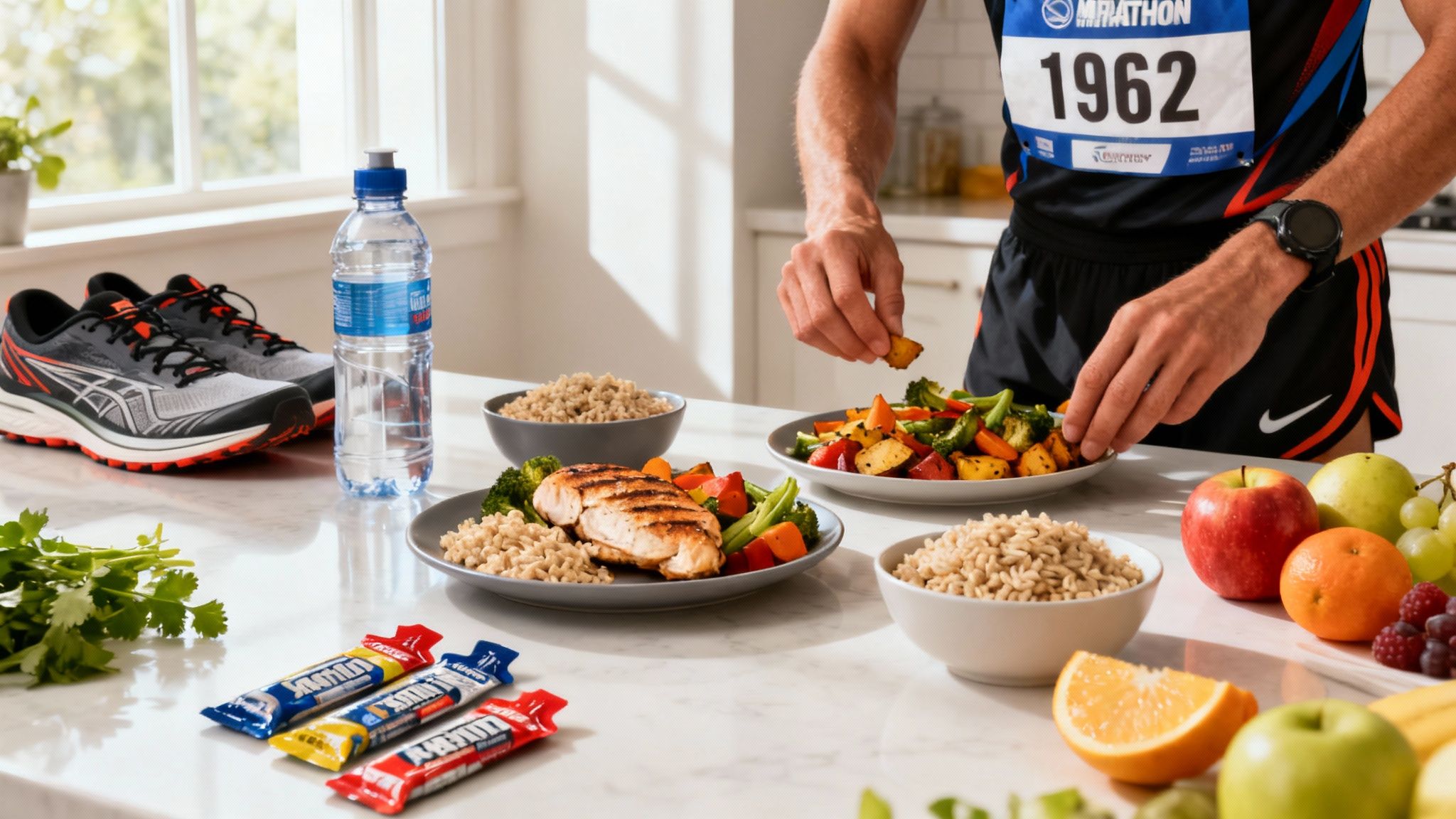
Like with any serious sport, proper nutrician is essential. When to eat, what to eat, and how much to eat can be the difference between winning and quitting due to injury. A successful marathon isn't just about logging miles, it's also about fueling your body to support those miles. Transitioning from a regular diet to one built for high mileage training is essential. The goal is to keep energy stores topped off and prioritize recovery from day one. Proper nutrition prevents under fueling and builds the foundation for a strong race day. Article Index: Dialing In Your Macronutrient Needs Mastering Your Daily Meal and Hydration Timing How to Fuel and Hydrate During Long Runs Your Race Week and Race Day Nutrition Plan Nailing Your Nutrition During the Taper Answering Your Biggest Marathon Nutrition Questions References Dialing In Your Macronutrient Needs Before discussing race day gels, we must cover the basics. Your body is a high performance engine that needs the right fuel mix (carbohydrates, protein, and fats) to handle the stress of marathon training. For endurance athletes, these macronutrients play distinct but connected roles. The Role of Carbohydrates Your marathon training nutrition plan must include the right source of carbohydrates. They are your primary energy source. Your body stores them as glycogen in your muscles and liver, converting them to glucose to power your runs. A diet rich in complex carbs (whole grains, potatoes, starchy vegetables) keeps glycogen stores full, helping you avoid "the wall." Simple carbs (fruit, sports drinks) offer quick energy, ideal for pre run or mid run fueling. Why Protein is Your Recovery Partner If carbs are fuel, protein is the repair crew. Running creates micro tears in your muscles, and protein provides the amino acids to rebuild them stronger. This is fundamental for adapting to training and staying injury free. Marathon runners need more protein than sedentary individuals. While the standard is 0.8 grams of protein per kilogram of body weight, endurance athletes should aim for 1.2 to 1.4 grams per kilogram daily to support muscle repair. Key Takeaway: Protein is essential for recovery from high mileage weeks. It's not just for bodybuilders; it's crucial for runners. The Importance of Healthy Fats Healthy fats are a vital part of a runner's diet. They serve as a secondary, slow burning fuel source, particularly useful during long, lower intensity runs. Fats are also crucial for hormone production, reducing inflammation, and absorbing certain vitamins. Focus on unsaturated fats from sources like avocados, nuts, seeds, and olive oil for sustained energy. To maximize your fueling, build a strong foundation with our guide on strength training for distance runners to boost your pace . Daily Macronutrient Targets for Marathon Runners This table provides a reference for daily macronutrient intake per kilogram of body weight. Macronutrient Recommended Daily Intake (per kg of body weight) Primary Role in Training Carbohydrates 5-10 g The primary fuel source for moderate to high-intensity runs. Protein 1.2-1.4 g Essential for muscle repair, recovery, and adaptation after training. Fats 1 g A secondary energy source and vital for hormone production and health. Use these as a starting point and adjust based on your body's response as you progress in your training. Mastering Your Daily Meal and Hydration Timing Knowing what to eat is half the battle; knowing when is equally important. Synchronizing nutrition with your training schedule is essential for maximizing energy, performance, and recovery. This involves understanding the three critical fueling windows: before, during, and after your run. Pre-Run Fueling The Right Way Eating before a run tops off your glycogen stores with easily digestible carbohydrates. For runs over 90 minutes , have a substantial meal 2-3 hours beforehand . A good option is oatmeal with a banana or toast with peanut butter and jam. For early morning runs, a small, quick digesting snack 30-60 minutes before is sufficient. A small banana, a handful of pretzels, or an energy gel works well. Keep fat, fiber, and protein low to avoid stomach issues. For a deeper dive, see our guide to pre and post workout nutrition for maximum results . Post-Run Recovery Nutrition After a tough run, your body needs to replenish energy and repair muscle damage. The 30-60 minute window post-run is crucial for nutrient absorption. Missing this window can slow recovery and increase muscle soreness. The ideal recovery meal has a 3:1 or 4:1 ratio of carbohydrates to protein . A study backed by the American College of Sports Medicine found that combining carbohydrates with protein post exercise significantly enhances glycogen replenishment and reduces muscle damage compared to consuming carbs alone. This combination kickstarts the recovery process more effectively. As shown, carbs are your main fuel, protein rebuilds, and healthy fats offer support. A balanced approach is key. Creating Your Hydration Strategy Proper hydration is nonnegotiable. Even slight dehydration can negatively impact performance, causing fatigue and cramps. A personalized plan starts with determining your sweat rate. Weigh Yourself: Weigh yourself with minimal clothing before a one-hour run. Run for an Hour: Run at your usual pace for 60 minutes without drinking. Weigh Yourself Again: After the run, towel off and weigh yourself again. Calculate Fluid Loss: The weight difference represents fluid loss. Each kilogram (2.2 lbs) lost is equivalent to about one liter of fluid. Knowing your sweat rate allows you to create a precise hydration strategy for before, during, and after your runs. How to Fuel and Hydrate During Long Runs Long runs are your dress rehearsal for race day, providing the perfect opportunity to test your fueling strategy and avoid "hitting the wall." As you run, your body uses stored glycogen; replenishing it with simple, easy to digest carbs is key to maintaining energy. Building Your Mid-Run Fueling Plan Aim for 30-60 grams of carbohydrates per hour for runs longer than 75-90 minutes. Start fueling around the 45 to 60-minute mark and continue every 45 minutes thereafter. Don't wait until you feel fatigued; consistent fueling prevents energy crashes. A study of the 2022 Seville Marathon found a strong correlation between carbohydrate intake and performance. Runners who met their carb targets were significantly more likely to achieve faster finishing times, highlighting the importance of consistent fueling (Viribay et al., 2023). You can read the full study about race performance and nutrition. Choosing Your Fuel Source The best fuel is what works for you. Experiment during long runs to find what provides energy without digestive issues. Energy Gels: Designed for fast absorption, providing a concentrated dose of simple carbs. Energy Chews: Similar to gels but with a gummy texture, allowing for more gradual fueling. Real Food: Bananas, dates, or small pieces of boiled potato can work well if processed fuels don't agree with you. Practice is crucial. Never try anything new on race day. Perfecting Your Hydration Strategy Fluids and electrolytes are as important as carbs. Dehydration leads to cramps and fatigue. Start Hydrated: Sip water throughout the day before your run. Sip Early and Often: Take small, frequent sips of water or an electrolyte drink. Combine with Fuel: Always take gels or chews with water to aid absorption and prevent stomach upset. Add Electrolytes: For runs over two hours or in the heat, an electrolyte drink is essential to replace minerals lost in sweat. By dialing in your fueling and hydration during long runs, you train your gut and build confidence for race day. Your Race Week and Race Day Nutrition Plan In the final week, your focus shifts to nutrition to prime your body for peak performance. This is where strategic carb loading becomes critical to ensure your muscles are fully stocked with energy. The Art of Carb-Loading Carb-loading is a calculated process that begins 2-3 days before the race . The goal is to maximize your muscle glycogen stores. During this period, increase your carbohydrate intake to 70-80% of your total daily calories by swapping some fat and protein for additional carbs. Pro Tip: As you increase carbohydrate intake, your body stores more water (about three grams of water per gram of glycogen). This is normal and indicates your strategy is working. Reduce your fiber intake by choosing simple, easily digestible carbs like white rice, potatoes without skin, and white pasta to prevent stomach issues on race day. Sample 3-Day Carb-Loading Meal Plan Day Breakfast Lunch Dinner Snacks 3 Days Out Oatmeal with berries & honey Large turkey sandwich on white bread, pretzels Chicken breast with a large serving of white rice & steamed green beans Greek yogurt, banana 2 Days Out 2 bagels with jam Big bowl of pasta with marinara sauce & a side salad (light on dressing) Salmon with a large baked potato (no skin) & cooked carrots Fruit smoothie, rice cakes with honey 1 Day Out Pancakes with maple syrup & a side of fruit White rice bowl with grilled chicken (low fiber veggies) Large portion of pasta with a simple tomato sauce Sports drink, pretzels, energy chews Stick with familiar foods your body handles well. Your Pre Race Morning Checklist Eat a familiar, carb rich breakfast 3-4 hours before the race. Good options include a bagel with peanut butter, oatmeal with banana, or an English muffin with jam. Stick to what you've practiced during training. About 30-60 minutes before the start , have a final small top up like a gel or a few energy chews. Race Day Hydration and Post Race Recovery On race morning, continue sipping fluids but stop about an hour before the start. After crossing the finish line, the 30-60 minute recovery window is crucial. A snack with a 3:1 or 4:1 ratio of carbs to protein , like chocolate milk, is ideal for replenishing glycogen and starting muscle repair. For your first proper meal, focus on replenishing everything you lost. Get more ideas from our guide on the best post workout recovery foods for faster results . Nailing Your Nutrition During the Taper The taper, the final weeks before the marathon, involves reducing running volume to allow your body to repair and adapt. Many runners mistakenly cut calories during this phase. However, your nutrition plan needs a smart tweak, not a drastic reduction. Why You Still Need to Eat Like a Runner Even with less running, your body is working hard to repair muscle damage and, most importantly, store glycogen. This is the physiological basis of carb loading. Think of the taper as the final deposit into your energy bank. By keeping carbohydrate intake high while mileage drops, you create a surplus that maximizes glycogen stores, leaving you feeling powerful on race day. This combination of physical rest and smart nutrition is what leads to that energetic feeling at the starting line. How to Adjust Your Plate for the Taper The main adjustment is to your macronutrient ratios, not total calories. Keep carbs high while slightly reducing fat and protein to match your lower energy expenditure. Keep Carbs King: Aim for 7-10 grams of carbohydrates per kilogram of body weight, using familiar, easy to digest sources. Moderate Your Protein: Aim for the lower end of your usual range, around 1.2 grams per kilogram , as muscle damage is reduced. Listen to Your Body: Honor hunger cues and stick to nutrient dense foods that you know work for you. Research shows that marathoners who pair a taper with a focused nutrition plan achieve better finishing times by reducing training stress while maximizing fuel stores. Allergy Free Mixes Answering Your Biggest Marathon Nutrition Questions Fueling for a marathon can be confusing. Here are answers to common questions. Gels or Real Food? What's a Runner to Do? There is no single "right" answer. The best fuel is what works for your body. Gels and chews offer fast, convenient energy but may cause stomach issues for some. Real food alternatives like bananas, dates, or boiled potatoes are also effective. The key is to practice with your chosen fuel during long runs to see what your stomach can handle. How Much Water Should I Actually Drink the Day Before the Race? Aim to sip fluids consistently throughout the day before the marathon to top off hydration stores without overdoing it. Check your urine color; it should be pale yellow. A general target is 2-3 liters of total fluid. Consistent sipping is more effective than chugging water at the last minute. An electrolyte drink can help your body absorb and retain fluid. What are the Biggest Fueling Mistakes Runners Make? Not Practicing Race Day Fueling: Failing to test your nutrition strategy during training can lead to stomach issues on race day. Under fueling on Long Runs: Underestimating calorie needs can cause you to "hit the wall." Skipping Post Run Recovery: Missing the 30-60 minute recovery window slows muscle repair and compromises your next workout. Are Supplements Really Necessary for Marathon Training? A "food first" approach is best. For most runners with a balanced diet, extensive supplements aren't necessary. However, electrolyte tablets can be helpful for replacing sodium lost through sweat, especially in the heat. Some runners benefit from caffeine gels, but this must be tested in training. Always consult a doctor or registered dietitian before starting new supplements. References American College of Sports Medicine. (n.d.). ACSM Information On... Fueling for Marathon Running . Viribay, A., Arribalzaga, S., Mielgo-Ayuso, J., Castañeda-Babarro, A., Seco-Calvo, J., & Urdampilleta, A. (2023). Carbohydrate Intake During a Marathon Predicts Running Performance in Male Runners. Medicine and Science in Sports and Exercise , 55(11), 2096-2104. At Flourish-Everyday , we believe that having the right information and the right gear can make all the difference in your fitness journey. We're here to help you feel empowered and prepared, whether that's demystifying your nutrition plan or helping you find the perfect running shoes. Check out our expert reviews and health guides to support every step toward that finish line. Find everything you need at https://www.flourish-everyday.com .
- Running Shoe Recommendations for Your Best Run
Finding the right running shoe is deeply personal. It's about your unique feet, running style, and goals. The Running Shoe Recommendations for Your Best Run guide cuts through the noise to help you find your perfect match with confidence, focusing on how your body moves, the surfaces you run on, and the comfort you need. The right pair works with you, making every run more enjoyable while helping to keep injuries at bay. Index of Sections: Understanding Your Gait to Prevent Injury : Learn how your foot's natural roll (pronation) impacts shoe selection and injury prevention. Matching Your Shoes to Your Running Surface : Discover key differences between road, trail, and gym shoes. How to Decode Cushioning and Support : Understand terms like "stack height" and "heel-to-toe drop." Top Running Shoe Models for Men and Women: Curated recommendations for different running needs. Extending Your Shoe Life and Running Health : Tips on shoe care and knowing when to replace them. Informative Health Information: Explore the connection between footwear and running-related injuries. Comparison of Well-Being Trends: How running shoe technology fits into broader health and wellness movements. Common Questions About Running Shoes: Quick answers to frequently asked questions. References Understanding Your Gait to Prevent Injury Your running gait is your unique movement pattern, and understanding it is the first step to finding the right shoes. A key part of gait is pronation, the natural inward roll of your foot upon landing. This motion is your body's built in shock absorber. The goal isn't to stop it, but to ensure it's balanced. When that roll is excessive or insufficient, it can throw your body out of alignment and lead to injuries. The Three Types of Pronation Knowing your pronation pattern determines whether you need a neutral shoe or one with added support. Neutral Pronation: The ideal state, where your foot rolls inward by about 15%, absorbing shock efficiently. Shoe wear is typically even across the ball of the foot and heel. Overpronation: The foot rolls inward more than 15%, often associated with low arches. This can cause instability and stress on the inner ankle, shins, and knees. Supination (Underpronation): The foot doesn't roll inward enough, placing most of the impact on the outside of the foot. It's common in runners with high, rigid arches and can lead to issues like IT band syndrome. Discover Your Arch Type with the Wet Test A simple "wet test" at home can give you a good indication of your arch type and pronation. Pour a shallow layer of water into a pan. Wet the sole of one foot. Step onto a dry piece of cardboard or a dark towel. Examine the footprint. A full footprint suggests a low arch (potential over pronation). Seeing only the heel and ball of your foot indicates a high arch (potential supination). A print with a distinct curve along the inside is a sign of a neutral arch. This infographic guides you from gait analysis to selecting a shoe based on your running surface and cushioning preference. Choosing the Right Shoe for Your Gait Match your arch type to the appropriate shoe category for optimal support. Neutral Shoes: Best for neutral pronators and most supinators, focusing on cushioning without motion control features. Stability Shoes: Designed for mild to moderate overpronation, using guide rails or medial posts to gently correct foot alignment. Motion Control Shoes: Offer maximum support for severe overpronators, with a firmer, more rigid structure to limit excessive inward roll. Matching Your Shoes to Your Running Surface The surface you run on dictates the grip, protection, and cushioning you need. A shoe designed for smooth pavement will feel inadequate on a rocky trail, and vice versa. Matching your shoe to your environment is a critical step toward comfort and injury prevention. Road Running Shoes: The Pavement Specialists Road shoes are designed for hard, consistent surfaces like asphalt, concrete, and treadmills. Their design prioritizes cushioning to absorb impact and flexibility for a smooth stride. Lightweight Construction: Built for a quick, nimble feel. Breathable Uppers: Often use engineered mesh for ventilation to keep feet cool. Flexible Design: Promotes a natural foot motion from landing to toe-off. Trail Running Shoes: The Off-Road Explorers For dirt paths, rocky terrain, and muddy hills, trail shoes provide protection, stability, and aggressive grip. Durable Uppers: Made from rugged materials to resist abrasions and tears. Aggressive Outsoles: Feature deep lugs to dig into soft ground and grip uneven surfaces. Protective Features: Many include a rock plate in the midsole to shield feet from sharp objects. Road vs. Trail: A Clear Comparison Feature Road Running Shoes Trail Running Shoes Outsole Flatter with minimal tread for smooth surfaces. Deep, aggressive lugs for superior grip. Midsole Focused on cushioning and shock absorption. Often includes a rock plate for underfoot protection. Upper Lightweight, breathable mesh for ventilation. Durable, reinforced materials to resist abrasions. Weight Generally lighter for a faster feel. Heavier and more robust for increased durability. How to Decode Cushioning and Support Understanding terms like "stack height" and "drop" is key to finding a shoe that feels right. Shoe cushioning acts as a suspension system, absorbing the impact force of up to three times your body weight with each step. The right amount is subjective, some runners prefer a minimalist feel, while others opt for maximalist cushioning. Understanding Stack Height Stack height is the amount of material between your foot and the ground, measured in millimeters. A higher stack height generally means more cushioning. Minimalist (Low Stack): Very little cushioning, promoting a "barefoot" running style. Requires a significant adaptation period. Maximalist (High Stack): Thick midsoles for maximum impact protection, ideal for long distances or recovery runs. What is Heel-to-Toe Drop Heel-to-toe drop is the height difference between the heel and forefoot, also in millimeters. It influences your running form. High Drop (8+ mm): Common in traditional shoes, it can reduce strain on the Achilles and calves. Best for heel strikers. Low/Zero Drop (0-4 mm): Puts the foot in a more level stance, encouraging a midfoot or forefoot strike. Requires a gradual transition to avoid overloading the calves. Understanding stack height and drop allows you to choose a shoe that matches your body's mechanics and comfort preferences. Top Running Shoe Models for Men and Women With a handle on your gait, terrain, and cushioning needs, let's review specific shoe models. This list provides a starting point with standout options known for consistent performance. Best for Neutral Runners (Daily Training) For a neutral gait, the focus is on balanced cushioning and a smooth ride. Brooks Ghost 16 ( Men's & Women's ): Legendary for its reliable, soft, and smooth ride. The DNA LOFT v3 cushioning provides a plush feel suitable for daily miles. Hoka Clifton 9 ( Men's & Women's ): Known for maximalist cushioning, the Clifton offers excellent shock absorption without excess weight, perfect for long or recovery runs. Best for Stability (Overpronation Support) Stability shoes offer gentle guidance to counter over pronation and reduce strain on joints. ASICS GEL-Kayano 31 ( Men's & Women's ): An icon in the stability category, it combines plush cushioning with a supportive frame for a secure ride over any distance. Saucony Guide 18 ( Men's & Women's ): Strikes a balance between stability and flexibility with a supportive frame and responsive cushioning. Best for Trail Running (Off-Road Adventures) Trail shoes must provide durability, traction, and protection for varied terrain. Hoka Speedgoat 6 ( Men's & Women's ): A trail beast with incredible grip from its Vibram Megagrip outsole and generous cushioning to absorb impact from rocks and roots. Brooks Cascadia 17 ( Men's & Women's ): A versatile all round shoe offering a mix of protection, stability, and traction, with a rock shield for underfoot safety. Extending Your Shoe Life and Running Health Proper shoe care is crucial for injury prevention. A worn-out shoe loses its supportive properties, forcing your body to compensate and increasing stress on joints and muscles. While the 300-500 mile guideline is common, it's better to pay attention to visual and sensory cues. How to Spot a Worn-Out Shoe Crushed Midsole: Deep wrinkles in the midsole foam indicate the cushioning is compressed and ineffective. Worn Tread: Smooth, bald spots on the outsole mean you've lost crucial grip and stability. New Aches and Pains: Unexplained discomfort in your feet, shins, or knees can often be traced back to worn-out shoes. Making Your Shoes Last Longer Extend the life of your shoes with proper care. Rotating between at least two pairs allows the foam midsole 24 hours to decompress, which can reduce injury risk by up to 39% (Messier et al., 2018). Avoid machine washing; instead, hand-wash with mild soap and cold water, then air dry away from direct heat. Informative Health Information The right running shoes are a cornerstone of injury prevention. Improper footwear is a leading contributor to common running ailments like plantar fasciitis, Achilles tendonitis, and shin splints (van Gent et al., 2007). Shoes that don't match your gait type can exacerbate biomechanical imbalances. For example, an overpronator running in a neutral shoe may experience increased stress on their medial knee, potentially leading to patellofemoral pain syndrome. Conversely, a well chosen shoe provides the necessary support and cushioning to mitigate impact forces, promoting proper alignment from the foot up through the kinetic chain (ankles, knees, hips). This alignment reduces abnormal stress on soft tissues and joints, allowing you to run more efficiently and with a lower risk of injury. Comparison of Well Being Trends Modern running shoe technology is part of a larger wellness movement emphasizing personalized health and proactive injury prevention. Just as wearable tech tracks heart rate and sleep, advanced footwear aims to optimize biomechanics. This trend moves beyond simple comfort, integrating data-driven design to enhance performance and longevity in the sport. The minimalist running trend, for instance, challenged traditional shoe design by advocating for a more natural foot motion to strengthen intrinsic foot muscles. While not universally adopted, it spurred innovation toward lower drop shoes and a greater focus on running form. Today, the market offers a spectrum of choices, from maximalist cushioning that aligns with a comfort, first wellness approach to responsive, high tech racers for performance, oriented goals. This variety allows runners to select gear that aligns with their personal well being philosophy, whether it's focused on peak performance, injury resilience, or pure enjoyment. Allergy Free Mixes Common Questions About Running Shoes Here are answers to some frequently asked questions. How Much Should I Spend on Running Shoes? A quality pair of running shoes typically costs between $120 and $160 . This price range reflects durable materials, advanced cushioning technology, and construction designed to last for hundreds of miles. While more expensive models with features like carbon plates exist, they are often specialized for racing and unnecessary for daily training. Can I Use My Running Shoes for Other Activities? It's best to reserve your running shoes exclusively for running. They are designed for forward motion and may not provide adequate support for the lateral movements common in gym workouts. Using them for walking or other activities will also wear down the midsole cushioning faster, reducing their lifespan for running. Do I Need a Professional Gait Analysis? While not essential for everyone, a professional gait analysis can be valuable, especially for new runners or those with persistent injuries. However, the at home "wet test" is an effective way to determine your arch type, which is often sufficient information to choose between a neutral, stability, or motion control shoe. References Fortune Business Insights. (2023). Athletic Footwear Market Size, Share & COVID-19 Impact Analysis . explore more about these market trends Future Market Insights. (2023). Running Shoes Market Outlook . explore more about the running shoe market Messier, S. P., Martin, D. F., Mihalko, S. L., et al. (2018). A 2-Year Prospective Cohort Study of Overuse Running Injuries: The Runners and Injury Longitudinal Study (TRAILS). The American Journal of Sports Medicine , 46(9), 2211–2221. van Gent, R. N., Siem, D., van Middelkoop, M., van Os, A. G., Bierma-Zeinstra, S. M., & Koes, B. W. (2007). Incidence and determinants of lower extremity running injuries in long distance runners: a systematic review. British Journal of Sports Medicine , 41(8), 469–480. For further reading on pronation, visit in-depth articles on pronation. To learn about the benefits of a shoe rotation, see advantages of a running shoe rotation. At Flourish-Everyday , our goal is to cut through the noise and make finding the right gear and health info simple. Visit us to explore curated recommendations and expert advice to support your wellness journey .
- Strength Training For Distance Runners: Boost Your Pace
It’s a common myth in the running world is that to get faster, you just need to run more and wear the right shoes. But what if the key to your next personal record isn't just on the pavement, but in the weight room? Many runners fear that lifting will make them bulky and slow them down. In reality, a smart strength training for distance runners program is one of the most powerful tools for building a more durable, efficient, and faster running body. This isn't about becoming a bodybuilder. It's about building a stronger, more resilient engine to power your endurance. By strengthening the key muscles that drive you forward, you create a system that can better handle the relentless pounding of thousands of foot strikes, mile after mile. Index of Sections: Unlocking Your True Running Potential The Real Science Behind Strength and Endurance Building Your Runner-Specific Strength Plan Essential Strength Exercises for Peak Performance How to Fit Lifting Into Your Running Schedule Common Strength Training Mistakes Runners Make Your Top Strength Training Questions, Answered References Unlocking Your True Running Potential The benefits of a good lifting routine go beyond just getting stronger, they directly impact your running performance in several key ways. Improved Running Economy: This is your body's version of fuel efficiency. Strength work helps your muscles generate more force with less oxygen, meaning you can hold your pace with less effort. Injury Resilience: Running is a high impact sport. Strengthening the muscles, tendons, and ligaments around your hips, knees, and ankles provides crucial support and stability. Increased Power and Speed: A stronger posterior chain (glutes, hamstrings, and calves) leads to a more explosive stride, which translates to faster finishing kicks and more power on hills. A comprehensive scientific review found that heavy and explosive strength training gives trained runners a small but significant boost in running economy, typically in the 1–3% range (Balsalobre-Fernández, Santos-Concejero, & Grivas, 2016). Over a half marathon or marathon, this can make a massive difference. Consistent strength work is your best defense against common overuse injuries. For a deeper dive, check out our guide on how to prevent running injuries with top tips for safe running . How Strength Training Directly Impacts Your Running Benefit Impact on Running Performance Primary Goal Improved Running Economy Run faster at the same effort level or hold a pace longer with less fatigue. Increase force production without needing more oxygen. Enhanced Injury Resilience Reduces the risk of common overuse injuries like runner's knee, IT band syndrome, and shin splints. Strengthen muscles and connective tissues to better absorb impact. Increased Power & Speed Develop a stronger finishing kick and improve your ability to surge or tackle hills. Boost neuromuscular coordination for more explosive strides. Better Biomechanics Helps you maintain proper running form, even when you're tired late in a race. Corrects muscular imbalances that lead to form breakdown. The Real Science Behind Strength and Endurance The goal of strength training for distance runners isn't to build large muscles, but to improve running economy, your body's miles per gallon. Better economy means you can hold a faster pace using less oxygen and energy. Think of your muscles and nerves as a circuit. Strength training, especially with heavy loads and explosive movements, upgrades this system. It trains your brain to send stronger, more coordinated signals, activating more muscle fibers with each command. This improved neuromuscular wiring means each footstrike packs more punch with less wasted energy. Your VO2 max may stay the same, but your ability to use that oxygen gets a serious boost. The Neuromuscular Advantage Lifting heavy or performing plyometrics teaches your body to generate maximum force quickly. This conditions your muscles and tendons to become "stiffer" in a beneficial way, creating a powerful spring like effect with every stride. This extra stiffness allows your tendons to store and release more energy, much like a pogo stick, reducing the workload on your muscles and delaying fatigue. This leads to shorter ground contact time and a more powerful push-off. To learn more, see our guide on what is strength and conditioning and how it boosts athletic performance . Which Training Styles Deliver Real Results Not all gym work is equal for runners. To achieve these neuromuscular upgrades, you must apply the right kind of stress. Research consistently points to a few highly effective methods. High-Load Training: Lifting heavy (e.g., 3-5 reps of squats or deadlifts) is proven to enhance neuromuscular efficiency. Plyometric Training: Explosive movements like jumps train your muscles to produce force rapidly, which directly translates to more power on the run. Combined Training: A smart mix of heavy lifting and plyometrics often yields the most significant gains in running economy. Conversely, science shows that sub maximal training, lighter weights for high reps, and long isometric holds don't significantly benefit already fit runners (Piacentini et al., 2023). The most effective strategy combines heavy loads and explosive movements to rewire your system for efficiency. You can explore more research on these training methods on PubMed . Addressing the Fear of Unwanted Bulk Many runners worry that lifting will make them bulk up and slow them down. This fear is understandable but unsupported by science for endurance athletes. The type of strength training beneficial for runners, heavy weight, low reps, stimulates neural adaptations, not significant muscle growth (hypertrophy). Furthermore, the high volume of cardio from distance running creates a physiological environment that naturally limits muscle bulk. Studies show that when endurance athletes add a proper strength routine, they rarely see significant changes in body composition. Building Your Runner-Specific Strength Plan It's time to build a strength plan that works with your running, not against it. The key is to sync your strength training with your running calendar, a practice known as periodization. This means your lifting will vary between your off season and your peak marathon training block. Structuring Your Workouts By Season Your strength plan should mirror the phases of your running year to provide the right stimulus at the right time without causing burnout. Off-Season/Base-Building: This is your prime time to get strong. With lower running mileage, your body can handle more in the weight room. Focus on lifting heavier in the 4-6 rep range for your main compound lifts. Pre-Competition/Peak Training: As running volume increases, shift your gym sessions into maintenance mode. You've built the strength; now you just need to keep it. Drop the volume and focus on 2-4 reps with heavy, explosive movements to keep your neuromuscular system sharp without excessive soreness. Race Phase/Taper: In the final 1-2 weeks before a major race, back off significantly. Light bodyweight circuits or mobility work are fine, but heavy lifting is off the table. The priority is arriving at the start line fresh and recovered. Defining Frequency, Volume, and Intensity For most runners, 2 to 3 strength sessions per week on non-consecutive days is the sweet spot. This provides enough stimulus for adaptation with ample recovery time. During peak race season, one or two focused sessions may be sufficient to maintain gains. The best bang for your buck comes from compound, multi joint movements . Forget bicep curls; exercises like squats, deadlifts, and lunges are superior because they recruit large muscle groups and build functional power that mimics running demands. A typical workout should include 2-3 sets per exercise, with rep ranges adjusted based on your season. For intensity, choose a weight that is challenging but allows for perfect form. The final reps should be tough, but not at the expense of technique. Essential Strength Exercises for Peak Performance A smart strength training for distance runners plan strengthens the entire system that powers your stride, from your core to your upper back. Focusing on big, compound movements builds functional strength that improves performance and reduces injuries. Foundational Lower Body Movements Your legs are your engine. These exercises build the raw power and stability needed to handle thousands of footstrikes. We'll use bilateral movements for pure strength and unilateral (single leg) work to correct imbalances. Squats: The king of lower-body strength, building power in your glutes, quads, and hamstrings. Focus on keeping your chest up and sinking your hips back and down. Deadlifts: Your secret weapon for a stronger stride. It targets the entire posterior chain including glutes, hamstrings, and lower back, which is your powerhouse for propulsion. A flat, neutral spine is essential for safety. Bulgarian Split Squats: This single leg exercise is excellent for identifying weaknesses. By elevating your back foot, you isolate one leg, challenging your balance and exposing strength discrepancies. For more exercise options, see our guide on the top resistance training exercises to unleash your strength . The Runner's Strength Training Cheat Sheet Exercise Target Muscles Benefit for Runners Squats Glutes, Quads, Hamstrings Builds the raw leg power needed for hill climbs and finishing kicks. Deadlifts Posterior Chain (Glutes, Hamstrings, Back) Increases stride power and helps maintain a strong, upright posture. Bulgarian Split Squats Glutes, Quads, Core Corrects muscle imbalances and improves single-leg stability for a more efficient stride. Plank Entire Core (Abs, Obliques, Back) Creates a rigid torso to prevent energy waste and protect the spine. Pallof Press Obliques, Transverse Abdominis Fights rotational forces, keeping you running in a straight, efficient line. Pull-Ups / Lat Pulldowns Lats, Upper Back, Biceps Promotes an upright posture, which opens up your chest for better breathing. Inverted Rows Rhomboids, Mid-Traps Counters the runner's slouch, pulling shoulders back for better form. Push-Ups Chest, Shoulders, Triceps, Core Builds upper body and core endurance to maintain arm drive and posture when fatigued. Core Work for Unshakeable Stability A strong core is the bridge between your legs and upper body. It acts as a stabilizing platform, preventing energy leaks and helping you maintain form when fatigued. Plank: A classic that teaches your entire core to brace and protect your spine. Pallof Press : An essential anti rotation exercise that strengthens your obliques to withstand twisting forces while you run. Bird-Dog : Challenges coordination by requiring you to maintain a flat back while extending opposite limbs, targeting deep stabilizing muscles. Functional Upper Body Exercises for Better Form Your upper body plays a key role in posture and arm swing. A strong back and shoulders prevent slouching, which keeps your chest open for easier breathing. Pull-Ups (or Lat Pulldowns): Builds strength in your lats and upper back, crucial for an upright running posture. Inverted Rows: The perfect antidote to the runner's forward lean, strengthening the muscles that pull your shoulder blades back. Push-Ups: A full-body exercise that builds chest, shoulder, and triceps strength while demanding serious core engagement, reinforcing good running posture. How to Fit Lifting Into Your Running Schedule When should you lift? A poorly timed session can leave your legs feeling heavy, but a smart schedule can make you feel unstoppable. The goal is to integrate strength training for distance runners so it supports your running. One of the most effective philosophies is to keep your hard days hard and your easy days truly easy. This means doing your lifting on the same day as your toughest runs, like a track workout or tempo run. The Hard Days Hard Approach This strategy consolidates stress into a single 24 hour window, allowing the following day to be a true recovery day. By stacking a tough run and a lift on the same day, you give your body a real chance to adapt. A common method is to do your key run in the morning and lift in the afternoon, allowing a few hours for refueling and rest. This approach protects your easy days, ensuring they remain dedicated to recovery. Alternative Scheduling Strategies Lifting on Easy Run Days: For some, pairing a lift with an easy run works. Keep the run genuinely easy and leave several hours between the run and the lift. Dedicated Lifting Days: If your schedule allows, having a day solely for strength training can be effective, especially during the off season when mileage is lower. Putting It Into Practice: A Runner's Week Example Week: Marathon Peak Season (Hard Days Hard) Day Activity Monday Easy Run (4-6 miles) Tuesday Hard Day : Track Workout AM / Strength Session PM Wednesday Recovery Run (3-5 miles) Thursday Hard Day : Tempo Run AM / Strength Session PM Friday Rest or Cross-Train Saturday Long Run (16-20 miles) Sunday Recovery Run (3-5 miles) Example Week: Off-Season (Base Building) Day Activity Monday Easy Run (5 miles) Tuesday Strength Session (Focus on heavy lifts) Wednesday Moderate Run with Strides Thursday Strength Session (Focus on heavy lifts) Friday Easy Run (5 miles) Saturday Long-ish Run (8-10 miles) Sunday Rest or Active Recovery Ultimately, the best schedule is one you can maintain consistently. Listen to your body, and don't neglect proper fueling and sleep, which are crucial for handling the combined stress. Common Strength Training Mistakes Runners Make To ensure your gym time translates to better running, avoid these common traps. One of the biggest errors is focusing on the wrong exercises. Isolation movements like bicep curls don't provide the same benefit as compound exercises like squats and deadlifts, which build functional, full body power. Another major pitfall is inconsistency. Two consistent sessions per week are far more effective than an erratic, all out approach that leads to burnout or injury. Mismanaging Intensity and Expectations Going too heavy too soon is a classic mistake. Your tissues need time to adapt. Piling on weight before mastering form is a fast track to injury. It's also vital to have realistic expectations. Strength work improves performance metrics, but the link to race times isn't always direct. For instance, one study found that while 21 weeks of strength training significantly improved collegiate athletes' jump height and balance, there was no direct correlation between these specific gains and their cross-country race times (Trowell et al., 2020). This doesn't negate the value of strength training; it simply highlights that the primary benefits are often improved running economy and reduced injury risk, rather than a predictable drop in your 5K time. You can view the study on neuromuscular gains and race performance . Allergy Free Mixes Your Top Strength Training Questions, Answered Here are quick answers to the most common questions about strength training for runners. How Many Days a Week Should a Distance Runner Lift Weights? For most runners, 2-3 non-consecutive days per week is the sweet spot. This provides enough stimulus for strength gains without compromising recovery. During a peak training block, you might reduce this to one or two maintenance sessions. Consistency is key. Will Strength Training Make Me Bulky and Slow? This is the biggest myth holding runners back. The type of strength training for distance runners we advocate, heavy lifts for low reps, builds neural strength and efficiency, not muscle size (hypertrophy). Paired with high volume running, getting bulky is extremely difficult. The goal is to become stronger and more resilient, not bigger. Can I Do Strength Training and Run on the Same Day? Yes, this is an effective way to structure your week. Lifting a few hours after a hard run consolidates stress, allowing for better recovery on easy days. If you must do them back-to-back, run first to keep your legs fresh for your primary sport. Listen to your body and find a schedule that works for you. References Balsalobre-Fernández, C., Santos-Concejero, J., & Grivas, G. V. (2016). Effects of Strength Training on Running Economy in Highly Trained Runners: A Systematic Review With Meta-Analysis of Controlled Trials. Journal of Strength and Conditioning Research, 30 (8), 2361–2368. Piacentini, M. F., La Torre, A., Lacasella, G., et al. (2023). Effects of a combined strength, power, and plyometric training in elite middle- and long-distance runners. Frontiers in Sports and Active Living, 5 . Trowell, D., Vicenzino, B., Saunders, N., et al. (2020). The effect of a 21-week, in-season strength-training program on the physical characteristics of collegiate cross-country runners. International Journal of Sports Physiology and Performance, 15 (8), 1144-1151. Here at Flourish-Everyday , our commitment is to give you the best, most practical information to help you on your fitness journey. We believe in a balanced approach that brings together endurance, strength, and overall wellness. To get the right gear and more expert advice to fuel your training, check us out at https://www.flourish-everyday.com .
- Circuit Training for Fat Loss: Your Definitive Guide
Circuit training is a powerhouse strategy for fat loss and overall health, blending resistance and cardio exercises with minimal rest. This high intensity style elevates your heart rate and metabolism, torching a significant number of calories both during your workout and for hours afterward. Index Why Circuit Training Melts Fat So Effectively Building Your Ultimate Fat Loss Circuit Circuits vs Traditional Lifting for Fat Loss Three Ready-To-Go Fat Loss Circuits Fueling Your Body for Maximum Fat Burn Answering Your Top Circuit Training Questions Top Athletic Shoes for Circuit Training References Why Circuit Training Melts Fat So Effectively The secret to effective fat loss workouts lies in intensity and efficiency. Circuit training masterfully combines both. By moving quickly from one exercise to another, you keep your heart rate elevated, turning your entire session into a highly effective cardio workout, even while lifting weights. This mix of strength and cardio demands more oxygen and energy from your whole body, leading to a massive calorie burn in a short time. The Science of the Afterburn Effect One of the most significant benefits of circuit training is the “ afterburn effect ,” or Excess Post exercise Oxygen Consumption (EPOC). After an intense circuit, your body works hard to recover, replenishing oxygen stores, clearing metabolic waste, and repairing muscle. This recovery process burns additional calories, keeping your metabolism elevated for hours after you've left the gym. The more intense the circuit, the greater the afterburn. This provides a distinct advantage over steady state cardio, where the calorie burn stops when the activity does. For a deeper look into high intensity training, you might be interested in our guide on why HIIT workouts are the best for overall fitness . Key Takeaway: Circuit training leverages the afterburn effect, meaning your metabolism stays elevated for hours post workout. This extended calorie burn is a critical component for accelerating fat loss. Key Benefits of Circuit Training for Fat Loss Here’s a summary of why circuit training is a game changer for shedding fat. Benefit How It Accelerates Fat Loss Metabolic Boost High intensity keeps your metabolism elevated for hours post-workout (EPOC). Time Efficiency Combines cardio and strength training into one short, powerful session. Muscle Building Resistance exercises build lean muscle, which increases your resting metabolic rate. Enhanced Calorie Burn The mix of exercises burns more calories per minute than traditional workouts. Building Muscle to Boost Metabolism Circuit training changes your body’s composition to burn more fat 24/7. By incorporating resistance exercises like squats, presses, and rows, you stimulate muscle growth. Muscle is metabolically active, meaning it burns more calories at rest than fat tissue. Building more lean muscle increases your resting metabolic rate (RMR), so you burn more calories all day long. A systematic review confirmed that resistance circuit based training led to a significant 4.3% reduction in fat mass while increasing muscle mass by an average of 1.9% (Paoli et al., 2017). This dual effect, burning fat while building muscle, makes circuit training a powerful strategy for getting and staying lean. Building Your Ultimate Fat Loss Circuit An effective fat burning circuit is about strategic design. The goal is to create a workout that keeps your heart rate high, hits multiple muscle groups, and boosts your metabolism without causing premature burnout. A well designed circuit blends different movements, compound lifts, targeted work, and cardio, to keep intensity high from start to finish. Selecting Your Exercises Strategically The foundation of a great circuit is a balanced mix of exercises. A sweet spot is typically 6-10 different movements, or "stations." Compound Lifts: These are your most metabolically demanding exercises, working multiple joints and large muscle groups at once (e.g., Goblet Squats, Dumbbell Bench Presses, Kettlebell Swings). Targeted Moves: Single joint exercises like Bicep Curls or Tricep Extensions can add volume and push muscles further. Cardio Bursts: Essential for keeping your heart rate soaring. Include exercises like High Knees, Burpees, or Jumping Jacks between strength moves. This infographic breaks down exactly how circuit training torches fat and builds muscle at the same time. As you can see, the high intensity triggers muscle growth, which then fuels that awesome afterburn effect for more sustained fat loss long after you've left the gym. Structuring Work and Rest Intervals Your work to rest ratio dictates the intensity of the workout and should match your fitness level. A good starting point is 45 seconds of work followed by 15 seconds of rest . As you improve, you can adjust the intervals. A study on elite rowers found their energy expenditure could reach nearly 50 kcal per minute during an all-out effort (Hagerman & Staron, 1983). While most of us are not Olympians, this demonstrates that intense work followed by brief recovery drives a massive calorie burn. Below are typical work-to-rest protocols.: Beginner (1:1 Ratio): 30 seconds work , 30 seconds rest . Intermediate (2:1 Ratio): 40 seconds work , 20 seconds rest . Advanced (3:1 Ratio): 45 seconds work , 15 seconds rest . Creating a Seamless Workout Flow Arrange exercises intelligently to avoid premature fatigue. The key rule is to avoid working the same muscle group back to back. This allows one part of your body to recover while another works, helping you maintain a higher output. Alternate between upper body, lower body, and full body cardio movements. Example of an effective circuit flow : Station 1 (Lower Body): Goblet Squats Station 2 (Upper Push): Incline Dumbbell Press Station 3 (Cardio): Burpees Station 4 (Lower Body/Posterior): Kettlebell Swings Station 5 (Upper Pull): Dumbbell Rows Station 6 (Core): Plank This sequence ensures a powerful and productive circuit training for fat loss session. Circuits vs Traditional Lifting for Fat Loss When fat loss is the goal, should you choose fast paced circuits or heavy, traditional lifting? The best answer depends on your schedule, goals, and personal preferences. Traditional strength training involves lifting heavy for a set number of reps, followed by long rest periods ( 2 to 3 minutes ). This method is unparalleled for building maximal strength and muscle size. Circuit training uses moderate weights with minimal rest, creating a metabolic furnace that combines cardiovascular conditioning and muscle stimulation. Time Efficiency and Metabolic Impact High Intensity Circuit Training (HICT) is incredibly efficient. You can complete a full body workout in 30 minutes that might take over an hour with a traditional routine. This non stop movement torches a high number of calories during the workout and significantly boosts the after burn effect (EPOC). While traditional lifting also provides an EPOC boost, circuits tend to create a larger immediate metabolic impact. A study comparing HICT with traditional strength training found both methods similarly effective for enhancing strength and lean body mass while reducing body fat percentage. HICT delivered comparable results in much less time (Alcaraz et al., 2011). HICT vs Traditional Strength Training: A Comparison Feature High-Intensity Circuit Training (HICT) Traditional Strength Training Primary Goal Fat loss, muscular endurance, cardio Maximal strength, muscle hypertrophy Workout Duration 20-30 minutes 45-90 minutes Rest Periods 15-30 seconds (or none) 2-5 minutes Intensity High heart rate, moderate weight High weight, low reps Calorie Burn (During) Very high Moderate EPOC (Afterburn) Significant Moderate to significant Best For Time-crunched individuals, fat loss Building maximum strength & size Muscle Growth Potential Traditional lifting excels at creating mechanical tension , the primary driver of muscle growth (hypertrophy). If your main goal is getting as big and strong as possible, heavy lifting is superior. However, circuits are fantastic at creating metabolic stress, another key factor for muscle growth. The high volume, short rest work can trigger hypertrophy, especially for those not aiming to be competitive bodybuilders. To learn more, see our guide on the top resistance training exercises to unleash your strength . The smartest approach is often a blend of both. You might dedicate two days a week to heavy lifting for strength and another two to circuits for conditioning and fat loss, giving you the best of both worlds. Three Ready-To-Go Fat Loss Circuits Here are three complete circuits for different fitness levels. These templates provide a clear roadmap for circuit training for fat loss. The Foundational Bodyweight Circuit This beginner friendly circuit uses only your bodyweight, perfect for mastering basic movements. The Structure: Work Interval: 40 seconds per exercise Rest Interval: 20 seconds between exercises Total Rounds: Complete 3 rounds Rest Between Rounds: 60-90 seconds The Exercises: Bodyweight Squats: Push hips back and down, keeping your chest up. Incline Push-ups: Use a bench or chair to reduce the load while building strength. Alternating Lunges: Step forward, lowering your back knee toward the floor. Plank: Maintain a straight line from head to heels. Jumping Jacks: A cardio burst to keep your heart rate up. The Intermediate Dumbbell Challenge This circuit adds dumbbells to increase resistance, build more lean muscle, and boost your metabolism. The Structure: Work Interval: 45 seconds per exercise Rest Interval: 15 seconds between exercises Total Rounds: Complete 4 rounds Rest Between Rounds: 60 seconds The Exercises: Dumbbell Goblet Squats: Hold one dumbbell vertically against your chest. Dumbbell Renegade Rows: In a push-up position, row one dumbbell to your chest, then the other, keeping hips stable. Dumbbell Reverse Lunges: Holding dumbbells, step backward into a lunge. Dumbbell Floor Press: Lie on your back and press dumbbells up from your chest. Burpees (No Push-up): A high intensity finisher for your cardiovascular system. The Advanced Metabolic Push For experienced individuals, this circuit combines heavier weights and plyometrics with minimal rest to maximize the afterburn effect. The Structure: Work Interval: 50 seconds per exercise Rest Interval: 10 seconds between exercises Total Rounds: Complete 4-5 rounds Rest Between Rounds: 45-60 seconds The Exercises: Kettlebell Swings: An explosive hip hinge movement that torches calories. Dumbbell Thrusters: A seamless front squat into an overhead press. Pull-ups (or Bodyweight Rows): The ultimate upper body pulling exercise. Box Jumps: An explosive plyometric move to build power and elevate heart rate. Farmer's Carry: Pick up heavy weights and walk to build grip strength and core stability. Fueling Your Body for Maximum Fat Burn Your effort in the gym is only half the battle. You cannot out-train a poor diet. Smart, sustainable eating habits are essential to fuel your workouts, promote recovery, and achieve the results you want. The Smart Calorie Deficit To lose fat, you must be in a calorie deficit, meaning you burn more calories than you consume. A moderate deficit of 300-500 calories per day is ideal. This promotes steady, sustainable fat loss without causing muscle loss, energy crashes, or a stalled metabolism. Prioritize Protein to Protect Muscle In a calorie deficit, your body may break down muscle for energy. To prevent this, make protein your priority . Aim for 0.7-1.0 grams of protein per pound of body weight. Protein helps preserve lean muscle and keeps you feeling fuller for longer, making it easier to stick to your calorie goals. Good sources include lean meats, fish, eggs, Greek yogurt, legumes, and quality protein powders. In one study, a 12 week circuit training program combining resistance and aerobic exercises led to significant reductions in body weight, body fat percentage, and BMI, highlighting the synergy between smart training and supportive nutrition (Gettman et al., 1982). Time Your Carbs for Energy and Recovery Carbohydrates are your body's preferred fuel source for high intensity workouts. Pre-Workout: A serving of complex carbs (like oatmeal) 1-2 hours before your session tops off energy stores. Post-Workout: Consuming carbs with protein within an hour or two after your circuit helps replenish energy and start muscle repair. For more on this topic, see our guide to pre and post workout nutrition for maximum results . Also, stay hydrated. Proper hydration is crucial for performance, metabolism, and recovery. Answering Your Top Circuit Training Questions Here are answers to common questions about using circuit training for fat loss. How Often Should I Do Circuit Training? Aim for 2 to 4 sessions per week . This frequency provides enough stimulus for fat loss and muscle toning while allowing adequate time for recovery. Overtraining is a risk with high intensity work, so listen to your body and take rest days when needed. Can I Build Muscle with Just Circuits? Yes, especially if you are new to lifting. Circuits create metabolic stress, a key driver of muscle growth. However, for maximizing muscle size (hypertrophy), traditional strength training with heavier weights and longer rest is more effective at creating the necessary "mechanical tension." A hybrid approach, combining circuits for conditioning and heavy lifting for strength, is often ideal. How Long Should a Circuit Workout Last? A solid fat loss circuit should last 20 to 45 minutes , including a warm up and cool down. This is long enough to boost your metabolism and trigger the afterburn effect without leading to burnout or poor form. Should I Do Cardio on Separate Days? For most people, the cardio is already integrated into the circuit. However, adding low intensity, steady state (LISS) cardio like brisk walking or cycling on off days can aid recovery by increasing blood flow, add to your weekly calorie burn, and improve your aerobic base. Keep any extra cardio light and treat it as active recovery. Top Athletic Shoes for Circuit Training Having the right footwear is crucial for safety and performance during circuit training. The ideal shoe offers a combination of stability for lifting, flexibility for dynamic movements, and cushioning for impact. For Women: Nike Metcon 9 : A top choice for its stability, featuring a wide, flat heel perfect for squats and deadlifts. The flexible forefoot allows for agility during jumps and lunges. Reebok Nano X4 : Known for its versatility and comfort. It provides a stable base for lifting while offering enough cushioning and flexibility for sprints and box jumps. Under Armour TriBase Reign 6 : This shoe excels in ground contact and stability. The low profile design gives you excellent feedback and power transfer during heavy lifts. For Men: Nike Metcon 9 : Just as popular for men, it delivers the stability and durability needed for intense, varied workouts. The Hyperlift insert in the heel provides extra support for heavy lifts. Reebok Nano X4 : A workhorse shoe that balances stability with responsive cushioning. It’s durable enough for rope climbs and flexible enough for burpees. Adidas Dropset 2 : Specifically designed for strength training, it features a dual density midsole that is firm in the heel for stability and softer in the forefoot for comfort during dynamic movements. References Alcaraz, P. E., Sanchez-Lorente, J., & Blazevich, A. J. (2011). Physical performance and cardiovascular responses to an acute bout of heavy resistance circuit training versus traditional strength training. Journal of Strength and Conditioning Research, 25 (5), 1277-1283. Gettman, L. R., Ward, P., & Hagan, R. D. (1982). A comparison of combined running and weight training with circuit weight training. Medicine and Science in Sports and Exercise, 14 (3), 229-234. Hagerman, F. C., & Staron, R. S. (1983). Seasonal variations in selected blood parameters of elite rowers. The Physician and Sportsmedicine, 11 (1), 91-99. Paoli, A., Gentil, P., Moro, T., Marcolin, G., & Bianco, A. (2017). Resistance training with single vs. multi-joint exercises at equal total load volume: effects on body composition, cardiorespiratory fitness, and muscle strength. Frontiers in Physiology, 8 , 1105. At Flourish-Everyday , we believe that the right information and the right gear are essential for your fitness journey. We provide expert reviews on the best athletic shoes and reliable health insights to support your goals. Find everything you need to build a stronger, healthier lifestyle at https://www.flourish-everyday.com .
- 10k Training Plan Intermediate: Crush Your PR
So, you've conquered the 10K distance, but now you're hungry for more. You’ve moved past the "just finish" feeling, and the thrill of chasing a faster time has taken over. If that sounds like you, then this intermediate 10K training plan is exactly what you need. This isn’t about just piling on more miles. It's a structured approach built for runners with race experience who are ready to get strategic. We'll blend different types of workouts with smart recovery and race day tactics to help you run smarter, not just harder. Index Your Roadmap to a New Personal Best: Setting the stage for purposeful training. The Building Blocks of Your 10K Training Schedule: Understanding the key workouts. Fueling for Performance and Recovery: Nutrition strategies to support your training. Choosing the Right Gear for Your Runs: Reviews of top athletic shoes and essential gear. Building a Resilient Runner's Body: Injury prevention through strength and mobility. Mastering Your Race Day Execution: Pacing, tapering, and pre race preparation. Common Questions on Intermediate 10K Training: Answering your most frequent questions. References: Sources for further reading. Your Roadmap to a New Personal Best Crossing that 10K finish line is an incredible feeling. But for many runners, the real buzz comes from seeing that clock and knowing you’ve set a new personal record (PR). This guide is designed to shift your focus from simply covering 6.2 miles to running it with a clear purpose and strategy. We’ll dig into the "why" behind every tempo run, interval session, and long run. Think of this plan as your complete roadmap, taking you from day one of training all the way to a faster finish time. We've laid it all out to build your speed, endurance, and confidence, making sure you show up to the starting line feeling prepared, not burned out. A solid plan is your best defense against injury and your ticket to unlocking your true potential. The Building Blocks of Your 10K Training Schedule A smart 10k training plan for intermediate runners isn't just a list of runs. It's a strategic system where every workout has a specific job, building on the last to make you stronger and faster for race day. When you understand the "why" behind each session, your training transforms from a simple to do list into a powerful tool for improvement. The core of any solid plan is variety . Running the same loop at the same pace every day is a fast track to a plateau. To get better, you must mix it up, challenging your body with a blend of endurance, speed, and, most importantly, recovery. This infographic lays out the essential pieces of a well rounded training cycle. It shows how different workouts, smart recovery, and race day thinking all fit together. As you can see, balance is everything. Skipping any one of these components holds back your progress and opens the door to potential injuries. The Four Pillars of Effective Training Your weekly schedule will revolve around a handful of key run types. Each one targets a different aspect of your fitness. Long, Slow Runs: These are the bedrock of your endurance. Running for a longer time at an easy, conversational pace teaches your body to become more efficient at using fat for fuel while strengthening your bones and ligaments. Tempo Runs: Often called "comfortably hard," tempo runs are sustained efforts near your lactate threshold. Training here makes your body better at clearing lactate, which means you can hold a faster pace for longer. Interval Training: These are your secret weapon for raw speed. Intervals involve short, intense bursts of running followed by recovery periods. This boosts your VO2 max and improves your running economy. Recovery Runs: A short, super slow run the day after a tough session gets blood flowing to tired muscles, helping flush out waste products and kickstart the repair process. They are essential for getting stronger. Finding the Right Paces and Intensity To benefit from each workout, you have to run it at the right intensity. This is where listening to your body (perceived effort) or using a heart rate monitor comes in. It ensures your easy days are truly easy and your hard days are hard enough. For an intermediate runner, the real magic is in learning to hold a challenging but controlled pace. You're pushing your limits without hitting the red line too soon. The old mentality of running hard all the time is out. Modern intermediate 10K plans, usually spanning 8–16 weeks , focus on a smart mix of aerobic work, race pace efforts, and recovery. The core of your training will be workouts at 90%, 95%, and 100% of your goal 10K pace, with only a few sessions pushing faster. This approach is far more effective for building race specific fitness than just hammering out exhausting speed work (1). The Power of Progressive Overload Your body adapts to stress, but only if that stress increases gradually over time. This is the principle of progressive overload. Your training plan is built to strategically increase the length, intensity, or frequency of your runs from one week to the next. This slow build up gives your body time to adapt and get stronger. The plan will also have "de-load" weeks, where volume is reduced to let your body fully recover and absorb the hard work. Fueling for Performance and Recovery You can’t out train a bad diet. Pushing through a demanding 10K training plan for intermediate runners means your body needs the right fuel. Think of your nutrition as the invisible part of your training, get it right, and you'll feel stronger and recover quicker. This isn’t about a restrictive diet. It's about smart, strategic fueling to support your energy demands and muscle repair. Your Daily Macronutrient Needs For a runner, not all calories are created equal. You need a solid mix of carbohydrates for energy, protein to repair muscles, and healthy fats to keep the system running smoothly. Carbohydrates: Your number one fuel source. Aim for carbs to make up about 50-60% of your daily intake. Stick to complex carbs like oats, brown rice, and sweet potatoes. Protein: Training creates micro-tears in your muscles, and protein repairs them. Target around 1.2 to 1.7 grams of protein per kilogram of your body weight. Load up on lean chicken, fish, beans, and tofu. Healthy Fats: Vital for hormone production and taming inflammation. Get them from sources like avocados, nuts, seeds, and olive oil. For a deeper dive, check out our guide to pre and post workout nutrition for maximum results . Timing Your Fuel for Success When you eat is almost as important as what you eat. A small, easy to digest snack about 30-60 minutes before a run will top off your energy stores. Think a banana or a small piece of toast. Avoid high fat or high fiber foods right before a run. After your run, the mission is recovery. Aim to get a mix of carbs and protein into your system within 30-60 minutes of finishing. This is the "anabolic window," when your muscles are primed to refuel and repair, which can speed up recovery. A perfect post-run recovery meal could be a smoothie with protein powder and fruit, or Greek yogurt with berries. Allergy Free Mixes Hydration and Race Day Fueling Hydration is non-negotiable. Being even slightly dehydrated can tank a workout. Sip water all day long. In the 2-3 days leading up to your 10K, slightly bump up your carbohydrate intake. This "carb-loading" maxes out your muscle glycogen stores. On race morning, have your usual pre-run breakfast 2-3 hours before the gun goes off. Stick with what you know—race day is not the time to experiment. Choosing the Right Gear for Your Runs The right gear won't run the 10k for you, but the wrong stuff can ruin it. As you dive into a structured 10k training plan for intermediate runners, your equipment choices matter a lot more. It’s often the difference between a smooth run and one that ends with blisters or pain. Your running shoes are your foundation. They absorb thousands of impacts and support your unique body mechanics. For injury prevention and performance, getting this right is non-negotiable. The Foundation: Your Running Shoes Running shoes generally offer neutral or stability support. A neutral shoe is for runners whose feet don’t roll inward much (pronate). A stability shoe has extra support to help control that inward roll (overpronation). Figuring out your gait is the first step. For the best results, visit a specialty running store for a proper gait analysis. They’ll watch you run and ensure you get a shoe that works with your body. Our expert guide on how to choose running shoes covers everything you need to know. Top Athletic Shoe Reviews for Men and Women Here are standout models from trusted brands that perform well for intermediate runners. Men's Top Picks: Brooks Ghost : A classic daily trainer with a perfect balance of soft cushioning and responsiveness. It’s a neutral shoe known for its consistently smooth ride, making it a reliable workhorse for various workouts. Hoka Clifton : Famous for its "maximalist" cushioning, the Clifton is surprisingly lightweight. An excellent choice to minimize joint impact during high mileage weeks, especially on recovery runs. Women's Top Picks: Saucony Guide : A fantastic option for runners needing some stability. It offers gentle guidance to keep overpronation in check without feeling stiff, making it versatile for any run on your schedule. Brooks Adrenaline GTS : A long time favorite in the stability world, the Adrenaline uses innovative GuideRails technology to support your entire body. A dependable choice for runners seeking consistent support. The best shoe is always the one that feels best on your foot. Prioritize comfort and proper fit over trends. Always break in your gear during training, never on race day. Beyond the Shoes: Apparel and Accessories Your clothing and accessories play a huge supporting role. The name of the game is moisture, wicking fabrics like polyester or merino wool. Cotton absorbs sweat, gets heavy, and can lead to chafing. A few key accessories also make a difference: GPS Watch: Your best friend for tracking pace, distance, and time, providing data to ensure you’re hitting the right intensity. Hydration Belt or Vest: For long runs pushing past an hour, carrying water becomes non-negotiable.. A simple belt is usually sufficient for 10K training. Anti-Chafe Balm: A lifesaver. Apply it to any areas prone to rubbing before your run to prevent irritation. Building a Resilient Runner's Body Crushing your 10K best is about more than just logging miles. A truly effective 10k training plan for intermediate runners is built on a body that’s strong from head to toe. This means weaving in strength and mobility work to fend off common issues like shin splints and runner's knee. Think of your legs as the engine and your core, hips, and glutes as the chassis. If that foundation is weak, your running form crumbles, you leak energy, and your injury risk shoots up. A Simple and Effective Bodyweight Routine You don’t need a gym to build a more durable running body. Consistency beats complexity. Try this simple bodyweight routine twice a week. Plank: The cornerstone of core strength. Hold for 30-60 seconds , keeping your back flat. Glute Bridges: Wakes up your glutes, the powerhouse muscles for runners. Lie on your back, bend your knees, and lift your hips. Squats: Hits your quads, hamstrings, and glutes. Focus on solid form. Lunges: Targets each leg individually, helping iron out muscle imbalances and improve stability. For more ideas, check our guide on how to prevent running injuries with top tips for safe running . The Importance of Warm-Ups and Cool-Downs How you start and finish your runs is as important as the miles in between. Before every run, perform a dynamic warm-up. This involves active movements like leg swings, high knees, and walking lunges to get your muscles ready. After the run, focus on recovery. Gentle static stretching, holding each stretch for 20-30 seconds , or using a foam roller can help release muscle tightness. Don't skip this part. Recovery is an active part of training. Most plans rightly include rest days and easy runs to facilitate adaptation. However, injury rates often climb when runners follow generic programs. Studies show success rates below 45% because 'one size fits all' plans fail to match individual recovery needs (2). Mastering Your Race Day Execution All those weeks of training have led you here. Race day is the finale. Nailing your race isn't just about fitness; it's about having a solid strategy and keeping a cool head. The final week is all about the taper . You strategically cut back on running volume to let your body fully recover and store energy. It might feel weird to run less, but trust the process. The Final 48 Hours: Fuel and Preparation What you do in the days before the race sets the stage. Your main goals are to top off energy stores and minimize stress. Pre-Race Dinner: Stick with what you know. Your meal should be heavy on carbs with some protein, think grilled chicken with pasta or a sweet potato. Race Day Breakfast: Have a simple, easy to digest breakfast 2-3 hours before the race. Classics like a banana with a bagel or oatmeal are popular for a reason. Packing Your Gear: Lay everything out the night before: your bib, clothes, shoes, watch, and fuel. A calm morning is a fast morning. Executing a Smart Pacing Strategy The most common mistake is starting too fast. Adrenaline is pumping, and it's easy to burn through your energy reserves in the first few minutes. Your goal for the first mile or two is to feel like you're holding back. Let others sprint past. Settle into your rhythm and find your goal race pace, that "comfortably hard" effort you practiced. Once settled, lock into that pace for the middle part of the race. Save your big push for the final 1-2 miles . This is when you dig deep and draw on all the strength you've built. This systematic approach is a shift from rigid, old-school plans. Since the 1990s, 10K training has evolved to focus more on periodization and individual needs. Early plans often had a one size fits all structure leading to injury or burnout in as many as 40–50% of runners. Today's adaptive plans are built on listening to your body, leading to better outcomes (3). Common Questions on Intermediate 10K Training Even experienced runners have questions when starting a new plan. Let’s tackle some common ones to keep you on track. What Should I Do if I Miss a Training Run? Life happens. The golden rule is: don't panic or try to cram workouts together. Trying to make up for lost time by squeezing two runs into one day is asking for injury or burnout. If you miss an easy recovery run, just forget it and move on. If you miss a key session like a long run or tempo workout, you have some flexibility. You could bump a missed Thursday tempo to Friday and take Saturday off before your Sunday long run. If you’ve been out for a few days due to sickness, ease back in with shorter, easier runs. How Do I Know if My Easy Runs Are Actually Easy? Running easy days too hard is the single biggest mistake intermediate runners make. Easy runs build your aerobic base and let your body recover. The best way to know if you're truly running easy is the "talk test." You should be able to hold a full conversation without gasping. If you can only spit out a few words, you're going too fast. On a scale of 1 to 10 for perceived effort, an easy run should feel like a 3 or 4 . On a heart rate monitor, this is Zone 2 , roughly 60-70% of your max heart rate. Should I Train by Distance or by Time? Both work, but training by time is often more effective. A "60 minute easy run" is a consistent effort regardless of conditions. A "6 mile easy run" might force you to push too hard on a tough day. This plan gives a guide for both, but your main focus should be on the effort of the run. How Much Strength Training Do I Really Need? Consistency beats volume. Two focused sessions of 20-30 minutes a week is all it takes to see huge benefits in injury prevention and running economy. Focus on compound movements that fire up your core, glutes, and hips: squats, lunges, planks, and glute bridges. This builds resilience without causing so much fatigue that it wrecks your running workouts. Comparison of Wellness Trends: Ice Baths vs. Foam Rolling For recovery, two popular methods are ice baths and foam rolling. Let's compare them: Feature Ice Baths (Cold Water Immersion) Foam Rolling (Self-Myofascial Release) Primary Goal Reduce inflammation and muscle soreness by constricting blood vessels. Release muscle tightness, improve flexibility, and increase blood flow to muscles. Best For Immediately after a very hard workout or long run to manage acute inflammation. Daily use, pre-run activation, or post-run cool-down to address knots and tightness. Feeling Intense, often uncomfortable initial shock, followed by numbness. Can be painful on tight spots ("good pain"), but provides immediate relief. Verdict Highly effective for acute, intense soreness, but less practical for daily use. More accessible and versatile for day-to-day muscle maintenance and flexibility. For a detailed breakdown of different recovery methods, see our comprehensive guide. References MyMottiv. (n.d.). 10k Training Plans for Every Level . MyMottiv.com. Runner's World . (n.d.). Accessed from RunnersWorld.com. RunnersConnect.net . (n.d.). Accessed from RunnersConnect.net. At Flourish-Everyday , we're committed to being your trusted resource for every step of your fitness journey. We provide expert reviews on athletic shoes for men and in-depth health information to empower you. Find everything you need to support a healthier, happier you at https://www.flourish-everyday.com .
- The Ultimate Guide to Shoes for Weight Training and Cardio
Finding the ultimate guide to shoes for weight training and cardio involves balancing stability with responsive cushioning and understanding the shoe's purpose. Top cross-training shoes like the Nike Metcon, Reebok Nano, and NOBULL Trainer+/Impact are popular for a reason: they provide a firm base for lifting while offering enough flexibility for cardio bursts like HIIT or treadmill sprints. Not buying the right pair of cross-training shoes can lead to serious injuries. Take the time to get the right shoe; it will definitely pay off in the long run. Decoding Your Ideal Hybrid Workout Shoe The classic gym dilemma is finding one pair of shoes for both heavy lifting and dynamic cardio. Weightlifting demands a flat, stable foundation for safe power transfer, especially during compound movements like squats and deadlifts. Conversely, cardio activities like running require flexible cushioning to absorb impact and protect your joints. The secret to enhancing performance and preventing injury lies in finding a shoe that masters both. This guide will help you select the perfect all-around performer. We'll analyze the critical features of a great hybrid shoe, from midsole firmness to outsole grip, so you can make an informed decision. For more curated lists and recommendations, check out our guide on top-rated athletic gear . Navigating This Guide To help you find your ideal shoe, we’ve broken down our analysis into these key sections: Introduction Why Running Shoes Undermine Lifts Anatomy of a Great Cross-Training Shoe Top Hybrid Shoes for Men & Women * Nike Metcon 9 * Reebok Nano X4 * NOBULL Trainer+ * On Cloud X 3 Matching Shoes to Your Workout Style Health Information & Common Questions Comparison of Wellbeing Trends: Minimalist vs. Cushioned Shoes References Top Hybrid Shoes at a Glance For a quick overview, this table highlights our top rated shoes for weight training and cardio, detailing their ideal workout scenarios and standout features. Shoe Model Best For Stability Level Cushioning Level Key Feature Nike Metcon 9 Lifting-focused workouts with short cardio bursts High Low Hyperlift plate for heel stability Reebok Nano X4 Balanced 50/50 lifting and HIIT routines Medium-High Medium Lift and Run (L.A.R.) Chassis System NOBULL Trainer+ Durability and versatile functional fitness High Low-Medium Abrasion-resistant SuperFabric® upper On Cloud X 3 Agility drills, HIIT, and light lifting Medium Medium CloudTec® sole for responsive cushioning This table is your starting point. As we dive deeper, you'll gain a clearer understanding of which shoe best aligns with your specific training needs. Why Running Shoes Undermine Your Lifts Using plush running shoes for squats is a common gym mistake. While excellent for running, their soft foam and high heel drops create an unstable base for strength training. This mismatch can compromise form, reduce power, and increase injury risk during hybrid workouts. Lifting in cushioned shoes is like squatting on a mattress. The soft surface compresses and causes instability, absorbing the force you're trying to drive into the ground. This "power leak" makes your lifts less effective. This instability is also dangerous, as it forces your ankles, knees, and hips to work overtime to maintain balance, leading to poor alignment and joint stress. The Problem with Compression and Elevated Heels The issue lies in the midsole. Running shoes are designed to absorb shock, not provide a rigid platform for force generation. Midsole Instability: Thick, soft foam compresses under heavy loads, creating a wobbly surface and disrupting your connection to the floor. Force Absorption: Cushioning soaks up energy instead of transferring it into the lift, diminishing your strength potential. Altered Mechanics: Many running shoes have a high heel-to-toe drop, which can pitch your torso forward during squats and strain your lower back. A 2021 study highlighted how different heel heights in footwear significantly alter body posture and muscle activation during squats, reinforcing the need for a stable, low drop shoe for lifting (1). A stable, grounded connection to the floor is nonnegotiable for safe and effective lifting. The 'sinking' feeling of squatting in running shoes is a clear signal that your footwear is undermining your strength and stability, not supporting it. From Unstable Lifts to Potential Injury Repetitive lifting on an unstable surface can lead to chronic issues. The constant micro adjustments your joints make to compensate for shoe compression may contribute to tendonitis, ligament strain, and other overuse injuries. A proper training shoe provides the rigid, flat base needed for exercises demanding maximum stability. Finding the best shoes for weight training and cardio is about striking a balance: enough firmness for lifting without sacrificing all cushioning for cardio. Anatomy of a Great Cross-Training Shoe To find the best shoes for weight training and cardio, you must understand their core components. It boils down to a balance of stability, flexibility, and support. The global athletic footwear market's significant growth reflects a consumer shift towards versatile gear that can handle modern, multi faceted workouts (2). The Midsole: The Engine of Your Shoe The midsole is the heart of a training shoe, balancing a firm platform for lifts with adequate cushioning for cardio. Cross-trainers use denser foam than running shoes to prevent compression under heavy loads, providing a stable base. However, a good midsole also needs flexibility in the forefoot to allow natural movement during dynamic exercises like box jumps or sprints. The Outsole: Your Connection to the Ground The outsole provides traction. For lifting, a flat, wide base maximizes contact with the floor for efficient power transfer. For cardio and agility, the outsole needs a multidirectional tread pattern for grip during quick movements. A durable rubber compound is essential to withstand abrasion from various gym surfaces and activities. The Upper: Durable and Breathable Support The upper wraps your foot, providing structure and support. Quality cross-trainers feature uppers made from tough, reinforced materials like engineered mesh to lock your foot in place during lateral movements. Breathability is also crucial to manage moisture and prevent blisters during intense workouts. "The single most important technical spec for a hybrid training shoe is its heel-to-toe drop. A lower drop, typically 4mm or less, keeps your foot closer to a natural, flat position, which is superior for activating the posterior chain and maintaining proper form during heavy lifts." This lower drop offers the grounded feel needed for weight training while remaining comfortable enough for cardio, making it the ideal compromise for a versatile athlete. Allergy Free Mixes Top Hybrid Shoes for Men & Women Here, we review the top hybrid shoes, focusing on their real world performance in mixed modality workouts. Finding the best shoes for weight training and cardio means understanding the trade offs each model makes between stability and flexibility. Nike Metcon 9 : Performance Breakdown The Nike Metcon 9 continues the series' legacy of stability. Its key feature is the large Hyperlift plate in the heel, which provides an exceptionally rigid platform for heavy lifting. During squats and deadlifts, this ensures a grounded, locked in feel with minimal heel compression. However, this stability makes the shoe feel stiff during runs or dynamic cardio. The Metcon 9 is ideal for athletes whose routines are roughly 80% lifting and 20% cardio. Lifting Scenario: Provides a rock solid base under a heavy squat, allowing maximum power transfer. Cardio Scenario: Feels clunky during sprints due to its rigid sole; best for short, explosive bursts. Reebok Nano X4 : In the Gym The Reebok Nano X4 is designed as a true 50/50 hybrid. It features the Lift and Run (L.A.R.) Chassis System, with a dome shaped heel piece that compresses for cushioning during cardio and flattens for stability during lifts. This technology makes it one of the most versatile options available. The Nano X4 offers solid stability for lifts, though not as locked down as the Metcon, but excels in comfort and flexibility for HIIT and short runs. It's perfect for athletes who split their time evenly between strength and conditioning. For a deeper dive, explore our comprehensive shoe reviews . The Nano X4 represents a significant step toward solving the hybrid shoe dilemma. Its dual density midsole successfully bridges the gap between the rigid stability needed for lifting and the responsive cushioning required for cardio. The infographic below illustrates the key components of a high-performance cross-training shoe. NOBULL Trainer+ (Impact) : Versus the Competition The NOBULL Impact prioritizes durability and a minimalist, grounded feel. Its standout feature is the seamless, one piece SuperFabric® upper, which is highly resistant to abrasion from rope climbs and other high wear movements. The firm, low profile midsole offers excellent stability for lifting. The training shoe market is expanding rapidly, reflecting a trend toward durable, all in one gym footwear (3). While its firm base is excellent for strength work, the Impact offers minimal cushioning, making it less suitable for high impact activities. It best serves lifters who value durability and a close to the ground feel. Men's Cloud X 3 Sneakers Ultra lightweight training shoes featuring On's signature CloudTec cushioning technology with HelionTM superfoam. Designed for versatile athletic performance, they offer breathable performance mesh construction, perforated panels for ventilation, and reflective accents. The rubber outsole provides reliable traction while maintaining a minimalist feel that's comfortable right out of the box without requiring a break in period. The Cloud X 3 is engineered for multiple activities including: Cross-training and gym workouts Running (both road and light trail) Matching Your Shoes to Your Workout Style The best shoe is one that supports your specific training style. General advice is a start, but performance gains come from matching shoe features to your gym routine. Since many people use one pair of shoes for all workouts, a trend reflected in market growth projections (4), it's crucial to understand which profile fits your needs. The Lifter Who Runs Sprints (80% Lifting, 20% Cardio) Your priority is maximum stability. You need a shoe with a firm, flat midsole and a minimal heel-to-toe drop for heavy lifts. Ideal Shoe Type: A stability focused cross-trainer like the Nike Metcon. Why It Works: These shoes feature a rigid heel and dense midsole that resist compression, ensuring force is directed into the lift. They sacrifice plush cushioning, as your cardio is limited to short bursts where a responsive forefoot is more valuable. The HIIT and Agility Specialist You need a shoe that is both agile and supportive for high intensity intervals and explosive movements. Seek a combination of moderate cushioning, multi-directional traction, and lateral stability. Ideal Shoe Type: A responsive trainer like the On Cloud X 3. Why It Works: These shoes lock your foot in during lateral movements while offering forefoot flexibility and cushioning to handle the impact of high rep plyometrics. The Balanced 50/50 Athlete Your routine is an even split between moderate strength training and sustained cardio. You need the most versatile shoe available. Ideal Shoe Type: A balanced cross-trainer like the Reebok Nano X4. Why It Works: These models use innovative midsole technology that is firm enough for moderate lifting yet flexible and cushioned enough for runs up to a few miles. They are the quintessential multi-talented individuals. Comparison of Wellbeing Trends: Minimalist vs. Cushioned Shoes The debate between minimalist (low-drop, firm) and cushioned (high-drop, soft) shoes is a major trend in athletic footwear. Minimalist Trend: Proponents argue that minimalist shoes promote a more natural foot motion, potentially strengthening foot muscles and improving biomechanics (5). The firm, stable base is highly advantageous for weight training, as it mimics barefoot lifting, which is considered the gold standard for power transfer. For cardio, it encourages a forefoot or midfoot strike, which some runners find more efficient. Maximalist Cushioning Trend: This approach, popular in running, emphasizes shock absorption to reduce impact forces on joints. While beneficial for long distance running, this level of cushioning creates instability and absorbs power during lifts, making it unsuitable for serious strength training. Method Comparison: For the hybrid athlete, the optimal method is a middle ground. The best shoes for weight training and cardio adopt principles from the minimalist trend (low drop, stability) while incorporating enough targeted cushioning to make cardio comfortable and safe. This balanced approach supports overall well being by protecting joints during impact without compromising form and safety during lifts. Common Questions Navigating the world of hybrid footwear can be confusing. Here are answers to some frequently asked questions. Can I just use one pair of shoes for everything? Yes, a high quality cross-training shoe is designed for this purpose. However, it's a compromise. A hybrid shoe won't offer the specialized stability of a weightlifting shoe or the plush cushioning of a dedicated running shoe. For the average gym goer with a varied routine, a single pair of cross-trainers is a practical choice. How often should I replace my workout shoes? A good rule of thumb is every 300-500 miles of use, which for a regular gym-goer is typically every 6-12 months . Look for signs of wear: a compressed midsole that feels flat, a worn out outsole with bald spots, or a frayed upper that no longer provides support. Don't wait for pain; replace shoes when their structural integrity is compromised to reduce injury risk. What is the ideal heel-to-toe drop for a hybrid shoe? A lower heel-to-toe drop, in the 0mm to 4mm range, is ideal. This keeps your foot in a more natural, flat position, which is crucial for a stable base during squats and deadlifts. A low drop improves your connection to the ground and helps activate the posterior chain. Does the sock I wear matter? Yes. Choose athletic socks made from moisture wicking materials like polyester, nylon, or merino wool. These fabrics pull sweat away from your skin, preventing blisters. Avoid cotton, which absorbs moisture and can lead to friction. References Sato, K., Fortenbaugh, D., & Hydock, D. (2021). Kinematic changes using weightlifting shoes on an unstable surface. Journal of Strength and Conditioning Research , 35(1), 133-138. Fortune Business Insights. (2023). Athletic Footwear Market Size, Share & COVID-19 Impact Analysis . Report No. FBI100257. Allied Market Research. (2024). Training Shoes Market by Type, Distribution Channel, and End User: Global Opportunity Analysis and Industry Forecast, 2024-2035 . Technavio. (2024). Athletic Footwear Market in US 2024-2028 . Warne, J. P., & Gruber, A. H. (2017). Transitioning to minimal footwear: a systematic review of the evidence. Journal of Sports and Health Science , 6(3), 284-293. At Flourish-Everyday , we're all about helping you find the perfect gear for your fitness journey. Check out our curated picks and deep-dive reviews to make your next choice with confidence. Visit us at https://www.flourish-everyday.com .
- Plyometric Leg Workout for Explosive Power
A plyometric leg workout is a training method centered on explosive, jump based movements that utilize the stretch shortening cycle (SSC) to build lower body power. By rapidly transitioning from a muscle stretch to a powerful contraction, you can significantly improve jump height, sprint speed, and agility. Performing these exercises is extremely important because it will give you the reaction time to catch yourself if you trip and prevent you from falling. These exercises are particularly relevant for the older population. What is a Plyometric Leg Workout? Think of your muscles as a rubber band. Stretching it before letting go makes it snap back with force. This is the core principle of plyometric training. You load the muscle with a quick stretch (eccentric phase) and immediately follow with an explosive contraction (concentric phase). This training style, filled with exercises like squat jumps and box jumps, trains your nervous system to fire muscle fibers more rapidly, thereby increasing your power output. It is highly beneficial for athletes as it: Boosts vertical jump by targeting fast-twitch muscle fibers. Improves acceleration and sprint speed. Enhances agility for quick directional changes. Caution: A solid strength foundation is crucial before beginning plyometrics. Ensure you can comfortably perform bodyweight squats to minimize injury risk. Always prioritize soft landings and wear supportive footwear to protect your joints. Index of Sections The Science Behind Explosive Power: Understanding the neuromuscular mechanics of plyometrics. Preparing for Plyometric Training: Essential warm-ups and safety considerations. The Complete Plyometric Leg Workout : A structured routine with beginner, intermediate, and advanced levels. Choosing the Right Shoes for Jump Training : Reviews and key features for optimal footwear. Frequently Asked Questions : Expert answers to common plyometric queries. References : Sources cited in this guide. For a deeper dive, check out our guide on how plyometric training can help you jump to peak performance . The Science Behind Explosive Power A plyometric leg workout is more than just jumping; it is a precise training method designed to enhance the efficiency of your neuromuscular system. It trains the brain and muscles to communicate more effectively, allowing for faster and more forceful muscle contractions. This develops power —the ability to apply strength in a fraction of a second. Strength vs. Power It is essential to distinguish between strength and power. Strength is the maximum force a muscle can generate, regardless of time. Think of a powerlifter executing a slow, heavy squat. Power is the ability to exert force rapidly. An example is a basketball player exploding upwards for a dunk. While strength is a vital foundation, a plyometric leg workout specifically targets the power component, bridging the gap between being strong and being athletic. Neuromuscular Adaptation The effectiveness of plyometrics lies in its impact on the central nervous system. Each explosive jump trains the nervous system to recruit muscle fibers, especially fast twitch fibers, more rapidly and in greater numbers. Over time, your body becomes highly efficient at converting stored elastic energy into explosive force. This concept was significantly advanced by Russian coach Yuri Verkhoshansky in the late 1960s with his "shock method," which demonstrated how to use the stretch shortening cycle to build explosive athletes (Verkhoshansky, 1968). Modern research confirms that plyometric workouts can lead to a 10 to 20% increase in power output compared to traditional strength training alone (Markovic & Mikulic, 2010). You can read more about the history of plyometrics to see its evolution. Preparing for Plyometric Training Attempting a high impact plyometric leg workout without proper preparation is a significant injury risk. This preparation phase ensures your body is ready for the demands of explosive training. A baseline level of strength is nonnegotiable. If you can perform a set of bodyweight squats with proper form, your muscles and connective tissues are likely prepared for the initial shock of jumping and landing. Essential Gear and Surface Your equipment and training environment are crucial for safety and performance. Proper Footwear: Cross-training shoes are ideal. They provide a balance of firm cushioning to absorb shock and robust lateral support for stability. Running shoes are often too soft and lack the necessary side to side support. Training Surface: Avoid hard, unforgiving surfaces like concrete. Opt for surfaces with more give, such as a rubberized gym floor, a track, or dry grass, to reduce joint stress. A safe landing is a soft landing. Absorb force with your muscles, not your joints, to protect your knees and ankles from unnecessary strain. The Dynamic Warm-Up A dynamic warm-up is critical before any plyometric session. It increases blood flow, activates key muscle groups, and primes the nervous system for explosive movements. A proper warm-up should last 5-10 minutes . For more detail, see our article on how to warm up before exercise for peak performance . Sample Dynamic Warm-Up: Leg Swings: 10-12 reps forward-and-backward and 10-12 side-to-side on each leg. Glute Bridges: 15 reps, focusing on squeezing the glutes at the peak. Walking Lunges: 10 steps forward on each leg with an upright torso. 3. The Complete Plyometric Leg Workout This section provides a structured plyometric leg workout with progressions for beginner, intermediate, and advanced levels. The focus should always be on the quality of each repetition. Explode up with maximum intent and land softly, absorbing the impact with your muscles. Beginner Level: Foundational Power Focus on mastering landing mechanics and building initial explosive strength. Squat Jumps (3 sets of 5 reps): From a quarter squat, explode vertically. Land softly with bent knees. Box Jumps (Low Box, 12-18 inches) (3 sets of 4 reps): Jump onto a sturdy box, landing gently. Step down, do not jump down. Jumping Rope (2 sets of 60 seconds): Improves coordination and conditions lower legs for plyometric stress. Rest: 60-90 seconds between sets. Intermediate Level: Building Athleticism Once the basics are mastered, increase the intensity to enhance power and coordination. Broad Jumps (3 sets of 5 reps): Jump forward for maximum distance, sticking the landing. Tuck Jumps (3 sets of 6 reps): Jump vertically, pulling your knees toward your chest at the peak. Box Jumps (Medium Box, 20-24 inches) (3 sets of 4 reps): Increase box height while maintaining perfect form. Rest: 90 seconds between sets. Remember, the goal of a plyometric leg workout is to train for power, not endurance. Ample rest is crucial for neural recovery. Advanced Level: Peak Explosiveness For experienced athletes with a strong strength base. These movements are highly demanding. Research shows consistent plyometric training can increase muscle power by up to 20% in just eight weeks (Markovic & Mikulic, 2010). You can learn more about the history and impact of plyometrics in sports . Depth Jumps (3 sets of 4 reps): Step off a low box (12-18 inches). Upon landing, immediately explode into a vertical or broad jump. Minimize ground contact time. Single-Leg Hops (3 sets of 5 reps per leg): Perform a series of forward hops on one leg, focusing on power and stability. Rest: 2-3 minutes between sets for full neural recovery. Workout Progression Summary Fitness Level Exercise Sets x Reps Rest Between Sets Beginner Squat Jumps 3 x 5 60-90 seconds Box Jumps (Low Box, 12-18") 3 x 4 60-90 seconds Jumping Rope 2 x 60 sec 60-90 seconds Intermediate Broad Jumps 3 x 5 90 seconds Tuck Jumps 3 x 6 90 seconds Box Jumps (Medium Box, 20-24") 3 x 4 90 seconds Advanced Depth Jumps 3 x 4 2-3 minutes Single-Leg Hops 3 x 5 per leg 2-3 minutes 4. Choosing the Right Shoes for Jump Training The right shoes are a critical component of safety and performance in a plyometric leg workout. They must provide stability for takeoff, absorb shock upon landing, and support the foot during multi-directional movements. Key Shoe Features Midsole Cushioning: Look for a firm but responsive midsole that protects joints without feeling unstable or absorbing takeoff power. Outsole Grip: A durable rubber outsole with a multi-directional tread pattern is essential for reliable traction. Supportive Upper: The upper material should be durable and reinforced around the heel and midfoot to prevent the foot from sliding inside the shoe. Top Athletic Shoe Reviews: Men Nike Metcon 9 : Known for its exceptional stability. The wide, flat heel and Hyperlift plate create a solid base, making it a great choice for workouts that combine plyometrics with strength training. Reebok Nano X4: The Nano series excels in versatility. The X4 features Floatride Energy Foam for responsive cushioning and a secure upper, providing a great balance of stability and flexibility. Hoka Kawana : While known for maximum cushioning, the Kawana offers a firmer, more stable platform than other Hoka models. It provides excellent shock absorption, making it ideal for those prioritizing joint protection. Top Athletic Shoe Reviews: Women Women's shoes are often designed on a different last to better fit the female foot. Nike Metcon 9 (Women's): Offers the same stability and durability as the men's model but is shaped for a more precise women's fit. Excellent for controlled, powerful movements. Reebok Nano X4 (Women's): A true "do-it-all" shoe, the women's Nano X4 provides a comfortable and stable platform suitable for varied workouts including box jumps and agility drills. NOBULL Trainer+ : This shoe is renowned for its durability and minimalist design. The stable platform and high-traction outsole offer excellent ground-feel and secure footing during explosive exercises. Choosing the right footwear is a crucial step. A dedicated training shoe provides the specific support that running shoes lack, minimizing injury risk while maximizing performance. Most of these fall into the cross-training category. To learn more, read our article: what are cross training shoes? An essential guide . Allergy-Friendly Mixes 5. Frequently Asked Questions How often should I do a plyometric leg workout? For most individuals, one to two sessions per week is optimal. These sessions are highly demanding on the central nervous system, so they should be performed on non-consecutive days with at least 48 hours of rest in between to allow for proper recovery and adaptation. Can I combine plyometrics with strength training? Yes, this combination is highly effective. Perform plyometric drills at the beginning of your workout after a dynamic warm-up. This ensures your nervous system is fresh, allowing for maximum power generation. Follow with your traditional strength exercises like squats and deadlifts. What is the difference between plyometrics and normal jumping? The primary differences are intent and ground contact time. A plyometric leg workout focuses on minimizing the time spent on the ground to rapidly utilize the stretch shortening cycle. The intent is to be as explosive and reactive as possible, unlike casual jumping, which lacks this focus on speed and efficiency. Can I do plyometrics if I have bad knees? If you have a pre-existing knee condition, consult a doctor or physical therapist before starting. If cleared, begin with the lowest impact variations. Master landing mechanics by stepping off a very low box. Progress to jumping onto a soft plyo box to remove the landing stress. Avoid high impact drills like depth jumps until you have built significant strength and stability around the knee joint. 6. References Markovic, G., & Mikulic, P. (2010). Neuro-musculoskeletal and performance adaptations to lower-extremity plyometric training. Sports Medicine, 40 (10), 859–895. Verkhoshansky, Y. V. (1968). Perspectives in the improvement of speed-strength preparation of jumpers . Yessis Review of Soviet Physical Education and Sports, 3(2), 28-34. At Flourish-Everyday , we are dedicated to providing the information and gear necessary for your fitness journey. We help you find the best shoes and health insights to support every activity. Explore our resources at https://www.flourish-everyday.com to empower your path to a healthier life.
- 10 of the Best CrossFit Workouts to Build Elite Fitness
CrossFit has it's own way of looking at fitness. It has its own workout definitions and philosophy. CrossFit is defined by its intensity, community, and most iconically, its workouts. Known as 'Workouts of the Day' or WODs, these benchmarks are the ultimate test of fitness, combining weightlifting, gymnastics, and metabolic conditioning. They are designed not just to challenge you physically, but to forge mental resilience. This guide breaks down ten of the best CrossFit workouts, from legendary 'Hero WODs' like Murph to the deceptively simple 'Girls' such as Fran and Cindy. This "10 of the Best CrossFit Workouts" article hones in on specifics. It's your roadmap to understanding and conquering CrossFit's most foundational challenges. Prepare to measure your progress, push your limits, and understand what it takes to build elite, well rounded fitness. Article Index Murph Fran Helen Annie Grace Cindy Fight Gone Bad Diane Karen Chelsea Putting It All Together Sources: CrossFit LLC. (2024). The CrossFit Level 1 Training Guide . CrossFit Journal. Glassman, G. (2002). What Is Fitness? CrossFit Journal. 1. Murph Murph is a "Hero WOD" honoring Navy Lieutenant Michael P. Murphy, who was killed in action in Afghanistan in 2005. It is one of the best CrossFit workouts because it is a definitive test of grit, cardiovascular endurance, and muscular stamina. The sheer volume and combination of running with high rep calisthenics make it a formidable physical and mental challenge. The Workout Structure The "Murph" prescription is brutally simple yet profoundly challenging: For Time: * 1-mile Run * 100 Pull-ups * 200 Push-ups * 300 Air Squats * 1-mile Run Prescription (Rx) for this workout includes wearing a 20-lb weight vest for men or a 14-lb vest for women. Strategy and Scaling Success in Murph hinges on strategy. Most athletes partition the repetitions. A common approach is 20 rounds of "Cindy" (5 pull-ups, 10 push-ups, 15 air squats). The initial one mile run should be at a sustainable pace. The final mile is about emptying the tank. Scaling Options: Murph is universally scalable. Beginners can perform half the volume (a "Half Murph"), use bands for pull-ups, or do push-ups on their knees. For those still building a foundation, knowing what to expect in a CrossFit class can make scaling less intimidating. 2. Fran Fran is one of the original CrossFit "Girls" workouts and arguably the most famous benchmark in the sport. It is a blistering, all out sprint that serves as a gut-check of an athlete's power and capacity. Included among the best CrossFit workouts, Fran's short duration and intense metabolic demand make it a pure test of fitness. The Workout Structure The design of Fran is a couplet designed for maximum intensity, pushing athletes to their anaerobic threshold quickly. For Time (21-15-9 reps): * Thrusters * Pull-ups Prescription (Rx) is a 95-lb barbell for men and a 65-lb barbell for women. Strategy and Scaling Executing Fran effectively is a masterclass in pain management. For many, its structure is a perfect example of high intensity training, and you can read more about why HIIT workouts are effective to understand the science behind it. The key is to minimize rest between movements. A strategic, quick rest approach is superior to sprinting the first round and crashing. Scaling Options: Fran is infinitely scalable. Athletes can reduce the thruster weight, use bands or jumping pull-ups, or perform dumbbell thrusters and ring rows to match their current ability level. 3. Helen Helen is a classic "Girl" WOD that masterfully blends running, weightlifting (kettlebell swings), and gymnastics (pull-ups). It is considered one of the best CrossFit workouts because its short, intense format pushes athletes to find a sustainable pace balancing speed with stamina. The Workout Structure Helen is a triplet designed to be completed as fast as possible, typically taking 8 to 15 minutes. 3 Rounds For Time: * 400-meter Run * 21 Kettlebell Swings * 12 Pull-ups Prescription (Rx) is a 53-lb (24-kg) kettlebell for men and a 35-lb (16-kg) kettlebell for women. Strategy and Scaling Success in Helen depends on managing heart rate and minimizing transition time. The 400 meter run sets the tone for each round; aim for a fast but repeatable pace. Kettlebell swings should be done in large, manageable sets, ideally unbroken. Scaling Options: Helen is easily modified. Kettlebell weight can be reduced. Pull-ups can be scaled to jumping pull-ups, ring rows, or banded pull-ups. For great ideas on integrating this tool, explore these top kettlebell CrossFit workouts . 4. Annie "Annie" is a classic CrossFit "Girl" workout that benchmarks gymnastics skill, coordination, and anaerobic capacity. This is among the top CrossFit workouts as it pairs double-under rope skipping with sit-ups in quick succession, rigorously challenging rhythm, timing, and midline stability when fatigued. The Workout Structure The format for "Annie" is a descending rep scheme designed for high intensity. For Time (50-40-30-20-10 reps): * Double-Unders * Sit-ups Elite athletes often finish in under six minutes. Strategy and Scaling Success in "Annie" depends on your double-under proficiency and ability to maintain a consistent sit-up pace. The focus on double-unders should be on finding a calm, steady rhythm. Breaking up sit-ups from the beginning can prevent burnout. Scaling Options: If you are mastering double-unders, a common modification is to perform single-unders at double the reps (100-80-60-40-20). For sit-ups, ensure a full range of motion. 5. Grace "Grace" is one of CrossFit's original "Girl" WODs. Its single movement and low rep scheme seem simple, but this workout is a blistering test of power, speed, and technique. Grace’s standing as one of the best CrossFit workouts comes from its ability to expose an athlete's Olympic lifting proficiency while demanding incredible cardiovascular output. The Workout Structure Grace is a pure expression of Olympic weightlifting under metabolic fatigue. The workout is a sprint. For Time: * 30 Clean and Jerks Prescription (Rx) is 135 lbs for men and 95 lbs for women. Strategy and Scaling Executing Grace effectively is about finding a rhythm. A sustainable approach for most is to break the reps into manageable sets, such as three sets of 10 or six sets of 5, with minimal rest. Many athletes opt for a "touch and go" style to maintain momentum. Scaling Options: The most straightforward way to scale Grace is to reduce the weight to a load that allows for good form and consistent cycling. The goal is to complete the workout in under five minutes while maintaining high quality movement. 6. Cindy "Cindy" is one of the best CrossFit workouts for measuring pure work capacity. As a foundational "Girl WOD," its elegance lies in its simplicity: three basic bodyweight movements performed in a continuous loop for 20 minutes. It tests muscular endurance, cardiovascular stamina, and mental fortitude. The Workout Structure "Cindy" is an AMRAP (As Many Rounds As Possible) within a set time frame. 20-Minute AMRAP: * 5 Pull-ups * 10 Push-ups * 15 Air Squats Elite athletes often achieve scores of 30+ rounds. Strategy and Scaling Sustaining a consistent pace is key. The workout is a marathon of continuous movement. The goal should be to maintain unbroken sets for as long as possible. Take short, planned breaks between rounds rather than long rests mid-movement. Scaling Options: Cindy is infinitely scalable. Beginners can modify pull-ups with bands or ring rows and perform push-ups from their knees or on an incline box. The objective is to keep moving consistently and safely. 7. Fight Gone Bad Designed to simulate the intensity of an MMA fight, "Fight Gone Bad" is one of the best CrossFit workouts for testing all around metabolic conditioning. The workout's structure cycles through different energy systems with minimal rest, making it a supreme test of an athlete's power output and aerobic capacity. The Workout Structure The format is a relentless three-round, 17-minute AMRAP where the score is the total number of reps completed. 3 Rounds For Total Reps: * 1 minute of Wall Balls (20/14 lb) * 1 minute of Sumo Deadlift High-Pulls (75/55 lb) * 1 minute of Box Jumps (20-inch box) * 1 minute of Push Press (75/55 lb) * 1 minute of Rowing (for calories) * 1 minute of Rest The score is the total number of repetitions, with calories on the rower counting as one rep each. Strategy and Scaling Success is about maintaining a consistent pace across all five stations. Your goal should be to find a rep count you can sustain for all three rounds. Move quickly but calmly between stations to minimize wasted time. Scaling Options: Athletes can easily scale the weights. Box jump height can be lowered, or step-ups can be substituted. Choose loads and movements that allow for continuous work. 8. Diane Diane is a classic benchmark that serves as a blistering test of strength, gymnastics skill, and speed. As one of the best CrossFit workouts, Diane is exceptional for building raw power in the posterior chain while developing upper body pressing strength and shoulder stability. The Workout Structure The "Diane" prescription is a fast and heavy couplet, designed to be completed in minutes. For Time (21-15-9 reps of): * Deadlifts (225 lbs for men / 155 lbs for women) * Handstand Push-ups Strategy and Scaling Success in Diane requires managing the interplay between a heavy lift and a high-skill movement. Choose a deadlift weight that allows you to complete the first set of 21 reps with one or two quick breaks. For handstand push-ups, break them into quick, manageable sets from the beginning to prevent burnout. Scaling Options: Diane is highly adaptable. Beginners can reduce the deadlift weight. For handstand push-ups, scaling options include pike push-ups, box push-ups, or dumbbell strict presses. 9. Karen "Karen" epitomizes deceptive simplicity. Consisting of one movement, it is a relentless test of power endurance, midline stability, and mental fortitude. As one of the best CrossFit workouts for gauging anaerobic threshold, its high-volume structure forces athletes to confront their limits. The Workout Structure The prescription for Karen is straightforward, but the execution is not. For Time: * 150 Wall Balls Prescription (Rx) weight and height are a 20-lb ball to a 10-foot target for men, and a 14-lb ball to a 9-foot target for women. Strategy and Scaling Executing Karen efficiently requires a smart game plan. Break the 150 reps into manageable chunks from the start, such as 15 sets of 10 reps, with short, planned rests. Focus on using your legs to drive the ball up, minimizing arm fatigue. Scaling Options: Athletes can scale by reducing the total reps (e.g., 75 or 100), lowering the medicine ball weight, or decreasing the target height. The priority is to maintain good form. 10. Chelsea Chelsea is a classic "Girl" benchmark that is a true test of gymnastic stamina and pacing. As an EMOM (Every Minute On The Minute) workout, it forces athletes to work against a relentless clock for 30 minutes, securing its place among the best CrossFit workouts for exposing weaknesses in muscular endurance. The Workout Structure The structure is a continuous 30-minute effort. EMOM for 30 Minutes: * 5 Pull-ups * 10 Push-ups * 15 Air Squats If you cannot complete a round within the 60-second window, the workout is over. Your score is the number of full rounds completed. Strategy and Scaling Success is 100% dependent on pacing. Going out too fast leads to early burnout. The key is to find a rhythm that leaves you with a consistent, small amount of rest each minute. Aim to complete the first few rounds with 15-20 seconds of rest. Scaling Options: If the volume is too high, scaling is essential. You can reduce reps (e.g., 3 pull-ups, 6 push-ups, 9 squats), use bands for pull-ups, or perform push-ups from your knees. Putting It All Together: Your Path to Peak Performance These ten iconic WODs offer unique challenges and powerful metrics for tracking your fitness journey. They are carefully designed tests of GPP (General Physical Preparedness), hitting every major metabolic pathway and physical skill. The true value is found not in a single performance, but in their repetition over time. Seeing your "Fran" time drop or adding a round to your "Cindy" score provides concrete proof of progress. Your Actionable Next Steps To leverage the power of these best crossfit workouts, you need a strategic approach. Establish a Baseline: Pick one or two WODs that align with your current skills. Perform them with good form, scale appropriately, and record your score. Program with Purpose: Plan benchmark WODs as a culmination of a training block, not a random daily event. Embrace Strategic Scaling: A scaled workout with proper form is infinitely more valuable than a poorly executed RX attempt. Use scaling to maintain the intended stimulus. Track Everything: Keep a detailed log of your time/score, date, and scaling options. This data is key to long-term progress. Ultimately, mastering one or several of the10 the best CrossFit workouts will be a byproduct of a committed and well rounded approach to health. Consistent sleep, proper nutrition, and active recovery are fundamental components of peak performance. The right gear, from supportive cross-training shoes to breathable apparel, also plays a critical role. These benchmarks are milestones, not the destination. Embrace the challenge, respect the process, and celebrate every victory. Ready to optimize every aspect of your fitness journey? At Flourish-Everyday , we provide in-depth reviews on cross-training shoes, compare the latest wellness trends, and offer the health information you need to support your hard work in the gym. Visit Flourish-Everyday to find the gear and knowledge that will help you conquer your next WOD.
- Best Shoes for Tendonitis for Lasting Pain Relief
Everybody has had some foot pain, but when dealing with tendonitis, the right shoes are a critical tool for recovery. The best shoes for tendonitis for lasting pain relief combine superior cushioning, firm heel support, and proper arch alignment to reduce pressure on inflamed tendons. For Achilles tendonitis, a moderate heel-to-toe drop is particularly effective, as it helps offload tension from the back of the heel. This guide will explore the best shoes for tendonitis and detail what makes them effective. Index of Sections Understanding Tendonitis and How Shoes Can Help Essential Features in Shoes for Tendonitis Top Athletic Shoes for Men with Tendonitis Top Athletic Shoes for Women with Tendonitis A Closer Look at Specific Therapeutic Shoe Models Complementary Wellness Strategies for Tendonitis Common Questions About Footwear for Tendonitis References Understanding Tendonitis and How Shoes Can Help Tendonitis is the inflammation or irritation of a tendon, the fibrous cord connecting muscle to bone. When this occurs in the foot or ankle, simple movements can become painful. Common forms like Achilles or posterior tibial tendonitis often stem from repetitive strain, overuse, or poor biomechanics. Footwear plays an essential role in the healing process. Unsupportive shoes force your tendons to overwork, absorbing shock and stabilizing the foot alone. This constant strain leads to micro tears and inflammation. The Role of Supportive Footwear A good shoe for tendonitis minimizes stress on affected tendons by correcting biomechanical flaws and providing a stable, cushioned environment. Think of it as an external support system that gives injured tendons a chance to heal. Key therapeutic features include: Strategic Cushioning: Absorbs impact from hard surfaces, protecting tendons from shock. Firm Heel Counters: A rigid heel cup prevents excessive side-to-side motion, stabilizing the ankle and reducing Achilles strain. Proper Arch Support: Prevents the arch from collapsing inward (overpronation), a common cause of posterior tibial tendonitis. Market Recognition and Health Information The importance of supportive footwear is reflected in the healthcare market. The global tendonitis treatment market was valued at approximately USD 232.02 billion and continues to grow. Achilles tendonitis is the dominant segment, accounting for 48.8% of the revenue . This highlights why so many therapeutic shoes focus on features like enhanced heel cushioning and support. (Precedence Research) By choosing shoes with specific design features for your condition, you can transform your footwear from a source of pain into a powerful recovery tool. Essential Features in Shoes for Tendonitis The best shoes for Tendonitis for lasting pain relief means choosing the right shoes. Tendonitis relief requires focusing on specific shoe design elements that actively reduce strain. Understanding these features allows you to make a targeted choice that promotes pain relief. The right shoe changes how your foot interacts with the ground, redistributing pressure and correcting biomechanical quirks that worsen tendon strain. Heel Construction and Support For tendonitis, especially Achilles issues, the heel construction is paramount. Two non-negotiable features are the heel-to-toe drop and the heel counter. The heel-to-toe drop is the height difference between the heel and forefoot. A higher drop of 8-12mm provides a slight lift, which can immediately reduce the load on the Achilles tendon with every step. A rigid heel counter, the plastic insert cupping the heel, is equally critical. It locks the heel in place, preventing wobbling (pronation or supination) that can destabilize the ankle and stress the tendons. Midsole Cushioning and Shock Absorption The midsole is the shoe's engine, providing comfort and protection. For tendonitis, its primary function is shock absorption. A quality midsole, typically made of EVA foam or proprietary cushioning, acts as a sponge, soaking up impact forces before they can irritate your tendons. A well cushioned midsole is a buffer between your body and hard pavement. Without it, your tendons absorb repetitive impact, hindering their ability to heal. Arch Support and Stability Proper arch support is crucial for preventing the foot from rolling inward (overpronation). This inward roll places significant stress on the posterior tibial tendon. By supporting the arch, the shoe maintains a neutral foot alignment, making the foot and ankle work more efficiently and reducing the workload on key tendons. For more details on how shoe components work together, see our expert guide on how to choose running shoes . Critical Shoe Features for Tendonitis Management Essential Feature Its Role in Tendonitis Relief What to Look For in a Shoe Optimal Heel Drop Reduces tension on the Achilles tendon by slightly elevating the heel. A drop between 8mm and 12mm is often ideal for Achilles relief. Rigid Heel Counter Stabilizes the rearfoot and prevents excessive side-to-side motion. Squeeze the back of the shoe; it should feel firm and resist collapsing. Superior Shock Absorption Cushions the foot from ground impact, protecting inflamed tendons. Look for thick, responsive midsole foam (e.g., EVA, PU, or brand-specific tech). Robust Arch Support Prevents overpronation and reduces strain on the posterior tibial tendon. Check for a contoured footbed that matches your natural arch shape. Focusing on these features will make your search for the right shoe more effective, turning it into a tool that supports your body's healing process. Top Athletic Shoes for Men with Tendonitis Finding the right athletic shoe for tendonitis is a personal process. Brands like Brooks, Hoka, and New Balance use unique technologies to reduce strain, but they achieve it in different ways. Your choice depends on your activity level, foot shape, and the specific location of your tendon pain. Brooks running shoes are known for DNA LOFT cushioning, an adaptive foam providing a soft landing without feeling mushy. This makes them excellent for daily walkers or runners needing consistent shock absorption. Hoka stands out with its thick cushioning and Meta-Rocker geometry. This curved sole promotes a smooth heel-to-toe transition, which can be a game changer for men with Achilles tendonitis by reducing the load on the calf and tendon. Comparison Reviews: Cushioning and Stability Systems New Balance features its Fresh Foam X midsole for an ultra plush, lightweight feel. The brand also excels in stability, with many models including a firm medial post to control overpronation, a common cause of posterior tibial tendonitis. For the Daily Walker: The adaptive cushioning in a Brooks Ghost or Glycerin offers reliable, durable support for everyday comfort. For the Active Runner: The Hoka Bondi or Clifton with its Meta-Rocker design actively works to reduce Achilles strain during runs. For the Overpronator: A stability shoe like the New Balance Fresh Foam X 860 combines soft cushioning with medial support to address the biomechanics of overpronation. The core difference lies in their approach: Brooks adapts, Hoka propels, and New Balance corrects. Understanding this distinction is key to choosing a helpful shoe. The demand for such specialized footwear is growing. The orthopedic footwear market was valued at USD 4.37 billion and is projected to reach USD 15.45 billion by 2037 , driven by an aging population seeking relief from chronic foot pain. (Research Nester) You can discover more insights about the orthopedic footwear market on researchnester.com . Top Athletic Shoes for Women with Tendonitis For women, shoe selection is even more specific due to biomechanical differences like a narrower heel and wider forefoot. Brands such as Asics, Saucony, and Altra have designed models that address these needs, combining performance with pain management features. The goal is a shoe that eases strain and provides support for all activities. Comparison Reviews: Top Brands for Female Athletes Asics, Saucony, and Altra approach shoe design with different philosophies, resulting in unique benefits for women with tendonitis. Asics GEL vs. Saucony PWRRUN Asics is renowned for its GEL technology, placing soft, silicone-based pods in the heel and forefoot for superior shock absorption. This is highly beneficial for Achilles tendonitis, softening impact at the point of stress. The Asics GEL-Kayano combines this cushioning with stability features to control overpronation. Saucony utilizes PWRRUN cushioning, a responsive foam balancing softness and energy return. For women needing arch support for posterior tibial tendonitis, the Saucony Guide is an excellent choice. It features a gentle medial post to prevent excessive inward rolling, thus reducing strain on the inner ankle tendon. Asics GEL offers classic, protective cushioning ideal for high impact activities. Saucony's PWRRUN provides a more well rounded, stable, and responsive feel for everyday support. Situational Recommendations Based on Activity The best shoe depends on your activity. For the Runner with Achilles Pain: The Asics GEL-Nimbus offers significant heel cushioning and a higher heel-to-toe drop to offload the Achilles tendon. For Cross-Training: The Saucony Guide provides the medial support needed for lateral movements, preventing ankle instability that can aggravate tendonitis. For Natural Foot Shape: Altra's FootShape™ toebox and Balanced Cushioning (zero-drop) platform allow toes to spread naturally. Note: Transition to zero-drop shoes slowly if you have Achilles tendonitis. The Altra Provision offers subtle stability features to aid this transition. Choosing the best athletic shoe involves matching its strengths to your body and activity level. A Closer Look at Specific Therapeutic Shoe Models When standard athletic shoes aren't enough for persistent tendonitis, specialized therapeutic footwear from brands like OrthoFeet and Aetrex is the next step. These shoes are engineered from the ground up to address specific foot problems, incorporating medical-grade components for managing chronic pain and aiding recovery. Brand Shoe Review: OrthoFeet OrthoFeet focuses on a multi-layered cushioning and support system. Their Ortho-Cushion™ System combines a contoured orthotic insole, an ergonomic sole with a gentle rocker design, and an extra-cushioned heel pad. This is highly effective for posterior tibial tendonitis, as the robust arch support prevents the foot from rolling inward. For Achilles pain, the roomy toe box and non binding uppers prevent pressure on sensitive areas. If you need athletic options, see our guide on the best running shoes for Achilles tendonitis . Brand Shoe Review: Aetrex Aetrex is known for its signature Aetrex Arch Support , which is built directly into the shoe to promote biomechanical alignment and combat overpronation. Their shoes often include memory foam cushioning that molds to your foot's unique shape, distributing pressure evenly to reduce stress on inflamed tendons. The strength of these therapeutic brands lies in their intense focus on biomechanics. OrthoFeet excels with its multi part cushioning system, while Aetrex integrates proven arch support technology. The medical footwear market, valued at roughly USD 11.47 billion in 2023, continues to grow for a reason. Brands like these lead the industry by developing technology that offers tangible relief. Complementary Wellness Strategies for Tendonitis While finding the best shoes for tendonitis is a crucial first step, a holistic recovery plan is more effective. Integrating other wellness strategies can speed up healing and prevent recurrences by addressing the root causes of tendon strain. Physical Therapy and Targeted Exercises Physical therapy is a cornerstone of tendonitis recovery. A therapist can identify biomechanical issues and design a program of targeted exercises to stretch and strengthen the affected muscles and tendons. For example, eccentric heel drops are proven effective for Achilles tendonitis, while calf raises can strengthen the posterior tibial tendon. The goal is to build flexibility and resilience to prevent future injury. Custom Orthotic Inserts For those needing more specific support, orthotic inserts can be beneficial. While over-the-counter options exist, custom orthotics from a podiatrist offer tailored correction for issues like severe overpronation or fallen arches. An orthotic provides precise arch support and heel stabilization, taking a significant load off inflamed tendons and ensuring neutral foot alignment. Remember that even the best shoes wear out, so knowing how often to replace running shoes is critical for maintaining support. The R.I.C.E. Method for Well-Being For acute flare-ups, the R.I.C.E. method offers effective, immediate relief. Rest: Avoid activities that cause pain to allow the tendon to heal. Ice: Apply a cold pack for 15-20 minutes several times a day to reduce swelling. Compression: Use an elastic bandage to minimize swelling. Elevation: Prop your foot above heart level to help drain excess fluid. Combining these strategies with the right footwear provides a comprehensive toolkit for managing tendonitis. Common Questions About Footwear for Tendonitis Switching to therapeutic shoes can bring up questions. Here are answers to some common concerns to help you use your new footwear as an effective recovery tool. How Quickly Should New Shoes Help My Tendonitis Pain? While some feel immediate relief, allow one to two weeks of consistent wear to notice a significant difference. These shoes work by reducing daily stress on the tendon, giving it a chance to heal. Combine them with gentle stretching and rest for faster, more lasting results. Should I Wear My Supportive Shoes Around the House? Yes, absolutely. Walking barefoot or in unsupportive slippers on hard floors can continuously aggravate the tendon, negating the benefits of your shoes. Wear your supportive shoes indoors, or get a dedicated pair of supportive house shoes or sandals to provide constant protection and speed up healing. Can the Wrong Shoes Make My Tendonitis Worse? Definitely. Shoes lacking arch support, cushioning, or a firm heel can worsen tendonitis. Flat, flexible shoes like flip flops or high heels alter your foot's natural mechanics and place excessive strain on tendons. Switching to proper supportive footwear is a direct and powerful step toward managing your pain. Do I Need Custom Orthotics with My New Shoes? Not always. Many high quality supportive shoes offer excellent built in arch support sufficient for mild to moderate tendonitis. However, if you have a significant biomechanical issue like severe flat feet or very high arches, a custom orthotic from a podiatrist can provide targeted correction. Try a quality supportive shoe first; if pain persists after a few weeks, consult a specialist. I hope this article helps, and gives you a better understanding of what options you have to relieve your pain or prevent it. Be well. References Precedence Research. "Tendonitis Treatment Market (By Treatment: Therapy, Surgery; By Condition: Tennis Elbow, Golfer's Elbow, Pitcher's Shoulder, Swimmer's Shoulder, Jumper's Knee, Achilles Tendonitis) - Global Industry Analysis, Size, Share, Growth, Trends, Regional Outlook, and Forecast 2023-2032." read the full research about tendonitis treatment trends Research Nester. "Orthopedic Footwear Market - Global Demand Analysis & Opportunity Outlook 2035." discover more insights about the orthopedic footwear market on researchnester.com At Flourish-Everyday , our goal is to give you the expert insights and straight-up recommendations you need for your wellness journey. We're here to help you find the perfect footwear and health information to support a more active, healthier life. Check out all of our comprehensive guides at https://www.flourish-everyday.com .
- Best Shoes for Treadmill Running
When shopping for the best shoes for treadmill running , it’s a different game than picking a pair for the pavement. The focus shifts from rugged durability to lightweight cushioning and breathability. Top tier options like the Brooks Ghost, Hoka Clifton, and New Balance Fresh Foam X 880v14 are consistent favorites because they deliver comfort and support designed for the controlled surface of a treadmill. These models excel indoors by reducing weight and improving airflow. Table of Contents Why Your Treadmill Run Needs a Specific Shoe What Makes a Great Treadmill Running Shoe? Top Treadmill Running Shoes for Men * Brooks Ghost Series * Hoka Clifton Series * New Balance Fresh Foam X 880 Series Top Treadmill Running Shoes for Women * Hoka Clifton 9 * Brooks Adrenaline GTS Series * On Cloudmonster * Saucony Kinvara How Your Shoes Impact Your Running Health How to Choose Your Best Treadmill Shoe Got Questions About Treadmill Running Shoes? We’ve Got Answers. References Why Your Treadmill Run Needs a Specific Shoe Running on a treadmill feels different because the surface is engineered to be consistent and forgiving on your joints. This changes how your body responds, meaning a great road shoe might not be the best choice indoors. This guide explains what to look for in a treadmill shoe, focusing on breathability and lightweight cushioning to enhance performance and prevent injury. The running shoe market is experiencing significant growth as health consciousness and technology advance. Market estimates for 2025 range from $14.65 billion to a staggering $48.42 billion , driven by demand for better cushioning, support, and ventilation. You can discover more insights about the running shoe market growth and its underlying factors. Your treadmill already provides a cushioned, predictable surface. Your shoe's job is to complement that environment with flexibility and breathability, not fight it with unnecessary bulk. What Makes a Great Treadmill Running Shoe? What makes the best shoes for treadmill running? Selecting the appropriate indoor running shoe involves focusing on the appropriate features rather than the most features. A shoe built for rough trails is unnecessary for the smooth surface of a treadmill. Recognizing how treadmill running alters your requirements is essential. Think of shoe cushioning like car suspension. Heavy duty suspension is ideal for bumpy, off road trails. On a smooth treadmill, however, that same cushioning can feel sluggish. A lighter, more nimble shoe offers sufficient comfort without extra weight. Why Lightweight is King Indoors Every ounce matters during repetitive treadmill runs. Heavy shoes, especially those with thick rubber outsoles for pavement, can cause extra muscle strain. Lighter shoes feel more natural and promote an efficient stride. This specialization drives the running shoe market's expansion. With the U.S. trail running market projected to hit $2.34 billion by 2025, it is clear consumers seek terrain specific gear. Innovations in lightweight foams and breathable uppers are now central, especially for indoor running. You can learn more about trends in the running shoe market to see how technology shapes our choices. Grip and Flex for a Smooth Ride The shoe's outsole requires a different approach for treadmill use. Deep, aggressive lugs designed for mud and gravel are clumsy on a flat belt and can make your run feel unstable. For the best treadmill experience, look for a shoe with: A Flatter Outsole: A smoother bottom provides more consistent contact with the belt. Great Flexibility: The shoe should bend with your foot's natural motion for a fluid step. A treadmill shoe’s job is to work with the machine, not against it. The best ones provide a secure grip through simple surface contact, not aggressive tread, letting you run smoothly and efficiently. Breathability is Essential Ventilation is crucial for indoor running. Without an outdoor breeze, heat and moisture build up quickly. A shoe with a highly breathable mesh upper acts like performance activewear for your feet. Good airflow prevents overheating, reduces blister risk, and keeps you comfortable, separating a decent treadmill shoe from a great one. Allergy Friendly Products Top Treadmill Running Shoes for Men Finding the right treadmill shoe is a personal journey, depending on your running style, foot shape, and workout goals. Whether you need cloud like comfort for long distances or a responsive feel for speed intervals, there is a shoe designed to improve your indoor run. The global market for running shoes is projected to reach $30.5 billion by 2034 , reflecting consumer value on comfort and performance. You can learn more about the running shoe market trends to understand how innovation is shaping shoe design. Brooks Ghost Series The Brooks Ghost is a top daily trainer known for its reliable comfort and smooth ride, making it an excellent choice for the treadmill. I have owned this shoe for years and rely on its support and cushioning. As a neutral shoe, it’s ideal for runners who don’t need extra stability. The key is its DNA LOFT v2 cushioning, a smart shock absorber that provides a soft landing without feeling sluggish. Best For: Runners seeking a blend of soft cushioning and responsiveness for daily treadmill sessions. Key Specs: A 12mm heel-to-toe drop helps reduce strain on the Achilles tendon. The engineered air mesh upper is highly breathable, essential for indoor runs. The Brooks Ghost is like that trusted friend you can always count on. It’s dependable, comfortable, and always ready to go. You can slip it on, forget it’s even there, and just focus on your workout. Hoka Clifton Series For those who prioritize maximum cushioning, the Hoka Clifton is a must-try. This shoe is famous for its thick yet lightweight midsole, delivering an incredibly plush feel, like running on clouds. The Clifton also features an early stage Meta Rocker, a curved sole that promotes a smooth, efficient stride, making each step feel almost effortless on the treadmill. This infographic lays out the essentials for a great treadmill shoe: cushioning to soak up impact, grip for a stable footing on the belt, and ventilation to keep your feet from overheating.When these elements come together, you get a comfortable and effective indoor running experience. New Balance Fresh Foam X 880 Series The New Balance 880 is a versatile workhorse, perfect for everything from slow recovery jogs to faster paced intervals. It strikes a balance between soft cushioning and a firm, responsive ride. The dual layer Fresh Foam X midsole features a softer top layer for immediate comfort and a firmer bottom layer for durability and stability, making the 880 both protective and energetic. For a deeper look at similar top tier options, read the top 5 running shoes for men that will transform your run . Top Treadmill Running Shoes for Women Finding the perfect women's treadmill shoe involves matching features to your movement. Women's running shoes are often designed differently, considering factors like a narrower heel, wider forefoot, and the Q-angle. This tailored construction provides more effective support where it's needed most. Let's review top models that excel on the treadmill, chosen for their comfort, responsiveness, and features suited for indoor running, such as breathable uppers and tuned cushioning. Hoka Clifton 9 The Hoka Clifton 9 is renowned for its massive cushioning, making it a fantastic choice for women who want a soft, protective ride. It feels incredibly plush yet remains lightweight, ideal for long runs or recovery days. The thick CMEVA foam absorbs impact effectively, while Hoka's early stage Meta Rocker design promotes a smooth, natural stride. Best For: Runners who crave maximum cushioning and a lightweight feel for their daily treadmill miles. Key Specs: A 5mm heel-to-toe drop encourages a natural midfoot strike. The engineered knit upper offers excellent breathability. Brooks Adrenaline GTS Series For women who overpronate (foot rolls inward), the Brooks Adrenaline GTS is the gold standard for stability. It provides solid support without feeling stiff, making it one of the best shoes for treadmill running. The GuideRails® support system acts like bumpers, gently guiding your foot into its natural path only when needed. This smart support is perfect for the repetitive motion of treadmill running. The Brooks Adrenaline GTS provides support that feels intuitive, not forceful. It works with your body to reduce excess movement, helping to protect your knees and hips from the strain of thousands of identical steps on the treadmill. On Cloudmonster The On Cloudmonster brings energy to treadmill workouts. Known for its unique CloudTec® cushioning pods, this shoe offers a feel that is both soft on landing and explosive on push off. The large "monster" clouds compress to absorb impact, then firm up for a powerful rebound, making treadmill runs feel more dynamic and less monotonous, especially during interval training. Cushioning & Responsiveness: The combination of CloudTec® and a snappy Speedboard® plate creates a bouncy, forward propelling sensation. Fit and Feel: It has a roomy toe box and a secure midfoot lockdown, making it comfortable for various foot shapes during long indoor sessions. Saucony Kinvara The Saucony Kinvara is an excellent choice for women who prefer a more connected, minimalist feel without sacrificing essential cushioning. It is a lightweight, flexible trainer that excels during faster paced treadmill workouts. With a low 4mm drop and a responsive PWRRUN foam midsole, the Kinvara promotes a faster leg turnover and natural running form, providing just enough cushion for comfort while maintaining a connection to the surface. Running shoes are more than gear; they are the foundation of your running form. The right pair works with your body's mechanics, while the wrong pair can lead to discomfort or injury. This is especially true on a treadmill, where the repetitive motion magnifies any small footwear issue. Understanding Your Foot's Natural Motion Pronation , the natural inward roll of your foot upon landing, is your body's built in shock absorber. Neutral Pronation: Your foot rolls inward just enough to absorb impact. Standard "neutral" shoes are ideal. Overpronation: Your foot rolls inward too much, stressing ankles, shins, and knees. Stability shoes with features like GuideRails can help. Supination (Underpronation): Your foot doesn't roll inward enough, concentrating force on the outside edge. Highly cushioned, flexible shoes are key. Matching a shoe to your pronation style is crucial for alignment and joint protection. "Proper footwear is an investment in your health. Just as a car needs the right tires for a smooth ride, a runner needs the right shoes to protect their joints and prevent the wear and tear of repetitive impact." Matching Shoe Features to Your Running Needs Use this table to compare shoe features against different running goals and foot types. Your Priority Cushioning Level Ideal Shoe Weight Key Feature to Prioritize Speed/Intervals Minimal to Moderate Lightweight Responsiveness , firm midsole Long, Slow Runs High or Max Cushion Moderate to Heavy Shock Absorption , plush feel Injury Prevention Varies (Stability for overpronation, Cushion for supination) Moderate Stability Features or Cushioning General Fitness Moderate Lightweight Breathability and Comfort The Link Between Shoes and Common Injuries Incorrect shoes can lead to common running injuries like shin splints (from inadequate cushioning) or knee pain (from a lack of proper stability). The foam in your shoe's midsole also breaks down over time. A good rule is to replace shoes every 300-500 miles . For more details, see our guide on how often to replace running shoes . Viewing shoes as an investment in your joint health empowers you to run stronger and longer. How to Choose Your Best Treadmill Shoe Choosing the right treadmill shoe means prioritizing features for an indoor environment. Unlike outdoor running, your focus should be on superior breathability, a lightweight design, the right amount of cushioning, and a secure fit. These elements ensure comfort and efficiency on the belt. The perfect treadmill shoe doesn't fight the machine with unnecessary bulk. Instead, it works in harmony with the cushioned, predictable surface, allowing your feet to move naturally and comfortably. Your Pre-Purchase Checklist Before buying, ask yourself these questions: Does the upper feel breathable? It should feel airy, not suffocating. Is the cushioning right for my runs? Consider if you need plush comfort for long runs or a firmer feel for speed work. How does the outsole feel? A flatter, more flexible outsole provides a consistent grip. Is the fit secure? You should have a half-inch of space at the toe, and your heel shouldn't slip. The best shoe is a personal choice. For more guidance, see how to choose running shoes . Common Questions About Treadmill Running Shoes Even with the basics covered, practical questions often arise. Clearing up these uncertainties can help you choose a shoe you'll love. Can I Just Use My Outdoor Running Shoes on the Treadmill? You can, but it’s not ideal. Outdoor shoes are built with rugged outsoles and dense cushioning for varied terrain, which is overkill for a treadmill. This extra bulk can feel clunky and cause your feet to overheat indoors. A dedicated treadmill shoe is lighter, more flexible, and more breathable, making your run more comfortable. How Often Do I Need to Replace My Treadmill Shoes? The general rule is every 300 to 500 miles . On a forgiving treadmill surface, you can often aim for the 500 mile mark. Watch for signs of wear: a compressed midsole, worn out tread, or new aches and pains. These indicate your shoes have lost their supportive structure. Think of your shoe's midsole like a kitchen sponge. When it's new, it's bouncy, full of life, and absorbs impact like a champ. After hundreds of miles of pounding, it gets compressed and loses that ability to protect your joints from shock. Do I Really Need a Stability Shoe for a Flat Treadmill? This depends on your foot's natural pronation. The treadmill belt is flat, but your foot will still move as it naturally does. If you overpronate, a stability shoe is just as important indoors to maintain proper alignment and prevent injury from repetitive motion. A gait analysis at a specialty running store can determine if you overpronate. At Flourish-Everyday , we believe the right gear is the foundation of a great workout. We're here to provide the insights you need to find the perfect shoes and health information to support your fitness journey. Explore our resources to empower your wellness lifestyle . References Fortune Business Insights. (2024). Running Shoe Market Size, Share & COVID-19 Impact Analysis . Retrieved from https://www.fortunebusinessinsights.com/running-shoe-market-102196 Grand View Research. (2024). United States Trail Running Shoes Market Size, Share & Trends Analysis Report . Retrieved from https://www.grandviewresearch.com/horizon/outlook/trail-running-shoes-market/united-states Custom Market Insights. (2024). Running Shoe Market Size, Trends and Insights . Retrieved from https://www.custommarketinsights.com/report/running-shoe-market/ Flourish-Everyday. (n.d.). Top 5 Running Shoes for Men That Will Transform Your Run . Retrieved from https://www.flourish-everyday.com/post/top-5-running-shoes-for-men-that-will-transform-your-run-discover-the-ultimate-fit Flourish-Everyday. (n.d.). How Often to Replace Running Shoes: An Evidence-Based Guide . Retrieved from https://www.flourish-everyday.com/post/how-often-to-replace-running-shoes-an-evidence-based-guide Flourish-Everyday. (n.d.). How to Choose Running Shoes: An Expert Guide . Retrieved from https://www.flourish-everyday.com/post/how-to-choose-running-shoes-an-expert-guide
- Finding the Best Shoes for Hip Pain Relief
When your hips are screaming, the last thing you might think to blame is your shoes. Buying the best shoes for hip pain relief can be a game changer. We're talking shoes with excellent cushioning, stable arch support, and a design that keeps your foot properly aligned. Brands like Hoka and Brooks nail this for athletic wear, while options from Vionic offer great everyday support to tackle the root causes of that nagging hip pain. In This Guide: How Your Shoes Affect Hip Pain Decoding Essential Shoe Features Top Athletic Shoe Brands: Reviews Best Casual and Everyday Shoe Brands Wellness Strategies for Hip Health Frequently Asked Questions How Your Shoes Affect Hip Pain There's a direct connection between your feet and your hips. Think of your feet as the foundation of a house. If that foundation is uneven, the whole structure above it feels the strain, and your hips often bear the worst of it. This whole body connection is what experts call the kinetic chain . A problem that starts in your feet, like poor arch support or inadequate cushioning, sends a ripple effect up your legs, altering how your knees and hips absorb shock with every step. When your shoes lack a solid base, it can lead to overpronation, where your foot rolls too far inward. This forces your entire leg to rotate internally, placing unnatural stress directly on the hip joint. The Growing Need for Supportive Footwear More people are recognizing how footwear impacts their overall health. The global orthopedic footwear market is booming, with a valuation somewhere between USD 4.37 billion and USD 10.67 billion (Future Market Insights, 2024; Research Nester, 2024). This growth is partly due to an aging population. The number of people over 60 is set to double by 2050 , meaning more joint issues are on the horizon. At least one in four older adults experiences foot pain, much of which can lead to referred pain in the hips. Key Takeaways on Footwear and Hip Health Swapping your shoes is a powerful first step for relief. By choosing footwear that corrects alignment and cushions your step, you tackle a major contributor to hip strain. Poor Support Causes Misalignment: Shoes without good arch support create an unstable walk, forcing your hips to overcompensate. Inadequate Cushioning Increases Impact: Worn out soles let the full force of each step jolt your legs and hip joints. The Right Shoes Restore Balance: Supportive shoes help realign your feet, correcting your posture and taking pressure off your hips. Decoding Essential Shoe Features for Hip Pain To find the right shoes, you need to understand why certain features matter. Think of a shoe’s midsole cushioning like a car's suspension, it absorbs shock and protects your entire body. When shoes lack the right structure, your foot becomes unstable, setting off a chain reaction of misalignment that travels right up to your hip. This infographic shows how an unstable foot leads to a misaligned knee and subsequent hip pain. Your foot is the foundation. If it's wobbly, every joint above it is compromised, putting significant strain on your hips. Let's break down the key features that create a solid, supportive base. Comparison: Key Shoe Features for Hip Pain Relief Feature What It Does How It Helps Relieve Hip Pain Superior Cushioning Absorbs shock from ground impact. Reduces jarring forces that travel up your leg to the hip joints with each step. Firm Arch Support Prevents the foot's arch from collapsing inward (overpronation). Keeps your ankle, knee, and hip properly aligned, reducing rotational stress on the hip joint. Firm Heel Counter A rigid cup at the back of the shoe that secures the heel. Prevents heel wobbling, which stabilizes the entire leg and minimizes hip strain. Wide, Stable Outsole Provides a broader base of support for the entire foot. Increases stability and prevents foot rolling, helping maintain a balanced gait. Rocker Bottom Sole A curved sole that helps the foot roll smoothly from heel to toe. Eases the walking motion and reduces the required flexion of hip and ankle joints. Cushioning: The Foundation of Comfort Great cushioning is nonnegotiable for easing hip pain. A well cushioned shoe acts as a buffer, absorbing a huge amount of the impact that travels up your leg with each step. Look for shoes with midsoles made from materials like EVA foam or Gel technologies, which are designed to absorb force effectively. This is crucial for anyone who spends significant time on hard surfaces. Arch Support: The Key to Alignment Firm arch support is arguably the most critical feature. Your foot's arch is its natural shock absorber. When it collapses (overpronation), your whole leg rotates inward, pulling the hip joint out of its natural alignment and causing strain. Good arch support holds your foot in its proper shape, preventing this inward roll and ensuring your ankle, knee, and hip stay correctly stacked. The demand for such features is growing. In North America, the orthotic insoles market was valued at USD 1.81 billion , driven by rising awareness of conditions like arthritis and improved footwear technology (Fortune Business Insights, 2024). Stability Features: Heel Counter and Sole Design Beyond cushioning and arch support, other design details are crucial for stability. A Firm Heel Counter: The stiff cup at the back of the shoe locks your heel down, preventing sideward ankle movements that throw your hips out of alignment. A Wide, Stable Outsole: A broader base provides a more stable platform, preventing your foot from rolling and keeping your stride balanced. Rocker Bottom Soles: These curved soles help you roll smoothly through your stride, reducing the amount of bending your hip and ankle have to do. We cover more on shoe mechanics in our article on how to choose running shoes an expert guide . Top Athletic Shoe Brands for Hip Pain Relief When you're active, the right support is critical. A few brands consistently excel at providing the cushioning and stability needed to manage hip pain. The goal is to find shoes that absorb shock, correct faulty foot mechanics, and offer a solid base for movement. Let's break down what makes these brands leaders in supportive footwear. Hoka: For Men & Women Seeking Max Cushioning Hoka is known for its "maximalist" philosophy, incorporating a significant amount of soft, lightweight foam into its midsoles. This design offers superior shock absorption, drastically reducing the impact that travels up your legs to your hips. Their wide, stable base and rocker style sole also guide your foot through a smooth stride, further reducing strain on your hip flexors. If you want to learn more, check out our review of the Hoka Clifton 10 Sneaker . Top Hoka Models for Hip Pain: Hoka Bondi : The king of cushion, offering maximum shock absorption ideal for walkers, runners, and anyone on their feet for long hours. Hoka Clifton : An all-rounder that balances soft cushioning with a responsive feel, making it a fantastic daily trainer. Brooks: For Men & Women Needing Stability Brooks focuses on stability and guided support through its GuideRails system , which acts like bumpers to keep your foot, knee, and hip in proper alignment. This technology is a game changer for those whose hip pain is linked to overpronation, as it maintains a stable kinetic chain and prevents the hips from overcompensating. Top Brooks Models for Hip Pain : Brooks Adrenaline GTS : A fan favorite that blends soft cushioning with reliable GuideRails support, excellent for walkers and runners needing moderate stability. Brooks Ghost : A neutral shoe with such a well cushioned, stable ride that many with hip pain find it offers ample support without aggressive correction. New Balance: For Men & Women Wanting Responsive Foam New Balance utilizes Fresh Foam technology , an engineered midsole foam providing a soft yet energetic ride. Using data from athletes, they place cushioning and support precisely where needed. For hip pain, Fresh Foam offers great shock absorption and stability without feeling overly soft. Their shoes typically feature a wider base and a secure heel counter, creating a solid platform that prevents micro movements leading to misalignment. Top New Balance Models for Hip Pain : New Balance Fresh Foam 880 : A reliable workhorse with durable cushioning, perfect for daily walks and runs. New Balance Fresh Foam 1080 : A plusher, premium option with maximum Fresh Foam cushioning, ideal for comfort on long walks. Best Casual and Everyday Shoe Brands Comfort shouldn't be reserved for workouts. What you wear for daily activities matters just as much. Several brands successfully blend orthopedic support with casual style, ensuring your hips are supported throughout the day. Birkenstock: The Contoured Cork Innovator The iconic contoured cork footbed is Birkenstock's strength. The cork latex mix molds to your foot's unique shape, providing custom like arch support. This prevents your foot from rolling inward, helping keep your ankles, knees, and hips correctly aligned and reducing the rotational stress that can trigger hip pain. Key Features of Birkenstock : Deep Heel Cup: Cradles the heel, preventing destabilizing side-to-side motions. Raised Toe Bar: Encourages a natural gripping motion, improving foot mechanics. Spacious Toe Box: Allows toes to spread, creating a more stable base. Aetrex : Fusing Technology with Foot Health Aetrex uses advanced scanning technology to inform its Aetrex Orthotic System , which is built directly into every shoe. This integrated system provides a blend of support, cushioning, and proper alignment. By absorbing shock and distributing pressure evenly, it prevents imbalances that travel up the kinetic chain to the hips. Vionic : Podiatrist-Designed Style Founded by a podiatrist, Vionic features Vio-Motion Support technology,a hidden orthotic providing stability, arch support, and cushioning. This technology gently realigns your feet to their natural position, correcting gait issues like overpronation at the source and taking undue stress off the hip joints, making them an excellent choice for all day wear. Wellness Strategies to Complement Your Footwear The right shoes are a crucial first step, but a holistic approach yields the best long term results. Your shoes provide the foundation, while targeted exercises and lifestyle choices build a strong, resilient structure on top. Comparison of Wellness Methods for Hip Health Method Benefit for Hip Pain Best For Low-Impact Exercise Strengthens supporting muscles without jarring the hip joints. Individuals with joint sensitivity; building cardio and muscle endurance. Targeted Stretching Improves flexibility and releases tension in tight hip flexors and glutes. People who sit for long periods; improving range of motion. Orthotics Provides personalized support to correct foot mechanics and alignment. Those with specific gait issues like severe overpronation or high arches. Weight Management Reduces the overall load and pressure placed on the hip joints. Anyone looking to decrease daily strain on their joints. Low-Impact Exercise for Stronger Hips High impact activities can be jarring. Instead, focus on low impact exercises that build strength without straining your hips. Swimming: The water's buoyancy supports your body weight, taking pressure off your hips while providing a full body workout. Cycling: Builds leg strength with minimal impact on hip joints. Pilates: Focuses on strengthening the core muscles that stabilize your pelvis, which is essential for hip support. Learn more about the hidden power of Pilates for ultimate health and strength according to experts . Targeted Stretches for Improved Flexibility Tight hip flexors and glutes are common culprits of hip pain. A regular stretching routine can release this tension. Seated Figure-Four Stretch: While seated, cross one ankle over the opposite knee. Gently press down on the bent knee to feel a stretch in your glute. Standing Hip Flexor Stretch: Step back into a lunge, keeping your torso upright. Push your hips forward to feel a stretch in the front of your back leg’s hip. The Role of Orthotics and Weight Management Orthotics can provide personalized arch support and heel cushioning, correcting subtle alignment issues. Additionally, managing your weight is crucial. For every pound of body weight, your hip joint feels 3 to 6 pounds of pressure with each step. Losing even a small amount of weight can significantly reduce this load. Your Next Steps to Pain-Free Walking The journey to less hip pain starts from the ground up. Remember the critical link between your feet and your hips, a stable foundation is nonnegotiable. When shopping, focus on the three pillars: superior cushioning , robust arch support , and firm stability . Use this knowledge to evaluate your current shoes and make smarter choices moving forward. Investing in the right shoes for hip pain is a proactive step toward a more active, mobile, and pain free life. Take that first step today and feel the difference proper support can make. Your Questions About Shoes and Hip Pain, Answered Can wearing the wrong shoes really cause hip pain? Yes. Shoes lacking proper support can alter your natural walking rhythm. This instability creates a chain reaction up your legs, forcing your knees and hips to overcompensate. Over time, this leads to strained muscles, inflammation, and persistent hip pain. How often should I replace my supportive shoes? For athletic shoes used for walking or running, a good rule is every 300-500 miles . For casual shoes, pay attention to wear. If the soles are worn down or the cushioning feels flat, it's time for a new pair. If they no longer feel supportive, their ability to protect your hips is diminished. Do I have to buy expensive orthopedic shoes? Not necessarily. The best shoe is about the right fit and support for your foot, not the price. A well-made running or walking shoe from a trusted brand with the right stability and cushioning can be just as effective. Focus on key features, not just the brand name. At Flourish-Everyday , we review and recommend top-notch athletic shoes built for support and wellness. Take a look through our guides to find the perfect pair to get you on the path to a healthier, happier you. References Future Market Insights. (2024). Orthopedic Footwear Market . Retrieved from https://www.futuremarketinsights.com/reports/orthopedic-footwear-market Fortune Business Insights. (2024). Foot Orthotic Insoles Market Size, Share & Industry Analysis . Retrieved from https://www.fortunebusinessinsights.com/industry-reports/foot-orthotic-insoles-market-100348 Research Nester. (2024). Orthopedic Footwear Market - Global Demand Analysis & Opportunity Outlook 2029 . Retrieved from https://www.researchnester.com/reports/orthopedic-footwear-market/2508 World Health Organization. (2020). Physical activity . Retrieved from https://www.who.int/news-room/fact-sheets/detail/physical-activity