How to Breathe During Exercise for Better Performance

Updated: Oct 17, 2025
Every runner and serious workout enthusiast understands the importance of correct breathing. If you are having trouble pushing through that last rep or finishing that final mile, then the issue might not be your muscles at all, but something much more fundamental: your breath. Learning how to breathe during exercise can completely change your workout, turning it from a gasping struggle into a controlled, powerful session. It's the essential factor for enhancing endurance and strengthening your core.
Table of Contents:

Why Your Breath Is Your Secret Fitness Weapon
Most of us go through our day without giving breathing a second thought, it just happens. How to breathe during exercise for better performance is a skill that can seriously boost your performance. It's not just about sucking in air; it's about using oxygen efficiently to fuel your muscles and support every single move you make.
When I learned to control my breath, I gained control over my entire workout. Shifting from passive, automatic breathing to an active, conscious technique gives you a few major advantages:
Better Oxygen Delivery: The right technique ensures your muscles get a steady stream of oxygen, which pushes back fatigue and boosts your stamina.
A More Stable Core: Your breath and your core are directly connected. Breathing correctly creates intra-abdominal pressure that acts like a natural weightlifting belt, protecting your spine during heavy lifts.
Lower Risk of Injury: Controlled breathing helps you avoid the dizziness and spikes in blood pressure that can happen when you hold your breath or breathe erratically.
Proper breathing doesn’t just make exercise feel easier, it makes it safer and more effective. By syncing your breath with your movements, you build a stronger foundation for every physical activity, from a light jog to a heavy squat. Learning these techniques is a simple adjustment that delivers powerful results, helping you push past plateaus and achieve your fitness goals.
Build Your Foundation with Diaphragmatic Breathing
Before we get into specific exercises, we need to master the most fundamental technique of all: diaphragmatic breathing. It's the absolute cornerstone of efficient movement.
This method trains you to use the large, dome-shaped diaphragm muscle to pull air deep into your lungs instead of just taking shallow sips into your chest. This is a complete game changer, especially for endurance activities like running or cycling.
Instead of overworking the smaller muscles in your neck and shoulders, you engage your diaphragm for a much fuller, deeper inhalation. The result is more oxygen gets to your working muscles, you reduce tension in your upper body, and your overall performance gets a serious boost.
This infographic gives you a great visual of the correct form, showing exactly how the abdomen should rise and fall.
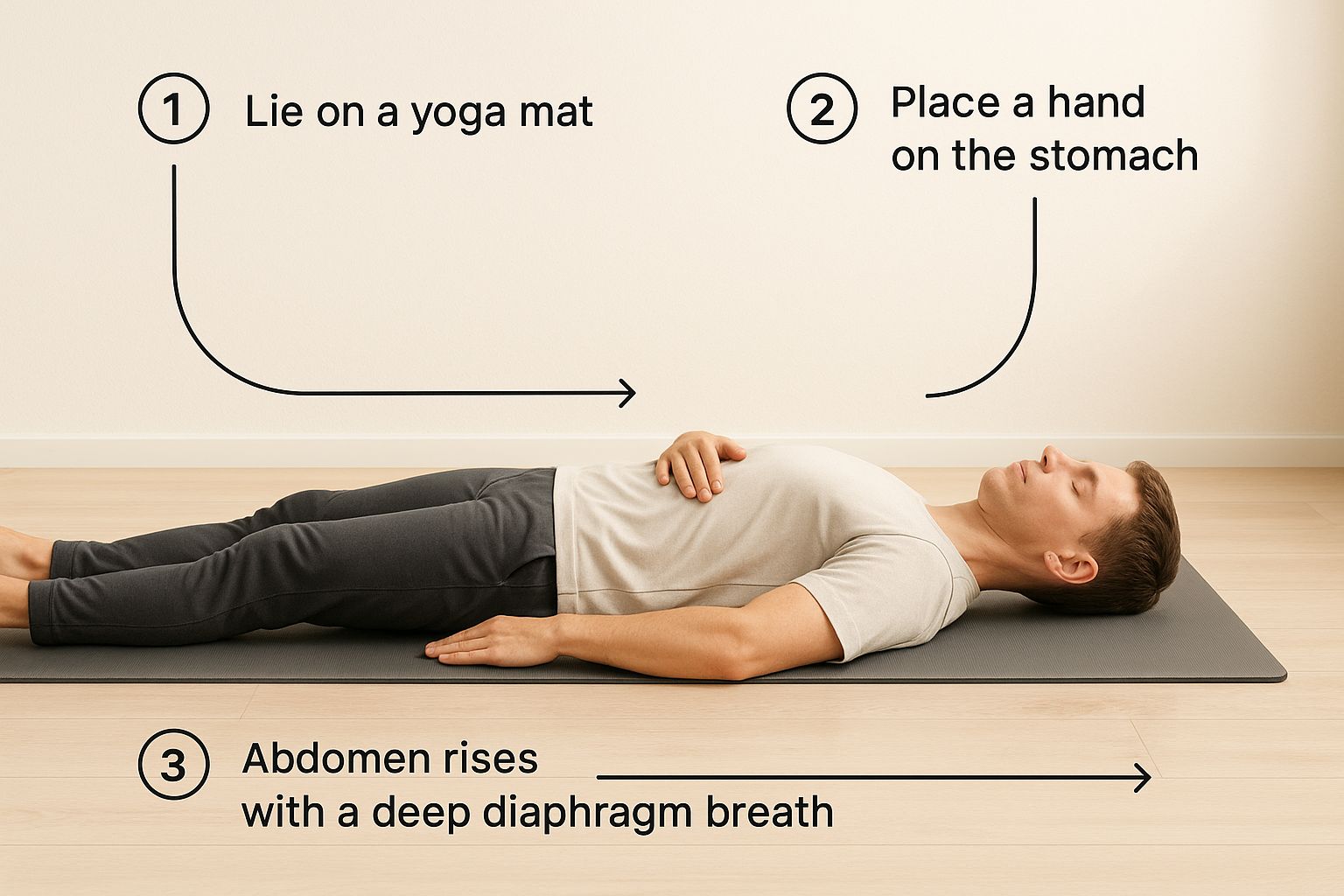
The main thing to remember is that your chest should expand outward when you breathe in. That's the clearest sign you're using your diaphragm correctly.
Practicing the Technique
The best way to feel this in action is to lie on your back with your knees bent. Place one hand on your upper stomach area and one on your chest.
Now, inhale slowly through your nose, focusing all your attention on making the hand on your upper stomach area (diaphragm) rise as your lungs fill with air. Try to keep the hand on your chest as still as possible. Then, exhale slowly through your mouth, feeling your stomach fall back down.
A very common mistake I see is "chest heaving," where the chest and shoulders rise up dramatically with every breath. This is super inefficient and can even lead to neck strain over time. Consciously keeping your chest still is the key to isolating and strengthening your diaphragm.

This technique isn't just for exercise, either. It has some pretty significant cardiovascular benefits. Research has shown that controlled breathing exercises can help lower blood pressure, some studies even found that just one session of deep breathing can bring down systolic blood pressure.
Plus, proper diaphragmatic breathing is essential for a stable core. When you engage your diaphragm, you're also firing up the deep abdominal muscles that protect your spine. To build on this, check out our guide on **the best core workouts for a stronger midsection**. Think of mastering diaphragmatic breathing as the very first step toward a more powerful and resilient core.
Breathing Strategies for Strength and Power
When you swap out the treadmill for the weight rack, your breathing strategy needs a complete overhaul. Lifting heavy objects safely and effectively demands a specific technique that goes far beyond simple inhales and exhales. It’s all about creating stability from the inside out.
How to breathe during exercise for better performance is essential. During strength training, it creates intra-abdominal pressure, which basically acts like a natural weightlifting belt. This internal pressure braces your core and protects your spine, giving you a solid foundation to push, pull, and lift from. This is a fundamental piece of any successful strength and conditioning program.
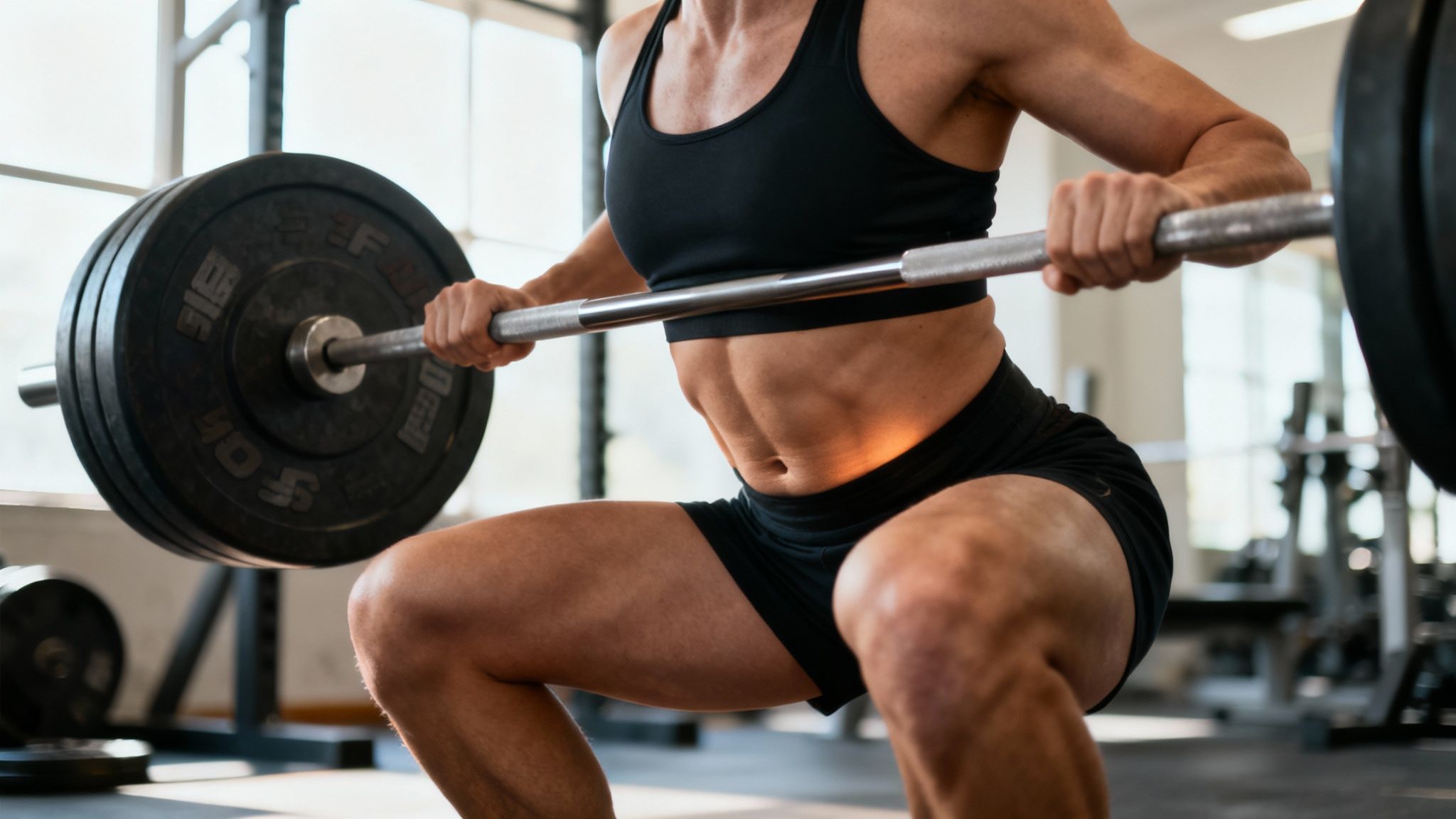
The most proven method is actually quite straightforward: inhale during the easier part of the lift (the eccentric phase) and exhale forcefully during the hardest part (the concentric phase). This simple rhythm makes sure your muscles get the oxygen they need while preparing your core for that moment of maximum effort.
Applying the Technique
Let's break down how this works with a couple of common lifts you're probably already doing.
For a Squat: Take a deep breath in through your nose as you lower yourself down. Really focus on filling your abdomen with air to brace your entire core.
The Exertion: As you drive back up to the starting position, exhale powerfully through your mouth.
For a Bench Press: Breathe in as you lower the barbell down to your chest.
The Exertion: Forcefully push that air out as you press the weight back up.
This kind of rhythmic breathing doesn't just protect your spine, it genuinely helps you generate more power. For a deeper dive into how these principles build a stronger athlete, you can learn more about what strength and conditioning truly is in our comprehensive guide.
A quick note on the Valsalva Maneuver: You might have seen advanced powerlifters holding their breath during a massive lift. This technique dramatically increases intra-abdominal pressure, but it also spikes your blood pressure. For the vast majority of us in the gym, this is both unnecessary and risky. Just stick to the “exhale on exertion” method for a safer and highly effective workout.
Syncing Breath with Movement in Yoga and Stretching
When you step onto a yoga mat or settle into a deep stretch, your breath isn't just a background process, it's the main event. In yoga, this is called pranayama, or breath control, and it's what turns a simple pose into a moving meditation. This conscious breathing is the engine that unlocks deeper flexibility, hones your focus, and brings a sense of calm to your mind.
The core idea is beautifully simple: inhale to lengthen and exhale to deepen. Think of your inhale as a way to create space in your body. As you breathe in, you might lift your chest a little higher or feel your spine extending. The exhale is your chance to release, letting go of tension and sinking further into the stretch.
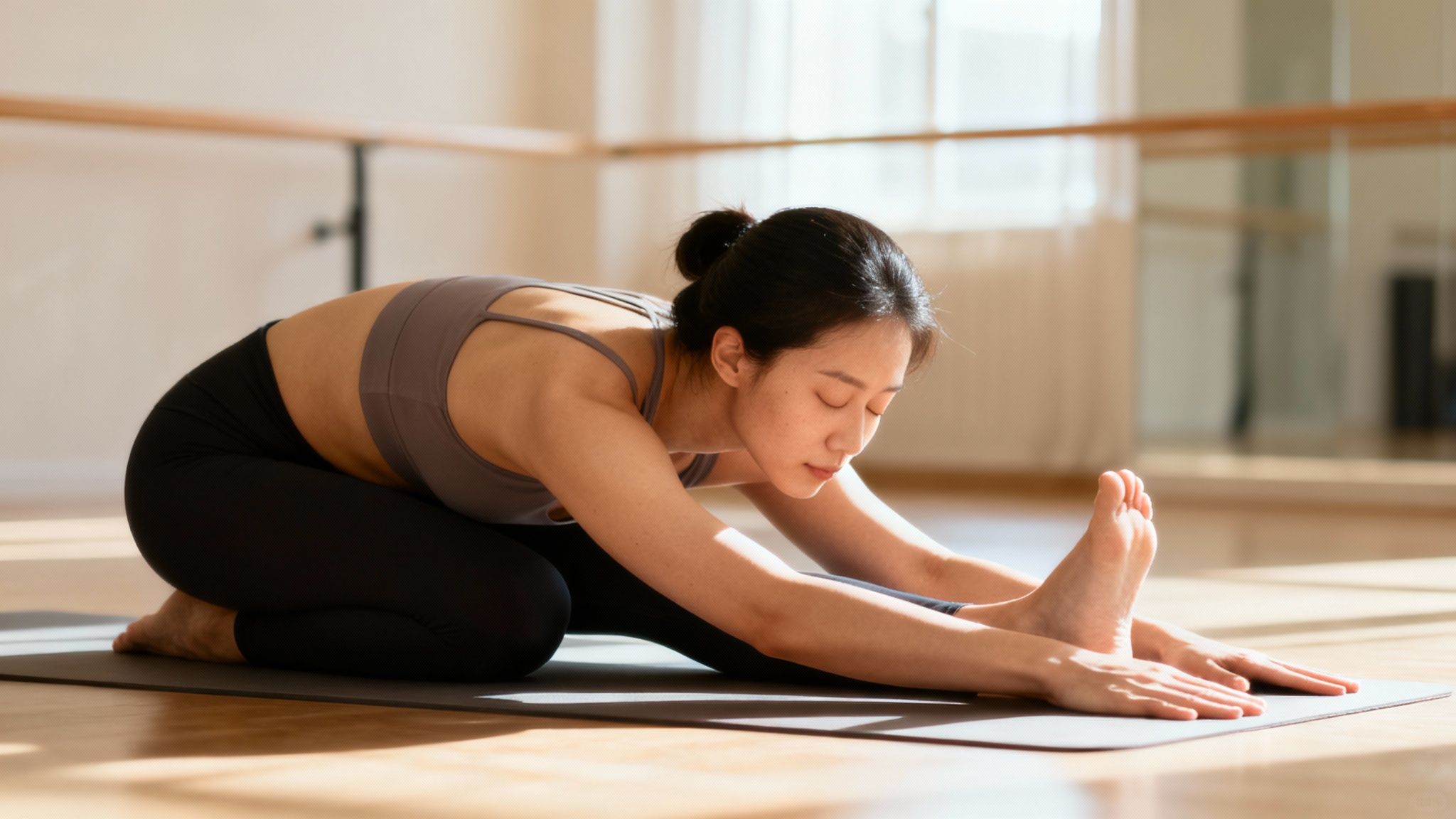
This powerful connection between breath and movement is central to practices like yoga and Pilates. In fact, you can see these same principles in action in **the hidden power of Pilates for ultimate health and strength**. When you intentionally link breath to movement, you send a clear signal to your nervous system that it's safe to relax and let go.
Mastering the Ujjayi Breath
One of the most common breathing techniques you'll hear about is the Ujjayi breath, often called the "ocean breath" for its gentle, rhythmic sound. To do it, you slightly constrict the back of your throat while breathing in and out through your nose.
This creates a soft, audible whooshing sound, almost like distant ocean waves. The Ujjayi breath is fantastic for building internal heat, keeping a steady rhythm, and anchoring your mind squarely in the present moment.
Let's try it with a simple forward fold:
Stand tall: Take a big inhale through your nose, reaching your arms up and making your spine long.
Fold forward: As you exhale with the Ujjayi breath, hinge from your hips and fold down, letting your head and arms hang heavy.
Hold and breathe: On your next inhale, imagine your spine lengthening. On each exhale, let your body release a bit more into the fold.
This isn't just about relaxation; it's an active way to manage your body's stress response. The goal is to let your breath guide your movement, rather than just holding a pose and breathing without thinking.
This isn't just yoga theory. A 2018 study involving college athletes showed that structured breathing exercises, like guided diaphragmatic breathing, were incredibly effective for stress management. When the sessions were at least five minutes long, 59% of the athletes showed better stress responses (1). It really drives home the point that guided practice makes a huge difference. You can read the full research about these breathing protocols here.
Common Breathing Mistakes That Sabotage Your Workout
Even with the best intentions, it’s surprisingly easy to fall into bad breathing habits that hold you back. The funny thing is, these mistakes often feel completely natural in the moment, but they’re secretly sabotaging your workout. Spotting them is the first real step to unlocking better performance.
One of the most common issues I see is breath holding. We’ve all done it, especially during a really tough lift or a tricky yoga pose. The problem is, when you hold your breath under that kind of strain, you can cause a huge spike in your blood pressure. That’s a fast track to feeling dizzy or lightheaded right when you need to be focused.
Another big one is shallow chest breathing. If you're only pulling air into your chest, you’re not getting nearly enough oxygen. Your body has to work overtime just to keep up, which is why you feel gassed way too early, especially during cardio.
Correcting Common Errors
Fixing these mistakes is totally doable with a bit of practice. It all comes down to building a little more awareness of what your body is doing while you exercise.
Here are two of the biggest bad habits to watch for and, more importantly, how to fix them for good:
The Mistake: Holding Your Breath on the Hard Part. The Fix: Get in the habit of exhaling forcefully during the toughest part of the movement. Think about the "push" phase of a lift or the moment you rise up from a deep squat. A powerful exhale here not only stabilizes your core but also prevents those dangerous spikes in blood pressure.
The Mistake: Fast, Shallow Chest Breaths While Running. The Fix: Before you even start your run, take a minute to practice deep diaphragmatic breaths. You should feel your belly, not just your chest, expand as you inhale. Try to carry that deeper breathing pattern into your run, using your nose for as long as possible to help warm the air before it hits your lungs.
By focusing on exhaling during exertion and breathing from your belly, you teach your body a more efficient pattern. This simple shift can dramatically improve your stamina, power, and overall safety during any workout.

A Few Common Questions About Breathing and Exercise
Let's address some of the most frequent questions about breathing during exercise. Consider this your quick reference guide for resolving challenges and perfecting your technique.
Should I Breathe Through My Nose or Mouth When Running?
For those easier, lower intensity runs, breathing through your nose is the way to go. It's fantastic for warming up and filtering the air, and it naturally encourages you to take those deeper, more efficient belly breaths.
But as you start to pick up the pace, your body is going to scream for more oxygen than your nose can possibly deliver. That’s your cue to switch over to mouth breathing. It’s completely normal and, honestly, necessary to get enough air in. Just listen to your body, start with the nose and open your mouth when things get serious.
What Causes a Side Stitch and How Do I Stop It?
You know that sharp, stabbing pain you get in your side? That's the dreaded side stitch, and it's often caused by spasms in your diaphragm, usually triggered by shallow, rapid breathing. The best defense is a good offense: focus on deep diaphragmatic breaths right from the start of your workout.
If a stitch does sneak up on you, slow down immediately. A great trick is to try exhaling forcefully just as the foot on the opposite side of the stitch hits the ground. You can also try gently pressing on the area while taking a deep breath in. And don't forget, staying well hydrated helps a ton, too.
Can Pre-Workout Breathing Exercises Actually Help My Performance?
Yes, absolutely. Taking just two to three minutes before your workout for some deep, controlled diaphragmatic breathing can really prime your body for what's to come. It’s like a warm-up for your respiratory muscles, helping to calm your nervous system and get your mind in the zone.
By doing this, you establish a solid, efficient breathing pattern from the start, which can help you delay fatigue and improve your performance through the entire session.
How Does My Breathing Affect My Mental Focus?
Your breath and your nervous system are directly linked. When you settle into a deep, rhythmic breathing pattern, you're tapping into your parasympathetic nervous system, what some people call the 'rest and digest' mode. This simple act can lower your heart rate and bring you into a state of calm focus.
By concentrating on the rhythm of your breath during a tough set or a long run, you can tune out distractions, manage how you perceive pain or effort, and stay mentally locked in. This makes your entire workout more effective.
This isn't just a feeling; there's science to back it up. A 2022 meta-analysis showed that breathwork leads to a measurable drop in stress scores for physically active people, proving its value for managing mental strain during exercise (2). You can dig into the specifics of these psychological well-being findings from Nature.com. OK, I hope this article helped you. Have a great workout and be well.
References
Houston, M. N., & Hoch, M. C. (2023). The effect of a single session and a 4-week protocol of diaphragmatic breathing on the stress response of collegiate student athletes: a randomized controlled trial. Journal of athletic training, 58(11-12), 920–928.
Zaccaro, A., Piarulli, A., Laurino, M., Garbella, E., Menicucci, D., Neri, B., & Gemignani, A. (2018). How Breath-Control Can Change Your Life: A Systematic Review on Psycho-Physiological Correlates of Slow Breathing. Frontiers in human neuroscience, 12, 353. Note: The article links to a different 2022 meta-analysis on Nature.com which supports the claim about breathwork and stress in physically active individuals, while the text in the original article cites a 2018 study. Both indicate a positive effect of breathwork on psychological well-being.
Here at Flourish-Everyday, we believe that truly understanding your body is the key to unlocking your full potential. From breathing techniques to finding the perfect athletic shoe, we provide the information you need to support a healthy, active lifestyle. Explore our reviews and guides at https://www.flourish-everyday.com.

