Finding the Best Running Shoes for Marathon Training

Updated: Dec 31
Finding the best running shoes for marathon training comes down to one simple fact: your shoes aren’t just gear; they’re your most important training partner. The right pair will carry you through hundreds of miles, help keep injuries at bay, and make that long road to the finish line feel not just possible, but maybe even fun.

Crossing the marathon finish line is an incredible feeling, but the real work happens on lonely roads and early mornings, hundreds of miles before race day. Your shoes are the foundation holding it all together. A bad pair can lead to blisters, black toenails, and nagging pains that can sideline you completely.
This guide is designed to cut through the marketing noise. Instead of just telling you what to buy, we're focused on the why. Understanding your own needs is far more valuable than any single shoe recommendation. My goal is to give you the confidence to find the perfect shoe for you.
In This Guide You Will Learn
Understanding Your Foot Type: How to identify your personal biomechanics to find the right support.
Anatomy of a Marathon Shoe: Decoding key features like cushioning, stability, and heel drop.
The Shoe Rotation Strategy: Why using multiple shoes can reduce injury risk and extend shoe life.
Getting the Perfect Fit: A practical checklist for ensuring comfort from mile 1 to 26.2.
Knowing When to Retire Your Shoes: Recognizing the signs of wear to prevent unnecessary stress on your joints.
Frequently Asked Questions: Answers to common questions about mileage, trail shoes, and carbon plates.
A good pair of running shoes can make the difference between you loving running and absolutely hating it. Properly fitted and selected running shoes can lower injury risk substantially, as they absorb some of the impact from your footstrike and provide stability.
By understanding these key ideas, you’re setting yourself up for a successful and rewarding marathon journey, right from the very first step.
Understanding Your Foot Type and Running Style
Before looking at shoe brands, the first step is to understand your own body. Running in a shoe that fights your body's natural motion is a recipe for discomfort and injury. The process starts with pronation, the natural inward roll of your foot when you land. This is your body's built in shock absorption system, and the amount of roll dictates the shoe you need.
Decoding Your Foot's Natural Movement
There are three main types of pronation. Identifying yours helps filter out shoes that won't work for you.
Neutral Pronation: The ideal. Your foot rolls inward about 15%, absorbing impact efficiently and keeping your body aligned.
Overpronation: Your foot rolls inward more than 15%. This can create instability and put extra stress on your ankles, shins, and knees.
Supination (Underpronation): The opposite. Your foot doesn't roll inward enough, placing pressure on the outer edges and hindering shock absorption.
Getting this right is crucial. Runner awareness has driven the global marathon shoe market to USD 5.2 billion in 2023, with projections of USD 8.9 billion by 2032. You can discover more insights on the marathon running shoe market to see how shoe technology is evolving to meet these demands.

The At-Home "Wet Test" for Arch Type
A simple and effective way to get clues about your foot type is the "wet test," as your arch height directly impacts pronation.
Pour water into a shallow pan.
Step into the water with one bare foot.
Step onto cardboard or a dark towel where your footprint will show clearly.
Examine the shape of the print.
A flat arch often corresponds with overpronation, as the foot rolls too far inward. A very high arch can be a sign of supination, as the foot is more rigid and less likely to roll inward for cushioning.
If you have particularly high arches, finding proper support is critical. For a deeper dive, check out our guide on the best running shoes for high arches.
Your Gait and Foot Strike
Finally, consider your running gait, where your foot first contacts the ground. Are you a heel striker, midfoot striker, or forefoot striker? Around 90% of runners are heel strikers, needing ample heel cushioning for repetitive impact. Midfoot and forefoot strikers may prefer shoes with a lower heel-to-toe drop.
Knowing your foot strike, pronation, and arch type creates a personal profile to find shoes right for your body.
Anatomy of a Great Marathon Shoe
To pick the right marathon shoe, you must understand its components. Specs like stack height (how much material is between your foot and the ground) and heel-to-toe drop (the height difference between the heel and forefoot) shape the shoe's performance.
Balancing Cushioning and Responsiveness
A shoe's cushioning is like a car's suspension. High cushion shoes (high stack height) offer a plush ride, perfect for long, slow runs where comfort is key. Less cushioned shoes feel more responsive and are better for speedwork, providing a better "feel for the road." The goal for marathon training is to find enough cushion for protection without feeling sluggish.
The midsole is the heart of a shoe's cushioning. It typically breaks down between 300-500 miles. Even if the outside looks fine, a compressed midsole no longer provides adequate protection.
Stability vs Flexibility: The Great Debate
Stability shoes are built for overpronators. They use features like firmer foam ("medial posts") or guide rails to keep the foot aligned. Neutral shoes are more flexible, allowing the foot to move naturally, and are best for neutral runners or supinators. It’s not about one being "better", it's about matching support to your body's mechanics.
Running Shoe Feature Trade-Offs
Feature | Choose This For | Consider This Trade-Off |
|---|---|---|
High Cushioning | Maximum comfort on long, slow runs and joint protection. | Can feel heavy or sluggish; less "road feel." |
Low Cushioning | A responsive, fast feel for speedwork and tempo runs. | Less impact absorption; not ideal for high mileage days. |
Stability Features | Correcting overpronation and providing guided support. | Can feel stiff or restrictive for neutral runners. |
Neutral/Flexible | A natural, uninhibited foot motion for efficient strides. | Offers no correction for runners who overpronate. |
High Durability | A long lasting "workhorse" shoe for daily training. | Usually heavier due to more robust materials. |
Light Weight | A fast, agile feel for race day and key workouts. | Often less durable; shorter overall lifespan. |
There's no single "best" combination. The goal is to find the right balance of features that supports your running style and training plan.
Durability and Weight
A durable shoe typically has a tough rubber outsole and dense midsole foam, adding weight but also longevity. These are your workhorses. A lighter shoe feels faster but is often less durable. Many runners save their lightest shoes for race day, sticking with a sturdier pair for the daily grind. Understanding these trade-offs lets you build a shoe rotation perfectly tuned for your marathon journey.
Why a Shoe Rotation Is Your Secret Weapon
Relying on one pair of shoes for all marathon training is a common mistake. Different runs place different demands on your body, and using a variety of shoes is the smart way to go.
This strategy, a shoe rotation, isn't just for pros. Switching between shoes gives the midsole foam time to decompress, extending their lifespan. More importantly, it can lower your injury risk. Each shoe model distributes stress differently across your body. Varying these forces prevents any single area from getting overloaded, making you more resilient.
Building Your Training Toolkit
A smart shoe rotation for marathon training includes at least two types of shoes:
The Daily Workhorse: Your go-to, high cushioning, durable trainer for long, slow runs where comfort and impact protection are priorities.
The Speed Day Shoe: A lighter, nimbler shoe for faster workouts like tempo runs and track intervals where you want to feel quick.
Some runners add a third pair for easy recovery days.
The Role of Your Race Day Shoe
As the marathon approaches, consider your race day shoe. Many runners choose a lighter, performance focused model. These are often less durable but offer advantages in energy return and weight savings.
A critical rule: never wear a brand new pair of shoes on race day. Test your race shoe on a few training runs, including at least one long run at marathon pace, to ensure it’s comfortable and won't cause blisters.
With marathoners logging 40-70 miles weekly, a shoe's shock absorption is vital. Advanced midsoles can cut impact forces, helping reduce the risk of shin splints. This push for better technology is a huge reason the running shoe market is booming. You can learn more about the growing global demand for running shoes and see how innovation is helping runners stay on the road.
Your Guide to a Perfect Shoe Fitting
Getting the right fit is about more than the number on the box. A shoe that feels "okay" in the store can become a torture chamber miles into a run. Modern shoes are made with advanced materials and should feel comfortable immediately, the myth of "breaking in" shoes is outdated. This checklist ensures your chosen shoe feels great from the first step to the last.
Preparing for Your In-Store Visit
Being prepared can transform your shoe buying experience. Follow these steps for the most accurate fit:
Shop in the Afternoon: Your feet swell during the day and even more during a run. Trying on shoes later gives a better idea of how they'll fit mid run.
Bring Your Running Socks: The thickness of your preferred running sock significantly affects fit. Always bring the socks you train in.
Know Your History: Be ready to discuss your running habits, past injuries, and what you liked or disliked about previous shoes.
The In-Store Fitting Checklist
A great fit balances length, width, and volume. For a deeper dive, see our complete guide on how to choose running shoes.
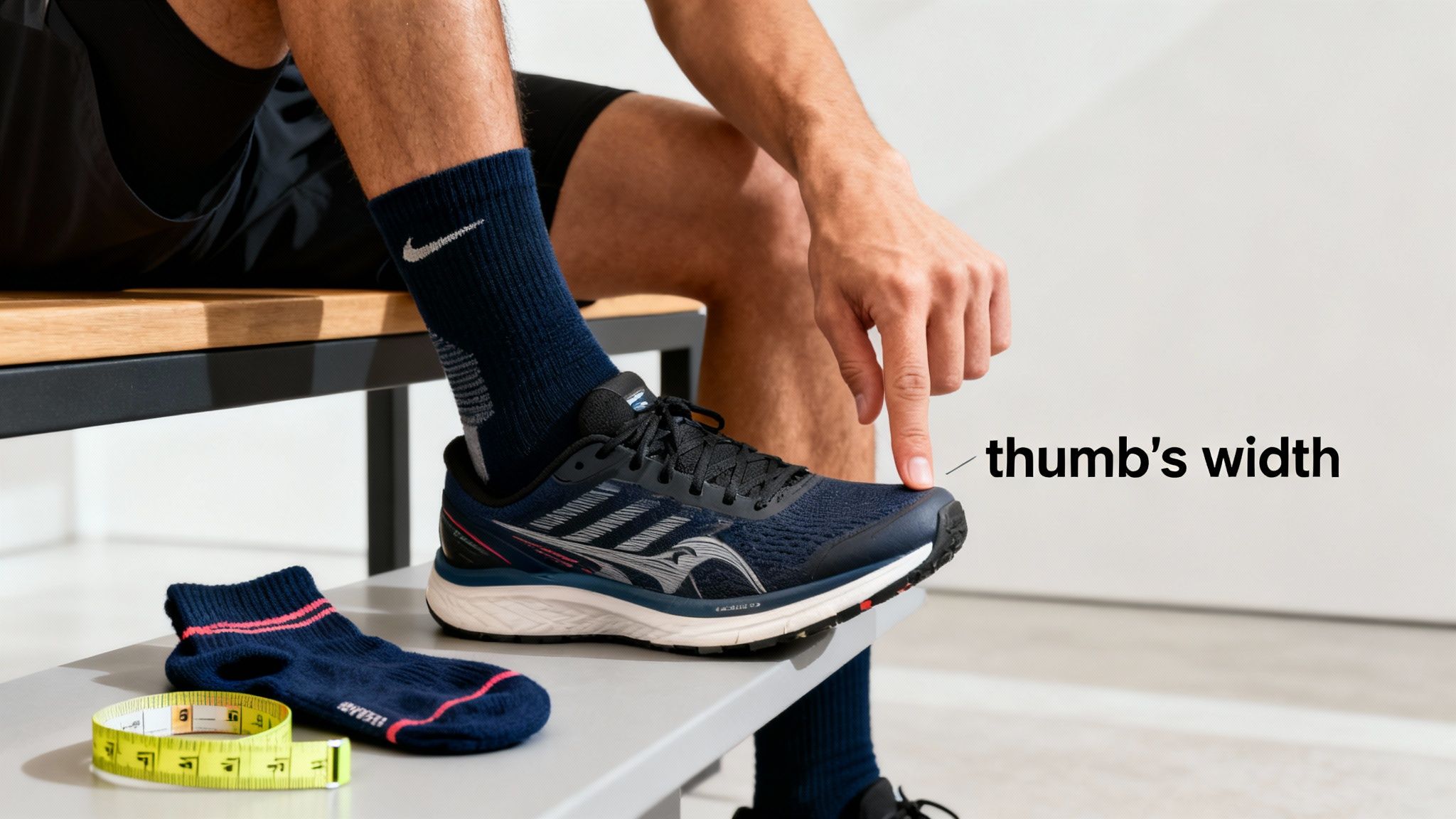
A golden rule of shoe fitting is to leave about a thumb's width of space between your longest toe and the end of the shoe. Your feet need room to splay and swell, which helps prevent bruised toenails.
Take any potential pair for a quick jog on a treadmill or sidewalk. Be alert for red flags: Does your heel slip? Do you feel any pinching or rubbing? These are signs the shoe isn't a good match for your foot.

Tips for Shopping Online
Buying shoes online requires you to be a detective. Read customer reviews, focusing on comments about sizing, whether a model runs large, small, or true to size. Most importantly, only buy from retailers with a hassle free return policy. You need to test the shoes indoors to check the fit. If you notice any red flags, send them back. The perfect fit is worth the extra effort.
When to Retire Your Shoes and Avoid Injury
Knowing when to replace running shoes is as crucial as selecting them. Pushing shoes past their prime is a fast track to injury. The midsole foam breaks down and loses its shock absorbing properties long before the shoe looks worn out. Running on "dead" shoes sends more force through your joints, leading to new aches and pains.
Key Signs Your Shoes Are Worn Out
Your body is your best early warning system. If new aches appear in your shins, knees, or hips without a change in your training, check your shoes first.
Look for these visual clues:
Midsole Creases: Deep, horizontal wrinkles on the side of the foam indicate it's permanently compressed.
Worn Outsole Tread: If the rubber patterns are worn smooth, the shoe has lost its grip and structural support.
The "Flat" Feeling: If your runs feel hard and jarring instead of cushioned, the midsole has lost its rebound.
These are signals that your shoes no longer provide the protection you need. For more details, see our guide on how often to replace running shoes.
How to Transition to a New Pair
When you get a new pair, don't just switch completely. Your body needs time to adapt, even to the same model.
Start by alternating between your old and new shoes. For the first week, wear the new pair for a couple of shorter, easier runs. Over the next few weeks, gradually use them for longer runs until they become your primary trainers.
This process allows your muscles and tendons to adapt smoothly, reducing your injury risk. Shoe technology is always improving, with brands engineering more resilient cushioning. Discover more insights about running shoe growth statistics to see how tech helps us run longer and safer. Treating your shoes as essential safety gear is key to a long, happy running journey.

Your Top Marathon Shoe Questions Answered
Many questions arise when training for a marathon, especially about shoes. Here are answers to some of the most common ones.
How Many Miles Can I Expect from My Training Shoes?
Most running shoes are built to last between 300 and 500 miles. This range depends on your body weight, running form, and the surfaces you run on. A heavier runner or one with a heavy footstrike may wear shoes out closer to the 300-mile mark. The best advice is to listen to your body. New aches and pains often mean the shoe's cushioning has worn out.
Can I Use My Trail Runners for Road Marathon Training?
You can, but it's not ideal. Trail shoes have aggressive lugs for grip on uneven terrain, which feel awkward and wear down quickly on pavement. Their midsoles are typically firmer for stability and lack the plush cushioning needed to absorb the impact of road running. A dedicated road shoe is a more comfortable and smarter choice.
Experts from Baylor College of Medicine emphasize that long-distance road shoes must prioritize cushioning and durability to handle the unique demands of marathon training.
Are Carbon Plated "Super Shoes" Necessary for Training?
No, they are not necessary for daily training. Carbon plated "super shoes" are designed for race day speed, using a stiff plate for energy return. They are less durable, more expensive, and can feel unstable at slower paces. For most of your training, a durable, cushioned "workhorse" shoe is better. Save the super shoes for key speed workouts and the race itself to get the performance boost when it matters.
References
Vantage Market Research. (2023). Running Shoe Market Size, Share to Surpass USD 58.7 Billion by 2030. GlobeNewswire. Retrieved from https://www.globenewswire.com/en/news-release/2023/04/18/2648793/0/en/Running-Shoe-Market-Size-Share-to-Surpass-USD-58-7-Billion-by-2030-Vantage-Market-Research.html
Baylor College of Medicine. (n.d.). Choosing the right athletic shoe. BCM.edu. Retrieved from https://www.bcm.edu/news/choosing-the-right-athletic-shoe
Best Colorful Socks Blog. (n.d.). Running Shoes Growth Statistics. Retrieved from https://bestcolorfulsocks.com/blogs/news/running-shoes-growth-statistics
At Flourish-Everyday, we believe the right gear is a powerful part of your journey. Keep exploring our expert guides to find the perfect shoes to support every single stride. https://www.flourish-everyday.com
